Archive for the ‘Science and Technology’ Category

NCSU scientist chases tornadoes to better understand them
Sunday, October 2, 2011, 10:24 pm No Comments | Post a Comment
Matt Parker
Matt Parker, a N.C. State University associate professor, sounded almost nostalgic when he talked about the more than 700 tornadoes that were reported roaring across the South, Southeast and Midwest in April, about four times as many tornadoes as hit the U.S. during an average April.
Parker is an atmospheric scientist and has studied how tornadoes develop to help improve weather forecasts.
“This was a historic year,” Parker told science writers and educators during a Sept. 27 talk at Sigma Xi in Research Triangle Park.
A spring storm season like this year’s doesn’t come around often. That’s a good thing, considering the loss of life and the devastating destruction the tornadoes wrought.
 April 2011 ranks as the most active tornado month on record, according to the National Oceanic and Atmospheric Association. A storm system that moved across Oklahoma, Arkansas, Mississippi, Alabama, Georgia, North Carolina and Virginia in mid-April killed 43 people, 22 of them in North Carolina. One of the tornadoes it spawned April 16 cut a 180-foot-long track through suburban Wake County, Parker said.
A second storm system at the end of the month was even deadlier. It caused a super outbreak of tornadoes in the South that killed more than 300 people in four days, according to NOAA.
A month later, on May 22, a powerful tornado hit Joplin, Mo., killing 157 people. According to NOAA, the Joplin tornado packed winds of more than 200 miles per hour, it was nearly a mile wide and its track lasted 6 miles.
What about climate change? Could that be a cause for the historic outbreak of tornadoes this year?
“We really don’t know,” Parker said.
A tornado is a mere blip in a 100-year data set that tracks changes in the climate, he said. The increase in the number of reported tornadoes, he added, is likely due to better forecasting and warning systems, a higher population density and the increase in the number of storm chasers.
What was devastating and deadly to the people who lived in the tornados’ way could have provided scientists like Parker with a bevy of otherwise hard-to-come-by data.
In May and June of 2009 and 2010, Parker and his team of students were among about 100 scientists who tracked storms with radar, measured wind speeds, sent up weather balloons and fed the information to a database. The study, called VORTEX2, was one of the largest field studies to determine the origin of tornadoes and a follow-on to a more limited tornado hunt in 1994 and 1995. The teams had about $10 million worth of equipment at hand.
April 2011 was never part of VORTEX2′s data collection phase.
Working with tornadoes is often frustrating, Parker acknowledged. May and June 2009 were two very uneventful months - only two storm systems that generated tornadoes.
“Two thousand ten was much better,” Parker said. “On some days we had the pick of tornadoes.”
About 40 storm systems with the potential to generate a tornado, also known as super cells, and about 20 tornadoes occurred in May and June 2010, he said.
A super cell starts similarly to an ordinary thunderstorm. Warm, moist air rises amidst cooler surroundings and the moisture condensates. In an ordinary thunderstorm, the precipitation creates a cool downdraft that cuts off the warm, moist updraft within about 30 to 45 minutes. The storm dissipates.
A super cell thunderstorm develops when strong upper-level winds allow the warm, moist updraft to continue for up to six hours. The stage is set for the downdraft and the updraft to begin rotating.
But the process that produces a tornado in a super cell thunderstorm is not well understood, Parker said.
For example, strong super cells are not associated with tornadoes, he said. Storms with similar structures may differ in tornado production. And the relationship between near-ground wind fields and structural damage isn’t clear either.
Scientists hope that once the VORTEX2 data is crunched and analyzed and published, some of the questions will be answered, Parker said. Especially head-to-head comparisons of data collected from storms that generated tornadoes and storms that didn’t might be fruitful.
Goals of the VORTEX2 study are to extend the average lead time for tornado warnings from about 13 minutes currently to at least 35 minutes and reduce the false alarm rate, which is currently at about 70 percent.
RTI to establish biocrude pilot plant in RTP or nearby
Sunday, September 11, 2011, 5:52 pm No Comments | Post a Comment
David Dayton
David Dayton is getting a chance to take the production of biocrude out of the laboratory at RTI International and into a pilot plant.
RTI’s Center for Energy Technology in Research Triangle Park recently received $5 million from the U.S. Department of Energy to bring down the cost of making a crude oil alternative from cellulose-rich biomass, such as wood chips, switch grass or corn stalks, husks and cobs. (More on RTI’s energy research here.)
Scaling up production is also part of the project. Dayton, the biofuels director at RTI’s Center for Energy Technology, plans to establish a pilot plant on RTI’s campus in RTP or nearby to daily convert about 5 kilograms of corn stalks, husks and cobs into biocrude.
The pilot plant is a long way from a commercial biocrude production plant that processes about 2,000 tons of biomass a day. Dayton projected the technology won’t be ready for commercial use before 2020. But, he said, “It’s a step in the right direction.”
To multiply the lab recipe and reduce production costs over the next four years, RTI is getting help from an international crew of technical advisors and collaborators.
Archer Daniels Midland, a Decator, Ill.-based maker of cereals and seed oils, will provide RTI with corn husks, stalks and cobs. The N.C. Biofuels Center will help find additional feedstocks grown in North Carolina, such as wood chips. The Shaw Group, Houston-based engineers who work with the petroleum refining industry, will design the pilot plant.
Most importantly, RTI will get a hand from Haldor Topsøe, a Danish catalyst company, to tweak the biocrude production process and bring down the cost of making and refining biocrude to where the resulting gasoline, diesel or jet fuel could be priced at $3 per gallon to $5 per gallon at the pump.
“Can we get there?” Dayton said. “We’re trying. The proof of concept works, now we have to make something that works commercially.”

A bottle of biocrude. (Photo courtesy RTI)
He suggested that the crew of technical advisors will give RTI a leg up in developing a biocrude that can reduce U.S. dependence on oil imports. The U.S. imports about 60 percent of the crude oil it consumes. At least two competitors are working on similar projects: KiOR, a Texas-based startup company that raised about $150 million in an initial public offering three months ago, and Honeywell UOP, a technology provider to the oil refinery industry.
Catalytic biomass pyrolysis, the technology used to made biocrude, has roots that go back more than 100 years. It involves heating cellulose under high pressure to break it apart into sugar molecules and parts of sugar molecules. The process is similar to caramelizing. It strips oxygen molecules and leaves hydrocarbons. When it goes too far, it produces carbon.
A catalyst controls and speeds up the process. In the past year, RTI scientists have worked on finding catalysts that help strip more oxygen and make a biocrude whose chemical composition more closely resembles crude.
“Petroleum is basically plant matter that has been sitting under the earth at high pressure and high temperature,” Dayton said. “What we’re doing is recreating what occurs over geologic time in less then a second.”
The problem is, nature has doing a better job stripping the oxygen. Crude has no oxygen in it. Biocrude has 20 percent or less and that makes it more expensive to refine it to gasoline, diesel and jet fuel.
“Our challenge is to reduce the oxygen content as much as possible and maximize the yield,” Dayton said.
From powering plug-in electric vehicles to backing up the grid
Saturday, July 30, 2011, 7:22 pm No Comments | Post a CommentIn a lab on N.C. State University’s Centennial Campus, engineers are probing the potential of the Chevrolet Volt’s T-shaped battery once it no longer powers General Motor’s plug-in hybrid electric car.
The research is based on an agreement GM and the ABB Group signed three months before the first Chevy Volt rolled off the lot, which was in December. The carmaker and the Swiss-based engineering firm are considering options that range from energy storage to powering bicycles.

A Chevy Volt battery is hooked up to an ABB inverter in the ABB lab on Centennial Campus.
ABB provides power and automation technologies to utilities and industrial customers worldwide. The firm concentrates on renewable energy and supplies wind and solar energy generators with electrical equipment and services. Its North American headquarters is in Cary and the R&D projects with the Chevy Volt batteries are conducted in the ABB lab on Centennial Campus. ABB employs about 500 in the Research Triangle area and 1,500 in North Carolina.
A first step in the research is combining a Chevy Volt battery with a commercially available ABB inverter, a device that exchanges direct current from the battery into alternating current used to transmit electricity on the grid.
The next step is hooking up several of the batteries to the inverter, said Sandeep Bala, an R&D engineer in the ABB lab.
“There’s a lot of work to do yet,” Bala said during a tour of the lab. “What the cost is, what the business case is.”
The learning curve will be steep, Pablo Valencia, the senior manager GM has assigned to the project, agreed. It’s not even known when it’s worth reconfiguring the battery, Valencia said.
The T-shaped lithium-ion battery consists of several cells and is built into the bottom of the Chevy Volt’s passenger cabin, with the cross bar being located under the back seat. The battery can power the car for about 40 miles in the city and has to be recharged. That’s the plug-in electric portion of the car. The Volt also has a gasoline tank to go another 300 miles. That’s the hybrid portion of the car.
The two power sources make the Chevy Volt the most fuel-efficient car on the market with a fuel economy of 90 miles per gallon to 95 mpg on the highway, according to the Edmunds.com review.
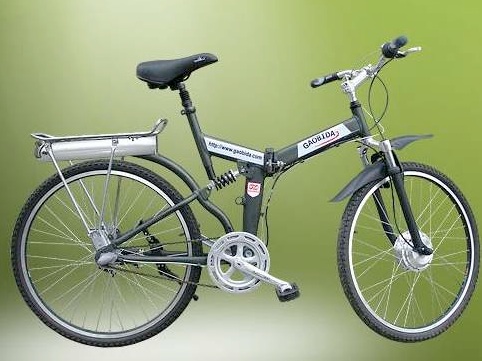
Battery cell above rear tire powers an e-bike.
How long it takes before a battery becomes available for reuse only time will tell. GM’s warranty on the battery is for eight years or 100,000 miles and after 10 years, the Volt’s battery retains about 70 percent of its capacity. But GM and ABB intend to figure out where else the batteries can be used once they come out of the cars.
One idea is to break down the battery and use single cells to power electric motors on bicycles.
Another is to use the batteries as storage - for renewable energy or as backup for electric outages. Renewable energy is dependent on the sun and the wind, which follow their own schedule. But stored in batteries, renewable energy would be available to flatten peaks and valleys in power consumption and allow utilities to run their power plants more evenly, and therefore more efficiently.
“The utilities love that,” Valencia said.
Power customers might like a backup system during power outages. The engineers estimated that 33 Chevy Volt batteries have enough storage capacity to power up to 50 homes for about four hours during a power outage.
TEDxChapel Hill: A glimpse into the global technology era
Sunday, June 12, 2011, 7:08 pm No Comments | Post a CommentSoftware programmers who build Web sites that map incidents reported by mobile phone. A branchless banking system that allows customers to send cash by mobile phone text message. Medical specialists who diagnose patients hundreds of miles away with the help of images uploaded through a mobile phone app and stored as electronic medical records.
These are just three innovative uses for mobile phones, crowdsourcing and open-source technology. But this type of innovation isn’t happening in rich, developed countries like the U.S. or in Europe.
The Ushahidi mapping tool has collected crowdsourced incidents reports in Afghanistan, the Democratic Republic of Congo and Mexico. Kenyans mail small amounts of cash through M-Pesa‘s branchless banking system. SANA‘s open-source technology brings healthcare screening to rural areas in India and the Philippines.

Diali Cissokho & Kairaba play music reminiscent of West African dance bands.
Presented at a TED talk independently organized by IntraHealth June 2 at the Varsity Theatre in Chapel Hill, these innovative technological applications provided a glimpse of what’s possible in places without functioning transportation, healthcare and banking infrastructures.
As Diali Cissokho & Kairaba, a band of Senegalese and North Carolina musicians, played between presentations, the crowd of more than 250 in the filled-to-capacity movie theater just across from the University of North Carolina’s Chapel Hill campus was left to re-examine perceptions of developed versus developing countries.
“It’s the new era of global technology,” said Heather LaGarde, special projects advisor to IntraHealth OPEN, an initiative that encourages the use of the latest technological advancements to improve healthcare in poor countries.
TED talks are an outgrowth of a conference that brought together technology geeks, entertainers and design mavens. The concept is owned by a private foundation a magazine publishing entrepreneur started in 1996.
TED talks follow in the footsteps of storytellers who spread knowledge and wisdom. Their purpose is to disseminate ideas.
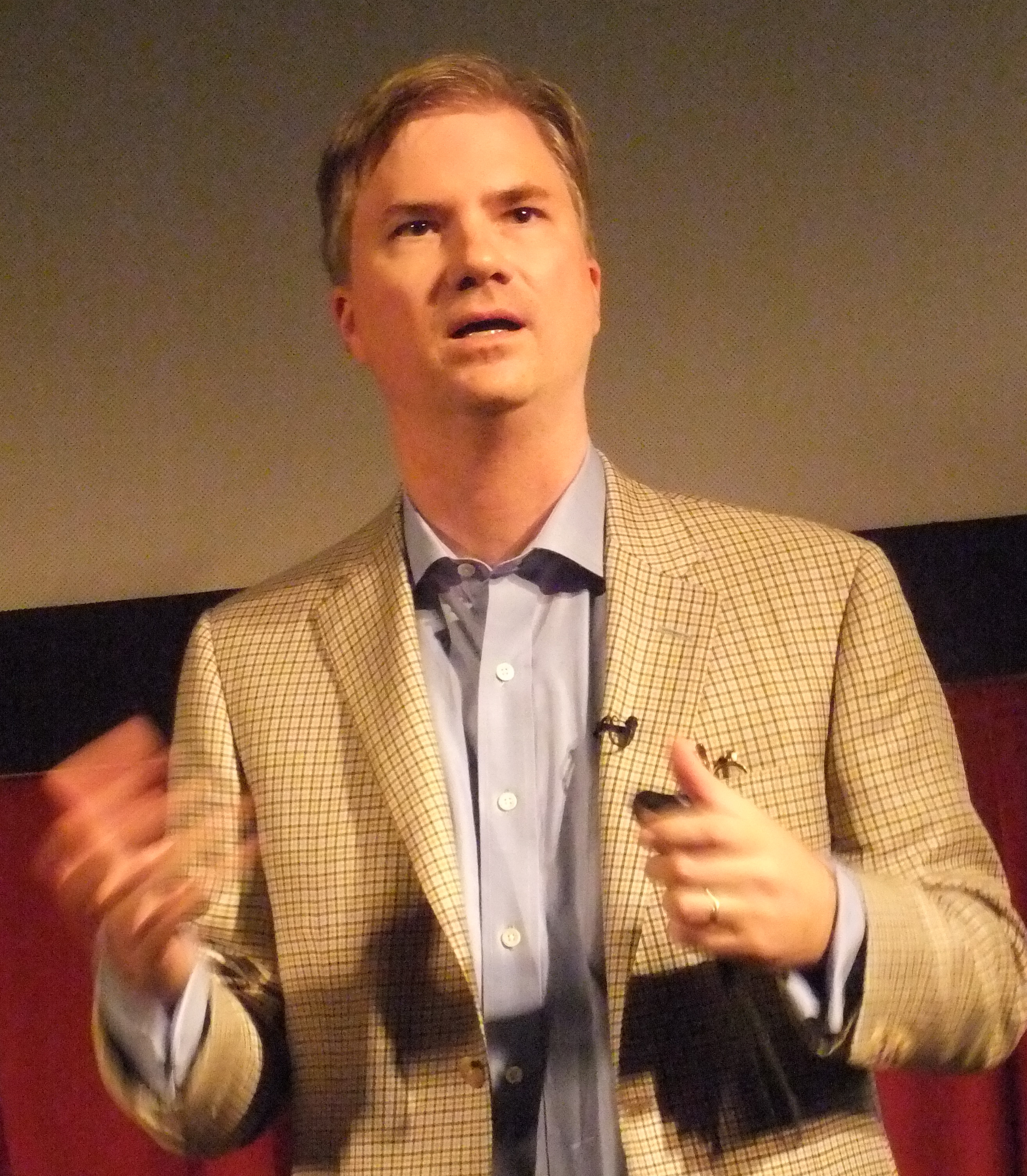
Holden Thorp at TEDxChapel Hill
TEDxChapel Hill was the fourth independently organized TED talk in the Research Triangle. Three previous talks took place in the past 18 months, one at the Research Triangle Park headquarters, one at N.C. State University and one in Raleigh. (More about the TEDxTriangle event at RTP here.)
The Chapel Hill talk was organized by IntraHealth, a UNC spinoff focused on global health. Among the speakers featured was Holden Thorp, UNC-CH’s chancellor, who as a UNC chemistry professor developed technology for electronic DNA chips and founded companies.
Thorp encouraged scientists to bring their research to bear upon problems people around the world are dealing with, such as drought, poverty and climate change.
“We have a leg up addressing these problems,” he said.
Thorp could draw some inspiration from the venue. In the mid 1980s, while he was an undergraduate at UNC, Thorp said, he watched the “Adventures of Buckaroo Banzai Across the 8th Dimension” 16 times at the Variety Theatre. The science fiction movie was about an adventurer, surgeon and rock musician who took on evil alien invaders with his band of men.
UNC and other universities as well as nonprofit research institutes and global health organizations in the Triangle are trying to do just what Thorp suggested.
At UNC, the Carolina Global Water Partnership developed a microfinancing program for Cambodians to buy biosand and ceramic filters and gain access to clean drinking water.

Robert Malkin
At Duke University, Robert Malkin, director of Engineering World Health, is encouraging engineers to develop medical equipment that works in hospitals in Sudan, Nigeria, Nicaragua, El Salvador, Haiti, Liberia and Sierra Leone.
The World Health Organization estimated that 70 percent of the medical equipment developed in the U.S. or Europe doesn’t work in poor countries in Asia, Africa and Latin America, including used and new surplus equipment donated by U.S. hospitals.
Indeed, much of this equipment is stacked in large warehouses, collecting dust, Malkin said. (More on barriers for medical devices in the developing world here.)
During his presentation at TEDxChapel Hill, Malkin said he observed this first-hand when he attended a heart surgery in a Nicaraguan hospital many years ago and the overhead surgery lights caught on fire. The nurses responded calmly, protecting the patients from the billowing smoke with a blanket, Malkin said. He found out later, that the special light bulbs for which the donated surgery lights were designed weren’t available in Nicaragua. The 100 Watt light bulbs the hospital used instead caught on fire routinely.
IntraHealth, which mostly deals with community health workers in developing countries, is also looking for hands-on solutions. IntraHealth’s OPEN Council brings together some of the most innovative thinkers, such as Jon Gosier, the founder of Appfrica, a company that invests in East African software startups; and Josh Nesbit, the chief executive of Medic Mobile, a nonprofit that uses mobile technology to create health systems in developing countries.

Dr. Radhika Chigurupati
Gosier and Nesbit also participated in TEDxChapel Hill, and so did Dr. Radhika Chigurupati, a surgeon at the University of California San Francisco Children’s Hospital, who talked about her work with SANA.
Mobile device technology developed by a team of students, volunteers and faculty at the Massachusetts Institute of Technology in Boston allows SANA to bring health screening to remote rural area.
More than half of the population in developing countries are mobile phone subscribers, according to a 2010 United Nations report.
In India, Chigurupati said, community health workers use their mobile phones to take high-resolution pictures of potentially cancerous lesions in patients’ mouths or on feet. The images are uploaded to a server to which physicians in faraway urban areas have access.
Trips from the countryside to see a doctor are prohibitively expensive for the patients. But mobile telemedicine enables community health workers to screen for cancerous lesions and connects them with experts who can help treat the lesions and save lives.
In 2010 alone, more than 4,000 patients in rural India were screened for oral cancer, a disease that is prevalent because of widespread tobacco and beetle nut chewing.
“I think the tide is high,” Chigurupati said. “If you’re shrewd enough and committed enough, you can make a difference in the lives of millions.”

Guest perspective: Sony shines at E3
Friday, June 10, 2011, 7:38 am No Comments | Post a Comment

The new PlayStation Vita, announced this week at the E3 Expo. | Image courtesy of Sony Computer Entertainment Inc.
This year’s E3 Expo in Los Angeles saw plenty of big announcements from the world’s top gaming companies, including a few from firms right here in the Triangle. As the gaming industry’s premiere showcase wrapped up this week, Gaming in the Triangle reached out to Amanda d’Adesky, a local aspiring game developer, to get her thoughts on the most exciting news from an event often fraught with hype. Here’s her take.
Gamers, gadget geeks and tech heads alike all flocked to the Electronic Entertainment Expo in Los Angeles earlier this week in hopes of getting a glimpse at the future of digital entertainment. While most go to this event for the games, a lot of hardware gets showcased at E3, and this year was no exception.
Last year was all about motion controls, both with and without the use of actual controllers. Microsoft revealed the Kinect, Sony announced the Move, and Nintendo stayed mostly silent on the subject, ironically enough. This year, while motion controls were a big part of the proceedings, combining the various gimmicks already available with one another was the name of the game, and the company poised to do it best looks to be Sony.

Amanda d'Adesky
While Microsoft was pushing the Kinect (again) and Nintendo announced a whole new console, Sony hit some very stable middle ground by doing a bit of both.
The NGP, short for Next Generation Portable, made it’s formal debut as the PlayStation Vita Monday. PSVita combines the easy accessibility of touch-screen gaming with the functionality and comfort of a game controller. Sporting a 5-inch multitouch screen, back multitouch pad, dual analog sticks (a first for next-generation handhelds) and 3G/Wifi capability, it appears to be just like any other mobile gaming platform. What makes it stand out is the rear- and front fa-cing cameras, which allow for implementing augmented reality capabilities in upcoming games.
Speaking of augmented reality, many game developers who presented at Sony’s press conference mentioned they would be including this functionality in their upcoming titles thanks to the PlayStation Move camera. Granted, Microsoft and Nintendo had similar news in this same vein, but the ability to experience these alternate realities in 3D makes for some very exciting possibilities. Combine this with the workability of PlayStation Move, and it seems they’ve hit on a very unique scenario. Overlaying monsters, weapons and in-game objects with your real-world surroundings and seeing them truly jump into your personal space certainly sounds like a screaming good time.
Sony also unveiled some nice accessories to bring more people into the world of 3D. A PlayStation-branded, 24-inch 3D display will be released this fall, specifically designed to give consumers affordable access to the wonders of 3D functionality. While this, on it’s own, doesn’t seem like much of big deal, the company boasts that their display will optimize two-player mode by giving each player their own full-screen view in 1080p high-definition, eliminating the inconvenience of split-screen.
The first bundle to be released, containing the PlayStation 3D monitor, one set of active-shutter glasses, an HDMI cable and a copy of Resistance 3 (a Move/3D enabled title from the Insomniac Games, a company with offices in the Triangle) will go for a heartbeat-skipping $499. The price may seem to contradict the goal of an affordable entry-point and spurring further 3D adoption, but to be fair, it isn’t nearly as likely to bring about full-on cardiac arrest like the offering of 3D televisions currently on the market.
Additionally, the choice to offer active 3D viewing while still trying to lower the price point is a bold move, given that the electronics giant could have easily gotten away with offering simple passive 3D like most everyone else. Active-shutter makes for crisper images, and that makes for better viewing.
Though 3D gaming and motion control are nothing new, the seamless integration of the two could prove to be a potent and profitable combination for Sony. Only time will tell just how successful this will be, but one thing’s for sure: Nintendo and Microsoft have some catching up to do.
Amanda d’Adesky is an aspiring game developer, organizer of the Triangle Game Developers Meetup and a contributing writer for Bulletproof Pixel. Follow her blog at Cage Match Panda and her tweets as @amandadadesky.
Triangle game engines dominate market
Thursday, June 2, 2011, 8:41 am No Comments | Post a Comment
One game engine to rule them all. | Photo courtesy of TwitPic
Feast your eyes on this delicious pie chart.
Shared by Epic Games Vice President and Co-Founder Mark Rein via TwitPic, it shows a recent report from Acacia Research Corporation that puts the Cary-based gaming powerhouse far and above all of its competitors in the 3D engine market. With a whopping 65-percent market share in 2010, the company’s Unreal Engine outpaced its closest rival, the Austin, Texas-based Vision Engine, nearly threefold.
The company’s prominent market position is probably aided by its distribution strategy. The entire Unreal Development Kit, which game designers can use to create content on par with flagship titles like Gears of War and Mass Effect, is free for educational and non-commercial use. With a $99 licensing fee, developers can sell their games royalty-free until their sales exceed $50,000. The company has even sponsored several events in the local area, like Unreal University at the East Coast Game Conference, to spread the use of its engine.
But there’s more good news from this report for the Triangle. Another top engine, Gamebryo, was also developed by a Research Triangle Park company. With its product, Gamebase USA claims about 6 percent of the market, matching the share of another industry favorite, Unity.
All told, that means Triangle gaming technology is powering almost three-quarters of all 3D gaming titles. And when you’re talking about an industry that pulled in $18.6 billion in 2010, that’s no small matter.
An RTP lab to test business ideas
Wednesday, June 1, 2011, 4:57 pm No Comments | Post a CommentA good idea has shelf life. We all know that.
Ideas pop into our heads every day. Only the good ones linger. They survive challenges and reassessment. That’s also true for business ideas, which hold the promise of starting a company, generating income and creating jobs.

Ron Harman
But it’s hard to test how good a business idea really is, because honest feedback is difficult to get, said Ron Harman, owner of CTO Outsourcing, a Durham company that provides software expertise to startups.
“Getting people to tell you how great you are is easy,” Harman said. But few friends, relatives or paid consultants aren’t usually willing to probe an idea for flaws that could kill it.
“Nobody wants to tell you bad news,” Harman said.
To fill that gap, he and six other entrepreneurs in North Carolina’s Research Triangle eight months ago founded the RTP Idea Lab. So far, they’ve held three idea vetting sessions at RTP headquarters.
The sessions attract crowds of a few dozen and combine idea pitches, question-and-answer follow-up and critiques. It’s a concept that’s also being tried in other areas where lots of people work in research and development, including Boston, Pasadena, Calif., Austin, Texas, and at universities, but the efforts aren’t mirror images of each other.
Pasadena-based Idealab has created and operated pioneering technology companies since 1996. Bostinnovation is a digital community hub for ideas that have matured into startups. The Business Innovation Factory in Austin, Texas, is a nonprofit that was founded in 2004 to help innovators test ideas before they turn them into startups. The University of North Carolina at Chapel Hill has an IDEA Group to develop novel biomedical imaging and analysis tools.
The RTP Idea Lab mainly aims to provide a forum where innovators pitch their business ideas to a group of people who are neither experts nor potential investors. Ideas bandied about have ranged from mining company e-mails to prevent theft of intellectual property to matching up retired executives with startups and nonprofits in need of short-term mentoring.

Jim Ingram
“Getting into a group and talking about ideas was very attractive,” said Jim Ingram, a technical writer and a RTP Idea Lab board member. At the most recent session in May, Ingram pitched his idea to reconfigure the hierarchy with which computers file information.
“An idea without an interaction with others is just a thought,” Ingram said. ” It dies in the brain if it isn’t talked about.”
The founders of the RTP Idea Lab, most of them local technology entrepreneurs, also want to stimulate the birth of new companies and the creation of jobs in the Triangle. The area’s unemployment rate has come down slightly in the past year, but it remains above 7 percent, according to April state unemployment figures. That compares to 9.5 percent unemployment statewide.
With federal and state budget cuts looming, it’s not likely that the government and public universities, important contributors to the Triangle’s economy, will be of much help. But technology startups are on a roll. Another Internet gold rush is on, stocks are up, investors are eager and startups are sprouting from New York to Durham.

Anthony Edwards
The Triangle offers plenty of services to form a startup and find a home for it. What the area lacked was a place where people with ideas could ask other people, “What do you think?,” and get a honest answer. That’s where the RTP Idea Lab fits in, said Anthony Edwards, board chairman of the RTP Idea Lab.
Edwards is an IT consultant and a founder of Morrisville-based Tavve Software. He’s also involved in RedOak Logic, a Chapel Hill startup that targets the drug development industry but has yet to be funded.
Having RTP Idea Lab sessions “is good for the community, for RTP,” he said. “It encourages people to form companies.”
He wants to add to the feedback sessions and form partnerships with serial entrepreneurs, venture capitalists and angel investors to also provide seed funding.
Webby wins highlight gaming as lifestyle
Monday, May 23, 2011, 7:30 pm No Comments | Post a Comment Russ Pitts finds it hard to remember a time when he wasn’t playing video games.
From the Magnavox Odyssey to the Fairchild Channel F, Pitts embraced gaming as a kid in the 70s — and he hasn’t let go since.
“My whole childhood was filtered through this lens of games,” Pitts said.
That’s why it’s not a big surprise that Pitts is now at the helm of The Escapist, an online gaming magazine based in Durham. Now approaching its sixth-year anniversary, The Escapist competes for gamers’ attention with heavy hitters like IGN and Gamespot. Both sites — and others like them — are filled with reviews, walkthroughs and trailers to guide gaming consumers.
“Our challenge has been trying to find our footing as we grow to the size of these gargantuan companies,” Pitts said. “Our success has put us toe-to-toe with some of these giants.”
But The Escapist has a different strategy. Read more…
NC history of flight extends to space
Thursday, May 19, 2011, 9:26 pm No Comments | Post a CommentNASA’s interest in North Carolina goes back to the 1960s, when U.S. astronauts came to the University of North Carolina at Chapel Hill to learn at the Morehead Planetarium how to navigate in space by looking at stars, according to a N.C. Museum of History report. In the past 25 years, a handful of North Carolinians flew on space shuttle missions, including Beaufort native Michael Smith, who died in 1986 when the Challenger exploded shortly after liftoff.
To prepare for and support NASA missions, researchers at N.C. State University have studied how to more precisely land a vessel on Mars and how to grow plants in a spacecraft operating in zero gravity.
But NASA’s involvement in North Carolina goes further. Since 1991, teachers and students at North Carolina universities, community colleges and public schools have received about $15 million to study science, technology, engineering and mathematics, to research issues related to space missions and to work in companies contracting with NASA.
Funding for the research grants, scholarships and summer internships has been provided through the N.C. space grant, a program administered at NCSU.
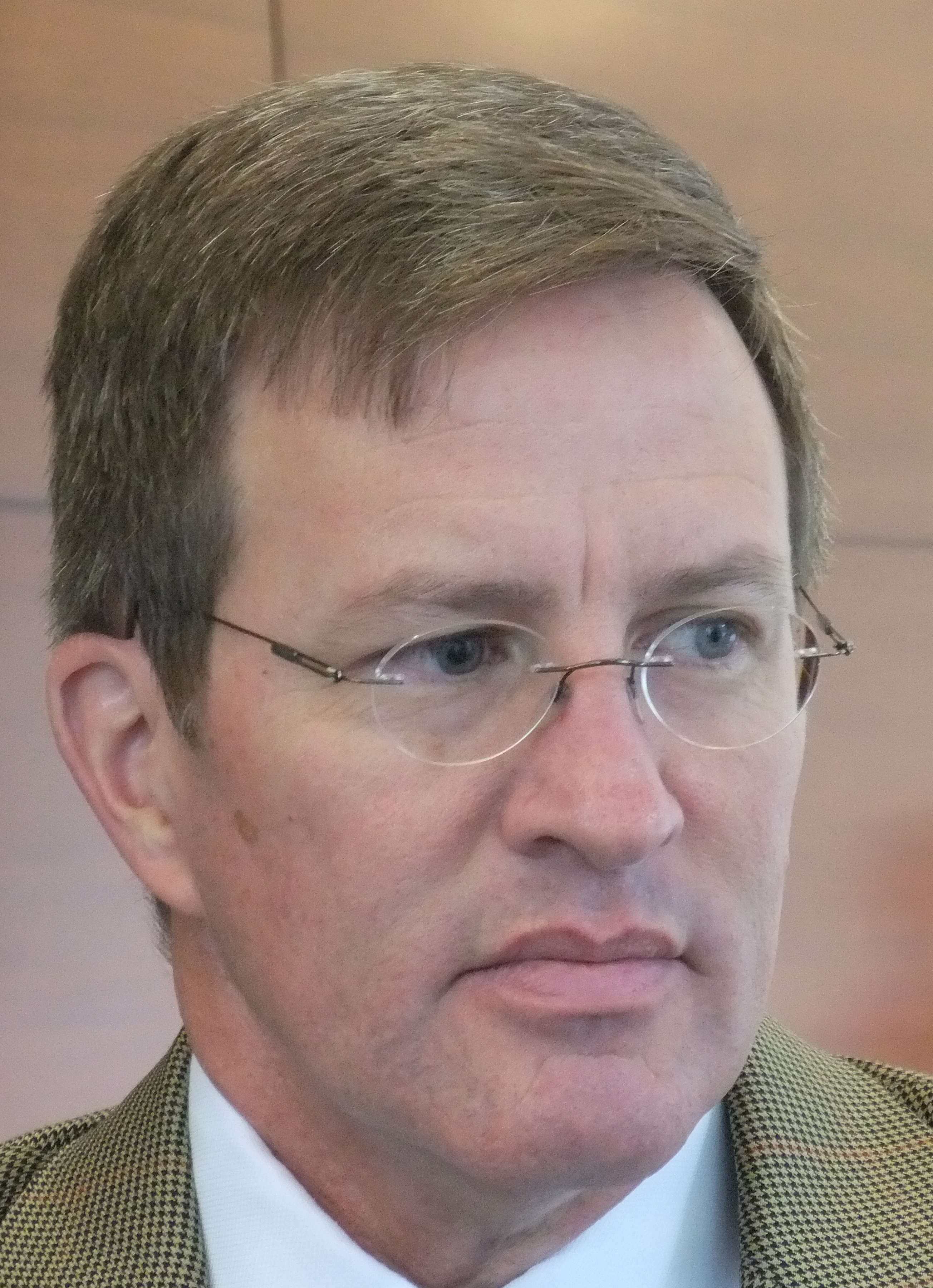
Christopher Brown
“The goal is to keep the pipeline filled for NASA,” Christopher Brown, director of the N.C. space grant, told members of the Triangle Area Research Directors Council who gathered this week at Research Triangle Park headquarters.
But “this isn’t just rockets and aerospace,” Brown said. Space grant projects in North Carolina include satellite tracking of red wolves and the development of an undergraduate robotics course at Duke University.
As a professor of plant biology at NCSU, Brown teaches a space biology class and some of his plant experiments will travel to the international space station on the last shuttle flight scheduled to take off in August.
NASA funds the N.C. space grant and similar programs in all other states through its annual budget.
In the past five years, the total for these grants has increased from about $30 million to $45.6 million. North Carolina’s portion is about $800,000 annually, Brown said. That includes a state match. The match used to be about $200,000 per year, but budget cuts have reduced it to $180,000.
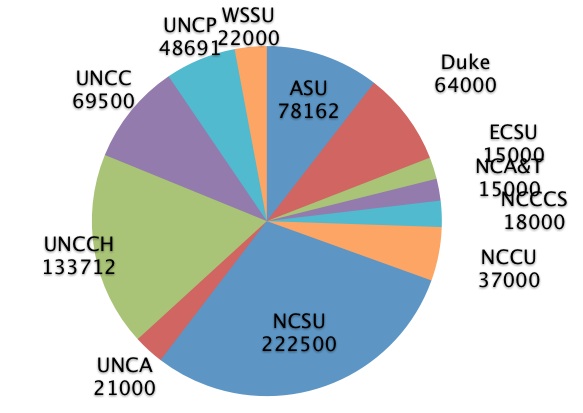
N.C. space grant beneficiaries
Federal cuts are also looming, but Brown said he didn’t think the program would be eliminated, because every Congressional district receives money. For fiscal year 2012, which starts Oct. 1, President Obama’s budget request for the space grant program is $26.5 million, according to NASA budget information. That’s a reduction of more than 40 percent.
In the past, N.C. space grant money has supported research of young university faculty, helped develop new college courses and paid for professional development of K-12 teachers, provided scholarships and summer internships for graduate and undergraduate students and students at community colleges.
Thirteen university campuses across North Carolina are affiliated with the N.C. space grant, from UNC Asheville to Elizabeth City State University.
Gears of War 3 beta wraps up, but more for fans
Tuesday, May 17, 2011, 8:24 am No Comments | Post a Comment
Augustus "Cole Train" Cole blasts an enemy locust soldier to save wounded teammate Anya Stroud. Gears of War 3 was available in private beta until Sunday. | Photo courtesy of Epic Games
Cary-based Epic Games had more announcements this week for fans despondent over the end of the Gears of War 3 multiplayer beta.
The special preview of the anticipated title, which allowed a select few to battle each other to the death on new maps, ended Sunday night. While the full version of the game isn’t due out on store shelves until Sept. 20, Epic dropped another morsel in the lap of its fan base Monday: details about the coveted limited editions.
On top of the regular game, which will retail for $59.99, the special editions will include premium downloadable content and collectables — all available only in limited quantities. Here are the details, per Epic’s press release:
Epic Edition - $149.99
• A limited edition statue of main character Marcus Fenix, designed by Epic Games Art Director Chris Perna and crafted by the artisans at Triforce.
• The “Art and Design of Gears of War” by Tom Bissell, author of Extra Lives: Why Video Games Matter. The book is a behind-the-scenes glimpse into the game, with 96 pages of interviews, photos, concept artwork and more.
• Infected Omen Weapon Pack – custom multiplayer skins for the game’s five starting weapons; Lancer, Retro Lancer, Hammerburst, Sawed-off Shotgun and Gnasher Shotgun.
• Everything in the limited edition.
Limited Edition - $79.99
• An Octus Award Box with Octus Service Medal. A 1:1 match in size and weight, this zinc-alloy cog-shaped medal replicates the award given to Adam Fenix, father of the game’s main character, in recognition of his work on the Hammer of Dawn, a devastating weapon in the war against the Locust.
• Exclusive unlockable Adam Fenix Multiplayer character – Each Octus Service Medal replica is engraved with a unique Xbox LIVE code that is the only way to unlock Adam Fenix in multiplayer.
• A fabric Coalition of Ordered Governments (COG) Flag
• The personal effects of Adam Fenix, including his “Last Will and Testament,” the initial Hammer of Dawn schematic and other Fenix family mementos.
But Epic’s not likely done hyping the crown jewel of its trilogy, the first two parts of which sold more than 12 million copies since the saga began in 2006. Franchise Executive Producer Rod Fergusson announced on Twitter last week that if Gears of War 3 wins IGN’s Most Anticipated Game Award, they’ll run a week-long event granting players 30 times the points in the Gears of War 2 multiplayer during the E3 Conference June 6.
Can’t wait until then? Then satisfy your bloodlust with this gruesome execution montage, from IGN (warning: graphic). Cheers!


