Posts Tagged ‘Events’

Nonprofits and social media
Tuesday, February 1, 2011, 1:40 pm 1 Comment | Post a Comment“There’s something hopelessly quaint about the little piles of pens and paper on the tables at #scio11.”
“Best thing about #scio11 is that people will pull out an iPhone or iPad in the middle of a convo and they’re not rude; they’re live-blogging.”
 If these two tweets give the impression that ScienceOnline 2011 (or #scio11 in the Twitterverse) was a brave new world populated by geeky early adopters who have foresaken pens, paper, and print in favor of devices and Web 2.0, well, that’s partly true.
After all, it was a conference where it was normal to see panelists consulting notes on their iPads, where attendees did in fact live-blog and live-tweet, and where many sessions had a panelist devoted to monitoring Twitter for questions and comments from the audience. (One aggrieved camera operator told me that people watching the live webcast were tweeting complaints about camera angles!) Read more…
Why scientists (should) blog
Tuesday, January 25, 2011, 9:17 am 2 Comments | Post a CommentLast weekend, the Triangle hosted ScienceOnline 2011, a lively annual conference spearheaded by the tireless bloggers Bora Zivkovik and Anton Zuiker. Now in its fifth year, the conference has become so popular that registration for 300 spaces sold out this year in less than a day. The participants, according to the conference website, are “scientists, students, educators, physicians, journalists, librarians, bloggers, programmers and others interested in the way the World Wide Web is changing the way science is communicated, taught and done.”
As a first-time attendee and representative of Science in the Triangle, I divided my time between chasing down interviewees and attending panels, which were organized by participants on an online wiki.
One of those interviewees, Katie Mosher of NC Sea Grant, told me that she’d observed a coming together of science blogging and science journalism in the three years since she’d started attending ScienceOnline. More journalists are using the blog form either to replace or to supplement their print or broadcast stories, she said, some of them writing in traditional journalistic objective form and some of them adopting a point of view. Some of those journalists were present at the conference, just as she sees bloggers now attending conferences hosted by organizations like the National Association of Science Writers.
But journalists appeared to be outnumbered at the conference by scientists who blog (or tweet, or both). As a professional writer who frequently covers science, I should perhaps see these scientist-bloggers as competition. Not at all. To me, they are representative of a welcome trend in academics to communicate with the public about scientific findings and (sometimes controversially) the public policy implications of these findings. A scientist-blogger who writes well (perhaps one who attended the panel by Carl Zimmer and Ed Yong on avoiding obfuscation in science writing) and who knows how to attract an audience can have an immediate impact on public understanding of breaking news, as has been the case with the scientists at Deep-Sea News who covered science surrounding the Gulf oil spill. (Bora Zivkovic explains why scientists are such good explainers.)
A scientist-blogger takes some professional risks. Although I was unable to attend “Perils of Blogging as a Woman under a Real Name,” panelist Kate Clancy provides a detailed writeup here, which alludes to the skepticism with which academic colleagues and tenure and promotion panels view blogging and similar “soft” activities.
A scientist-blogger has to deal with certain downsides of being an online presence, most notably “cranks . . . who come onto our sites and leave comments that foment dissension rather than productive commentary,” according to Rick MacPherson, interim executive director and conservation programs director at the Coral Reef Alliance. It happens wherever evolution or climate change are discussed, he said, and he is the target for negative comments every time he writes or is interviewed about the role of climate change in sea level rise and ocean acidification, both threats to coral reefs.
According to MacPherson, the negative commenters are evidence that the general public doesn’t understand the evidence-based nature of science. “People don’t understand how science works,” he said. “It’s not a democratic process. . . . not opinions.”
His sentiments were echoed in “Lessons from Climategate” by panelist Chris Mooney, coauthor of Unscientific America: How Scientific Illiteracy Threatens our Future, who listed these depressing statistics:
- only 18 percent of Americans know a scientist
- just 13 percent follow science and technology news
- 44 percent can’t name a scientific role model; those who can most frequently name Albert Einstein, Al Gore, and Bill Gates, two of whom are not scientists
- in every five hours of cable news, just one minute is devoted to science and technology
According to Mooney, the situation “is ripe for climate skeptics; they are well-trained, skilled communicators who exploit lack of public knowledge and are willing to fight hard in ways climate scientists are not.” His co-panelist Josh Rosenau, who works to defend the teaching of evolution at the National Center for Science Education, said that the language of the attacks against climate science has an eerie parallel in the attacks against evolution. “For 90 years we’ve been fighting same battle,” he said. “Public opinion has not moved. If that happens to climate change we are doomed.”
Mooney and Rosenau were joined on the panel by Thomas C. Peterson, chief scientist at NOAA’s National Climatic Data Center in Asheville. Peterson was one of the climate scientists whose emails were hacked and published just a few weeks before the 2009 Copenhagen Climate Summit. Although his role in the affair was minor, he was excoriated in blogs (Peterson reminds us that some “science” blogs are unsound scientifically), subjected to harassing calls and emails, and asked by a congressman to produce all emails on the topic (which he did, and which vindicated him). Yet he was still subsequently elected by his peers to be president of the World Meteorological Association’s Commission for Climatology. Clearly, in his professional circles, he is a rock star even if some of the public doesn’t think so.
For Peterson and his co-panelists, the implication is clearly that the public doesn’t understand scientists the way scientists do. Mooney said that the climate emails were taken out of context by people who don’t understand science or scientists. His solution: train “deadly ninjas of science communication”-people who can frame the message and convey science clearly to different constituencies. He wants good communicators to claim the vacancies created when CNN dumped its entire science reporting unit and when daily newspapers gradually reduced their science coverage.
That’s a space that good scientist-bloggers can occupy alongside professional writers: reporting on science from the trenches, bringing scientific research alive, demystifying the scientific method, and unveiling the wealth of unsound science out there.
Notes:
Read my colleague Sabine Vollmer’s post on credibility in science blogging here.
A great resource for finding science blogs is scienceblogging.org.
‘Companies to Watch’ Honors 25 Job-Creating, Revenue-Producing Firms in N.C.
Tuesday, October 19, 2010, 1:03 pm 3 Comments | Post a CommentStartup companies make for good storytelling. Entrepreneurial lore is filled with tales involving a couple of college dropouts, a garage, and a Big Idea. Some of them fail, and some of them morph into industry giants.
But along the way from startup to giant, those companies go through a second stage of growth, during which they add employees and revenue but are still growing fairly quickly. It’s these second-stage companies that are the unsung heroes of North Carolina’s economy, according to Penny Lewandowski of the Edward Lowe Foundation. In 2008, the last year for which figures are available, 9.7 percent of the resident companies in the state were second stage, but they accounted for almost 35 percent of the state’s jobs.

Scott Huler - ‘On The Grid’ at Quail Ridge Books
Thursday, May 27, 2010, 4:16 pm 4 Comments | Post a Comment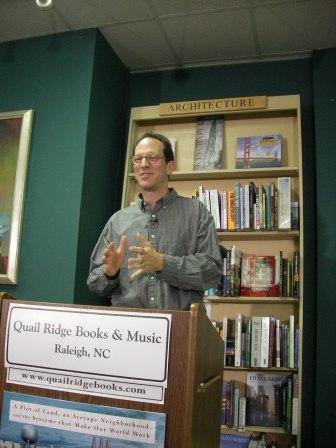 As I alerted you before, last night Scott Huler (blog, Twitter, SIT interview) did a reading from his latest book On The Grid (amazon.com) at the Quail Ridge Books in Raleigh.
The store was packed. The store sold out all the books before Scott was even done talking. The C-Span Book TV crew was there filming so the event will be on TV some day soon. Scott was also, earlier yesterday, on WUNC’s The State Of Things (the podcast will soon be online here) and the day before that he was on KERA’s Think with Krys Boyd (download MP3 podcast by clicking here).
Scott’s energy and enthusiasm are infectuos. He held the audience captive and often laughing. The questions at the end were smart and his answers perfectly on target. But most importantly, we all learned a lot last night. I think of myself as a reasonably curious and informed person, and I have visited at least a couple of infrastructure plants, but almost every anecdote and every little tidbit of information were new to me. Scott’s point - that we don’t know almost anything about infrastructure - was thus proven to me.
‘Bonobo Handshake’ coming soon to a bookstore near you
Monday, May 10, 2010, 8:14 am No Comments | Post a Comment Vanessa Woods (website, old blog, new blog, Twitter) will be reading from her new book “Bonobo Handshake” (comes out May 27th - you can pre-order on amazon.com) at the Regulator in Durham on May 27th at 7pm, at Quail Ridge Books on June 9th at 7:30pm, and at Chapel Hill Borders on June 12th at 2pm.
I have interviewed Vanessa last year so you can learn more about her there.
I received a review copy recently and am halfway through. Once I finish I will post my book review here.
From Publishers Weekly:
Devoted to learning more about bonobos, a smaller, more peaceable species of primate than chimpanzees, and lesser known, Australian journalist Woods and her fiancé, scientist Brian Hare, conducted research in the bonobos’ only known habitat—civil war–torn Congo. Woods’s plainspoken, unadorned account traces the couple’s work at Lola Ya Bonobo Sanctuary, located outside “Kinshasa in the 75-acre forested grounds of what was once Congo dictator Mobutu Sese Seko’s weekend retreat. The sanctuary, founded in 1994 and run by French activist Claudine André, served as an orphanage for baby bonobos, left for dead after their parents had been hunted for bush meat; the sanctuary healed and nurtured them (assigning each a human caretaker called a mama), with the aim of reintroducing the animals to the wild. Hare had only previously conducted research on the more warlike, male-dominated chimpanzee, and needed Woods because she spoke French and won the animals’ trust; through their daily work, the couple witnessed with astonishment how the matriarchal bonobo society cooperated nicely using frequent sex, and could even inspire human behavior. When Woods describes her daily interaction with the bonobos, her account takes on a warm charm. Woods’s personable, accessible work about bonobos elucidates the marvelous intelligence and tolerance of this gentle cousin to humans.”
Megalodon and other sharks at Darwin Day
Saturday, February 13, 2010, 8:44 am 1 Comment | Post a CommentLast night, braving horrible traffic on the way there, and snow on the way back, I made my way to the N.C. Museum of Natural Sciences for the Darwin Day shark lecture co-organized by NESCent and the sneak preview of the Megalodon exhibit which officially opens today.
Ecology, conservation, and restoration of oyster reefs in North Carolina
Thursday, January 28, 2010, 9:10 pm 4 Comments | Post a CommentOn Tuesday I went to the monthly pizza lunch at Sigma Xi, featuring a guest lecture by Dr. David B. Eggleston, Professor of Marine, Earth and Atmospheric Science at North Carolina State University and the Director of Center for Marine Sciences and Technology (CMAST).
While Dr.Eggleston conducts research in several areas (and several geographic locationa), in this talk he focused on the ecology, conservation, and restoration of oyster reefs in North Carolina.
NESCent panel on intersection of public policy, economics, & evolution
Thursday, November 26, 2009, 4:02 am No Comments | Post a CommentNESCent Catalysis Meeting, coorganized by the Evolution Institute was on November 13-15, 2009 and several of the participants remained another day and came to NESCent on the 16th to report on the meeting in a form of a panel. The meeting and the panel were organized by David Sloan Wilson, professor of evolution at Binghamton University and one of my newest SciBlings. The other panelists were Dennis Embry, John Gowdy, Douglas Kenrick, Joel Peck, Harvey Whitehouse and Peter Turchin.


