Posts Tagged ‘evolution’

Couple documents evolution as it happens
Friday, April 15, 2011, 8:56 pm No Comments | Post a CommentIf Charles Darwin returned to the Galapagos Islands today, he would find all but one of the finch species that lived there during his visit in the 1830s. But he would also find birds that look and sound different.
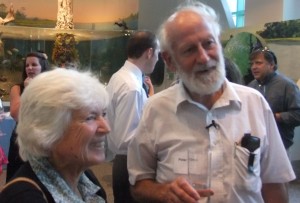
Rosemary and Peter Grant during a reception in their honor at the N.C. Museum of Natural Sciences
Peter and Rosemary Grant, husband-and-wife evolutionary biologists at Princeton University, have written about a medium ground finch that is heavier, has a broader beak and sings a different song than its closest relative.
The Grants have documented the emergence of this medium ground finch lineage since 1981, when they caught what they believe was an immigrant bird on Daphne Major, a tiny Galapagos island where they’ve measured, weighed and tagged ground finches several months every year since 1973.
The new lineage, which nobody has dared to call a new species yet, has been molded by droughts, above average rainfall and competition for food - factors that also affected other finches living on Daphne Major.
“In the 2000s, the birds are not the same as the ones that were on the island when we started,” Peter Grand told a crowd of more than 200 who had come to his and his wife’s presentation April 11 at the N.C. Museum of Natural Sciences in Raleigh.
That evolution can happen as researchers watch was unexpected. That the Grants documented the making of what might be a new species in 20 years has turned them into legends.Their research has won multiple awards and is featured prominently in biology textbooks and one Pulitzer-Prize-winning book.
The couple’s visit to North Carolina’s Research Triangle was the result of a collaboration of the museum, N.C. State University and the National Evolutionary Synthesis Center.
Thirteen species of ground finches live on the Galapagos archipelago, a cluster of more than a dozen islands located in the Pacific Ocean about 600 miles west of Equador. They are plain birds with brown, gray or black plumage that have been famous since they helped Darwin develop the theory of evolution.
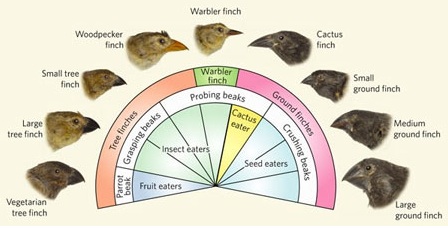
Darwin's finches
All descend from one species that lived on the South American mainland.
The smallest finch species on the Galapagos Islands weighs about one-fourth of the largest species and each species has developed a specific beak to eat a special diet.
The Warbler finch has a slender beak to probe for insects. Ground finches have broad beaks to crush seeds of various sizes. Cactus finches have long, curved beaks to probe flowers for nectar. The large tree finch has a powerful, curved beak to strip bark and extract insects and termites.
The diet has a lot to do with where a species lives. The medium tree finch, for example, can only be found on Floreana Island. The common cactus finch lives on all but the five Galapagos Islands that are inhabited by the large cactus finch.
Daphne Major is home to four species, the Grants reported. The couple caught small, medium and large ground finches and cactus finches, including some that had immigrated from neighboring islands.
The males of each species sing a different song, which male and female birds learn as nestlings listening to their fathers. Males and females of a species recognize each other by that song. Interbreeding can occur, Rosemary Grant said, for example, when the fatherly lesson gets garbled because the nest is close to the nest of another species in the same cactus bush.

Immigrant hybrid male the Grants caught in 1981. Source: Proceedings of the National Academy of Sciences
In 1981, the Grants caught a medium ground finch immigrant whose plumage was particularly glossy and black. The male bird was about 20 percent bigger than the biggest medium ground finch captured on Daphne Major and had a wider beak. It also sang an unusual song and a blood test determined that it carried cactus finch genes.
The immigrant hybrid male mated with a female hybrid that also carried genes of both species. Three generations of offspring - finches live up to 16 years - bred with local medium ground finches and other hybrids.
Then, all but two of the birds in the lineage died during a severe drought in 2003 and 2004. The remaining two birds, a sister and a brother, mated and their offspring has mated, but only with each other.
This has led to two distinct groups of medium ground finches on Daphne Major that do not mix, the Grants reported. They differ in weight, beak shape and song and breed in two different areas on the island.
(More in the Grants’ inaugural article in the 2009 Proceedings of the National Academy of Sciences.)
Of lizards, female choice and male competition
Friday, February 4, 2011, 2:50 pm 2 Comments | Post a Comment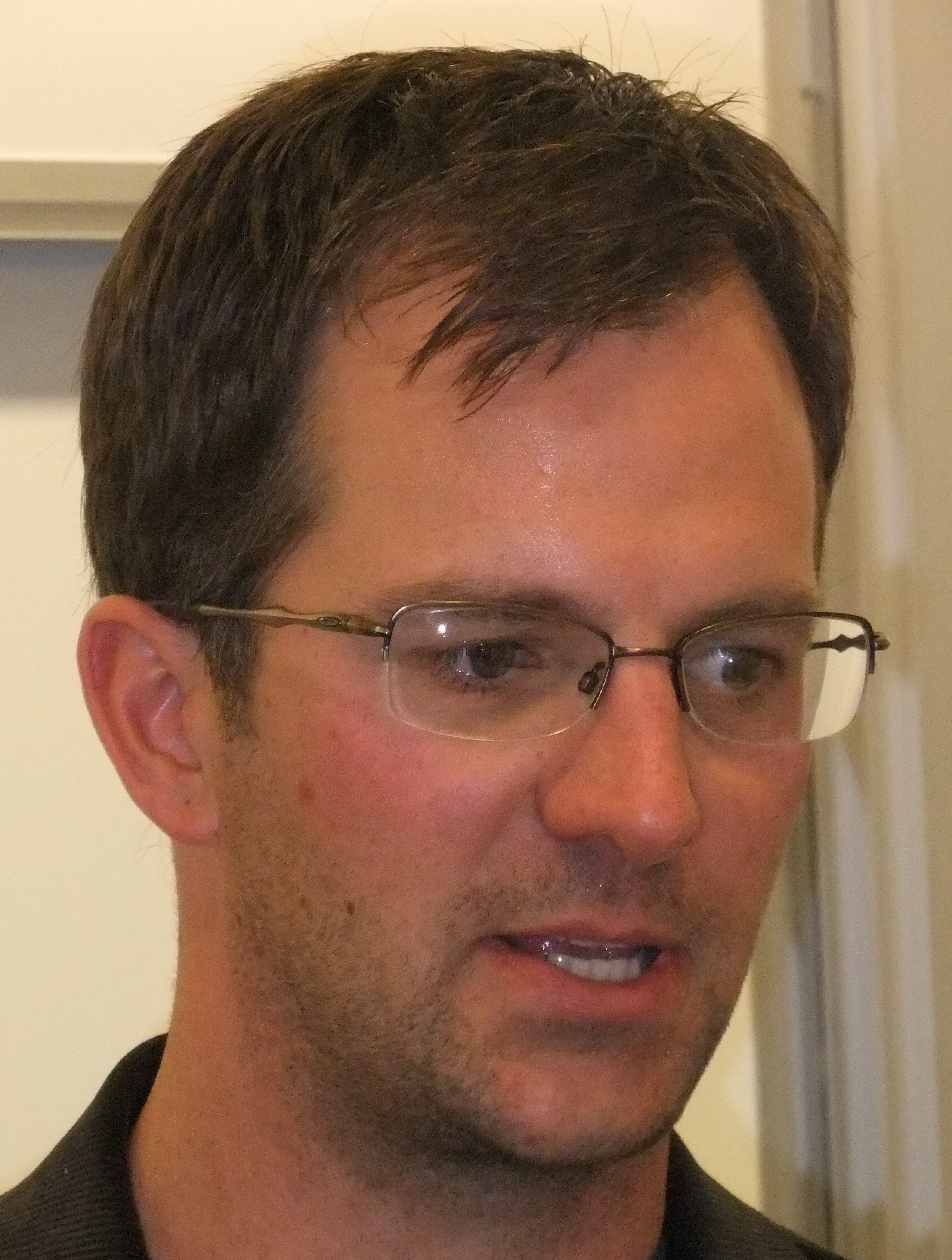
Ryan Calsbeek
I didn’t feel kinship with female lizards until I listened to Ryan Calsbeek talk about women having a say in whether their children will be boys or girls.
Calsbeek has studied natural selection among lizards and spoke about his research Thursday at N.C. State University’s biology department. He is an assistant professor of biological sciences at Dartmouth College and a visitor at the National Evolutionary Synthesis Center in Durham where he is working on a book.
Experiments he and his team have run with brown anoles, lizards native to Cuba and the Bahamas, suggest that the female lizards sort sperm to have the fittest males father more male offspring. It’s unclear how female brown anoles do that, Calsbeek said, but they’re not the only ones doing it.
“It’s even true in humans,” he said.
The remark generated quips from the audience about the exclusively female offspring of three consecutive U.S. presidents and the girl that Calsbeek’s pregnant wife is expecting. But Calsbeek argued that statistically four examples don’t mean much. Throughout history, women whose mates were presidents and kings tended to overproduce sons, he said.
Still, why should I care about sperm sorting among reptiles the size of my finger? Because brown anoles are, as Calsbeek put it, “the drosophila of lizards.” Both are model organisms. Just as the drosophila fruit fly has been extensively used to understand genetics, brown anoles can tell us something about the role female choice plays in the evolution of organisms, including ours, Calsbeek said.
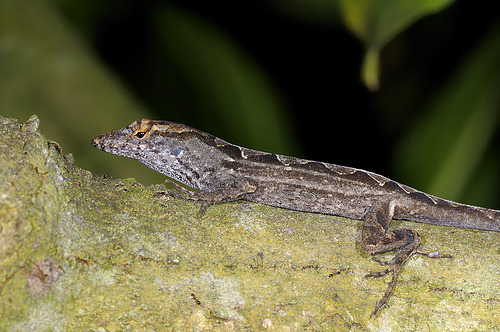
Brown anole
More than 150 years ago, Charles Darwin picked up on female behavior patterns that ensure reproductive fitness down the generations.
Nature is full of examples. To a peacock hen lustrous tail feathers on a male signal he’s not parasite-ridden. Size and strength help male elephant seals drive away competitors and attract harems of up to 100 cows. Size is also important for female brown anoles to determine male fitness.
After World War II, another Brit, Angus Bateman, determined through drosophila experiments that female choice makes sense, because the number of offspring a female fruit flies can produce is limited more by how many eggs she generates than by how many mates she has. Bateman concluded that eggs are more precious than sperm, Calsbeek said.
Calsbeek and his team conducted breeding experiments with brown anoles to learn more about the choices the female lizards made. The findings they reported last year suggested the dams were very sophisticated.
The experiments showed that the size of the father only played a role in the number of male offspring that hatched.
Males are either losers or winners while females do pretty well regardless, Calsbeek said. “If you’re a loser in the animal kingdom, you’re probably a male. Sorry guys.”

Why scientists (should) blog
Tuesday, January 25, 2011, 9:17 am 2 Comments | Post a Comment Last weekend, the Triangle hosted ScienceOnline 2011, a lively annual conference spearheaded by the tireless bloggers Bora Zivkovik and Anton Zuiker. Now in its fifth year, the conference has become so popular that registration for 300 spaces sold out this year in less than a day. The participants, according to the conference website, are “scientists, students, educators, physicians, journalists, librarians, bloggers, programmers and others interested in the way the World Wide Web is changing the way science is communicated, taught and done.”
As a first-time attendee and representative of Science in the Triangle, I divided my time between chasing down interviewees and attending panels, which were organized by participants on an online wiki.
One of those interviewees, Katie Mosher of NC Sea Grant, told me that she’d observed a coming together of science blogging and science journalism in the three years since she’d started attending ScienceOnline. More journalists are using the blog form either to replace or to supplement their print or broadcast stories, she said, some of them writing in traditional journalistic objective form and some of them adopting a point of view. Some of those journalists were present at the conference, just as she sees bloggers now attending conferences hosted by organizations like the National Association of Science Writers.
But journalists appeared to be outnumbered at the conference by scientists who blog (or tweet, or both). As a professional writer who frequently covers science, I should perhaps see these scientist-bloggers as competition. Not at all. To me, they are representative of a welcome trend in academics to communicate with the public about scientific findings and (sometimes controversially) the public policy implications of these findings. A scientist-blogger who writes well (perhaps one who attended the panel by Carl Zimmer and Ed Yong on avoiding obfuscation in science writing) and who knows how to attract an audience can have an immediate impact on public understanding of breaking news, as has been the case with the scientists at Deep-Sea News who covered science surrounding the Gulf oil spill. (Bora Zivkovic explains why scientists are such good explainers.)
A scientist-blogger takes some professional risks. Although I was unable to attend “Perils of Blogging as a Woman under a Real Name,” panelist Kate Clancy provides a detailed writeup here, which alludes to the skepticism with which academic colleagues and tenure and promotion panels view blogging and similar “soft” activities.
A scientist-blogger has to deal with certain downsides of being an online presence, most notably “cranks . . . who come onto our sites and leave comments that foment dissension rather than productive commentary,” according to Rick MacPherson, interim executive director and conservation programs director at the Coral Reef Alliance. It happens wherever evolution or climate change are discussed, he said, and he is the target for negative comments every time he writes or is interviewed about the role of climate change in sea level rise and ocean acidification, both threats to coral reefs.
According to MacPherson, the negative commenters are evidence that the general public doesn’t understand the evidence-based nature of science. “People don’t understand how science works,” he said. “It’s not a democratic process. . . . not opinions.”
His sentiments were echoed in “Lessons from Climategate” by panelist Chris Mooney, coauthor of Unscientific America: How Scientific Illiteracy Threatens our Future, who listed these depressing statistics:
- only 18 percent of Americans know a scientist
- just 13 percent follow science and technology news
- 44 percent can’t name a scientific role model; those who can most frequently name Albert Einstein, Al Gore, and Bill Gates, two of whom are not scientists
- in every five hours of cable news, just one minute is devoted to science and technology
According to Mooney, the situation “is ripe for climate skeptics; they are well-trained, skilled communicators who exploit lack of public knowledge and are willing to fight hard in ways climate scientists are not.” His co-panelist Josh Rosenau, who works to defend the teaching of evolution at the National Center for Science Education, said that the language of the attacks against climate science has an eerie parallel in the attacks against evolution. “For 90 years we’ve been fighting same battle,” he said. “Public opinion has not moved. If that happens to climate change we are doomed.”
Mooney and Rosenau were joined on the panel by Thomas C. Peterson, chief scientist at NOAA’s National Climatic Data Center in Asheville. Peterson was one of the climate scientists whose emails were hacked and published just a few weeks before the 2009 Copenhagen Climate Summit. Although his role in the affair was minor, he was excoriated in blogs (Peterson reminds us that some “science” blogs are unsound scientifically), subjected to harassing calls and emails, and asked by a congressman to produce all emails on the topic (which he did, and which vindicated him). Yet he was still subsequently elected by his peers to be president of the World Meteorological Association’s Commission for Climatology. Clearly, in his professional circles, he is a rock star even if some of the public doesn’t think so.
For Peterson and his co-panelists, the implication is clearly that the public doesn’t understand scientists the way scientists do. Mooney said that the climate emails were taken out of context by people who don’t understand science or scientists. His solution: train “deadly ninjas of science communication”-people who can frame the message and convey science clearly to different constituencies. He wants good communicators to claim the vacancies created when CNN dumped its entire science reporting unit and when daily newspapers gradually reduced their science coverage.
That’s a space that good scientist-bloggers can occupy alongside professional writers: reporting on science from the trenches, bringing scientific research alive, demystifying the scientific method, and unveiling the wealth of unsound science out there.
Notes:
Read my colleague Sabine Vollmer’s post on credibility in science blogging here.
A great resource for finding science blogs is scienceblogging.org.
“Dude, you make bananas happen,” or why humans are apes
Saturday, January 22, 2011, 1:44 am No Comments | Post a CommentWhat Brian Hare says might rub people who quibble about evolution the wrong way.

Brian Hare
Hare, an assistant professor of evolutionary anthropology at the Duke Institute for Brain Sciences, says humans are apes.
Indeed, on the timeline that tracks the evolution of hominids, we are between chimpanzees and bonobos on the left and gorillas and orangutans on the right.
“Humans are slap dab in the middle of the great ape clade,” Hare said during a talk he gave Friday at N.C. State University’s biology department.
But wait a minute. We may share 98.7 percent of our genetic material with apes, but we’ve accomplished a lot more than they have. We speak and write books. We pray. We build cities and pay with money that’s part of a global financial system. We join different groups. We depose dictators. Apes live in trees. They grunt and scream. Their allegiances tend to be with one group only and they usually follow a strict ranking system.
To figure out how we humans got to be that way, researchers have begun to set up experiments with chimpanzees and bonobos, the apes most closely related to us. Hare’s research is based on these experiments. At Duke, for example, he has access to two sanctuaries, the Tchimpounga Natural Reserve in the Republic of Congo and Lola y Bonobo in the neighboring Democratic Republic of Congo, a country formerly known as Zaire. Read more…

‘Bonobo Handshake’ coming soon to a bookstore near you
Monday, May 10, 2010, 8:14 am No Comments | Post a Comment Vanessa Woods (website, old blog, new blog, Twitter) will be reading from her new book “Bonobo Handshake” (comes out May 27th - you can pre-order on amazon.com) at the Regulator in Durham on May 27th at 7pm, at Quail Ridge Books on June 9th at 7:30pm, and at Chapel Hill Borders on June 12th at 2pm.
I have interviewed Vanessa last year so you can learn more about her there.
I received a review copy recently and am halfway through. Once I finish I will post my book review here.
From Publishers Weekly:
Devoted to learning more about bonobos, a smaller, more peaceable species of primate than chimpanzees, and lesser known, Australian journalist Woods and her fiancé, scientist Brian Hare, conducted research in the bonobos’ only known habitat—civil war–torn Congo. Woods’s plainspoken, unadorned account traces the couple’s work at Lola Ya Bonobo Sanctuary, located outside “Kinshasa in the 75-acre forested grounds of what was once Congo dictator Mobutu Sese Seko’s weekend retreat. The sanctuary, founded in 1994 and run by French activist Claudine André, served as an orphanage for baby bonobos, left for dead after their parents had been hunted for bush meat; the sanctuary healed and nurtured them (assigning each a human caretaker called a mama), with the aim of reintroducing the animals to the wild. Hare had only previously conducted research on the more warlike, male-dominated chimpanzee, and needed Woods because she spoke French and won the animals’ trust; through their daily work, the couple witnessed with astonishment how the matriarchal bonobo society cooperated nicely using frequent sex, and could even inspire human behavior. When Woods describes her daily interaction with the bonobos, her account takes on a warm charm. Woods’s personable, accessible work about bonobos elucidates the marvelous intelligence and tolerance of this gentle cousin to humans.”
NESCent panel on intersection of public policy, economics, & evolution
Thursday, November 26, 2009, 4:02 am No Comments | Post a CommentNESCent Catalysis Meeting, coorganized by the Evolution Institute was on November 13-15, 2009 and several of the participants remained another day and came to NESCent on the 16th to report on the meeting in a form of a panel. The meeting and the panel were organized by David Sloan Wilson, professor of evolution at Binghamton University and one of my newest SciBlings. The other panelists were Dennis Embry, John Gowdy, Douglas Kenrick, Joel Peck, Harvey Whitehouse and Peter Turchin.
Steven Churchill at Sigma Xi
Wednesday, November 25, 2009, 6:00 am No Comments | Post a CommentSteven Churchill is a professor of Evolutionary Anthropology at Duke University. His focus is on the role of projectile weapons in the evolution of humans. Dr.Churchill gave a talk at Sigma Xi as a part of their Pizza Lunch monthly series.
A path to Eureka
Tuesday, June 23, 2009, 10:33 am No Comments | Post a CommentIt hit me when my mind wandered through a blog post by Robert Lee Hotz, a Wall Street Journal science writer, about research that explores the brain during sudden Eureka moments. Also a contributing factor was a book, that, as I’m reading it, makes me wonder whether it’s smarter to be a nematode or a human.


