Posts Tagged ‘ScienceOnline2010’

ScienceOnline2010 - interview with Marla Broadfoot
Tuesday, November 2, 2010, 11:57 am No Comments | Post a CommentContinuing with the tradition from last two years, I occasionally post interviews with some of the participants of the ScienceOnline2010 conference that was held in the Research Triangle Park, NC back in January. As the next one - ScienceOnline2011 - is quickly approaching, I hope you enjoy these Q&As with past participants. See all the interviews in this series here. You can check out previous years’ interviews as well: 2008 and 2009.
Today, I asked Marla Broadfoot to answer a few questions.
Read more…
The Open Laboratory - what, how and why
Monday, September 27, 2010, 1:11 am 1 Comment | Post a CommentThe Open Laboratory is the annual anthology of the best writing on science blogs. Yes, this is an actual, physical book, printed on paper.
The aim of the book is twofold: first, to showcase the quality of science blogging to the audience that does not read blogs and perhaps has a negative opinion of blogs due to the anti-blog propaganda in the mainstream media, and second, to build and strengthen the science blogging community.
The idea for the compilation came from a discussion between Anton Zuiker and a representative of the Raleigh-based online book publisher Lulu.com. They were trying to find a fun and useful way for the company to sponsor the first ScienceOnline conference (then called Triangle Science Blogging Conference). As it was late December 2006 there were only about four weeks left until the conference, so they thought there was not sufficient time to collect and publish such a book and have it ready in time for the meeting.
Read more…
Block By Block
Saturday, September 25, 2010, 3:42 pm 3 Comments | Post a CommentThis Thursday and Friday I attended the Block By Block conference in Chicago, a meeting about local and niche online journalism.
The conference was organized by Michele McLellan (Twitter), a Reynolds Fellow, and Jay Rosen (Twitter), professor of journalism at NYU.
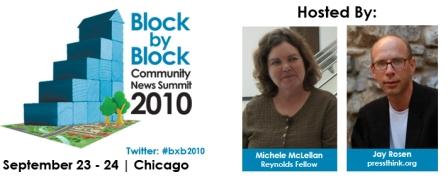
For various reasons (mostly personal and financial) I had to miss a number of interesting conferences this year, from Lindau Nobel meeting, through Open Summit in Berkeley, to Science Online London, but this meeting was worth the scramble and a tight-budget travel. Out of 120 participants, the only one I have met before in real life was Jay Rosen. But I knew a number of others from their online work - on Twitter, their blogs, their news-sites and in case of Scott Rosenberg (Twitter) also his excellent book which I keep recommending to everyone who is interested in blogs.
The first thing I did when I arrived was edit my name-tag. I crossed off “PLoS” and in its place wrote in big black letters ScienceInTheTriangle.com - the local, niche news-site we have been developing over the past three years or so. What we are doing with the site and our experiences with developing it were topics of interest for many of the people I met and talked to at the conference.
Read more…
ScienceOnline2010 - interview with Morgan Giddings
Tuesday, September 7, 2010, 7:48 am 1 Comment | Post a CommentContinuing with the tradition from last two years, I will occasionally post interviews with some of the participants of the ScienceOnline2010 conference that was held in the Research Triangle Park, NC back in January. See all the interviews in this series here. You can check out previous years’ interviews as well: 2008 and 2009.
Today, I asked Morgan Giddings to answer a few questions.
Welcome to Science In The Triangle. Would you, please, tell my readers a little bit more about yourself? Where are you coming from (both geographically and philosophically)? What is your (scientific) background?
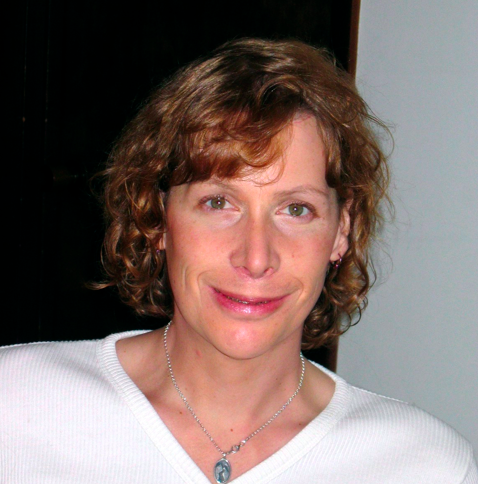 I am presently situated geographically in the center of North Carolina, specifically the Triangle area. If someone has already done it, then I’m bored with it. If the answers are already known, then I’m looking somewhere else.
My scientific background combines degrees in Physics, Computer Science, and a PhD focused on bioinformatics from UW Madison. After that, I got introduced to proteins and proteomics, and ever since have been tinkering with systems and approaches for combining proteomics, genomics, and computing to do hopefully useful things like helping to annotate the genes on the human genome.
Read more…
ScienceOnline2010 Interview – Jennifer Williams
Wednesday, September 1, 2010, 7:50 pm No Comments | Post a CommentContinuing with the tradition from last two years, I will occasionally post interviews with some of the participants of the ScienceOnline2010 conference that was held in the Research Triangle Park, NC back in January. See all the interviews in this series here. You can check out previous years’ interviews as well: 2008 and 2009.
Today, I asked Jennifer Williams to answer a few questions.
Read more…
ScienceOnline2010 - interview with Stephanie Willen Brown
Thursday, July 22, 2010, 1:32 pm No Comments | Post a CommentContinuing with the tradition from last two years, I will occasionally post interviews with some of the participants of the ScienceOnline2010 conference that was held in the Research Triangle Park, NC back in January. See all the interviews in this series here. You can check out previous years’ interviews as well: 2008 and 2009.
Today, I asked Stephanie Willen Brown to answer a few questions.
Welcome to A Blog Around The Clock. Would you, please, tell my readers a little bit more about yourself? Where are you coming from (both geographically and philosophically)? What is your (scientific) background?
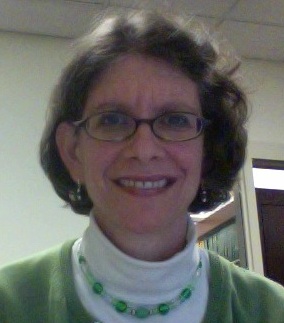 I’m Stephanie Willen Brown, aka CogSciLibrarian living in the Triangle area in North Carolina. I’ve been a librarian since 1996, and I started calling myself the CogSciLibrarian in 2004, when I was the librarian for the School of Cognitive Science at Hampshire College in Amherst, MA. I started the blog as a way of sharing cool cognitive science stories and books that I thought my colleagues would enjoy.
My scientific background is limited to that of a librarian, supporting faculty and students working in cognitive science, communications, and psychology over the years. I’d grown up intimidated by math and science, but cognitive / brain / neuroscience is so interesting AND there is so much good, accessible writing about it that I have become a fan.
My current reading interests include the effect of mindfulness on the brain, the development and use of language, and concussions in NFL and other athletes.
Tell us a little more about your career trajectory so far: interesting projects past and present?
I’m thrilled to be working at my dream job, as director of the Park Library at the School of Journalism and Mass Communication at the University of North Carolina, Chapel Hill. It incorporates many of my interests, such as library science, journalism, marketing, and advertising. I am a consumer of mass media, and I love to be around academics who are studying various aspects mass communication.
ScienceOnline2010 - interview with William Saleu
Tuesday, July 20, 2010, 5:13 pm No Comments | Post a CommentContinuing with the tradition from last two years, I will occasionally post interviews with some of the participants of the ScienceOnline2010 conference that was held in the Research Triangle Park, NC back in January. See all the interviews in this series here. You can check out previous years’ interviews as well: 2008 and 2009.
Today, I asked William Saleu to answer a few questions:
Welcome to A Blog Around The Clock. Would you, please, tell my readers a little bit more about yourself? Where are you coming from (both geographically and philosophically)? What is your (scientific) background?
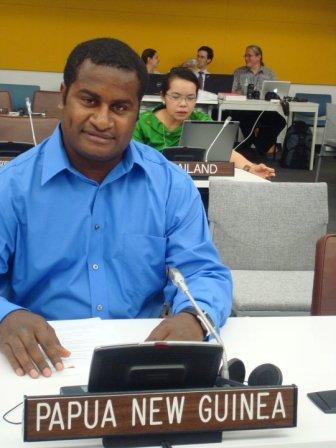 My name is William Saleu and I blog at BomaiCruz. I am from Papua New Guinea (PNG), an independent island nation making up the eastern part of the island of New Guinea which lies immediately north of Australia. I am a research fellow at the Duke University Marine Lab (DUML) in Beaufort, North Carolina.
I am part of a team that studies population structure and species connectivity among invertebrates from hydrothermal vent systems from the western Pacific. Most of our samples were collected from PNG so as you can imagine I have naturally taken up a personal interest in this subject. My ultimate goal is to be able to use the results of this research and other similar work to help identify and design conservation strategies for these unique ecosystems in PNG.
Tell us a little more about your career trajectory so far: interesting projects past and present?
So one might wonder how I ended up doing this. To answer that question I will have to take you back to my final days as an undergraduate at the University of Papua New Guinea (UPNG). I was a biophysics major and was almost at the end of my program when I realized that my options for employment after college were very slim and I decided to look at opportunities for post grad research at UPNG. I spoke to my physics advisor but he was not so enthusiastic about having me on his projects but told me to come up with my own project.
ScienceOnline2010 - interview with Anne Frances Johnson
Friday, July 16, 2010, 9:59 am No Comments | Post a CommentContinuing with the tradition from last two years, I will occasionally post interviews with some of the participants of the ScienceOnline2010 conference that was held in the Research Triangle Park, NC back in January. See all the interviews in this series here. You can check out previous years’ interviews as well: 2008 and 2009.
Today, I asked Anne Frances Johnson to answer a few questions. Anne is a freelancer and grad student at the University of North Carolina at Chapel Hill.
Welcome to A Blog Around The Clock. Would you, please, tell my readers a little bit more about yourself? Where are you coming from (both geographically and philosophically)? What is your (scientific) background?
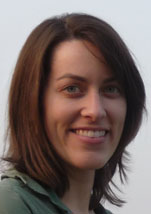 When I was a kid, I, like all 8-year-old girls, wanted to be a marine biologist and ride around on dolphins. A couple decades later, I’m still into science and nature, but I don’t actually ride wild animals. I’m a freelance science writer and master’s student in the Medical & Science Journalism program at UNC. I like to think it’s as fun as riding dolphins, but probably better for the environment.
I’m originally from Raleigh, NC, and I’ve recently come full circle back to the Triangle after more than ten years away with stops in New Mexico, New England, New Zealand and Washington, DC (I lived there even though it doesn’t have “new” in its name). I have a B.A. in biology from Smith College, where I spent lots of time cutting open fish stomachs for my thesis on lobster predation (What Eats Lobsters besides People?).
I always liked learning about science, but in college I found actually doing it to be rather gooey and tedious, and decided I probably didn’t have the endurance for it as a career. I found myself gravitating instead toward the edges of science, where it interacts with society. I worked at a marine reserve in New Zealand, patrolled Costa Rican beaches for would-be sea-turtle-egg poachers, and tended persimmons, goats and alpacas on various farms here and abroad. But it wasn’t until my first “real” job-at the National Academy of Sciences-that I discovered science writing. Instantly smitten, I’ve been a ravenous science reader and writer ever since.
Tell us a little more about your career trajectory so far: interesting projects past and present?
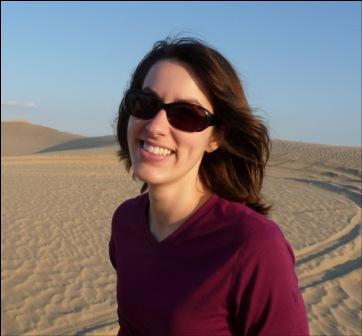 My first science communications piece was an educational booklet on stem cells. Most of the stem cell information available at the time followed either the science community’s party line (embryonic stem cells are more useful than adult stem cells so we should use them) or the conservative/political party line (scientists want to kill babies and we should stop them). Since I was working for a scientific organization, it would have been simple to take the usual tack, but we decided it was really time to go beyond that. I spent a lot of time talking to people ethically opposed to human embryonic stem cell research and tried to craft the booklet so it could reach those folks on their terms, while still being true to the science. Dealing with both the scientific and ethical issues head-on ultimately made it a more useful product for people, and tens of thousands of the booklets found their way into schools and doctors’ offices. It was very rewarding.
After that, I had the pleasure of developing a whole slew of other booklets (and posters and gadgets and websites) on topics including how to plant a pollinator-friendly garden, why microbes are cool and what the new science of “metagenomics” can tell us, and how climate change might affect ecosystems across the U.S. It’s been a constant learning experience.
What is taking up the most of your time and passion these days? What are your goals?
Last year I decided to go back to school to pick up some additional communications skills I wasn’t sure I could learn on the job. So now I’m a science journalism grad student. Perhaps the most exciting aspect of the curriculum is the multimedia work I’m doing. I know “multimedia” is a silly buzzword, but it really is useful to be able to apply whatever combination of media-text, sound, video, graphics, animations-is right for the topic at hand. I’m enjoying learning to wield all those tools and figuring out how to leverage the strengths of each to communicate in an engaging way.
Although teamwork is incredibly powerful, it’s also useful to be able to function as a “one-woman-band,” with a complete suite of skills to produce everything from documentaries to press releases myself. Wherever I end up after I graduate in 2011, I hope I’ll be able to apply all my fun new skills and continue to learn and adapt to the changing communications landscape.
What’s up with going to journalism school? No offense, but isn’t that a dying industry?
I get that a lot. Journalism school is actually alive and well, even in the current climate. The journalism business model is in a period of adjustment that’s leaving a lot of traditional journalists out of work, and that’s too bad. But I think people are hungrier than ever for information, and for the most part they know the difference between bad information and good information. I think there will always be a role for good journalistic work-especially when it comes to science topics.
Career-wise, I’m more interested in communications than traditional journalism, but I think going through this experience of learning to write more like a journalist makes me a stronger communications person. I also just love being in journalism school because I’m surrounded by really creative thinkers from all different backgrounds, which challenges me to go beyond the obvious and try different approaches.
What aspect of science communication and/or particular use of the Web in science interests you the most?
I love that there’s this vast array of genuinely interesting science content online that teachers can use as part of science education. Science education has had a terrible reputation for a long time. The Web gives teachers and parents opportunities to engage children in ways that have never existed before. Kids can interact with the scientific world on their terms and keep following the leads that interest them most. It sure beats those awful textbooks and cheesy videos I remember from childhood.
How does (if it does) blogging figure in your work? How about social networks, e.g., Twitter, FriendFeed and Facebook? Do you find all this online activity to be a net positive (or even a necessity) in what you do?
I have a healthy skepticism about using blogs and social networking in science communications. Organizations pour so much into getting their content out in all these different ways. They’re available and “free,” so why not? And sometimes they’re really effective at amplifying your reach and visibility. But they’re not magical. Sometimes, you’re better off simply producing more or better actual content, and your resources would be better spent focusing on the dissemination avenues that are most effective for your specific target audiences. There’s always a trade-off between quantity and quality, between producing new content and promoting your existing content. You have to hit the right balance, and I think blogs and social networking can be distracting if you don’t keep them in perspective. I try to use ‘em when they’re right for the task, and leave ‘em when they’re not.
What was the best aspect of ScienceOnline2010 for you? Any suggestions for next year? Is there anything that happened at this Conference - a session, something someone said or did or wrote - that will change the way you think about science communication, or something that you will take with you to your job, blog-reading and blog-writing?
One of my favorite experiences was getting to hold these really old dead birds they keep in the bowels of the NC Museum of Natural Sciences. There were just racks and racks of them. We got to pass them around, and they were so astoundingly light and beautiful. It was fun to connect with nature in the way that taxonomists have for years and years, where you can take note of the tiniest differences among species. I loved that behind-the-scenes tour, and would be thrilled to be able do more of the tours next year.
On blogging, the conference perhaps counter-intuitively convinced me that it’s okay not to blog about science. Seeing all those people blogging and tweeting so passionately, I thought, you know, there’s room for all types here. And if daily blogging isn’t my thing, it’s okay. People are blogging about science, and people are writing involved, long-form articles and books about science, and folks will continue to be engaged with science on whatever basis is useful for them-whether it’s monthly, daily or by the second. There are so many possibilities, so many ways for people to talk about science. With all those opportunities, you can really shop around and focus on what you can do best.
Thank you so much for the interview. I hope you will come to the meeting again next January.
ScienceOnline2010 - interview with Cassie Rodenberg
Tuesday, June 1, 2010, 9:50 pm No Comments | Post a CommentContinuing with the tradition from last two years, I will occasionally post interviews with some of the participants of the ScienceOnline2010 conference that was held in the Research Triangle Park, NC back in January. See all the interviews in this series here. You can check out previous years’ interviews as well: 2008 and 2009.
Today, I asked Cassie Rodenberg to answer a few questions:
ScienceOnline2010 - interview with Fenella Saunders
Monday, May 31, 2010, 3:21 pm No Comments | Post a CommentContinuing with the tradition from last two years, I will occasionally post interviews with some of the participants of the ScienceOnline2010 conference that was held in the Research Triangle Park, NC back in January. See all the interviews in this series here. You can check out previous years’ interviews as well: 2008 and 2009.
Today, I asked Fenella Saunders from The American Scientist to answer a few questions:


