Posts Tagged ‘Internet’

Why scientists (should) blog
Tuesday, January 25, 2011, 9:17 am 2 Comments | Post a Comment Last weekend, the Triangle hosted ScienceOnline 2011, a lively annual conference spearheaded by the tireless bloggers Bora Zivkovik and Anton Zuiker. Now in its fifth year, the conference has become so popular that registration for 300 spaces sold out this year in less than a day. The participants, according to the conference website, are “scientists, students, educators, physicians, journalists, librarians, bloggers, programmers and others interested in the way the World Wide Web is changing the way science is communicated, taught and done.”
As a first-time attendee and representative of Science in the Triangle, I divided my time between chasing down interviewees and attending panels, which were organized by participants on an online wiki.
One of those interviewees, Katie Mosher of NC Sea Grant, told me that she’d observed a coming together of science blogging and science journalism in the three years since she’d started attending ScienceOnline. More journalists are using the blog form either to replace or to supplement their print or broadcast stories, she said, some of them writing in traditional journalistic objective form and some of them adopting a point of view. Some of those journalists were present at the conference, just as she sees bloggers now attending conferences hosted by organizations like the National Association of Science Writers.
But journalists appeared to be outnumbered at the conference by scientists who blog (or tweet, or both). As a professional writer who frequently covers science, I should perhaps see these scientist-bloggers as competition. Not at all. To me, they are representative of a welcome trend in academics to communicate with the public about scientific findings and (sometimes controversially) the public policy implications of these findings. A scientist-blogger who writes well (perhaps one who attended the panel by Carl Zimmer and Ed Yong on avoiding obfuscation in science writing) and who knows how to attract an audience can have an immediate impact on public understanding of breaking news, as has been the case with the scientists at Deep-Sea News who covered science surrounding the Gulf oil spill. (Bora Zivkovic explains why scientists are such good explainers.)
A scientist-blogger takes some professional risks. Although I was unable to attend “Perils of Blogging as a Woman under a Real Name,” panelist Kate Clancy provides a detailed writeup here, which alludes to the skepticism with which academic colleagues and tenure and promotion panels view blogging and similar “soft” activities.
A scientist-blogger has to deal with certain downsides of being an online presence, most notably “cranks . . . who come onto our sites and leave comments that foment dissension rather than productive commentary,” according to Rick MacPherson, interim executive director and conservation programs director at the Coral Reef Alliance. It happens wherever evolution or climate change are discussed, he said, and he is the target for negative comments every time he writes or is interviewed about the role of climate change in sea level rise and ocean acidification, both threats to coral reefs.
According to MacPherson, the negative commenters are evidence that the general public doesn’t understand the evidence-based nature of science. “People don’t understand how science works,” he said. “It’s not a democratic process. . . . not opinions.”
His sentiments were echoed in “Lessons from Climategate” by panelist Chris Mooney, coauthor of Unscientific America: How Scientific Illiteracy Threatens our Future, who listed these depressing statistics:
- only 18 percent of Americans know a scientist
- just 13 percent follow science and technology news
- 44 percent can’t name a scientific role model; those who can most frequently name Albert Einstein, Al Gore, and Bill Gates, two of whom are not scientists
- in every five hours of cable news, just one minute is devoted to science and technology
According to Mooney, the situation “is ripe for climate skeptics; they are well-trained, skilled communicators who exploit lack of public knowledge and are willing to fight hard in ways climate scientists are not.” His co-panelist Josh Rosenau, who works to defend the teaching of evolution at the National Center for Science Education, said that the language of the attacks against climate science has an eerie parallel in the attacks against evolution. “For 90 years we’ve been fighting same battle,” he said. “Public opinion has not moved. If that happens to climate change we are doomed.”
Mooney and Rosenau were joined on the panel by Thomas C. Peterson, chief scientist at NOAA’s National Climatic Data Center in Asheville. Peterson was one of the climate scientists whose emails were hacked and published just a few weeks before the 2009 Copenhagen Climate Summit. Although his role in the affair was minor, he was excoriated in blogs (Peterson reminds us that some “science” blogs are unsound scientifically), subjected to harassing calls and emails, and asked by a congressman to produce all emails on the topic (which he did, and which vindicated him). Yet he was still subsequently elected by his peers to be president of the World Meteorological Association’s Commission for Climatology. Clearly, in his professional circles, he is a rock star even if some of the public doesn’t think so.
For Peterson and his co-panelists, the implication is clearly that the public doesn’t understand scientists the way scientists do. Mooney said that the climate emails were taken out of context by people who don’t understand science or scientists. His solution: train “deadly ninjas of science communication”-people who can frame the message and convey science clearly to different constituencies. He wants good communicators to claim the vacancies created when CNN dumped its entire science reporting unit and when daily newspapers gradually reduced their science coverage.
That’s a space that good scientist-bloggers can occupy alongside professional writers: reporting on science from the trenches, bringing scientific research alive, demystifying the scientific method, and unveiling the wealth of unsound science out there.
Notes:
Read my colleague Sabine Vollmer’s post on credibility in science blogging here.
A great resource for finding science blogs is scienceblogging.org.

The cybershrink will see you now
Friday, November 5, 2010, 9:05 pm 2 Comments | Post a CommentHow many people do you know who see a shrink? Marriage counseling, anger management, alcohol addiction. Therapists help identify and work through problems people have with others or themselves. Real-life problems. But what about virtual-life problems?
The Internet is a technology that is transforming the way we work, live and play one cell phone text, one tweet, one Facebook update at a time. When machines stop being mere tools and become companions, friends and emotional crutches, who do we call? The cybershrink.

Sherry Turkle
For the second lecture in its seminar series on engineering, policy and society Thursday, N.C. State University called on a clinical psychologist and sociologist who is the original cybershrink: Sherry Turkle, a professor at the Massachusetts Institute of Technology whose research has focused on people’s relationship with technology, particularly computers, for more than 30 years.
When Turkle started her research, bright minds at MIT wondered how we would keep computers busy.
Turkle recalled a two-day brainstorming session in 1978 where researchers tried to come up with ways to use computers. Ideas included tax preparation and games, she said. “Somebody suggested calendar and was told it was a dumb idea. Now we know, once computers connected us, once we were tethered, they keep us busy. We’re their killer app.”
It’s probably safe to say that the dark side of the Worldwide Web, mobile networks and social media isn’t a topic that’s frequently explored among computer scientists, software engineers and gadget geeks working on the next generation of virtual technology or among researchers in biology and chemistry eager to use it.
Those who participate in this kind of discussion risk being called Luddites, especially in universities, which are among the most wired places on the planet.
Turkle is no Luddite and neither were the panelists who joined her as part of the NCSU seminar series, which is sponsored by the College of Humanities and Social Sciences, the College of Engineering, the Institute for Emerging Issues, the Kenan Institute for Engineering, Technology and Science and the science, technology & society program.
The Research Triangle area, home of open-source software company Red Hat and IBM’s cloud computing center and the East Coast hub of the U.S. gaming industry, has its own bright minds whose research deals with the way the Internet is affecting our everyday life.
Three of them joined Turkle on a panel following her presentation: Victoria Szabo, program director for information science and information studies at Duke University; David Roberts, assistant professor of computer science at NCSU and David Gruber, a doctoral student in communication, rhetoric and digital media at NCSU.
Together, they explored the good, the bad and the ugly of computer technology.
First, the good.
The good …
Computer technology has changed medicine, transportation, education, business, politics and the flow of information. It has the potential to make us faster, smarter, more productive and more powerful, regardless of where we are, who we are and how much money we have.
It has brought about whole new industries.

David Roberts
Internet advertising already generates more than $25 billion in sales per year and mobile advertising $1.6 billion, Roberts said. And ever more remote areas are getting connected.
Just a week ago, CNN reported the Internet is now available on Mount Everest. As proof, Roberts showed a photo he received from a colleague standing next to a rock at the Mount Everest base camp. She took the photo with her mobile phone and sent it to him.
The next frontier? According to Roberts, it’s your living room as Google TV combines television, the Internet, apps and a way to search across all of them.
Instead of trying to break free of the tethering, Roberts suggested we use it to our benefit. Examples he named were the Mannahatta Game, which allows players to trace Manhattan’s history by walking the streets with an iPhone, or the UbiFit Garden, mobile technology that encourages users to exercise.
But even Roberts nodded in agreement when Turkle suggested universities de-wire some, especially to prevent students from cruising the Internet and texting on their mobile phones while they should be listening to a lecture. Both agreed that the ability to multitask bears some of computer technology’s rather negative consequences.
… the bad …
Szabo said she’s glad blogging and texting are emphasizing writing. Computer technology allows people to share real-life experiences with others online. It’s this content that keeps interest in technology high, she said.

Victoria Szabo
Without content as added value, interest in technology wanes, Szabo said. That’s why Second Life, a computer-based virtual world built by Linden Lab, is losing money.
Educators at local universities and some schools extensively use Second Life as a teaching tool. Szabo said she manages three Second Life islands as part of her job at Duke, but she’s not going to pay twice as much rent for the land now that Linden Lab will remove the 50 percent discount for nonprofits and educators.
For Turkle virtual worlds like Second Life are places where our vulnerabilities are on display. We make our avatars, our virtual alter egos, thinner, younger and better looking and we dress them better than our real selves, she said.
At MIT, some of her colleagues even list the names of their Second Life avatars on their business cards.
Computer technology’s potential to expose vulnerabilities concerns Turkle in particular when it involves adolescents, the generation that grew up with the Internet and the mobile phone. For adolescents, the Internet is the perfect personality workshop at a time when they are looking for a place to experiment, she said.
They reach out for attention but instead get the illusion of companionship, Turkle said. “It’s the new state of hiding, We’d rather text than talk.”
Unplugged, they feel isolated, she said. When they’re plugged, in they feel overwhelmed by hundreds of text messages they receive on their mobile phones and by having to constantly update their Facebook pages.
“The point is not to denigrate the good,” Turkle said. “It’s to get a grip of what technology can offer us.”
Without that grip, computer technology can rear its ugly head.
… and the ugly
After interviewing adolescents for 15 years, Turkle brought some anecdotes to share.
Teens who slept with their mobile phones as if the devices were phantom limbs. The 16-year-old boy who told her that he looks for a pay phone that takes coins whenever he wants to make sure his call remains private. And then there was the young woman with the thumb splints, who opened the door painfully texting on her mobile phone. Turkle asked to see her flatmate and the young woman, rather than walk a few feet and knock on her flatmate’s door, preferred the pain and texted her.

David Gruber
The risks of computer technology’s seductiveness prompted Gruber to wonder about what’s not changing despite the broad-ranging influences of the Internet, mobile phones and social media.
It’s an interesting thought.
By focusing more on what stays the same, it might become clearer whether computer technology merely puts on display and exaggerates existing societal weaknesses, or whether it creates them.
It might also provide a clue to who’s in charge, people or machines.
If the U.S. falls off the flat earth, so does RTP
Sunday, April 11, 2010, 5:41 pm No Comments | Post a CommentNeal Lane, a physicist who in the late 1990s was President Clinton’s top science advisor, worries when he looks at federal spending on research and development.
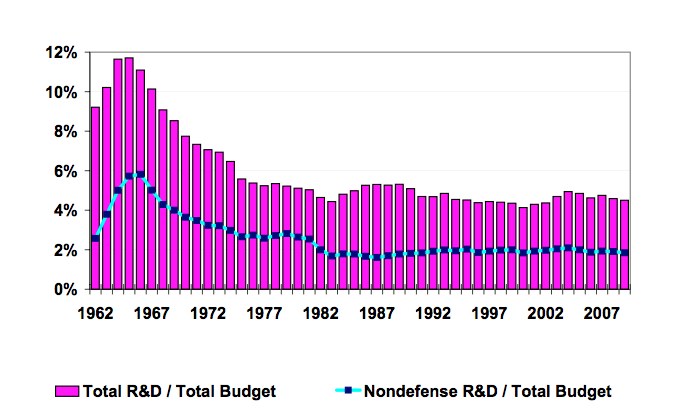
R&D spending as percentage of federal budget, FY 1962-2009
Sure, federal spending on R&D more than tripled in the past 50 years to about $147 billion in fiscal year 2009, as Lane pointed out Saturday in a talk at N.C. State University. But R&D’s share of all federal spending has been shrinking from nearly 12 percent during the height of the Apollo program in the late 1960s to about 5 percent in 2009, according to numbers from the American Association for the Advancement of Science.
Lane, a professor at Rice University and a senior fellow at the James A. Baker III Institute for Public Policy, is particularly concerned about federal funding for research in physics, mathematics and engineering, the disciplines that brought forth computers, the Internet and mobile devices such as the cell phone. Read more…

ScienceOnline2010 - interview with Mark MacAllister
Thursday, March 4, 2010, 12:07 am No Comments | Post a CommentContinuing with the tradition from last two years, I will occasionally post interviews with some of the participants of the ScienceOnline2010 conference that was held in the Research Triangle Park, NC back in January. See all the interviews in this series here. You can check out previous years’ interviews as well: 2008 and 2009.
Today, I asked Mark MacAllister, Coordinator of On-Line Learning Projects at the North Carolina Zoological Society to answer a few questions:
ScienceOnline2010 - interview with Andrea Novicki
Monday, March 1, 2010, 6:24 pm 1 Comment | Post a CommentContinuing with the tradition from last two years, I will occasionally post interviews with some of the participants of the ScienceOnline2010 conference that was held in the Research Triangle Park, NC back in January. See all the interviews in this series here. You can check out previous years’ interviews as well: 2008 and 2009.
Today, I asked Andrea Novicki from the Duke CIT blog to answer a few questions:
North Carolina science journalism/blogging projects getting noticed
Wednesday, February 24, 2010, 11:41 pm No Comments | Post a CommentIf you are interested in the topic of science journalism, how it’s changing, what’s new, and who’s who in it, you are probably already reading Knight Science Journalism Tracker. If not, you should start now.
They have recently been digging around and finding projects with which I am involved in one way or another:
A path to Eureka
Tuesday, June 23, 2009, 10:33 am No Comments | Post a CommentIt hit me when my mind wandered through a blog post by Robert Lee Hotz, a Wall Street Journal science writer, about research that explores the brain during sudden Eureka moments. Also a contributing factor was a book, that, as I’m reading it, makes me wonder whether it’s smarter to be a nematode or a human.
Mapping RTP's future
Sunday, May 31, 2009, 4:40 pm No Comments | Post a Comment Science and innovation will continue to drive economic development in the next 20 years, but where the new jobs will spring up is not as clear.
The Internet is emphasizing how researchers work over where they work. To solve scientific puzzles increasingly requires more than one researcher, one lab, or one organization. And in the global recession government is trading places with industry in stepping up investment in research and development.
RTP: Then and now
Sunday, May 17, 2009, 7:09 pm No Comments | Post a CommentOn a Friday afternoon, when traffic is bumper-to-bumper four lanes deep on Interstate 40 from Research Triangle Park to Raleigh, it’s hard to imagine RTP was nothing but scrub pines and possums 50 years ago.


