Archive for June, 2011

Biotech innovation: What isn’t funded
Tuesday, June 28, 2011, 11:35 pm No Comments | Post a CommentInnovation capital, money to turn some of today’s most innovative discoveries into tomorrow’s medical treatments, is getting so scarce in the U.S., politicians, economic developers and entrepreneurs in regions specializing in early stage biotech research and development are scrambling.
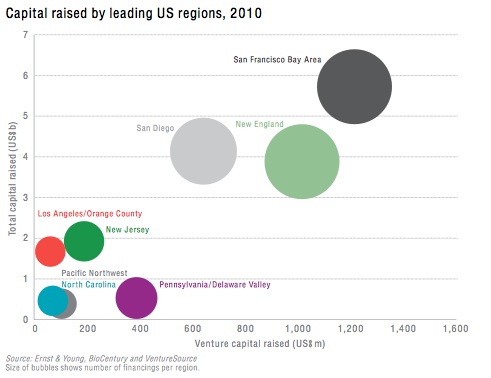
North Carolina, a hub for young biotech companies, trailed other U.S. biotech hot spots in venture capital raised last year, according to an Ernst & Young report.
North Carolina’s Research Triangle, the third largest U.S. biotech hub, is one of those regions.
Some of the world’s largest R&D companies have operations in the Triangle, including GlaxoSmithKline, Novartis and Bayer. But the lifeblood of the area has long been young, early stage companies in pursuit of ideas developed at local research universities such as Duke University, the University of North Carolina at Chapel Hill and N.C. State University or hatched by researchers who used to work in corporate labs in Research Triangle Park.
A little more than two years after a deregulated U.S. banking industry stumbled in the fall of 2008, investors are increasingly shying away from early stage biotech companies, a high-stakes, high-rewards gamble in the best of times. Innovation capital is drying up in the U.S., according to a 2011 report the U.S. accounting firm Ernst & Young published this month.
One consequence, a Research Triangle venture capital investor said, is “deals are dying on the vine.”
“More and more small, really good startups are having problems finding money,” said Norris Tolson, chief executive of the N.C. Biotechnology Center. “We’re about the only game in town for early stage biotech companies.”
The biotech center, which offers grants and loans up to $250,000, has seen the number of funding requests increase by about 10 percent, Tolson said. In the past year, about 280 applicants asked for financial support. About 130 were approved.
Traditionally, young biotech companies have relied on private investors, often venture capital investors, to kick their R&D into gear.
U.S. biotech companies raised $5.5 billion in venture capital in 2007, about twice as much as in 2000, according to Ernst & Young. But in the past three years, the amount has stagnated at about $4.5 billion annually and venture capitalists have begun to hold money back until companies reach certain milestones.
Total capital raised by biotech companies in the U.S. bounced back to $20.7 billion last year, from about $13 billion in 2008, according to Ernst & Young. But much of that capital went to mature companies. Young, early stage companies, which work on the most innovative technologies and generate more jobs than large, established companies, actually received about 20 percent less in capital than the year before.
In Europe, capital raised was more evenly distributed among startups and mature companies. In Singapore, China and India, governments are ratcheting up efforts to bolster biotech innovation. And in Latin America, Brazil’s already strong agricultural biotechnology sector is gaining attention.
But politicians, economic developers and university administrators in the Research Triangle have come up with ideas to encourage the formation of R&D startups despite the early stage funding crunch

The planned Alexandria Ag-Tech Center.
The biotech center teamed up with Alexandria Real Estate Equities, a Pasadena, Calif.-based real estate investment trust, to attract young companies working in agricultural biotech research. Alexandria, which already owns lab buildings in the Triangle, will build a $13.5 million business incubator with about 18,000-square-feet of greenhouse space near RTP.
Several universities and the Council for Entrepreneurial Development are working with the charitable arm of the Blackstone Group, a global investment firm, to turn more technologies developed at universities into companies and bolster the Triangle’s existing entrepreneurial network.
The chancellors at UNC-CH and NCSU have set up innovation funds to further support spinoffs.
And state legislators are again considering establishing a nonprofit that can loan young companies money. The legislation has come up twice before and would use about $100 million an out-of-state investor is willing to provide, Tolson said. Initially, only life science companies could benefit, but recently state lawmakers suggested that information technology and green technology companies should also be included.
“There’s a huge need for startup capital across the U.S.,” Tolson said. In North Carolina, “a lot of people are understanding the need.”
Former GSK drug researcher pursues ideas big pharma hasn’t
Monday, June 20, 2011, 9:23 am No Comments | Post a CommentEditor’s note: North Carolina’s Research Triangle is home to hundreds of young companies. Scientists and entrepreneurs started them to develop technologies and medicines for better detection and treatment of diseases. Some of the companies work on innovations that are the result of research done at one of the area’s universities. Others are outgrowths of established companies. Vijaya Pharmaceuticals, a drug discovery company founded in 2009 by a husband-and-wife team, is one of those young companies.
Subba Katamreddy
Former GlaxoSmithKline researcher Subba Katamreddy did what came natural to a medicinal chemist who in 2008 got caught at the beginning of U.S. drug research and development cutbacks that have rocked large pharmaceutical companies since then.
Katamreddy started his own drug discovery company, Vijaya Pharmaceuticals, and established a lab in the Park Research Center incubator in Research Triangle Park to explore some ideas he had for next-generation antibacterial and anti-inflammatory treatments.
So far, Katamreddy and his wife, Vijaya, have financed the startup on their own. Katamreddy is about to start making molecules to develop technology that he can patent and use to attract more investors. But funding early stage startups has gotten more difficult this year despite more money being raised.
So, Katamreddy has begun to take in contract work to generate revenue. He’s determined to keep going and hopes to hire a couple of employees in the next three to five years. “Vijaya,” is Telugu, a language that is spoken in the southern Indian region where the Katamreddies are from, and stands for “victory.”
“Whether you’re in a small lab or a big lab,” Katamreddy said, “an idea is an idea.”
He’s had good ideas before. During his seven years at GSK in RTP, Katamreddy was involved in discovering two experimental drugs. His area of research was metabolic diseases such as adult-onset diabetes. Large pharmaceuticals are investing heavily in finding treatments for diabetes and other chronic diseases, because these diseases are on the rise and require ongoing treatment.
Vijaya Pharma is treading were large pharma hasn’t.
The number of antibacterial drugs the Food and Drug Administration approved for sale declined 56 percent from 1983 to 2002, according to an analysis published 2004. Demand for new drugs is rising with the spread of multi-drug resistant bacteria. (More on the problems superbugs are causing here.)
Katamreddy is particularly interested in a group of antibacterials called macrolides. This group includes erythromycin, an antibiotic that is used to treat pneumonia, venereal disease and urinary tract infections.
Cempra Pharmaceuticals, another young drug development company in the Research Triangle, is testing a macrolide in patients. (More on Cempra Pharmaceuticals here.) There’s also some interest in macrolides outside of the U.S. European researchers are studying a macrolide to treat inflammatory bowel disease and rheumatoid arthritis. But large pharmaceutical companies hesitate to invest in antibacterial research, because successful drugs are used once and for a short time only.
Katamreddy’s other idea is related to a known anti-inflammatory called curcumin, which is the biologically active ingredient in the Indian spice turmeric. Researchers have tested curcumin’s effect on Alzheimer’s patients and cancer cells. Dennis Liotta, a researcher at Emory University, is also studying curcumin as a cancer treatment.
Large pharmaceutical companies have not shown much interest in curcumin, because it can’t be patented and it doesn’t stay in the body long enough. Katamreddy wants to tinker with naturally occurring curcumin, but he’s not ready yet to say how.
Universities anchoring RTP step up economic development efforts
Monday, June 13, 2011, 10:41 pm No Comments | Post a Comment
President Obama at Cree's manufacturing plant in Durham. Photo: Wall Street Journal
On his visit Monday to Cree’s Durham manufacturing plant President Obama brought his advisors from the Council on Jobs and Competitiveness along to impress on North Carolinians that his administration is focused on lowering the stubbornly high U.S. unemployment rate, which in May was 9.1 percent.
Jobs council members, which come from the business sector, labor and universities, are dedicating their time and energy to one singular task, Obama told Cree workers. “How do we create more jobs in America?”
Not far from where Obama was talking about getting out of the Great Recession, a job creation effort was under way to lower the state unemployment rate, which in April was 9.7 percent, and particularly the unemployment rate in the Research Triangle, which in April was at 7 percent in the Durham-Chapel Hill area and at 7.7 percent in the Raleigh-Cary area.
NCSU, Duke University and the University of North Carolina at Chapel Hill have long been engines of economic development in the region. They drove the formation of Research Triangle Park in the 1950s and educated the work force that attracted corporate research and development operations to RTP in the following three decades. The three universities that anchor RTP have also brought about technologies that started many an R&D company in the area.
Cree itself is a NCSU spinoff. The RTP company that makes light-emitting diodes, or LEDs, was formed in 1987 based on technology developed at NCSU.
With budget cuts for higher education looming, Triangle universities are stepping up and retooling their economic development efforts.
At NCSU, Terri Lomax, vice chancellor for research and innovation, is taking on responsibilities starting July 1 to help the state recruit companies and jobs, and the university is trying to boost the formation of spinoffs and their chances to survive and expand, be acquired or go public.
William Woodson, who was named NCSU chancellor in January 2010, established an innovation fund that will provide $2.5 million over the next five years to NCSU researchers to work on technologies that could be licensed or spun out as a company. To get off the ground, the young companies could tap into expertise at the university through a so-called proof-of-concept center on NCSU’s Centennial Campus.
To further accelerate startup formation, NCSU has joined forces with UNC, Duke, the Council for Entrepreneurial Development and N.C. Central University. The consortium is getting involved in the Blackstone Entrepreneurs Center, which has $3.6 million available over three years to evaluate technologies and tutor new companies.
“Most new jobs come from companies less than five years old,” Lomax said in an interview with Science in the Triangle. “We want to do everything we can to help these companies be successful. Especially after a recession that’s extremely important.”
She suggested that the efforts could double the number of successful startups that NCSU spins out per year to 10 to 12 by 2015.
“What we want is sustained economic development,” Lomax said.
Watch the entire Science in the Triangle interview with Terri Lomax here:

TEDxChapel Hill: A glimpse into the global technology era
Sunday, June 12, 2011, 7:08 pm No Comments | Post a CommentSoftware programmers who build Web sites that map incidents reported by mobile phone. A branchless banking system that allows customers to send cash by mobile phone text message. Medical specialists who diagnose patients hundreds of miles away with the help of images uploaded through a mobile phone app and stored as electronic medical records.
These are just three innovative uses for mobile phones, crowdsourcing and open-source technology. But this type of innovation isn’t happening in rich, developed countries like the U.S. or in Europe.
The Ushahidi mapping tool has collected crowdsourced incidents reports in Afghanistan, the Democratic Republic of Congo and Mexico. Kenyans mail small amounts of cash through M-Pesa‘s branchless banking system. SANA‘s open-source technology brings healthcare screening to rural areas in India and the Philippines.

Diali Cissokho & Kairaba play music reminiscent of West African dance bands.
Presented at a TED talk independently organized by IntraHealth June 2 at the Varsity Theatre in Chapel Hill, these innovative technological applications provided a glimpse of what’s possible in places without functioning transportation, healthcare and banking infrastructures.
As Diali Cissokho & Kairaba, a band of Senegalese and North Carolina musicians, played between presentations, the crowd of more than 250 in the filled-to-capacity movie theater just across from the University of North Carolina’s Chapel Hill campus was left to re-examine perceptions of developed versus developing countries.
“It’s the new era of global technology,” said Heather LaGarde, special projects advisor to IntraHealth OPEN, an initiative that encourages the use of the latest technological advancements to improve healthcare in poor countries.
TED talks are an outgrowth of a conference that brought together technology geeks, entertainers and design mavens. The concept is owned by a private foundation a magazine publishing entrepreneur started in 1996.
TED talks follow in the footsteps of storytellers who spread knowledge and wisdom. Their purpose is to disseminate ideas.
Holden Thorp at TEDxChapel Hill
TEDxChapel Hill was the fourth independently organized TED talk in the Research Triangle. Three previous talks took place in the past 18 months, one at the Research Triangle Park headquarters, one at N.C. State University and one in Raleigh. (More about the TEDxTriangle event at RTP here.)
The Chapel Hill talk was organized by IntraHealth, a UNC spinoff focused on global health. Among the speakers featured was Holden Thorp, UNC-CH’s chancellor, who as a UNC chemistry professor developed technology for electronic DNA chips and founded companies.
Thorp encouraged scientists to bring their research to bear upon problems people around the world are dealing with, such as drought, poverty and climate change.
“We have a leg up addressing these problems,” he said.
Thorp could draw some inspiration from the venue. In the mid 1980s, while he was an undergraduate at UNC, Thorp said, he watched the “Adventures of Buckaroo Banzai Across the 8th Dimension” 16 times at the Variety Theatre. The science fiction movie was about an adventurer, surgeon and rock musician who took on evil alien invaders with his band of men.
UNC and other universities as well as nonprofit research institutes and global health organizations in the Triangle are trying to do just what Thorp suggested.
At UNC, the Carolina Global Water Partnership developed a microfinancing program for Cambodians to buy biosand and ceramic filters and gain access to clean drinking water.

Robert Malkin
At Duke University, Robert Malkin, director of Engineering World Health, is encouraging engineers to develop medical equipment that works in hospitals in Sudan, Nigeria, Nicaragua, El Salvador, Haiti, Liberia and Sierra Leone.
The World Health Organization estimated that 70 percent of the medical equipment developed in the U.S. or Europe doesn’t work in poor countries in Asia, Africa and Latin America, including used and new surplus equipment donated by U.S. hospitals.
Indeed, much of this equipment is stacked in large warehouses, collecting dust, Malkin said. (More on barriers for medical devices in the developing world here.)
During his presentation at TEDxChapel Hill, Malkin said he observed this first-hand when he attended a heart surgery in a Nicaraguan hospital many years ago and the overhead surgery lights caught on fire. The nurses responded calmly, protecting the patients from the billowing smoke with a blanket, Malkin said. He found out later, that the special light bulbs for which the donated surgery lights were designed weren’t available in Nicaragua. The 100 Watt light bulbs the hospital used instead caught on fire routinely.
IntraHealth, which mostly deals with community health workers in developing countries, is also looking for hands-on solutions. IntraHealth’s OPEN Council brings together some of the most innovative thinkers, such as Jon Gosier, the founder of Appfrica, a company that invests in East African software startups; and Josh Nesbit, the chief executive of Medic Mobile, a nonprofit that uses mobile technology to create health systems in developing countries.
Dr. Radhika Chigurupati
Gosier and Nesbit also participated in TEDxChapel Hill, and so did Dr. Radhika Chigurupati, a surgeon at the University of California San Francisco Children’s Hospital, who talked about her work with SANA.
Mobile device technology developed by a team of students, volunteers and faculty at the Massachusetts Institute of Technology in Boston allows SANA to bring health screening to remote rural area.
More than half of the population in developing countries are mobile phone subscribers, according to a 2010 United Nations report.
In India, Chigurupati said, community health workers use their mobile phones to take high-resolution pictures of potentially cancerous lesions in patients’ mouths or on feet. The images are uploaded to a server to which physicians in faraway urban areas have access.
Trips from the countryside to see a doctor are prohibitively expensive for the patients. But mobile telemedicine enables community health workers to screen for cancerous lesions and connects them with experts who can help treat the lesions and save lives.
In 2010 alone, more than 4,000 patients in rural India were screened for oral cancer, a disease that is prevalent because of widespread tobacco and beetle nut chewing.
“I think the tide is high,” Chigurupati said. “If you’re shrewd enough and committed enough, you can make a difference in the lives of millions.”

Guest perspective: Sony shines at E3
Friday, June 10, 2011, 7:38 am No Comments | Post a Comment

The new PlayStation Vita, announced this week at the E3 Expo. | Image courtesy of Sony Computer Entertainment Inc.
This year’s E3 Expo in Los Angeles saw plenty of big announcements from the world’s top gaming companies, including a few from firms right here in the Triangle. As the gaming industry’s premiere showcase wrapped up this week, Gaming in the Triangle reached out to Amanda d’Adesky, a local aspiring game developer, to get her thoughts on the most exciting news from an event often fraught with hype. Here’s her take.
Gamers, gadget geeks and tech heads alike all flocked to the Electronic Entertainment Expo in Los Angeles earlier this week in hopes of getting a glimpse at the future of digital entertainment. While most go to this event for the games, a lot of hardware gets showcased at E3, and this year was no exception.
Last year was all about motion controls, both with and without the use of actual controllers. Microsoft revealed the Kinect, Sony announced the Move, and Nintendo stayed mostly silent on the subject, ironically enough. This year, while motion controls were a big part of the proceedings, combining the various gimmicks already available with one another was the name of the game, and the company poised to do it best looks to be Sony.
Amanda d'Adesky
While Microsoft was pushing the Kinect (again) and Nintendo announced a whole new console, Sony hit some very stable middle ground by doing a bit of both.
The NGP, short for Next Generation Portable, made it’s formal debut as the PlayStation Vita Monday. PSVita combines the easy accessibility of touch-screen gaming with the functionality and comfort of a game controller. Sporting a 5-inch multitouch screen, back multitouch pad, dual analog sticks (a first for next-generation handhelds) and 3G/Wifi capability, it appears to be just like any other mobile gaming platform. What makes it stand out is the rear- and front fa-cing cameras, which allow for implementing augmented reality capabilities in upcoming games.
Speaking of augmented reality, many game developers who presented at Sony’s press conference mentioned they would be including this functionality in their upcoming titles thanks to the PlayStation Move camera. Granted, Microsoft and Nintendo had similar news in this same vein, but the ability to experience these alternate realities in 3D makes for some very exciting possibilities. Combine this with the workability of PlayStation Move, and it seems they’ve hit on a very unique scenario. Overlaying monsters, weapons and in-game objects with your real-world surroundings and seeing them truly jump into your personal space certainly sounds like a screaming good time.
Sony also unveiled some nice accessories to bring more people into the world of 3D. A PlayStation-branded, 24-inch 3D display will be released this fall, specifically designed to give consumers affordable access to the wonders of 3D functionality. While this, on it’s own, doesn’t seem like much of big deal, the company boasts that their display will optimize two-player mode by giving each player their own full-screen view in 1080p high-definition, eliminating the inconvenience of split-screen.
The first bundle to be released, containing the PlayStation 3D monitor, one set of active-shutter glasses, an HDMI cable and a copy of Resistance 3 (a Move/3D enabled title from the Insomniac Games, a company with offices in the Triangle) will go for a heartbeat-skipping $499. The price may seem to contradict the goal of an affordable entry-point and spurring further 3D adoption, but to be fair, it isn’t nearly as likely to bring about full-on cardiac arrest like the offering of 3D televisions currently on the market.
Additionally, the choice to offer active 3D viewing while still trying to lower the price point is a bold move, given that the electronics giant could have easily gotten away with offering simple passive 3D like most everyone else. Active-shutter makes for crisper images, and that makes for better viewing.
Though 3D gaming and motion control are nothing new, the seamless integration of the two could prove to be a potent and profitable combination for Sony. Only time will tell just how successful this will be, but one thing’s for sure: Nintendo and Microsoft have some catching up to do.
Amanda d’Adesky is an aspiring game developer, organizer of the Triangle Game Developers Meetup and a contributing writer for Bulletproof Pixel. Follow her blog at Cage Match Panda and her tweets as @amandadadesky.
Big pharma goes back to college
Saturday, June 4, 2011, 3:53 pm No Comments | Post a CommentNorth Carolina’s Research Triangle is one of several research hubs in the U.S., Canada and the United Kingdom, where large drugmakers have hooked up with universities in the past year to boost drug discovery and shore up dwindling product lineups.
Pfizer signed a research collaboration with the University of California, San Francisco. Sanofi-Aventis has done the same with Harvard University, UCSF and Stanford University. GlaxoSmithKline and AstraZeneca called on the British University of Manchester. GSK, which is based in London and has its U.S. headquarters in Research Triangle Park, also struck up a strategic partnership with 16 academic institutions in Toronto.

Tom Denny
In the Research Triangle, Novartis went to Duke University.
“We had the right infrastructure,” said Tom Denny, chief operating officer of the Duke Human Vaccine Institute. Duke and Novartis will be working together on pandemic flu vaccines.
Big pharma companies have begun to troll for marketable innovation at universities - places where science and research are a taxpayer- and tuition-funded way of life - after spending increasing amounts of money on their own and other companies’ research and development with meager results.
Consolidation, R&D reorganizations, acquisitions of technologies and whole companies - large drugmakers have tried many strategies in the past decade to rejuvenate aging product lineups and plump up drug development pipelines. But the average number of innovative new medicines that came to market in the U.S. decreased to 22 in the second half of the decade from 28 in the first half, and that despite annually rising R&D expenses.

As blockbuster drugs lose patent protection, remaining sales drop off a cliff.
With R&D productivity stalled and valuable drug patents about to expire, big pharma three years ago began to cut R&D jobs and lay off thousands. The restructuring is still ongoing with a focus on reducing R&D expenses and boosting sales in emerging markets such as Asia and Latin America.
The driver behind the cost cutting is the U.S. “patent cliff.”
By 2015, cheaper generics are projected to replace prescription drugs worth more than $100 billion in U.S. sales. The losses are expected to send sales on a sharp decline that, drawn as a line, looks like a cliff.
After trying everything else with insufficient success, large pharma companies are now betting on universities for inspiration.
Pfizer agreed to pay UCSF $85 million over five years. Under the agreement, researchers from Pfizer and UCSF will work at UCSF labs to turn research into potential biological medicines.
The University of Manchester will receive about $16 million from GSK and AstraZeneca. The investment will establish a translational research center and recruit scientists who will look for novel treatments for inflammatory diseases, such as asthma and rheumatoid arthritis.
The pharma industry has long had relationships with individual university professors. It’s also not uncommon that university medical school faculty work with industry to test new treatments or that an academic research project attracts the interest of pharma companies. What’s new is that big pharma companies are outsourcing R&D to universities.
The seed for the pandemic flu vaccine collaboration grew out of an HIV/AIDS collaboration between Novartis and Duke, Denny said.

The Novartis vaccine manufacturing plant in Holly Springs.
One of the Novartis HIV/AIDS researchers was a Duke alumnus who knew his alma mater was just 30 miles from the state-of-the-art flu vaccine manufacturing plant Novartis opened in 2009 in Holly Springs. (More on the Novartis plant here.)
Flu viruses can change from year to year and vaccines have to be made to match the anticipated changes in the virus. But it’s only safe for researchers to work with highly contagious, maybe even deadly, flu virus strains in a specially equipped biocontainment lab. Duke has such a lab and the ability to test pandemic flu vaccines on animals.The vaccine manufacturing plant, which Novartis build in Holly Springs precisely because of the site’s proximity to RTP and its three anchor universities, has neither.
In case a new flu virus starts spreading around the world and the Centers for Disease Control and Prevention and the World Health Organization call a pandemic emergency, the agreement gains Novartis priority access to the Duke biocontainment lab within 24 hours for a daily fee.
The agreement also allows researchers from Duke and Novartis to collaborate on longer-term projects paid for by grants from the National Institutes of Health. The rights to any technology would be jointly owned by each partner, Denny said.
“This is, what we would hope, a long-term collaboration,” he said.
EPA funds Hamner research using virtual liver
Thursday, June 2, 2011, 8:52 am No Comments | Post a CommentA researcher at the Hamner Institutes for Health Sciences in Research Triangle Park has received a $750,000 grant from the Environmental Protection Agency to study the health risks that various toxins pose for the liver.
Sudin Bhattacharya
Sudin Bhattacharya, a research investigator in the Hamner’s Center for Dose Response Modeling and the Institute for Chemical Safety Sciences, will use a virtual liver for the research. The virtual liver is a computational model of the human liver that can predict liver cell response to varying doses of environmental chemicals.
The research is funded through the EPA’s National Center for Environmental Research to better understand the possible consequences of global change on human health, ecosystems and social well-being. Bhattacharya focuses on computational modeling of cell signaling and key gene regulatory networks and the disruption of these networks by toxic compounds and drugs.
The virtual liver, which was developed by a team headed by Dr. Paul Watkins, a UNC professor of medicine, is also used as a computer-based simulation of prescription drug-induced liver injuries. (More about the Hamner’s efforts here.)
Triangle game engines dominate market
Thursday, June 2, 2011, 8:41 am No Comments | Post a Comment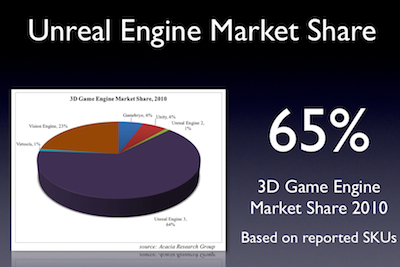
One game engine to rule them all. | Photo courtesy of TwitPic
Feast your eyes on this delicious pie chart.
Shared by Epic Games Vice President and Co-Founder Mark Rein via TwitPic, it shows a recent report from Acacia Research Corporation that puts the Cary-based gaming powerhouse far and above all of its competitors in the 3D engine market. With a whopping 65-percent market share in 2010, the company’s Unreal Engine outpaced its closest rival, the Austin, Texas-based Vision Engine, nearly threefold.
The company’s prominent market position is probably aided by its distribution strategy. The entire Unreal Development Kit, which game designers can use to create content on par with flagship titles like Gears of War and Mass Effect, is free for educational and non-commercial use. With a $99 licensing fee, developers can sell their games royalty-free until their sales exceed $50,000. The company has even sponsored several events in the local area, like Unreal University at the East Coast Game Conference, to spread the use of its engine.
But there’s more good news from this report for the Triangle. Another top engine, Gamebryo, was also developed by a Research Triangle Park company. With its product, Gamebase USA claims about 6 percent of the market, matching the share of another industry favorite, Unity.
All told, that means Triangle gaming technology is powering almost three-quarters of all 3D gaming titles. And when you’re talking about an industry that pulled in $18.6 billion in 2010, that’s no small matter.
An RTP lab to test business ideas
Wednesday, June 1, 2011, 4:57 pm No Comments | Post a CommentA good idea has shelf life. We all know that.
Ideas pop into our heads every day. Only the good ones linger. They survive challenges and reassessment. That’s also true for business ideas, which hold the promise of starting a company, generating income and creating jobs.
Ron Harman
But it’s hard to test how good a business idea really is, because honest feedback is difficult to get, said Ron Harman, owner of CTO Outsourcing, a Durham company that provides software expertise to startups.
“Getting people to tell you how great you are is easy,” Harman said. But few friends, relatives or paid consultants aren’t usually willing to probe an idea for flaws that could kill it.
“Nobody wants to tell you bad news,” Harman said.
To fill that gap, he and six other entrepreneurs in North Carolina’s Research Triangle eight months ago founded the RTP Idea Lab. So far, they’ve held three idea vetting sessions at RTP headquarters.
The sessions attract crowds of a few dozen and combine idea pitches, question-and-answer follow-up and critiques. It’s a concept that’s also being tried in other areas where lots of people work in research and development, including Boston, Pasadena, Calif., Austin, Texas, and at universities, but the efforts aren’t mirror images of each other.
Pasadena-based Idealab has created and operated pioneering technology companies since 1996. Bostinnovation is a digital community hub for ideas that have matured into startups. The Business Innovation Factory in Austin, Texas, is a nonprofit that was founded in 2004 to help innovators test ideas before they turn them into startups. The University of North Carolina at Chapel Hill has an IDEA Group to develop novel biomedical imaging and analysis tools.
The RTP Idea Lab mainly aims to provide a forum where innovators pitch their business ideas to a group of people who are neither experts nor potential investors. Ideas bandied about have ranged from mining company e-mails to prevent theft of intellectual property to matching up retired executives with startups and nonprofits in need of short-term mentoring.
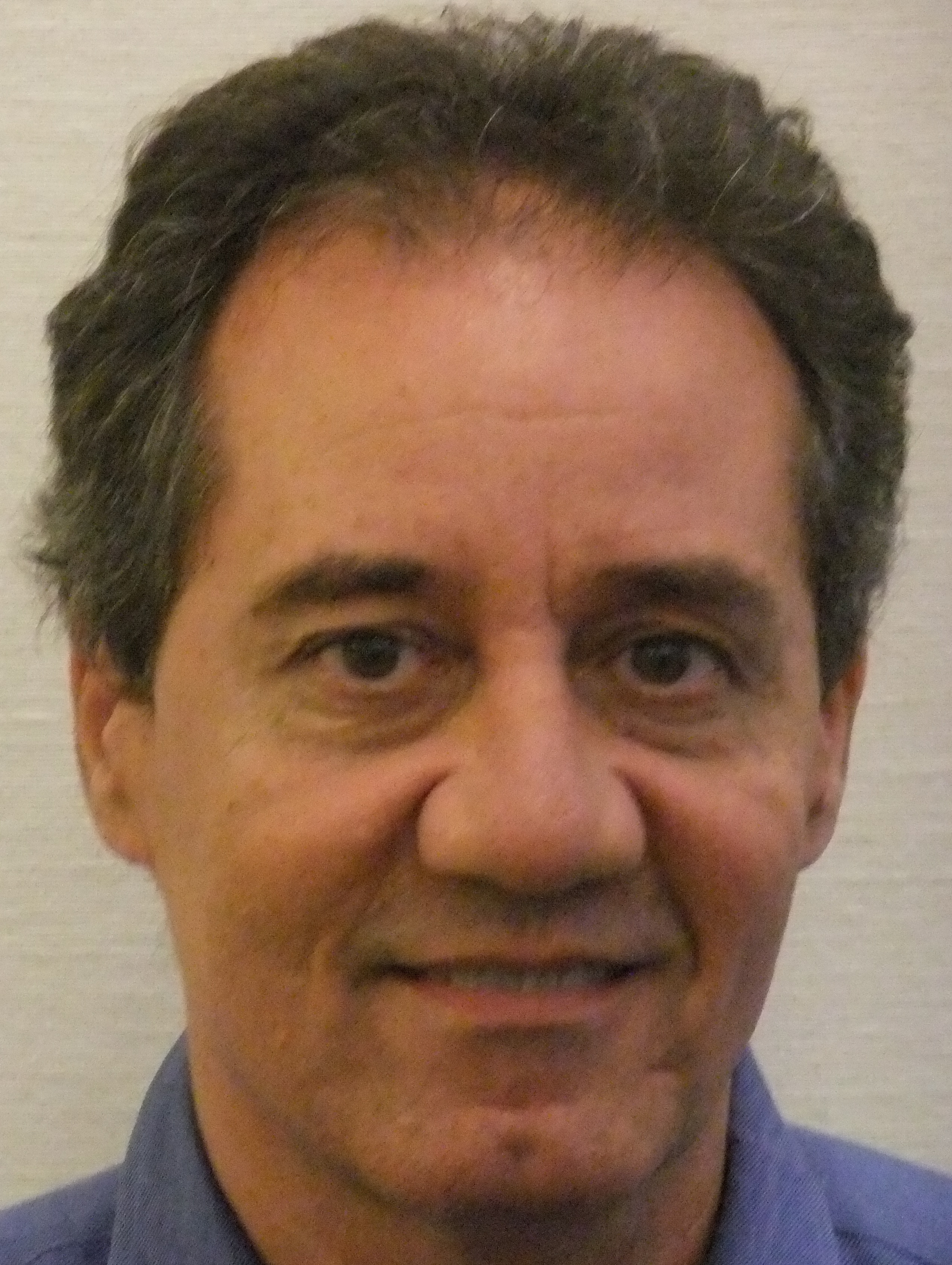
Jim Ingram
“Getting into a group and talking about ideas was very attractive,” said Jim Ingram, a technical writer and a RTP Idea Lab board member. At the most recent session in May, Ingram pitched his idea to reconfigure the hierarchy with which computers file information.
“An idea without an interaction with others is just a thought,” Ingram said. ” It dies in the brain if it isn’t talked about.”
The founders of the RTP Idea Lab, most of them local technology entrepreneurs, also want to stimulate the birth of new companies and the creation of jobs in the Triangle. The area’s unemployment rate has come down slightly in the past year, but it remains above 7 percent, according to April state unemployment figures. That compares to 9.5 percent unemployment statewide.
With federal and state budget cuts looming, it’s not likely that the government and public universities, important contributors to the Triangle’s economy, will be of much help. But technology startups are on a roll. Another Internet gold rush is on, stocks are up, investors are eager and startups are sprouting from New York to Durham.

Anthony Edwards
The Triangle offers plenty of services to form a startup and find a home for it. What the area lacked was a place where people with ideas could ask other people, “What do you think?,” and get a honest answer. That’s where the RTP Idea Lab fits in, said Anthony Edwards, board chairman of the RTP Idea Lab.
Edwards is an IT consultant and a founder of Morrisville-based Tavve Software. He’s also involved in RedOak Logic, a Chapel Hill startup that targets the drug development industry but has yet to be funded.
Having RTP Idea Lab sessions “is good for the community, for RTP,” he said. “It encourages people to form companies.”
He wants to add to the feedback sessions and form partnerships with serial entrepreneurs, venture capitalists and angel investors to also provide seed funding.


