Archive for September, 2011

Woodson envisions a new NCSU
Wednesday, September 28, 2011, 9:08 am No Comments | Post a CommentWilliam “Randy” Woodson has been frank about his intentions to shake things up since he moved halfway across the country from Indiana’s Purdue University to become N.C. State University’s chancellor last year.

Randy Woodson
More than doubling NCSU’s endowment to about $1 billion. Recruiting more tenure-track faculty to better serve a student population that has grown rapidly in the past decade. Woodson has repeatedly put these two priorities on the top of his to-do list. He did so again when he spoke Sept. 20 at the Triangle Area Research Directors Council in Research Triangle Park.
But he went further, telling TARDC members how another budget cut - NCSU lost about $80 million, or 15 percent, in the current school year - has made strategic restructuring necessary. To bolster NCSU’s research budget and educate top-notch graduates in science, technology, engineering and math, the NCSU model has to change, he said.
“Our goal shouldn’t be to be the biggest,” Woodson said. “We’ve got to be an engine for the economy of the state.”
The 15 percent budget cut - the largest in three years of state revenue shortfalls - prompted NCSU to pool resources rather than cut across the board. Courses were cut, administrative staff laid off, programs consolidated. NCSU lost about 780 employees, Woodson said.
Tuition increased. Although NCSU received about 20,000 application for about 4,000 student spots this year, Woodson said he knows he’s not popular among students fearful of further increases. But the adjustments were necessary.
“We didn’t ask for the model to be changed,” he said.
To further bolster revenue and research, NCSU is stepping up its efforts of marketing technologies developed in its labs and is getting more involved in helping the state and the region recruit companies. (More on NCSU’s economic development efforts here.)
In 2010, NCSU spun off four companies and took in $5.1 million in royalties, Woodson said. He would like to see the number of spinoffs double to about eight or 10 a year, he added.
To recruit more tenure-track faculty - graduate enrollment has increased nearly 50 percent in the past 10 years while new faculty enrollment rose only 2 percent during the same period - Woodson said NCSU established a faculty recruitment program and funded it with $5 million.
An issue he’s also burning to address: NCSU’s ability to raise salaries to prevent faculty from being raided.
Currently, a raise requires a letter from another university offering a faculty member a job with a higher salary. By that time, the faculty member has very likely already decided to leave and NCSU offering a pay raise comes too late, Woodson said.
Medicago vaccine plant preparing to start production
Tuesday, September 20, 2011, 8:53 pm No Comments | Post a CommentConstruction workers are swarming the two-story building in Research Triangle Park where Medicago plans to start vaccine production in January. In the adjacent greenhouse engineers are testing equipment and some of the first 38 employees are working on trays with 13-day-old wild tobacco plants about 1 inch tall.
Medicago is close to finish building its one-of-a-kind production plant. The French Canadian biotech company, which does its research and development in Quebec City, uses nicotiana benthamiana, a wild tobacco species from Australia, to make influenza vaccine.
The process to extract the vaccine from the leaves of the wild tobacco plants promises to be four times faster than traditional, egg-based vaccine production and require 10 percent of the capital. The RTP production plant will show how well Medicago’s approach is working.
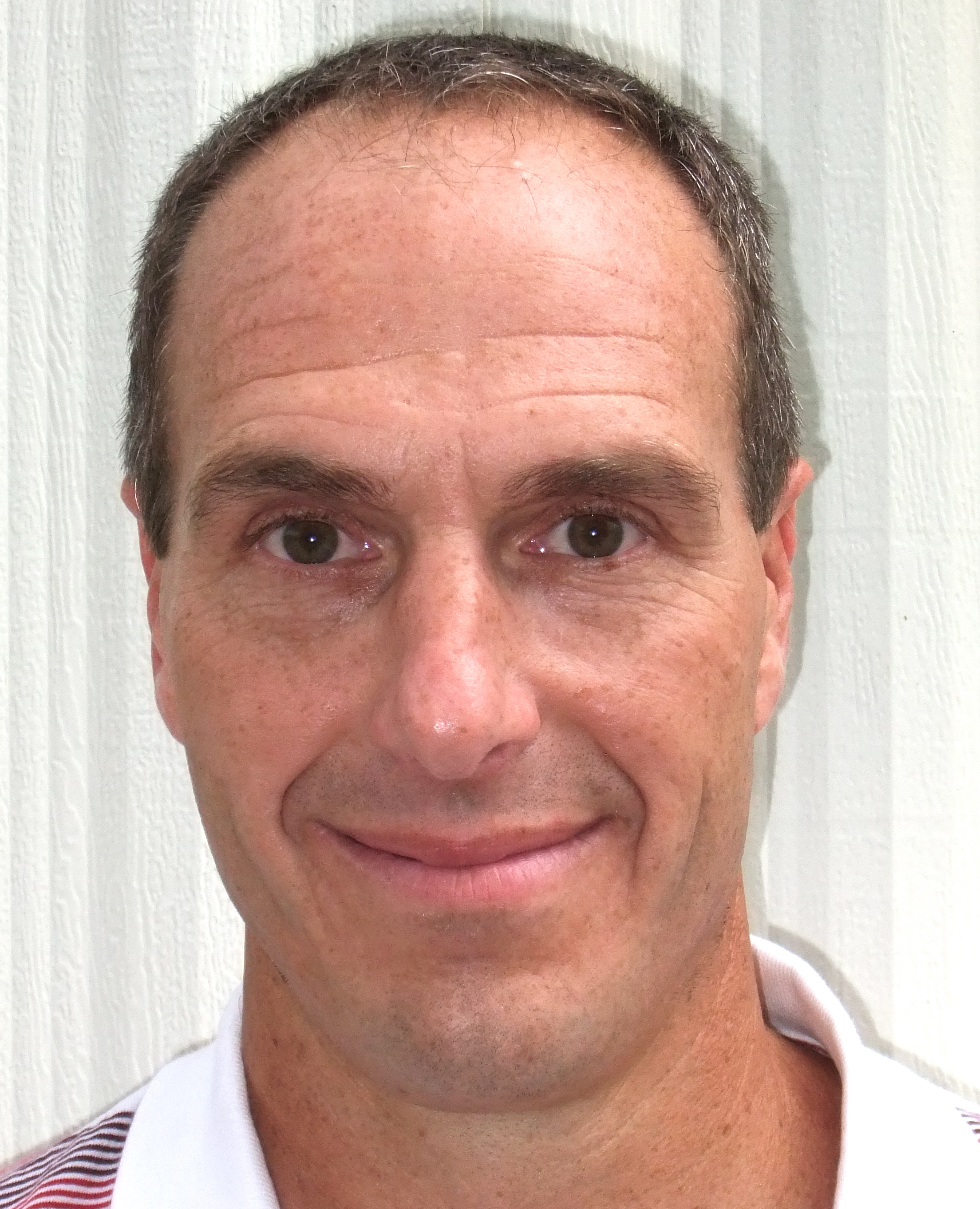
Todd Talarico
Test runs will start in November and continue in December, said Todd Talarico, senior director of industrial process at the production plant.
By January, Talarico projected to have another 40 temporary and permanent employees hired to produce the first 10 million doses of flu vaccine in 30 days.
“We’ll be able to tell whether we’re on track,” Talarico said.
Construction of the plant started in October 2010. Medicago received a $21 million grant from the U.S. Department of Defense to prove it can ramp up production to 10 million doses per month. Alexandria Real Estate, which builds facilities for life science companies, invested $13.5 million. Medicago contributed the remaining $7.5 million.
The plant is one of three built in the past 10 years to make commercial vaccines in North Carolina’s Research Triangle.
New Jersey-based Merck operates a $400 million plant north of Durham that has already undergone one expansion. The $500 million Novartis plant in Holly Springs is projected to start making flu vaccines from cell cultures in 2013. The Triangle is also home to most of North Carolina’s more than two dozen companies in vaccine research and development. (More on the Triangle vaccine hub here and here.)
Unlike Merck, Novartis and Pfizer, which acquired a vaccine plant in Sanford with the purchase of Wyeth in 2009, Medicago will grow its flu vaccine.
Flu vaccines are protein vaccines and proteins can be generated by cells, yeast, bacteria or eggs. Medicago uses a combination of agrobacteria and wild tobacco plants. The technology is the brainchild of Louis-Philippe Vézina, the company’s co-founder and chief scientific officer.
Starting with alfalfa and then switching to nicotiana benthamiana, Vézina was able to coax the plants to make virus-like particles, proteins called hemagglutinin, that prevent flu viruses from binding to and consequently infecting cells.
Hemagglutinin comes in 16 different types, including H1, H2 and H3, which are found on human flu viruses such as the H1N1 virus. H5 is part of the avian flu virus, or H5N1.

Infectious flu virus
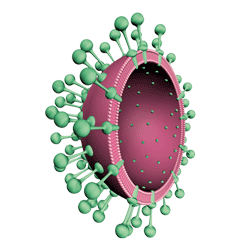
Medicago's non-infectious VLP
The virus-like particle, or VLP, the wild tobacco leaves produce is not an inactivated virus. It does not contain genetic material, is unable to replicate and is non-infectious. But in preclinical studies VLPs produced a strong and broad immune response in mice and ferrets.
In 2010, Medicago researchers published a report detailing the benefits of VLPs and their production in wild tobacco plants.
The company has also tested different vaccines in humans, including one for seasonal flu and one for pandemic avian flu. Results from Phase I and II clinical trials, which involved healthy volunteers, suggested the vaccines were safe and effective.
A lot remains to be done before Medicago can gain regulatory approval to produce vaccine for sale. Larger clinical trials to further test how well the VLPs work and whether they cause any side effects are among the requirements.
One step toward regulatory approval is for Medicago to prove that the plant-based process can crank out 10 million doses of vaccine per month. That would amount to about 120 million doses of single-strain pandemic flu vaccine or 40 million doses of triple-strain seasonal flu vaccine per year, a production capacity that comes close to the about 150 million annual doses of flu vaccine Novartis projected to manufacture at its Holly Springs plant.
Medicago’s approach combines botany, biotech and robots used in the Dutch tulip industry.
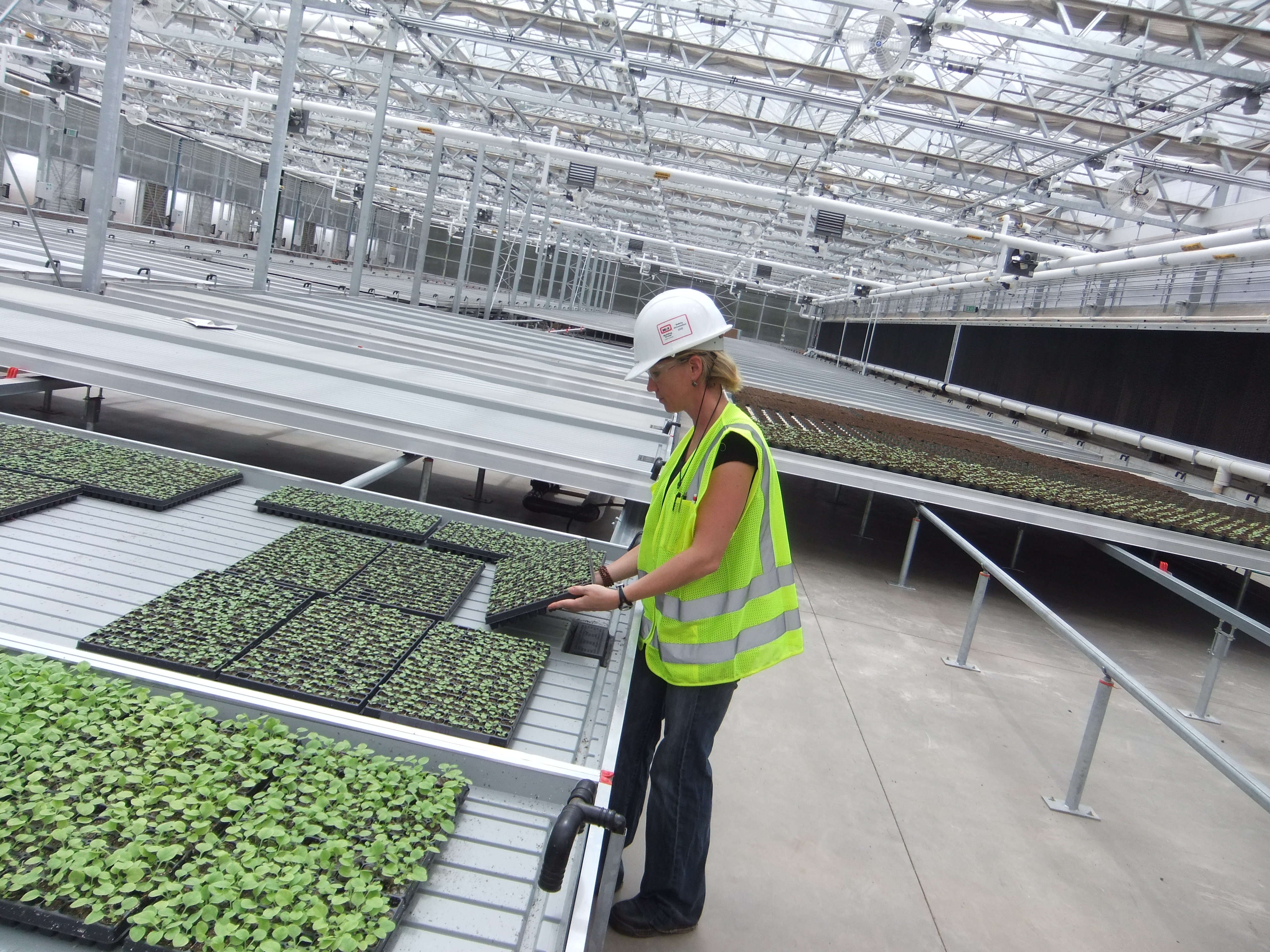
Tanya Blankenship, a greenhouse specialist at Medicago's RTP facility, places a plug tray with 13-day-old wild tobacco plants on a growing table.
Talarico explained the production process during a tour of the greenhouse that will be fully automatic once all the equipment is tested and running smoothly. For now, greenhouse specialists like Tanya Blankenship are doing much of the thinning, transplanting and placing of the plants on large growing tables by hand.
In full operation, the greenhouse will be able to accommodate about 90,000 plants.
Each plant will start as a seed that germinates in a plug tray. When the plants are a few days old, they will begin a two-week trip through the greenhouse.
A robot will transplant each little plant with its plug of dirt into a plastic pot filled with soil. A conveyer belt will transport the pots down the line to get watered and then placed on a growing table.
Lined up one after another, the growing tables will slowly move on rollers through the greenhouse. Machines will make sure the plants get watered and fertilized regularly.
“Nobody has to touch plants,” Talarico said.
When the trip through the greenhouse ends, the potted tobacco plants will be transferred into an enclosed chamber or tank and placed into a solution containing agrobacteria that carry the genetic blueprint to make a particular VLP.
A vacuum will suck the air out of the tank, which will prompt the leaves of the tobacco plants to take up the agrobaceria. This infusion will not alter the genetic makeup of the plant, but within an incubation time of about five days the cells in the leaves will start producing VLPs.
Then, machines will strip the leaves off the stalks, cut them in pieces and placed them into a solution to extract the VLPs.
Medicago already used this process at its R&D facility in Canada to make vaccine for the clinical trials. Now, Talarico said, the company is preparing to repeat the accomplishment at its RTP plant, which has the capacity to produce 25 times more and is 50 percent bigger than originally planned.
RTI to establish biocrude pilot plant in RTP or nearby
Sunday, September 11, 2011, 5:52 pm No Comments | Post a Comment
David Dayton
David Dayton is getting a chance to take the production of biocrude out of the laboratory at RTI International and into a pilot plant.
RTI’s Center for Energy Technology in Research Triangle Park recently received $5 million from the U.S. Department of Energy to bring down the cost of making a crude oil alternative from cellulose-rich biomass, such as wood chips, switch grass or corn stalks, husks and cobs. (More on RTI’s energy research here.)
Scaling up production is also part of the project. Dayton, the biofuels director at RTI’s Center for Energy Technology, plans to establish a pilot plant on RTI’s campus in RTP or nearby to daily convert about 5 kilograms of corn stalks, husks and cobs into biocrude.
The pilot plant is a long way from a commercial biocrude production plant that processes about 2,000 tons of biomass a day. Dayton projected the technology won’t be ready for commercial use before 2020. But, he said, “It’s a step in the right direction.”
To multiply the lab recipe and reduce production costs over the next four years, RTI is getting help from an international crew of technical advisors and collaborators.
Archer Daniels Midland, a Decator, Ill.-based maker of cereals and seed oils, will provide RTI with corn husks, stalks and cobs. The N.C. Biofuels Center will help find additional feedstocks grown in North Carolina, such as wood chips. The Shaw Group, Houston-based engineers who work with the petroleum refining industry, will design the pilot plant.
Most importantly, RTI will get a hand from Haldor Topsøe, a Danish catalyst company, to tweak the biocrude production process and bring down the cost of making and refining biocrude to where the resulting gasoline, diesel or jet fuel could be priced at $3 per gallon to $5 per gallon at the pump.
“Can we get there?” Dayton said. “We’re trying. The proof of concept works, now we have to make something that works commercially.”
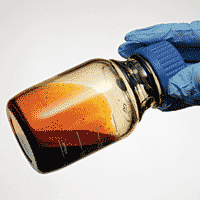
A bottle of biocrude. (Photo courtesy RTI)
He suggested that the crew of technical advisors will give RTI a leg up in developing a biocrude that can reduce U.S. dependence on oil imports. The U.S. imports about 60 percent of the crude oil it consumes. At least two competitors are working on similar projects: KiOR, a Texas-based startup company that raised about $150 million in an initial public offering three months ago, and Honeywell UOP, a technology provider to the oil refinery industry.
Catalytic biomass pyrolysis, the technology used to made biocrude, has roots that go back more than 100 years. It involves heating cellulose under high pressure to break it apart into sugar molecules and parts of sugar molecules. The process is similar to caramelizing. It strips oxygen molecules and leaves hydrocarbons. When it goes too far, it produces carbon.
A catalyst controls and speeds up the process. In the past year, RTI scientists have worked on finding catalysts that help strip more oxygen and make a biocrude whose chemical composition more closely resembles crude.
“Petroleum is basically plant matter that has been sitting under the earth at high pressure and high temperature,” Dayton said. “What we’re doing is recreating what occurs over geologic time in less then a second.”
The problem is, nature has doing a better job stripping the oxygen. Crude has no oxygen in it. Biocrude has 20 percent or less and that makes it more expensive to refine it to gasoline, diesel and jet fuel.
“Our challenge is to reduce the oxygen content as much as possible and maximize the yield,” Dayton said.
Biotech center funds steady, but funding requests are up
Monday, September 5, 2011, 10:04 pm No Comments | Post a CommentThe N.C. Biotechnology Center, a state-funded booster of the research and development enterprise in North Carolina’s Research Triangle, has as much money for grants and loans this fiscal year as a year ago despite a 13 percent budget cut.
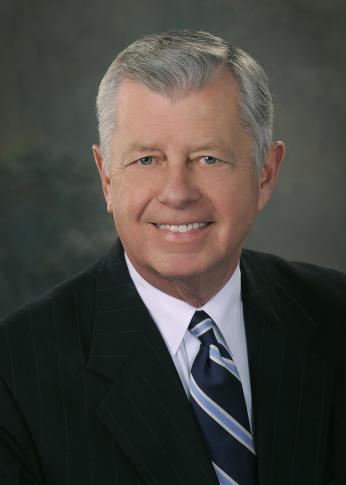
Norris Tolson
Coming up short in tax collections, state legislators approved only $17.5 million for the fiscal year that started July 1, said Norris Tolson, who took over the helm at the biotech center in 2007 after serving six years as state secretary of revenue. But the biotech center made up the difference with about $2.3 million savings that it didn’t have to give back.
“We underspent our budget,” Tolson said about the last fiscal year.
Still, the biotech center will again have to turn down a number of funding requests this year.
Established in 1984 in Research Triangle Park, the state-funded nonprofit has long supported researchers projects on university campuses across the state, paid for equipment, helped recruit companies and university scientists and funded educational activities in K-12 schools, community colleges and museums.
Grants awarded last fiscal years include research grants of up to $75,000 to researchers experimenting with blueberries, fungi and algae to find new treatments for diabetes or to kill cancer cells or viruses. The University of North Carolina bioengineering program at UNC-Chapel Hill and N.C. State University received $195,500 to advance its micromachining capabilities. Duke University received a $145,757 grant to establish an insect transgenesis facility.
The biotech center also earmarked $2.5 million to accelerate development of commercial products from marine biotech research in Eastern North Carolina. (More about the Marine Biotech Center of Innovation here.)
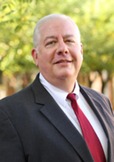
Ken Tindall
About $8.5 million in grants and loans were approved last fiscal year, said Ken Tindall, senior vice president of science and business development.
But demand for funding is up, Tindall said. The biotech center received requests totaling about $13.7 million last year, or about 61 percent more than it approved.
Former GlaxoSmithKline researcher Subba Katamreddy is among those who applied for a loan and got turned down. To start his own drug discovery company, Vijaya Pharmaceuticals, Katamreddy and his wife invested savings and established a lab in the Park Research Center incubator in Research Triangle Park to explore some ideas he had for next-generation antibacterial and anti-inflammatory treatments. (More on Vijaya Pharmaceuticals here.)
“Demand is up across the board,” Tindall said.
Large drugmakers in RTP, like GlaxoSmithKline, are struggling and cutting R&D budgets and jobs like others in the pharmaceutical industry, but the agricultural biotech sector is booming. RTP is home to U.S. headquarters of BASF and Bayer CropScience and Syngenta’s corporate biotech research hub. The area is also a hub for vaccine research and has growing medical device and nanotechnology sectors.


