Posts Tagged ‘climate change’

NCSU scientist chases tornadoes to better understand them
Sunday, October 2, 2011, 10:24 pm No Comments | Post a Comment
Matt Parker
Matt Parker, a N.C. State University associate professor, sounded almost nostalgic when he talked about the more than 700 tornadoes that were reported roaring across the South, Southeast and Midwest in April, about four times as many tornadoes as hit the U.S. during an average April.
Parker is an atmospheric scientist and has studied how tornadoes develop to help improve weather forecasts.
“This was a historic year,” Parker told science writers and educators during a Sept. 27 talk at Sigma Xi in Research Triangle Park.
A spring storm season like this year’s doesn’t come around often. That’s a good thing, considering the loss of life and the devastating destruction the tornadoes wrought.
 April 2011 ranks as the most active tornado month on record, according to the National Oceanic and Atmospheric Association. A storm system that moved across Oklahoma, Arkansas, Mississippi, Alabama, Georgia, North Carolina and Virginia in mid-April killed 43 people, 22 of them in North Carolina. One of the tornadoes it spawned April 16 cut a 180-foot-long track through suburban Wake County, Parker said.
A second storm system at the end of the month was even deadlier. It caused a super outbreak of tornadoes in the South that killed more than 300 people in four days, according to NOAA.
A month later, on May 22, a powerful tornado hit Joplin, Mo., killing 157 people. According to NOAA, the Joplin tornado packed winds of more than 200 miles per hour, it was nearly a mile wide and its track lasted 6 miles.
What about climate change? Could that be a cause for the historic outbreak of tornadoes this year?
“We really don’t know,” Parker said.
A tornado is a mere blip in a 100-year data set that tracks changes in the climate, he said. The increase in the number of reported tornadoes, he added, is likely due to better forecasting and warning systems, a higher population density and the increase in the number of storm chasers.
What was devastating and deadly to the people who lived in the tornados’ way could have provided scientists like Parker with a bevy of otherwise hard-to-come-by data.
In May and June of 2009 and 2010, Parker and his team of students were among about 100 scientists who tracked storms with radar, measured wind speeds, sent up weather balloons and fed the information to a database. The study, called VORTEX2, was one of the largest field studies to determine the origin of tornadoes and a follow-on to a more limited tornado hunt in 1994 and 1995. The teams had about $10 million worth of equipment at hand.
April 2011 was never part of VORTEX2′s data collection phase.
Working with tornadoes is often frustrating, Parker acknowledged. May and June 2009 were two very uneventful months - only two storm systems that generated tornadoes.
“Two thousand ten was much better,” Parker said. “On some days we had the pick of tornadoes.”
About 40 storm systems with the potential to generate a tornado, also known as super cells, and about 20 tornadoes occurred in May and June 2010, he said.
A super cell starts similarly to an ordinary thunderstorm. Warm, moist air rises amidst cooler surroundings and the moisture condensates. In an ordinary thunderstorm, the precipitation creates a cool downdraft that cuts off the warm, moist updraft within about 30 to 45 minutes. The storm dissipates.
A super cell thunderstorm develops when strong upper-level winds allow the warm, moist updraft to continue for up to six hours. The stage is set for the downdraft and the updraft to begin rotating.
But the process that produces a tornado in a super cell thunderstorm is not well understood, Parker said.
For example, strong super cells are not associated with tornadoes, he said. Storms with similar structures may differ in tornado production. And the relationship between near-ground wind fields and structural damage isn’t clear either.
Scientists hope that once the VORTEX2 data is crunched and analyzed and published, some of the questions will be answered, Parker said. Especially head-to-head comparisons of data collected from storms that generated tornadoes and storms that didn’t might be fruitful.
Goals of the VORTEX2 study are to extend the average lead time for tornado warnings from about 13 minutes currently to at least 35 minutes and reduce the false alarm rate, which is currently at about 70 percent.
Tackling the challenges of climate change modeling
Monday, February 21, 2011, 12:44 am 2 Comments | Post a CommentTrue to its mission, the Statistical and Applied Mathematical Sciences Institute in Research Triangle Park took on a tricky data- and model-driven scientific challenge in the first public talk it organized for a lay audience.

Douglas Nychka
SAMSI, a collaboration of the RTP area’s three main universities, the RTP-based National Institute of Statistical Sciences and the National Science Foundation, picked climate change as a topic for the talk on Feb. 15 and invited Douglas Nychka, a leading statistician and climate expert at the National Center for Atmospheric Research in Boulder, Colo., as its inaugural speaker.
Nychka didn’t go into the depths of the criticism that has dogged data-driven climate change modeling for more than a decade and has left most Americans convinced they can’t do anything to change global warming.
Only 18 percent of Americans strongly believe global warming is real, harmful and caused by humans, according to the 2008 American Climate Values Survey.
“This is an argument about cause and effect,” Nychka said.
He did, however, say that it was very difficult to statistically reproduce the global warming trend without including greenhouse gases from fossil fuel consumption. Read more…

Why scientists (should) blog
Tuesday, January 25, 2011, 9:17 am 2 Comments | Post a Comment Last weekend, the Triangle hosted ScienceOnline 2011, a lively annual conference spearheaded by the tireless bloggers Bora Zivkovik and Anton Zuiker. Now in its fifth year, the conference has become so popular that registration for 300 spaces sold out this year in less than a day. The participants, according to the conference website, are “scientists, students, educators, physicians, journalists, librarians, bloggers, programmers and others interested in the way the World Wide Web is changing the way science is communicated, taught and done.”
As a first-time attendee and representative of Science in the Triangle, I divided my time between chasing down interviewees and attending panels, which were organized by participants on an online wiki.
One of those interviewees, Katie Mosher of NC Sea Grant, told me that she’d observed a coming together of science blogging and science journalism in the three years since she’d started attending ScienceOnline. More journalists are using the blog form either to replace or to supplement their print or broadcast stories, she said, some of them writing in traditional journalistic objective form and some of them adopting a point of view. Some of those journalists were present at the conference, just as she sees bloggers now attending conferences hosted by organizations like the National Association of Science Writers.
But journalists appeared to be outnumbered at the conference by scientists who blog (or tweet, or both). As a professional writer who frequently covers science, I should perhaps see these scientist-bloggers as competition. Not at all. To me, they are representative of a welcome trend in academics to communicate with the public about scientific findings and (sometimes controversially) the public policy implications of these findings. A scientist-blogger who writes well (perhaps one who attended the panel by Carl Zimmer and Ed Yong on avoiding obfuscation in science writing) and who knows how to attract an audience can have an immediate impact on public understanding of breaking news, as has been the case with the scientists at Deep-Sea News who covered science surrounding the Gulf oil spill. (Bora Zivkovic explains why scientists are such good explainers.)
A scientist-blogger takes some professional risks. Although I was unable to attend “Perils of Blogging as a Woman under a Real Name,” panelist Kate Clancy provides a detailed writeup here, which alludes to the skepticism with which academic colleagues and tenure and promotion panels view blogging and similar “soft” activities.
A scientist-blogger has to deal with certain downsides of being an online presence, most notably “cranks . . . who come onto our sites and leave comments that foment dissension rather than productive commentary,” according to Rick MacPherson, interim executive director and conservation programs director at the Coral Reef Alliance. It happens wherever evolution or climate change are discussed, he said, and he is the target for negative comments every time he writes or is interviewed about the role of climate change in sea level rise and ocean acidification, both threats to coral reefs.
According to MacPherson, the negative commenters are evidence that the general public doesn’t understand the evidence-based nature of science. “People don’t understand how science works,” he said. “It’s not a democratic process. . . . not opinions.”
His sentiments were echoed in “Lessons from Climategate” by panelist Chris Mooney, coauthor of Unscientific America: How Scientific Illiteracy Threatens our Future, who listed these depressing statistics:
- only 18 percent of Americans know a scientist
- just 13 percent follow science and technology news
- 44 percent can’t name a scientific role model; those who can most frequently name Albert Einstein, Al Gore, and Bill Gates, two of whom are not scientists
- in every five hours of cable news, just one minute is devoted to science and technology
According to Mooney, the situation “is ripe for climate skeptics; they are well-trained, skilled communicators who exploit lack of public knowledge and are willing to fight hard in ways climate scientists are not.” His co-panelist Josh Rosenau, who works to defend the teaching of evolution at the National Center for Science Education, said that the language of the attacks against climate science has an eerie parallel in the attacks against evolution. “For 90 years we’ve been fighting same battle,” he said. “Public opinion has not moved. If that happens to climate change we are doomed.”
Mooney and Rosenau were joined on the panel by Thomas C. Peterson, chief scientist at NOAA’s National Climatic Data Center in Asheville. Peterson was one of the climate scientists whose emails were hacked and published just a few weeks before the 2009 Copenhagen Climate Summit. Although his role in the affair was minor, he was excoriated in blogs (Peterson reminds us that some “science” blogs are unsound scientifically), subjected to harassing calls and emails, and asked by a congressman to produce all emails on the topic (which he did, and which vindicated him). Yet he was still subsequently elected by his peers to be president of the World Meteorological Association’s Commission for Climatology. Clearly, in his professional circles, he is a rock star even if some of the public doesn’t think so.
For Peterson and his co-panelists, the implication is clearly that the public doesn’t understand scientists the way scientists do. Mooney said that the climate emails were taken out of context by people who don’t understand science or scientists. His solution: train “deadly ninjas of science communication”-people who can frame the message and convey science clearly to different constituencies. He wants good communicators to claim the vacancies created when CNN dumped its entire science reporting unit and when daily newspapers gradually reduced their science coverage.
That’s a space that good scientist-bloggers can occupy alongside professional writers: reporting on science from the trenches, bringing scientific research alive, demystifying the scientific method, and unveiling the wealth of unsound science out there.
Notes:
Read my colleague Sabine Vollmer’s post on credibility in science blogging here.
A great resource for finding science blogs is scienceblogging.org.
Seventeen Years of Discovery in Duke Forest
Tuesday, June 1, 2010, 1:22 pm 5 Comments | Post a Comment
Higher concentrations of carbon dioxide are pumped into four of the experimental rings. Photo: Will Owen
Late in 2010, an epic ecological experiment in the Triangle will begin drawing to a close when carbon dioxide stops pumping from four massive rings of towers in the Duke Forest. Since 1996, more than 250 scientists at Duke and dozens of other institutions have measured the response of this forest ecosystem to the elevated amounts of carbon dioxide expected in the Earth’s atmosphere in the future. They’ve measured tree and plant growth, photosynthesis, leaf size, soil composition, root growth, and water use in the plots bathed in elevated carbon dioxide and in three other “ambient” control plots.
The first, prototype ring was built in 1994; six more came in 1996 (three controls and three experiments). Each ring consists of 16 metal towers in a 30-meter diameter. Computer-controlled instruments in the experimental rings bathe the interior of the plot in carbon dioxide. It’s called Free-Air CO2 Enrichment, or FACE. As opposed to “chamber studies,” in which plants are studied in carefully controlled growth chambers or greenhouses, the rings are open to nature. That means that mammals and insects can circulate freely and that natural events like hurricanes, ice storms, and droughts affect the research site. Read more…
RTP researchers help track diseases linked to climate change
Tuesday, April 27, 2010, 8:53 pm No Comments | Post a CommentDuke University researchers suspect climate change is a reason why a deadly new version of a tropical fungus is spreading in the temperate climate of the Pacific Northwest.
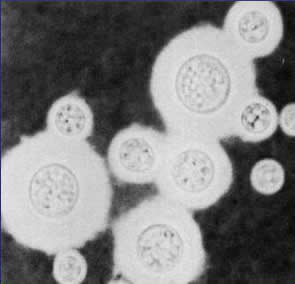
Cryptococcus gattii
In Africa, South America, Southeast Asia and Australia, crytococcus gattii infects eucalyptus trees and bothers people with compromised immune systems, such as HIV/AIDS patients and organ transplant recipients, who inhale its spores. But the strain that was first documented on Vancouver Island, Canada, a decade ago and has now spread to Seattle and Portland causes chest pain, fever, shortness of breath and weight loss in otherwise healthy people and has killed at least six of them.
In February 2007, the first North Carolina case, an otherwise healthy man, was treated at Duke University Medical Center, the Duke researchers reported in PLoS One. In a paper they published a week ago in PLoS Pathogen, the researchers wrote that the cryptococcus gattii strain in the Pacific Northwest was new, much more virulent and favored mammals.
RTI study: The cost of mandatory emissions controls
Thursday, December 10, 2009, 10:03 pm 1 Comment | Post a CommentDuring a week of climate discussions in Copenhagen and Washington, RTI International released results from a study that looks at the costs of mandatory emissions controls.
 The RTI analysis is based on the “Blueprint for Legislative Action,” a plan by the U.S. Climate Action Partnership that includes mandatory reductions of CO2 emissions. The partnership, which is a group of businesses and environmental organizations, recommended emissions reductions of 80 percent to 89 percent by 2020 and a 58 percent by 2030. Read more…

Acid ocean test looks to the past
Thursday, December 3, 2009, 10:03 pm 4 Comments | Post a Comment
UNC marine scientist Justin Ries holds two tropical pencil urchins grown under different seawater acidities. (Photo by Tom Kelindinst, WHOI)
Unlocking causes of past mass extinction events is a nifty – if not controversial – trick. But forecasting the future while also explaining the geologic past is even niftier. And that is just what a new study attempts to do by documenting experimental effects of ocean acidification upon shelled marine invertebrates.
The study, published Dec. 1 in Geology and led by a University of North Carolina scientist, reports a spectrum of positive to negative responses across seven major groups of calcifying marine organisms. It also offers supporting evidence for understanding patterns of past mass extinction — and survival — seen 251 million years ago at the Permian-Triassic boundary. Read more…


