Archive for February, 2011

Obama’s budget proposal affects NC energy, environment
Monday, February 28, 2011, 5:35 pm No Comments | Post a Comment
Graphic breakdown of the President's proposed 2012 fiscal budget. (via New York Times)
President Obama’s fiscal 2012 budget proposal aims to scale back spending in big-ticket areas like defense and homeland security. However, a lot of science and research-related sectors would see a boost in funding.
This stays in line with Obama’s January State of the Union promise for America’s “Sputnik moment” and his call for heightened investment in innovation. It also comes at a great time for North Carolina, which continues to place increasing focus on climate and alternative energy.
Still, not all research and development (R&D) programs would receive equal allotment. Some departments, like the Environmental Protection Agency, would see budget cuts if the president’s proposal passes through Congress.
Here’s a breakdown of how the budget proposal will affect two of the largest science and R&D-related fields: energy and the environment, both on a national and local level:
Energy
National: Clean energy and alternative fuel initiatives would reap a big boost from Obama’s budget pitch. The Department of Energy’s spending budget would climb a total of 12 percent. Discretionary spending would increase almost 40 percent from 2010 to $11.84 billion. That’s roughly $104.18 per household. Measures here would include investments in renewable sources of power like wind and solar—which would jump 70 percent from last year—and the push for all-electric vehicles.
Studies on hydrogen as a clean alternative to fossil fuels will incur significant cuts, losing $70 million. Federal energy assistance to low income homes would also be reduced.
Local: North Carolina will spend a total of $75.9 million on the state energy program, with $20.9 million for energy efficiency and conservation block grants. Within Orange County, grants include installing a new solar heat pump and a high-efficiency hand dryer at the Emergency Services building, improving lighting at Triangle Sportsplex, and adding a solar hot water heater at the Piedmont Food & Agriculture Center. Total project expenditures estimated at $451,350. A $1.4 million grant will go towards energy-efficient agricultural storage equipment.
So what is that money going towards, specifically?
“Right now, it’s solar and wind energy,” said Seth Effron, communications director for the North Carolina Energy Office. “You’re going to see very significant acceleration in the next year and a half.”
Effron said the federal government has just initiated a variety of steps to start leasing offshore sites for the development of wind energy. N.C. Gov. Bev Perdue has created a scientific panel on offshore energy for the eastern part of the state.
“People here are very interested in moving ahead,” said Effron. “Particularly with how it relates to an exploration of offshore petroleum.” He cited a June 2009 UNC study conducted by the General Assembly claiming North Carolina has the best offshore wind resources of any state on east coast.
Right now, almost all the State Energy Office’s budget comes from the Washington-led American Reinvestment and Recovery Act, but that expires in 2012.
Environment
National: As a whole, the president’s budget allocates $6.27 billion for Environmental and Other Defense Activities, down 4.6 percent from 2010. If the White House’s proposal passes, the EPA would lose 3.2 percent of its current research budget.
EPA Administrator Lisa Jackson said the agency will receive $8.97 billion, pending Congress’s approval, in a press conference Monday. More than $1.4 billion will be lost after an all-time high of $10.3 billion in federal funding last year.
Jackson said losses will include cuts to the Great Lakes Restoration Program and so-called “superfunds” which give the agency oversight of environmental repair on federal facilities.
These cuts would be offset in part by additional funding to the Science To Achieve Results (STAR) academic grants program.
Local: In tandem with Obama, Gov. Perdue included substantial reductions to environmental programs in her 2011-2013 budget proposition released Thursday. Among them comes the elimination of 224.5 Department of Environment and Natural Resources (DENR) jobs. Meanwhile, her plan appropriates roughly $180 million over two years to pursue DENR’s outlined 2009-2013 goals: sustaining clean air and water for future, growing a green economy, conserving natural worklands, and responding to climate change.
The EPA has a satellite facility in the Research Triangle Park, but it’s still a limb of the national headquarters, said senior press officer Cathy Milbourn. Milbourn said the budget committee is only now beginning to assess the president’s proposal and how it will affect the agency. She also added that it needs to pass through the House and Senate before anything is set in stone.
Susan Massengale, spokeswoman for NCDENR’s Division of Water Quality, said all environmental agencies have had funding constraints over the last year, and hers is no exception.
“We have very local budget issues with both the governor and the state legislature in town,” said Massengale. “In any case, we’ll use the money we have in the most efficient way and protect the state water quality to the best of our ability.”
Massengale’s division is working to establish a statewide water quality policy and to combat pollution with new wastewater infrastructure.

[Author's note: Wind technology--and specifically its non-immediate drawbacks--will be discussed further in the next article.]

North Carolina’s biotech industry gets wakeup call
Friday, February 25, 2011, 8:44 pm No Comments | Post a CommentBuyers looking for a kitchen appliance, computer or car can turn to a variety of product reviews and ratings, but there’s no version of Consumer Reports that helps physicians or patients with information about which treatments pack the most bang for the buck.
For that matter, in cases where multiple treatments are available, there may not even be any research to see which treatment does better under what circumstances.
Sure, health care providers like Duke University Health System and health insurers like Blue Cross Blue Shield keep extensive medical records to track an allergic reaction to a medication, length of stay in intensive care and other treatment results for each patient. Kaiser Permanente, the largest managed care organization in the U.S., developed a reputation early on for denying coverage of treatments that are not as effective as their cost might suggest. But in general, health insurers and providers don’t use comparative information extensively. They also rarely share the data.

Scott Evangelista
In the United Kingdom, regulators look at how new medicines fare against existing ones in clinical and cost effectiveness before they approve the new medicines for sale.
In the U.S., the standard test to get regulatory approval for a new medicine is a comparison with a placebo, a drug that is designed to do nothing, Scott Evangelista, a Deloitte consultant who lives in Chapel Hill and helps life science companies with tough problems nationwide, told an audience of hundreds this week at the North Carolina Biotech conference in Raleigh.
And when the new medicine passes the test, the drugmaker can claim, “We’re better than the sugar pill,” Evangelista said. The test results provide few clues how effective the new medicine is in a real-world situation.
But the pressure is rising to get the right medicines to the right people at the right time and the right value, he said.
For the more than 500 biotech companies in North Carolina - the majority of them call the Research Triangle area home - this could mean significant changes.
“You have to get your customers involved and you have to listen to things you don’t really want to hear,” Evangelista told the crowd at the conference.
Things like comparing a new drug head-to-head with existing ones, which can end favorably for the competition. Zeroing in on a small group of patients who stand to benefit most from a new drug, thereby limiting the drug’s sales potential. Adding a test to make sure only the patients who benefit from a drug get it, which makes the treatment more expensive and less convenient. Or suspending development of a drug, because it will cost a lot more than existing ones but is only a little bit more effective.
A 2010 report in the Journal of the American Medical Association suggested that of more than 300 studies the top six medical journals published over 15 months in 2008 and 2009, 43 percent included comparisons of different medications. Only 2 percent of the studies analyzed which treatments were better values.
Indeed, of the more than $2 trillion in annual U.S. health expenditures, only an estimated 0.1 percent is spent on researching the comparative effectiveness of medical treatments, according to a 2007 report of the Congressional Budget Office.

Source: Centers for Medicare and Medicaid Services, Office of the Actuary, National Health Statistics Group
The lack of information has contributed to health care costs that have little to do with how well patients do.
Case in point: Blood-pressure lowering drugs.
An 8-year-long study that followed more than 32,000 high-risk Americans age 55 and older found that diuretics were not only superior but also cheaper than newer enzyme inhibitors and calcium-channel blockers, according to outcome results published 2002 in JAMA.
With annual health care expenditures doubling to 16 percent of the U.S. economy in about 30 years and projected to reach 20 percent by 2016, this disconnect between costs and outcomes has insurers, employers and politicians pushing for a change in course.
In the past two years, Congress approved health care reform that stresses patients’ rights, earmarked $1.1 billion for comparative effectiveness research as part of the federal stimulus bill and established the Patient-Centered Outcomes Research Institute to set research priorities, oversee clinical trials and hand out money.
“None of this would be happening if cost wasn’t an issue,” Evangelista said.
Of course, comparative effectiveness isn’t a new concept in U.S. health care. It’s been around for more than 30 years. Two federal institutes to evaluate health care technology have opened and closed since 1978.
But this time around, America is graying - 10,000 baby boomers turn 60 every day, said Deidre Connelly, president of GSK North America Pharmaceuticals and a featured speaker at the biotech conference - treatments for chronic diseases account for an estimated 75 percent of U.S. health care spending and the rapid switch to electronic medical records will make comparative effectiveness analyses easier within a few years.
One Midwest health insurer has already launched its own research arm with plans to analyze its medical records for comparative effectiveness and conduct its own clinical trials, according to a report by CenterWatch, a trade publication that tracks the contract medical research industry.
This time, Evangelista said, “it’s going to happen.”

Triangle gaming hits the airwaves
Friday, February 25, 2011, 1:15 pm 2 Comments | Post a Comment I had a great opportunity a few weeks ago to discuss gaming in the Triangle with Chris Perrien on WXDU, Duke University’s noncommercial radio station (Chris also runs Blue Pane Studio, which created this blog).
His show on Feb. 13, aptly named Science in the Triangle, was the first in a series of interviews he’ll be doing on science and technology in Research Triangle Park.
This has been an exciting field to cover over the last year or so, and I’ve definitely learned a lot about why the Triangle area is the gaming’s industry’s No. 2 spot for production. More than 40 companies and 1,000 employees calling the area home.
Check out the interview in three parts here:
Audio clip: Adobe Flash Player (version 9 or above) is required to play this audio clip. Download the latest version here. You also need to have JavaScript enabled in your browser.
Audio clip: Adobe Flash Player (version 9 or above) is required to play this audio clip. Download the latest version here. You also need to have JavaScript enabled in your browser.
Audio clip: Adobe Flash Player (version 9 or above) is required to play this audio clip. Download the latest version here. You also need to have JavaScript enabled in your browser.
You can also subscribe to WXDU’s podcasts on iTunes.
I mentioned a few resources for people looking to get into the local game industry, including the Triangle Game Initiative. You can also find more information for the upcoming East Coast Game Conference, which runs April 13-14 at the Raleigh Convention Center. For job-seekers, there’s also the International Game Developers Association, a nonprofit professional organization with a Triangle chapter.
Know of more resources for discovering gaming in the Triangle? Add your thoughts in the comments!

From fish to turtles to Facebook to starting a science camp at the age of 12
Wednesday, February 23, 2011, 10:12 pm 1 Comment | Post a CommentEditor’s note: Molly is an example of what can happen when girls are free to explore and supported as science activists - even when that means having a menagerie of 36 fish, salamanders, turtles, dogs, rabbits and other pets at home. She is a seventh grader at Resurrection Lutheran School in Cary and the founder of the Raleigh Aquatic Turtle Adoption. In this guest post, which she wrote with her mother, Molly describes how getting a pet fish led to planning a STEM summer camp at her school this year.
My name is Molly, I am 12 and I created STEM Leadership Camp.

Betta fish come in many colors. This is a green one.
When I was little I wanted tons of pets. My mom said I could have a betta fish if I took really good care of it. So I got Rainbow, who lived for two years. When I was 5, I got my first puppy, Zoe, who is my best friend.
Once we drove by a pond and I saw a turtle. I had seen one in a nature book, so I asked for a turtle. My mom and I looked up what kind of tank they like and where to get one.
Eventually, we adopted two turtles from an owner who couldn’t keep them. We decided to adopt more and realized we needed a permit to have more than four, so my mom applied for one and now we take care of many turtles.We also created Raleigh Aquatic Turtle Adoption (RATA) www.raleighaquaticturtleadoption.com and it has been running since 2006. RATA helps to get new homes for unwanted aquatic pet turtles.
I currently have about 20 fish, including 13 koi, three salamanders, 12 turtles, two dogs, two rabbits, one betta and three moon jellyfish, making a grand total of 36 pets. Read more…
Epic’s Bulletstorm debuts to rave reviews
Tuesday, February 22, 2011, 1:11 pm No Comments | Post a Comment Tackling the challenges of climate change modeling
Monday, February 21, 2011, 12:44 am 2 Comments | Post a CommentTrue to its mission, the Statistical and Applied Mathematical Sciences Institute in Research Triangle Park took on a tricky data- and model-driven scientific challenge in the first public talk it organized for a lay audience.

Douglas Nychka
SAMSI, a collaboration of the RTP area’s three main universities, the RTP-based National Institute of Statistical Sciences and the National Science Foundation, picked climate change as a topic for the talk on Feb. 15 and invited Douglas Nychka, a leading statistician and climate expert at the National Center for Atmospheric Research in Boulder, Colo., as its inaugural speaker.
Nychka didn’t go into the depths of the criticism that has dogged data-driven climate change modeling for more than a decade and has left most Americans convinced they can’t do anything to change global warming.
Only 18 percent of Americans strongly believe global warming is real, harmful and caused by humans, according to the 2008 American Climate Values Survey.
“This is an argument about cause and effect,” Nychka said.
He did, however, say that it was very difficult to statistically reproduce the global warming trend without including greenhouse gases from fossil fuel consumption. Read more…
UNC neuroscientists tackle head trauma issues in football players
Thursday, February 17, 2011, 3:05 pm No Comments | Post a CommentOriginally published: 2/10/11
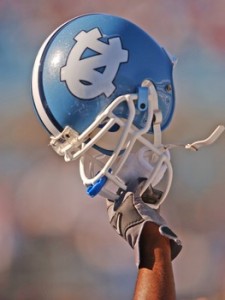 A record 111 million people tuned in for Super Bowl XLV Sunday night, analyzing everything from the agility of the running backs to the facial theatrics of the coaches.
What many likely did not consider is how dangerous the hits and tackles can be to players’ heads. In many cases, it can result in concussions and permanent brain damage.
This is not uncommon, either. In fact, the average UNC football player sustains 950 hits to the head per season, says Dr. Kevin Guskiewicz, chair of the school’s exercise and sports science department. He and fellow neuroscientists at the Matthew A. Gfeller Sport-Related Traumatic Brain Injury Research Center, located on UNC’s campus, are making it easier to monitor high impact head knocks on the field.
This could prove invaluable in learning how long-term exposure to hits can rupture the brain, said Guskiewicz.
What they’re doing, he said, is outfitting players’ helmets with small accelerometers: microsensors no bigger than a dime that measure the severity of the collision. There are six sensors scattered throughout each helmet. They provide instantaneous feedback to computers on the sidelines.
The accelerometers can gauge two forms of movement: linear acceleration and angula, or rotational, acceleration. Linear measures movement within one plane, or unidirectional motion. Rotational measures movement across several planes, generally in more of a diagonal.
“The lay way to describe it is the rate of change,” Guskiewicz said. “How quickly the head accelerates and decelerates upon impact.”
In effect, head collisions cause concussions, which harm brain cells and throw off the balance of ions important to brain function. It hurts, and it leaves its mark; memory can be lost, vision blurred, and blood flow reduced. In some cases, it could end up causing players’ brains to behave like those of Alzheimer’s patients.
Dr. Jason Mihalik, an assistant professor at the Gfeller Research Center, works closely with Guskiewicz on the project. He said there’s still much work to be done before any conclusions can be drawn. One thing that’s safe to say is that concussions come in all shapes, sizes, and severities.
“It’s not necessarily the bigger hits that cause the harshest or most permanent damage,” Mihalik said. “It might be other things like the number of hits. That’s what we’re still trying to figure out.”
However, some positions might be more liable to hard head injuries than others.
“What we do know,” said Guskiewicz. “Is there are more concussions on special teams plays than we see on regular plays. Also, there are more when they’re lowering their heads instead of hitting with the chest.”
The average acceleration of a head collision in football is about 23 gravitational force units (g). The mystery is where the threshold for injury lies. Some sustain concussions at 55g whereas some get up and walk away from blows at 100g.
Jason Freeman is the assistant equipment manager for the UNC football team. He said both offensive and defensive players wear helmets with the sensors. Quarterbacks, tight ends, linemen, safeties— any position can play with them, if they choose.
“It’s really just a comfort thing,” Freeman said. “Less whether they’re physically comfortably, but rather if they’re comfortable wearing them for the study. The players don’t actually feel the sensors at all.”
In total, Guskiewicz said, about 60 to 65 UNC players wear them each season. This is mainly because each unit can cost up to $1,000.
“Obviously we’d love to cover everybody,” he said. “But it’s just too expensive.”
When buying for the team in bulk, however, they’re able to get each unit for much less, somewhere between $350 and $450. A normal helmet costs $182. That money comes from various grant donors, including the Centers for Disease Control and Prevention (CDC) and the National Operating Committee for Standards in Athletic Equipment (NOCSAE).
Virginia Tech was the first school to utilize the sensor technology. The next was UNC, which has been using it since 2004. Other users include Dartmouth and Oklahoma.
Now it’s about to make its professional debut. This fall, the NFL will start outfitting players with collision sensors as part of the ongoing study. This is a big step forward to Guskiewicz, who’s the acting chair of the NFL subcommittee for safety equipment and rule changes.
“We’re looking at a number of issues with helmets,” he said. “We’ll start with trials of several players from different teams, looking at whether rules should be changed to minimize damage to head.”
At UNC, at least, it’s had a positive influence on players’ field strategies. Sometimes, Guskiewicz said, they will pull players aside and show them why lowering the neck or attacking with the crown of the head makes them more liable to long-term damage.
After they watch themselves on videotape, athletes tend to modify their behavior drastically. Also, when players complain of headaches and dizziness, it helps determine if it’s really concussive or simply dehydration.
Global health: What’s in it for the Research Triangle?
Wednesday, February 16, 2011, 5:25 pm No Comments | Post a CommentTravel can spread diseases as seafaring Europeans proved about 500 years ago, delivering smallpox, influenza and the bubonic plague to the Americas and in return bringing syphilis back with them to Europe.
So it shouldn’t come as a surprise that a biotech hot spot like North Carolina’s Research Triangle, where scientists are taking aim at diseases like HIV/AIDS, diabetes and cancer, is also a hub for global health research - an emerging academic discipline that has gained significance as international travel, trade and finance have picked up.
North Carolina’s global health sector supports at least 7,000 jobs, according to a Duke University study that was based on 2007 data and published last year. The sector generates more than $500 million in annual salaries and wages and more than $18 million in annual tax revenue. Most of the jobs are in the Triangle, home to three large universities, multiple research institutes and nonprofits dedicated to boost health and health care and hundreds of businesses involved in research and development.
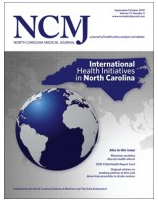
Cover of the North Carolina Medical Journal's latest issue.
The accumulation of brainpower makes the Research Triangle one of the few places in the U.S. where emerging diseases will be researched, medicines to treat them will be developed and programs to improve people’s wellbeing at home and abroad will be established.
“Global health involves highly interdisciplinary and interconnected areas that include human and animal health, medicine, law, engineering, economics, environmental science, agriculture and the social and biological sciences,” as four Duke researchers write in the North Carolina Medical Journal’s latest issue.
Their point of view is part of the NCMJ’s global health forum, which takes up much of the issue.
More than two dozen contributors, including nurses, doctors, community advocates, economists, a veterinarian, a lawyer and a pharmacist, explore what role North Carolina health care professionals and institutions play in global health and the benefits the state is reaping in return.
The forum’s premise follows much the same lessons we learned from the seafaring Europeans: Global health oftentimes is local health.
Today, HIV/AIDS has replaced the bubonic plague. Air travel spreads new influenza strains like H1N1. An obesity epidemic is threatening a rise in diabetes worldwide. Rising temperatures, an effect of global warming, are changing not only growing conditions for plants but also living conditions for animals that carry diseases.
North Carolina is feeling the effects of all these global developments:
- The number of people living with HIV/AIDS in North Carolina and in the Raleigh-Cary area is higher than the national average, according to the U.S. Centers for Disease Control and Prevention.
- Children ages 10 to 17 in North Carolina are among the most obese in the U.S., according to a 2009 report of the N.C. Department of Health and Human Services.
- Chronic disease and infant mortality rates in some eastern North Carolina are comparable to those in developing countries such as Malaysia, Thailand and Nicaragua, according to figures of the N.C. State Center for Health Statistics. The eastern part of the state also faces a particular shortage of health workers.
- North Carolina is getting warmer from the beaches through the Piedmont and across the mountains, according to the Arbor Day Foundation. Since 1990, much of North Carolina has switched from a zone where plants must survive temperatures as low as 0 degrees Fahrenheit to a zone where temperatures don’t dip below 10 degrees Fahrenheit. North Carolina has a long history of tick-borne diseases and research has shown milder winters increase tick-borne encephalitis among humans.
But North Carolina also stands to benefit from the work done in the Research Triangle to address global health issues:
- Researchers at the University of North Carolina at Chapel Hill and Family Health International, a Durham nonprofit, helped test a vaginal gel that contained 1 percent of the Gilead HIV/AIDS drug tenofovir. The test involved South African women and demonstrated that the gel reduced the risk of an HIV infection by up to 59 percent, according to results first published last year.
- RTI International, a research institute in Research Triangle Park, has developed a behavioral program to reduce the likelihood that at-risk women will get infected with HIV. The program is recognized by the CDC and implemented globally and locally.
- The UNC-CH chapter of Engineers without Borders has been involved in improving water quality in communities in Eastern Europe, Latin America and just outside Chapel Hill. Tests in a historically black neighborhood that borders the Orange County landfill showed that nine of 11 wells did not meet federal water quality standards.
- In 2009, UNC and CDC started a program in eastern North Carolina that used global models of mircofinance. It helps women start in business and provides health education.
- Nurses, physicians and dentists educated in India, the Philippines, Nigeria and Columbia are easing the health worker shortage in North Carolina. In the Research Triangle, about 15 percent percent of the physicians, 5.8 percent of nurses and less than 1 percent of dentists were educated outside of the U.S., according to an analysis by a postdoctoral fellow in the UNC School of Nursing that was based on unpublished data from the 2008 North Carolina Professions Data System.
Read all of the contributions to the NCMJ’s global health forum here.
Read here why in 2009 the Research Triangle was the first stop in the U.S. global health revamp.
Text-based game challenges homeless stereotypes
Monday, February 14, 2011, 10:39 am No Comments | Post a Comment
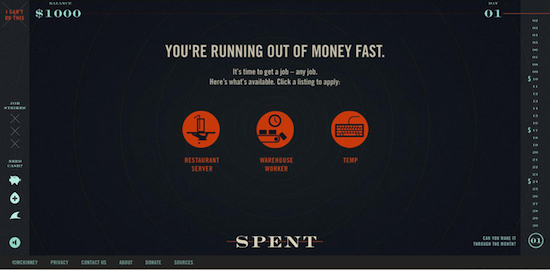
In Spent, players begin by choosing low-paying jobs to get them and their families through the month. | Image courtesy of McKinney
A new game from a Durham nonprofit is raising awareness about homelessness by challenging players to make a quickly dwindling bank account last a month.
Spent, developed by the advertising firm McKinney for Urban Ministries of Durham, puts players in the shoes of a jobless worker forced to make tough decisions about supporting a family with only $1,000 left. The text-based interface, which also employs a social media element, is designed to help users understand the causes of homelessness — and how close some people are to losing everything. Read more…
N.C. below national average in NAEP science scores
Sunday, February 13, 2011, 6:43 pm No Comments | Post a CommentOriginally published: 2/3/11
Kelly Allen teaches biology and chemistry at East Chapel Hill High School. She runs the Science Olympiad program and brings her Science Days seniors’ club to perform live demonstrations at local elementary schools to spark an interest in young minds. But, she recognizes, most students in North Carolina do not get the science opportunities hers do.
“In some instances,” Allen said. “Teachers are told, ‘DO NOT waste your time teaching science. Only teach math and reading.’ It’s really disheartening.”
Allen said this has been an unintentional consequence of No Child Left Behind, the controversial 2002 federal education overhaul which places a heavy emphasis on teaching to standardized K-12 math and reading tests. Other classes, some say, fall by the wayside.
It has long been Allen’s hypothesis that this would take its toll on science test scores. Now, she’s found the data to support her claim. The U.S. Department of Education published this week the results of the 2009 National Assessment of Educational Progress (NAEP) science test, finding less than half the nation’s youth have a ‘proficient’ understanding of science. North Carolina’s percentages were lower than the national average.
According to the N.C. Department of Public Instruction, 30 percent of state students who performed at or above the NAEP proficiency level in 2009. The national percentage was 32. The state had 69 percent at or above a basic level of understanding, compared to 71 percent nationally.
Nick Cabot taught high school physics in Seattle for 15 years. Now he’s at the UNC-Chapel Hill School of Education, teaching how to teach science. Cabot said he recognizes the state is not where it needs to be with regards to science education.
The way he sees it, students aren’t learning scientific thinking or reasoning skills.
“There’s too much emphasis on memorizing factoids,” he said. “But facts are no more science than a bunch of stones are a house. You need a conceptual framework to go with it.”
Cabot suggests more time spent teaching how to form a hypothesis, how to construct an experiment to test it, and how to reach a logical conclusion. Science is relevant to every student’s daily life, he said, and classroom lessons should reflect that.
This is a task DPI is actively undertaking, said Beverly Vance, section chief for K-12 science, curriculum and instruction. She said to expect more hands-on, interactive approaches to science in the future, inside and outside the classroom.
“One thing I’m really excited about is partnering informal education communities such as museums or Cub Scouts with the classrooms,” Vance said. “In class, you learn about ecosystems. In Cub Scouts, you’re out there seeing how an ecosystem works.”
Vance acknowledges the upward hike for science education in North Carolina, but holds high aspirations for the future. She thinks the best way to solve the big problem is to start with the small.
“Our goal is to be number one in the country,” she said. “However, to set a statewide goal, we really need to look at the data and make some target goals based on where they are, region by region.”
To Cabot, it’s more important to use new tactics to activate the students’ motivation. Foremost for him is an embrace of technology, even if the kids are literally playing games.
“I think we could use more video games to teach,” Cabot said. “They put us in that cognitive middle zone between what we can do now and what we can do with a little push. They also provide instant feedback.”
Cabot said he was one of the first science teachers to use technology in the classroom after he talked his school board into giving him $50,000 for Macintosh computers in 1994.
Cabot supports abolishing all standardized tests or at least significantly improving them. Tests, he says, are no good to students if they don’t teach what really matters.
“It’s not important to me that they don’t know a lithium ion has three protons and four neutrons,” Cabot said. “It’s that they don’t know what a legitimate argument is. What evidence is. How to get through their daily lives.”
Allen said she is not opposed to standardized testing, as long as it’s helpful and focuses on more than just math and reading. She even thinks math and science ought to be taught in concert.
“To be competitive in the world,” she said. “We need to have good scientists.”
North Carolina’s NAEP scores came in below 24 other states, better than nine other states, and on par with 13 more. Five states did not participate.
The test was given to fourth, eighth, and twelfth grade students around the country. Unlike many standardized tests, questions were both multiple choice and short-answer explanation boxes. Students were tested on physical, life, and space sciences.


