
RTI to establish biocrude pilot plant in RTP or nearby
Sunday, September 11, 2011, 5:52 pm No Comments | Post a Comment
David Dayton
David Dayton is getting a chance to take the production of biocrude out of the laboratory at RTI International and into a pilot plant.
RTI’s Center for Energy Technology in Research Triangle Park recently received $5 million from the U.S. Department of Energy to bring down the cost of making a crude oil alternative from cellulose-rich biomass, such as wood chips, switch grass or corn stalks, husks and cobs. (More on RTI’s energy research here.)
Scaling up production is also part of the project. Dayton, the biofuels director at RTI’s Center for Energy Technology, plans to establish a pilot plant on RTI’s campus in RTP or nearby to daily convert about 5 kilograms of corn stalks, husks and cobs into biocrude.
The pilot plant is a long way from a commercial biocrude production plant that processes about 2,000 tons of biomass a day. Dayton projected the technology won’t be ready for commercial use before 2020. But, he said, “It’s a step in the right direction.”
To multiply the lab recipe and reduce production costs over the next four years, RTI is getting help from an international crew of technical advisors and collaborators.
Archer Daniels Midland, a Decator, Ill.-based maker of cereals and seed oils, will provide RTI with corn husks, stalks and cobs. The N.C. Biofuels Center will help find additional feedstocks grown in North Carolina, such as wood chips. The Shaw Group, Houston-based engineers who work with the petroleum refining industry, will design the pilot plant.
Most importantly, RTI will get a hand from Haldor Topsøe, a Danish catalyst company, to tweak the biocrude production process and bring down the cost of making and refining biocrude to where the resulting gasoline, diesel or jet fuel could be priced at $3 per gallon to $5 per gallon at the pump.
“Can we get there?” Dayton said. “We’re trying. The proof of concept works, now we have to make something that works commercially.”
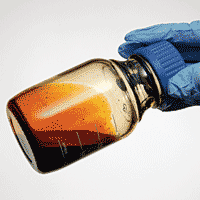
A bottle of biocrude. (Photo courtesy RTI)
He suggested that the crew of technical advisors will give RTI a leg up in developing a biocrude that can reduce U.S. dependence on oil imports. The U.S. imports about 60 percent of the crude oil it consumes. At least two competitors are working on similar projects: KiOR, a Texas-based startup company that raised about $150 million in an initial public offering three months ago, and Honeywell UOP, a technology provider to the oil refinery industry.
Catalytic biomass pyrolysis, the technology used to made biocrude, has roots that go back more than 100 years. It involves heating cellulose under high pressure to break it apart into sugar molecules and parts of sugar molecules. The process is similar to caramelizing. It strips oxygen molecules and leaves hydrocarbons. When it goes too far, it produces carbon.
A catalyst controls and speeds up the process. In the past year, RTI scientists have worked on finding catalysts that help strip more oxygen and make a biocrude whose chemical composition more closely resembles crude.
“Petroleum is basically plant matter that has been sitting under the earth at high pressure and high temperature,” Dayton said. “What we’re doing is recreating what occurs over geologic time in less then a second.”
The problem is, nature has doing a better job stripping the oxygen. Crude has no oxygen in it. Biocrude has 20 percent or less and that makes it more expensive to refine it to gasoline, diesel and jet fuel.
“Our challenge is to reduce the oxygen content as much as possible and maximize the yield,” Dayton said.


