Posts Tagged ‘green technology’

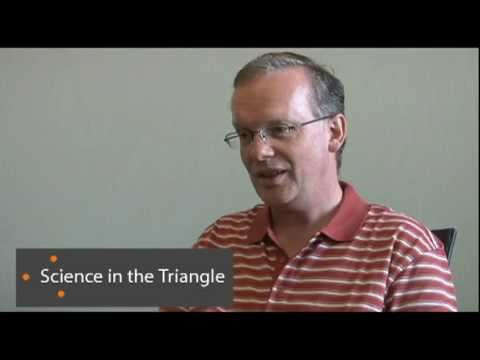
Greener and cleaner: A talk with the director of RTI’s new research center
Saturday, July 23, 2011, 5:43 pm No Comments | Post a CommentAs a molecular biologist, Niels van der Lelie has researched microorganisms in different settings - in cheese making, in cleaning up contaminated water and soil and in growing crops on marginal lands. As the director of RTI International’s newest research center, van der Lelie plans to expand on these experiences and help develop technologies that aim at being greener and cleaner.
The Center for Agricultural and Environmental Biotechnology will be operational on RTI’s campus in Research Triangle Park in about two months. Initially, about 15 researchers will work at the center. Construction of a greenhouse, measuring 3,000 square feet to 4,000 square feet, is planned, with room for expansions.
Within a year, the number of researchers working for the center is projected to double to 30 and Lelie plans to establish a computational biology group.
The center will target research that deals with beneficial microorganisms that help clean up persistent contamination and digest municipal or animal wastes into biofuels, as well as with harmful microorganisms, such as bacteria that cause food-borne illnesses. The center also wants to work on making crop plants more drought resistant and produce better tasting. And it will look into domesticating medicinal plants, so natural resources can be protected.
Lelie expects the work to come from government research contracts and collaborations with industry. He has good chances of finding potential research and business partners in or near RTP. North Carolina’s Research Triangle is a hub for agricultural biotechnology. Companies such as Bayer CropScience, Syngenta and BASF CropScience have operations here. (More about agricultural biotech in the RTP area here.)
Lelie talked to Science in the Triangle about setting up the center and getting started:

Unleashing the power of 1100 suns
Friday, December 17, 2010, 2:19 pm No Comments | Post a Comment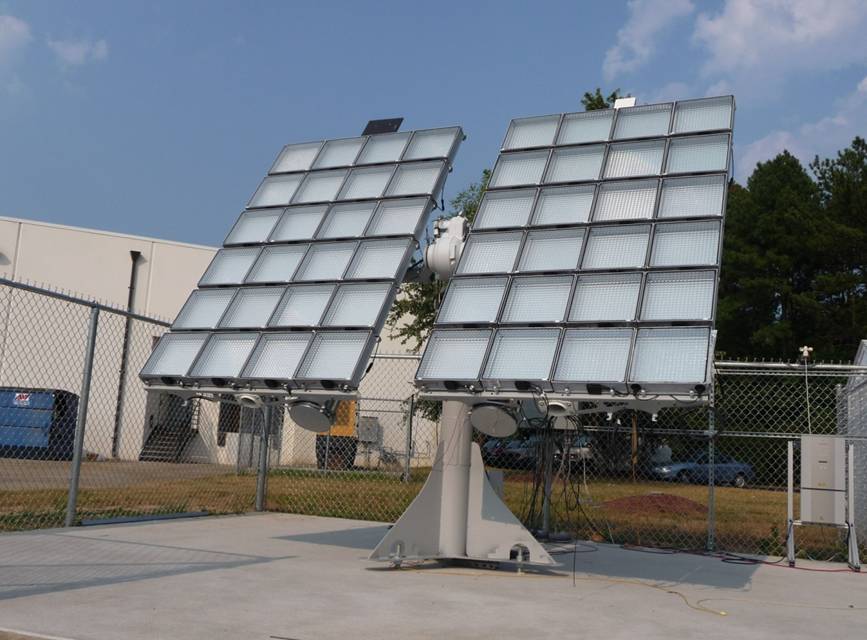
An array using high-concentration photovoltaics from Semprius, Inc.
A year or so ago, Joseph Carr found himself on an elevator with a man wearing a Siemens polo shirt. Having once worked for a division of Siemens, Carr introduced himself as the CEO of Semprius, Inc., a company that makes very high-efficiency solar modules. At the end of a fourteen-floor ascent, the two men exchanged business cards. Within months, Semprius and Siemens announced a joint development agreement.
Yes, a true “elevator pitch” success story.
A Conversation with Dr. Robert Koger of Advanced Energy
Monday, September 20, 2010, 7:04 am 1 Comment | Post a Comment
Dr. Robert Koger
Dr. Robert Koger is president and executive director of Advanced Energy, a nonprofit organization established by the North Carolina Utilities Commission in 1980 to forestall electrical rate increases by promoting energy conservation and alternative and renewable sources of electricity. Advanced Energy provides services that focus on energy efficiency for commercial and industrial markets, electric motors and drives, plug-in transportation, and applied building science.
Advanced Energy also operates NC GreenPower, a program funded through consumers’ voluntary contributions, designed to increase the amount of renewable energy put on the electric grid in North Carolina and to mitigate greenhouse gas emissions.
This month, Dr. Koger assumes the chairmanship of Triangle Area Research Directors Council (TARDC), a group of science and technology leaders from local companies, nonprofits, and universities. The group meets over lunch monthly from September to May, to exchange ideas and information and to hear from guest speakers. TARDC’s first meeting under Dr. Koger’s leadership will be September 21, and the guest speaker will be Mr. Joe Freddoso, president and CEO of MCNC/NC STEM. Non-members of TARDC can attend the luncheons.
I recently asked Dr. Koger about the history of Advanced Energy and about his leadership of TARDC. Read more…
“Power Plants” on North Carolina’s Roadsides
Monday, September 13, 2010, 9:46 am 1 Comment | Post a CommentLike many farmers, Ted Sherrod double-crops, growing canola in the winter on the same land where he harvested sunflowers or safflower grown during the summer. But Sherrod’s “farms” are stretches of roadside or median across the state, and his crops are part of an innovative experiment designed to produce biodiesel for N.C. Department of Transportation vehicles.
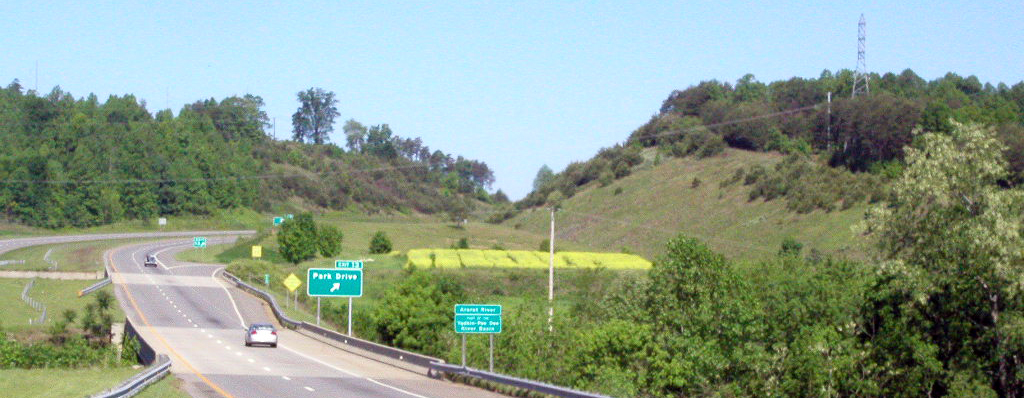
Biofuel crops on a roadside near Raleigh. Photo: NCDOT
RTI broadens energy research with federal greenbacks
Wednesday, July 14, 2010, 8:54 am 1 Comment | Post a CommentTechnologies that promise to lower greenhouse gas emissions and demand for U.S. oil imports are becoming more prominent on RTI International’s research smorgasbord, which has featured efforts in a related field, air pollution monitoring, as a reliable staple for the past 30 years.
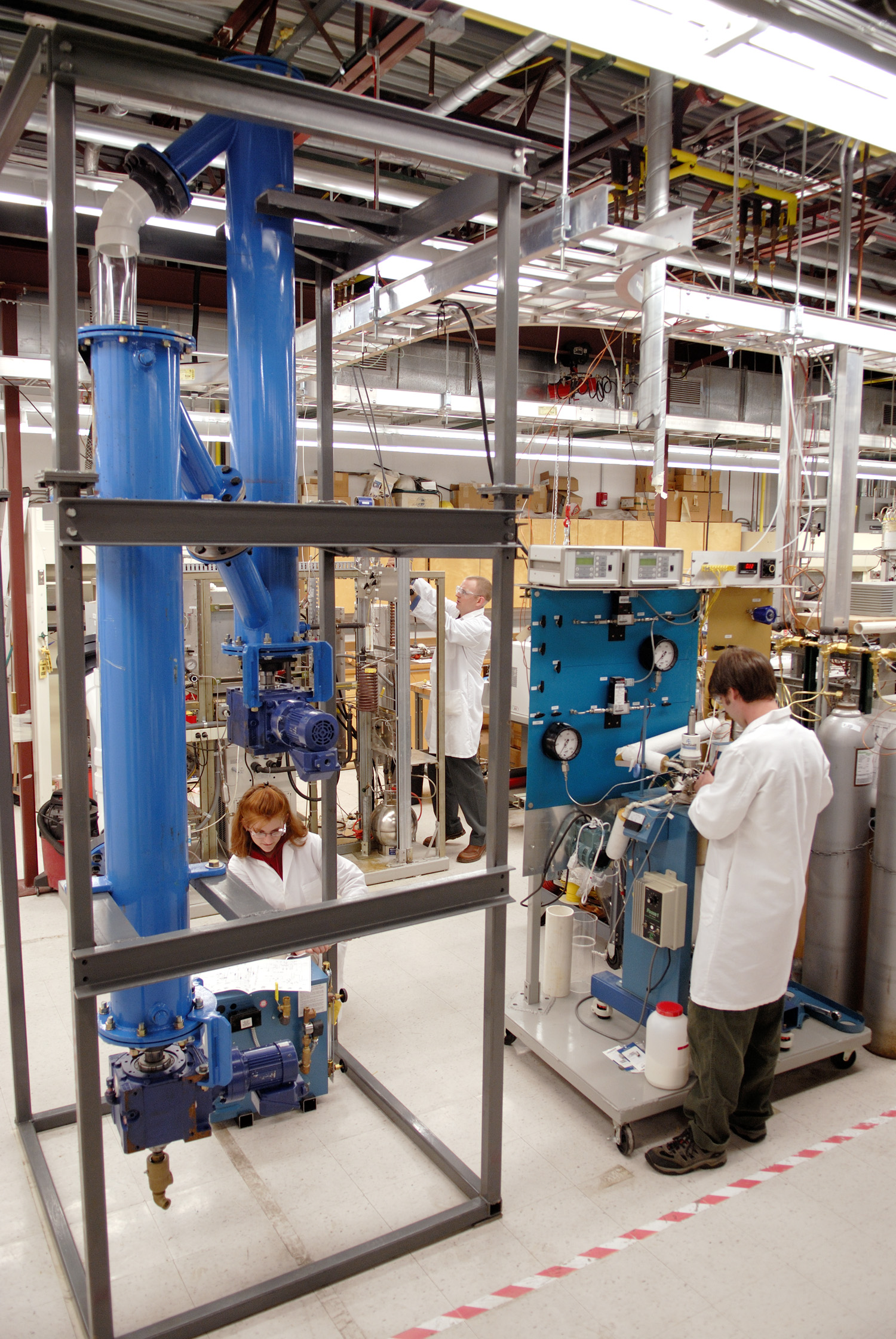
RTI energy lab (Photo courtesy of RTI)
One of the founding members of the Research Triangle Energy Consortium three years ago, RTI has scientists working on projects that include the capture and reuse of carbon dioxide - the most prominent greenhouse gas in the Earth’s atmosphere - production of bio-crude from organic waste and a nanotechnology light bulb that promises to be more energy efficient than a fluorescent light and doesn’t contain harmful mercury.
Stimulus funds the U.S. Department of Energy has awarded in the past year to help the economy recover fueled RTI’s stepped-up energy research. Of the institute’s $750 million in estimated revenue this year, energy research will contribute about $12.5 million, said RTI spokesman Patrick Gibbons.

Serious Gaming at Sigma Xi
Sunday, May 30, 2010, 10:33 pm No Comments | Post a CommentLast week I went to this season’s last American Scientist pizza lunch at Sigma Xi featuring Phaedra Boinodiris (Twitter, blog), Serious Games Product Manager at IBM.
I first saw Phaedra Boinodiris speak as the opening speaker at TEDxRTP (my review) back in March, but this was a different kind of talk, geared more towards scientists and science communicators.
I remember playing Pong when it first came out. I remember spending many hours back in 1980 or so playing The Hobbit on Sinclair ZX Spectrum. And I played many games at arcades (still not knowing which games started out as arcade games adapted to computers and which the other way round). Then I quit playing games for a couple of decades until my kids were ready for them. I loved Zoombinis - an amazing game of logic and a brilliant preparation for taking IQ tests! I loved Richard Scarry’s Busytown - the one and only game I know about infrastructure, where players build stuff and deliver it to others for the good of the town - from baking bread to paving roads - learning along the way how those things are done.
And sure, Phaedra Boinodiris started with a slide depicting Pong (to the chuckle of the audience) but soon got into the real stuff - the serious gaming and the story of how she got involved in developing such games, as well as about studies of gaming and how different kinds of games help develop different real-work skills, from eye-hand coordination to leadership to cooperation. Her first game - INNOV8 - was developed as a prototype, a proof of concept, in only three months and instantly became a huge hit. It is used by businesses and business schools around the world to teach Business Process Management. It is essentially a first person shooter game (without guns) in which the player is brought as an outside consultant into a company where s/he has to figure out the flow, the bottlenecks, etc. (including by interviewing employees, as well as data-sheets) and experiment in making it more efficient. The 2.0 version came soon after, adding such problems as traffic, customer service and supply chains.
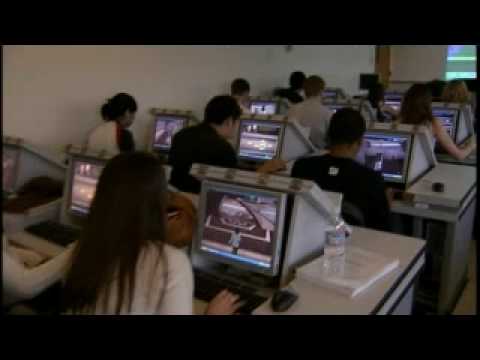
The next game, recently announced and coming out in October 2010, will be a Sim-City-like serious game CityOne, designed to help city planners, town councils, citizens, and engineers plan better, more efficient infrastructure for their cities. Put in your city’s specs and start building new infrastructure, see how much it will cost, see what problems will arise, see what solutions are available - probably something you could not have thought of yourself and may be surprised.
As I am currently reading ‘On The Grid’ it occured to me that the developers of CityOne should read that book, and that Scott Huler should be given a test-run of the game, perhaps for him to review for Charlotte Observer and Raleigh News&Observer and the local NPR station. And for Science In The Triangle, of course.
Scott Huler - ‘On The Grid’ at Quail Ridge Books
Thursday, May 27, 2010, 4:16 pm 4 Comments | Post a Comment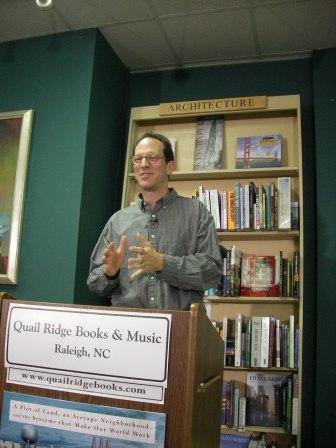 As I alerted you before, last night Scott Huler (blog, Twitter, SIT interview) did a reading from his latest book On The Grid (amazon.com) at the Quail Ridge Books in Raleigh.
The store was packed. The store sold out all the books before Scott was even done talking. The C-Span Book TV crew was there filming so the event will be on TV some day soon. Scott was also, earlier yesterday, on WUNC’s The State Of Things (the podcast will soon be online here) and the day before that he was on KERA’s Think with Krys Boyd (download MP3 podcast by clicking here).
Scott’s energy and enthusiasm are infectuos. He held the audience captive and often laughing. The questions at the end were smart and his answers perfectly on target. But most importantly, we all learned a lot last night. I think of myself as a reasonably curious and informed person, and I have visited at least a couple of infrastructure plants, but almost every anecdote and every little tidbit of information were new to me. Scott’s point - that we don’t know almost anything about infrastructure - was thus proven to me.
NCSU engineering students unveil their EcoCAR
Saturday, May 1, 2010, 7:05 pm No Comments | Post a CommentN.C. State University engineering students participating in the national EcoCAR Challenge for the first time Saturday showed off their entry: A Saturn Vue that runs up to 65 miles on electricity.
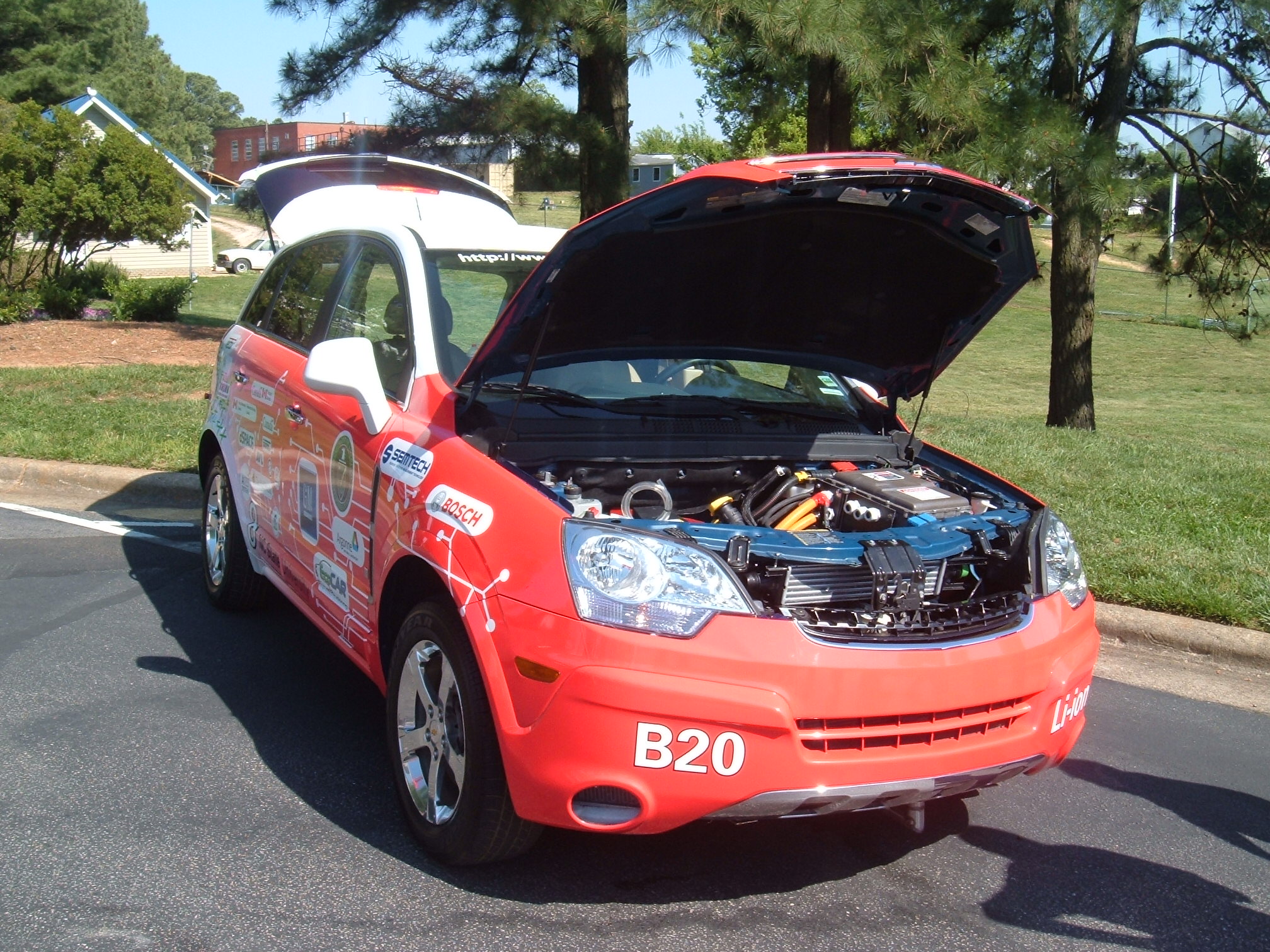
NCSU's EcoCAR
To reduce greenhouse gas emissions and fossil fuel consumption, the NCSU team installed a large lithium-ion battery pack behind the front seats of the crossover SUV. Up front is a diesel engine from an Opel Corsa, a European fuel-sipper, to power the wheels on longer-distance drives.
The NCSU team had less than six months to take the vehicle apart to where only a blue shell remained and rebuild it to specifications they had determined the previous school year.
On May 8, a carrier will pick up the car and take it to the General Motors Desert Proving Ground in Yuma, Ariz., where less than two weeks later it will be judged in more than a dozen technical events against entries of 15 other teams from Canadian and U.S. universities. Read more…
RTP Wrapup 2/19
Thursday, February 18, 2010, 11:18 pm No Comments | Post a CommentNovozymes says it has figured out how to make cellulosic ethanol possible that costs about the same as gasoline, GlaxoSmithKline’s restless leg drug raises safety concerns and the Hamner Institutes team up with a leading cancer cluster in Oslo, Norway. Read more…
RTP Weekahead 1/25
Monday, January 25, 2010, 12:09 am No Comments | Post a CommentEvents taking place the week of Jan. 25 in the Research Triangle area that are open to the public: Read more…


