Archive for April, 2010

RTP researchers help track diseases linked to climate change
Tuesday, April 27, 2010, 8:53 pm No Comments | Post a CommentDuke University researchers suspect climate change is a reason why a deadly new version of a tropical fungus is spreading in the temperate climate of the Pacific Northwest.

Cryptococcus gattii
In Africa, South America, Southeast Asia and Australia, crytococcus gattii infects eucalyptus trees and bothers people with compromised immune systems, such as HIV/AIDS patients and organ transplant recipients, who inhale its spores. But the strain that was first documented on Vancouver Island, Canada, a decade ago and has now spread to Seattle and Portland causes chest pain, fever, shortness of breath and weight loss in otherwise healthy people and has killed at least six of them.
In February 2007, the first North Carolina case, an otherwise healthy man, was treated at Duke University Medical Center, the Duke researchers reported in PLoS One. In a paper they published a week ago in PLoS Pathogen, the researchers wrote that the cryptococcus gattii strain in the Pacific Northwest was new, much more virulent and favored mammals.

IntraHealth - a focus on health care worldwide
Sunday, April 25, 2010, 10:46 am No Comments | Post a CommentIntraHealth International is a nongovernmental organization that works to make it easier for people to access high quality health care throughout the developing world. IntraHealth is based in Chapel Hill, with offices and programs in Africa, Latin America, Asia, and the Middle East.
On Thursday, April 22, IntraHealth celebrated its 30th anniversary. I spoke with Laura Hoemeke, IntraHealth’s director of strategic communications, about IntraHealth’s work and the challenges in providing health care in the developing world.
What are the problems that people working in health care face in the developing world?
Many health care problems faced in the developing world are the same issues faced throughout the world. People want access to good, affordable care, whether it’s for themselves, their children, or their parents. Health workers want access to the necessary knowledge, skills and materials to do a good job—and education to continue learning.
Much of our IntraHealth’s work focuses on basic family health care, or maternal and child care, which are very important issues around the world. Another interesting issue that everyone is looking at in the developing world is the emergence of chronic diseases, which we’ve traditionally associated with developed countries, but that are also becoming an issue throughout the world as people live longer and the population ages.
New technologies are also an issue. These can be as simple as a tool that allows a one-time injection that can be used for family planning, insulin injections, or other purposes. These are very simple things that because of either price issues or access haven’t gotten out. We think of technology that supports health workers will also have an impact in the future. For example, having a health worker do an online course to get education, or use technology to allow a health system better track data, so that not only a regional health system, but individual health workers, can use that data.
Can you define the term “health worker”? Why do you use this term rather than say, “doctors and nurses”?
For us, the term describes anyone who’s offering health care, or supporting the overall health system. In the states you don’t’ really say “I’ve got an appointment with my health care worker.” But worldwide a lot of health care is given not only by doctors and nurses, but by a whole cadre of health care workers. For us this term include doctors and nurses, but also technicians, hospital directors, or community health workers, who in many countries who are very vital in getting health care out to where people live.
What sort of projects is IntraHealth working on at the moment?
Our largest project is Capacity Plus. It’s a global project, supported by the U.S. government, that supports and strengthens health workers. This will include looking at things like planning for what a country needs in terms of its work force, strategies for motivating and maintaining health workers, and motivating and training health care workers.
We’re working on making a lasting difference. Training, for example, shouldn’t be a one-shot deal. We’d rather see training as continuing education, or something that helps each health worker better fit into the system where he or she is working.
So this project includes helping health workers develop planning, or help figure out not only how many doctors and nurses a country needs, but also find out what the performance of those health workers and how can that performance be optimized. We’re also doing lots of work with technology.
IntraHealth’s mission focuses on providing “sustainable and accessible” health care. Can you tell me why these issues are important in the developing world?
The word “accessible” means different things to different people. But for us, it means that health care should be there and be of good quality. I think too that this fits in with a broadening definition of what a health care worker is. In some countries, especially in rural areas, there aren’t hospitals or doctors that people are able to get to. So if you don’t bring health care closer to where people live and are, it isn’t accessible.
Making health care accessible also has connotations related to specific services and finances. So it can mean figuring out what services are that people need figuring out what people can pay and health care. In Rwanda, for example, we were very involved in supporting the country’s nationwide health care program called mutuelles. This program lets people buy a membership card every year, and that gives them access to a certain number of services. It’s been really successful, and in many areas, almost 90% of people are covered. That financial barrier is gone, so people aren’t afraid to go to the hospital when they are sick.
Making health care “sustainable” really plays on our desire to work with country governments to make sure that our health efforts and improvements have lasting benefits, rather than going away once our work ends. We work to ensure that whatever technologies or systems we have are developed in collaboration with a country’s ministry of health and that they then become part of that country’s policy framework. If you don’t do this kind of work with a local governments and in-country partners, none of it will be sustainable in the long run.
Read IntraHealth Global Health blog and follow IntraHealth on Twitter.

RTP Week Ahead
Sunday, April 25, 2010, 1:00 am No Comments | Post a CommentTuesday, April 27
XQuery Meetup for WWW2010 Future Web
7-11 PM
Solas, Raleigh
Duke University Immunology Seminar Series
4-5PM
Duke University, Edwin L Jones Building Room 143
Wednesday, April 28
The Future of the Web Conference (April 28-30)
Chapel Hill Bloggers Meetup
6:30-9:30 PM
Milltown Bar and Restaurant, 307 E Main St, Carrboro NC
Thursday, April 29
Carolina Innovations Seminar: What are the attributes of a good scientific founder?
5:30-6:30 PM
014 Sitterson Hall, UNC Chapel Hill
Friday, April 30
Emerging Tar Heel Leaders: Final Friday
Durham - Katherine Skinner, NC State Director for the Nature Conservancy
Raleigh - Amy Fulk, Chief of Staff to NC Senate Pro Tempore Marc Basnight
For a detailed listing of regional events and programs, please visit the Science in the Triangle calendar.
Regenerative medicine: Taking lessons from salamanders
Wednesday, April 21, 2010, 9:30 pm No Comments | Post a CommentDr. Anthony Atala likes to start his talks with a time-lapse video of a salamander regrowing an injured limb over two weeks. Then, the director of the Wake Forest Institute for Regenerative Medicine asks his listeners to imagine humans regenerating limbs, tissue or organs that have been damaged or are missing.
“Salamanders can regenerate. Why can’t we?,” Atala asked during a TEDMed talk last fall.
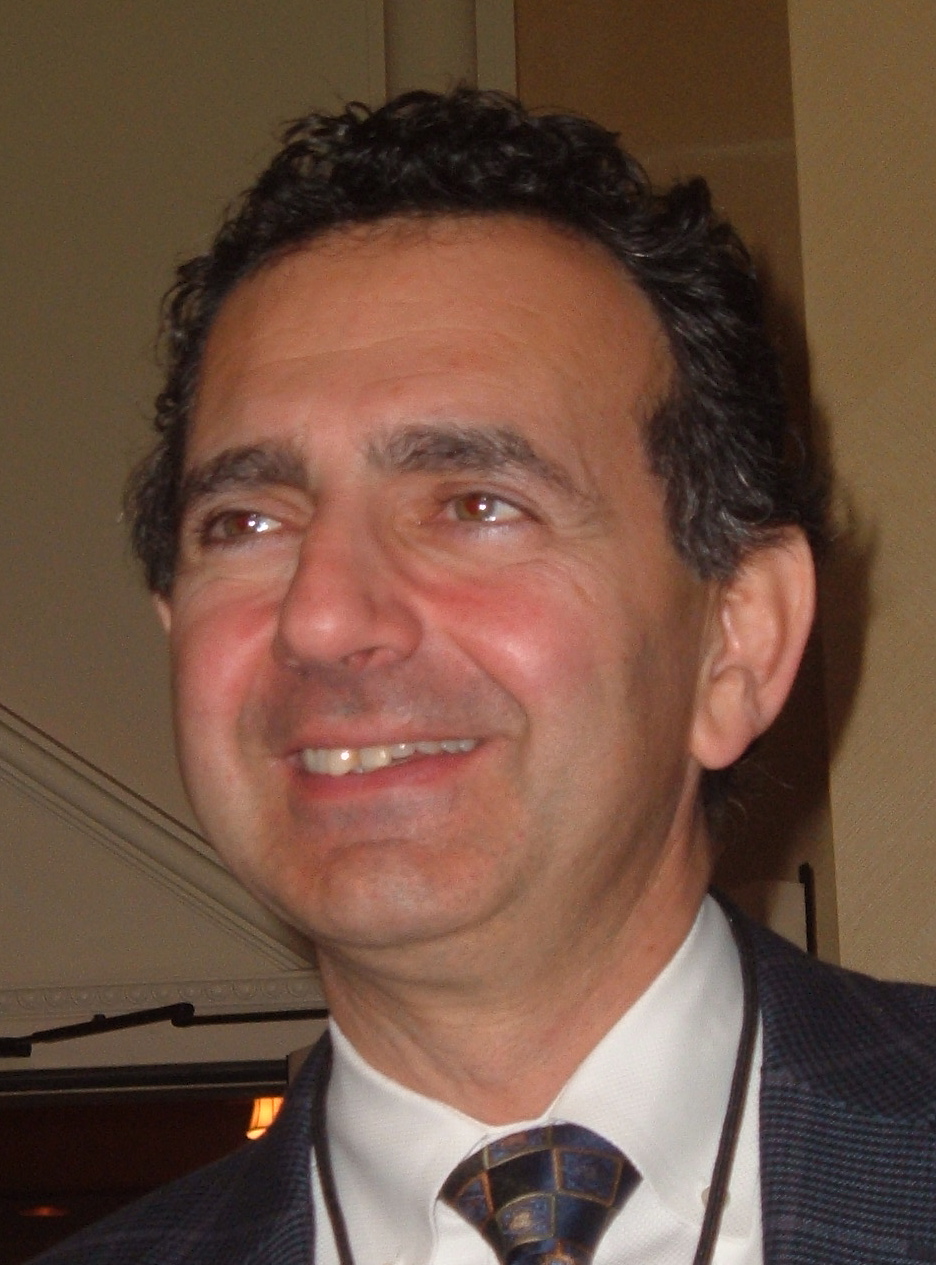
Dr. Anthony Atala
Actually, we can and we do, he responded Tuesday during a presentation at Research Triangle Park headquarters, where he had traveled from Winston-Salem to talk at the TARDC luncheon. “It’s real,” he said.
The human body replaces bones every 10 years, skin every two weeks and intestinal tissue every six days. Regenerative medicine taps into the body’s ability to regrow tissue, expands on it and speeds it up in the laboratory. Read more…

Homegrown innovation: MegaWatt Solar
Monday, April 19, 2010, 10:28 am 1 Comment | Post a Comment
A concentrated photovoltaic "solar tree" designed by MegaWatt Solar. (Image from MegaWatt Solar web site.)
I recently wrote a two-part post here reporting on a forum in Research Triangle Park which focused on barriers to homegrown global business innovation in the Triangle and in North Carolina. While contemplating the themes of the forum, and skimming today’s science news, I stumbled across this article in Popular Mechanics magazine which looks into the advances in concentrated photovoltaics over the past few years — and leads with the example of MegaWatt Solar, a renewable energy start-up in our own backyard. The company was formed by three professors at the University of North Carolina at Chapel Hill who seek to create utility-scaled concentrated photovoltaic systems to supplement fossil fuels-based energy production. (They’ve also been featured in UNC’s Endeavors research magazine, and have landed a story or two in the News & Observer, no longer available in their web archives.)
It struck me that MegaWatt Solar is a good example of the applied research that our area universities can generate to solve real-world problems, and also of the links that can be established between professors with marketable ideas and business-savvy entrepreneurs that can help carry the ideas from the research bench to the bank. Their story is truly one of homegrown innovation, though to be fair they are still in the pilot study phase and working out some kinks.
Because I’ve already written this story, I’m not going to write it again… Below is a reprint of the cover story article I penned about the people behind MegaWatt Solar, and their mission, for the fall 2009 issue of UNC College of Arts & Sciences magazine. It is reprinted here with full permission from the editors.
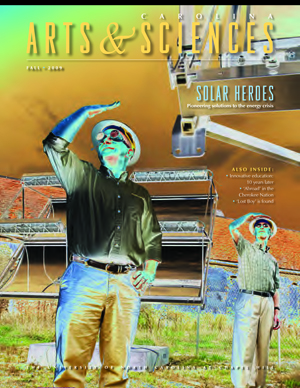
UNC Arts & Science cover, fall 2009, with MegaWatt Solar founders.
The Power of 20 Suns
MegaWatt Solar is a small start-up energy company in Hillsborough, N.C., backed by $17 million from Norwegian venture capitalists and mentally powered by three researchers in UNC’s College of Arts and Sciences. Tucked away in a brick textile-mill-turned-office-park, the company is poised to bring a new concentrated photovoltaic system to market that could provide the cheapest large-scale renewable source of electricity available anywhere.
But they didn’t design it for your home. They designed it for your utility company, to offset peak energy demand, which tends to coincide with the sunniest portions of the solar day. The term MegaWatt describes their goal of producing one megawatt of electricity from over a thousand solar “trees” spread across about 10 acres. The solar trees rotate on a dual axis mount that tracks the sun across the sky vault. One megawatt of electricity — one million watts — is enough to power about 800 homes.
MegaWatt Solar was founded by astrophysicist Chris Clemens, theoretical physicist Charles Evans, computer scientist Russ Taylor and a private sector power-grid systems engineer, Dan Gregory. They built their alpha version in spring 2006 in Evans’ driveway from what he describes as “an aluminum erector set for adults,” with parts bought off E-Bay, cheap advertising signboard and a highly reflective material scavenged from the interior of a Solotube skylight.
The best part? It worked.
“Boy, it was bright, “Evans said. “Everyone ran to get their sunglasses.”
They measured its electrical output and knew they were on to something red hot. Read more…
RTP Week Ahead
Monday, April 19, 2010, 8:41 am No Comments | Post a CommentTuesday, April 20
Making your Green Business Stand Out
6:00-9:00 PM
Durham Tech Small Business Center
No RSVP required, free.
American Scientist Pizza Lunch
12:00-1:30 PM
RSVP required: cclabby@amsci.org
Triangle Area Research Directors Council (TARDC)
12:00-1:30 PM
RTP Headquarters, 12 Davis Drive, RTP
RSVP required: rousseau@rtp.org and $35 fee
Thursday, April 22
Triangle Global Health Consortium: Leveraging the essential role and resource of US global health policy
7:30-9:00 AM
NC Biotechnology Center Congressional Conference Room, RTP
RSVP required: nicole.fouche@triangleglobalhealth.org
National Humanities Center Lecture: Do you have a will?
5:00-6:30 PM
National Humanities Center, 7 TW Alexander Drive, RTP
Intrahealth International’s “Global Voices”
6:00-8:00 PM
FedEx Global Education Center, 301 Pittsboro Street, Chapel Hill
RSVP to vherrington@intrahealth.org
Friday, April 23
Creative Capital Information Session
5:30-7:30 PM
Durham Arts Council, 120 Morris Street, Durham
No RSVP required, free.
Please visit the Science in the Triangle calendar of events to view a full listing of this week’s events in the RTP and Research Triangle region.
Wanted: Global innovation (part 2)
Saturday, April 17, 2010, 12:13 pm 1 Comment | Post a Comment… Continued from Part I of this two-part series:
While it would be impossible to separate the global from the state-level issues discussed at the forum, some of the local business people offered examples for specific challenges to innovation that they faced.
Alexander Macris is the president of Themis Group which is based in Durham, N.C. and is a strong example of the power of a science park like RTP to attract additional tech-based businesses to the region. Macris said that the Triangle region is one of the largest concentrations of gaming companies in the U.S. Most of the innovation potential in gaming is at the gaming engine and software level, he said, and the average median income of someone in the gaming industry is about $75,000. He expects to see about 300 to 400 new gaming-related jobs in the area over the next three to five years, he said, because the industry is growing in the double digits. But at the same time, the cost of game development is going up – whereas a decade ago it may have cost $1 million to develop a game, it costs $20 to $30 million to do so today, Macris said. Foreign countries give more tax credits to their gaming companies, he said, which makes them more competitive in the global field and is hurting U.S.-based gaming companies. “Targeted tax credits are a huge attractant to small and start-up businesses in the gaming industry,” Macris said. “And cool downtowns, the creative class really likes a vibrant downtown too.”
While deeper tax credits may help some start-ups get a toe-hold in emerging markets, retaining the best talent is necessary to sustain them over time. And while uber cool downtowns like the American Tobacco District in Durham are one component of enticements to retain the best brains, it’s a smaller part of the issue. Read more…
Wanted: Global innovation (part 1)
Saturday, April 17, 2010, 11:39 am 4 Comments | Post a CommentRepresentatives of businesses and research organizations in the Triangle met Friday April 16 at Research Triangle Foundation Headquarters to explore the role of government in spurring homegrown global innovation. The meeting was the first of a handful planned by the National Foreign Trade Council, a Washington DC-based organization that advocates for both domestic and foreign trade policies favorable to its member businesses.
“We’re here today to learn from you so that we can go back to Washington and do what we do,” said NFTC president Bill Reinsch in his opening remarks. “We want to build relationships with companies and open a conversation with them to develop stronger links.” Reinsch said that his group was traveling to technology-innovation clusters like RTP and Silicon Valley to find out first-hand from companies what sort of policies were encumbering them from doing business globally, which were helping, and what sort of ideas they had for the future.
How to create and sustain jobs and businesses is a question that both federal and local governments have wrestled with sharply and frequently since the economic downturn. Research Triangle Park, NC has long been a technology-hub and economic engine for the state, noted RTP CEO Rick Weddle, and the area has excelled in life sciences, information technology, and biotech markets, but capturing emerging markets like gaming and clean energy technologies will be vital to RTP maintaining its vitality in the future. But how can science parks like RTP, and the states they’re rooted in, cultivate homegrown small businesses (and they jobs and economic resilience they generate) in emerging and established markets, especially when the banks are slow to lend — if they lend at all — and cash is plain hard to come by? Read more…

ScienceOnline2010 - interview with Leah D. Gordon
Thursday, April 15, 2010, 11:02 pm No Comments | Post a CommentContinuing with the tradition from last two years, I will occasionally post interviews with some of the participants of the ScienceOnline2010 conference that was held in the Research Triangle Park, NC back in January. See all the interviews in this series here. You can check out previous years’ interviews as well: 2008 and 2009.
Today, I asked Leah D. Gordon from MEASURE Evaluation to answer a few questions:


