Posts Tagged ‘economic development’

NC biotech industry eyes unique chance to shape the FDA
Saturday, October 15, 2011, 8:48 pm No Comments | Post a CommentGov. Beverly Perdue’s announcement that a California biotech will set up shop in North Carolina’s Research Triangle was a welcome but short-lived diversion Wednesday during the annual meeting of the North Carolina Biosciences Organization in Research Triangle Park.
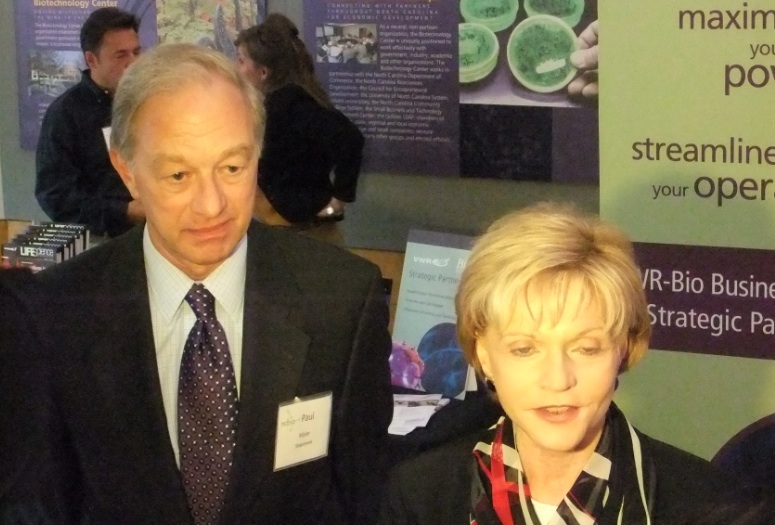
Paul Maier, Sequenom's chief financial officer, and Gov. Beverly Perdue face the TV cameras following Perdue's announcement that San Diego-based Sequenom will open a large lab in the Research Triangle.
Sequenom, a San Diego-based diagnostics company, plans to open a lab on Kit Creek Road next year and start analyzing blood samples from a new, prenatal blood test to detect Down Syndrome. The test would replace more invasive measures such as amniocentesis, which employs a long needle to sample amniotic fluid from inside the uterus.
Sequenom will invest $18.7 million and create up to 242 jobs.
The standing-room-only audience in the N.C. Biotechnology Center auditorium gave Paul Maier, Sequenom’s chief financial officer, a round of applause before Maier and Perdue faced the TV cameras and reporters outside.
Then, the biotech executives inside the auditorium went back to the unique chance that presents itself next year to shape the U.S. Food and Drug Administration.
Andrew von Eschenbach, former FDA commissioner and NCBIO’s keynote speaker, left no doubt that nothing short of a radical therapy will do.

Andrew von Eschenbach
“We’re approaching a crisis situation [in the U.S.] as far as being at the forefront of innovation,” Eschenbach said. The FDA is “in need of a systematic, systemic and formal revision. The moment for modernization is now.”
The FDA has been under close public scrutiny since 2004, when Vioxx was linked to thousands of sudden cardiac deaths before Merck pulled the pain killer off the market.
In 2009, a report released by the Government Accountability Office, the investigative arm of Congress, listed the FDA at risk of failing to fulfill its mission. Chronic underfunding, expanding responsibilities and an aging workforce that wasn’t keeping up with the rapidly advancing science hobbled the agency.
In July, FDAImports.com, a blog written by regulatory consultants, published information that suggested FDA Commissioner Dr. Margaret Hamburg was restructuring the agency’s top management tier. As a Washington Post profile pointed out, Hamburg, a Harvard-trained physician and former New York City health commissioner, had no ties to the pharmaceutical industry when President Obama appointed her.
With changes already under way at the FDA, it could become a watershed year.
In 2012, renewal of the Prescription Drug User Fee Act, or PDUFA, is up. Enacted in 1992, PDUFA established a funding mechanism for the FDA to regulate new medical products and make sure they are effective and do no unnecessary harm. The federal law has been subject to changes every five years, when Congress had to renew it to keep the system going.
The potential for significant changes is particularly large in 2012, because PDUFA for the first time is due for renewal during a presidential election year. And what a turbulent election year it promises to be four years into stubbornly high unemployment, ongoing banking crises and steep government budget cuts.
“This is going to create some interesting politics in Congress,” said J.C. Scott, the head lobbyist for AdvaMed, a trade association representing the medical device and technology industry. Scott was one of several NCBIO speakers addressing regulatory policy recommendations for overhauling the FDA.
Lobbyists for the biotech, pharmaceutical and medical device industries are not about to pass up this opportunity.
Young and small companies are getting squeezed by a lack of innovation capital. (More on innovation that isn’t being funded here.) Facing stagnant research and development productivity and the expiration of valuable drug patents in the U.S., large drugmakers have been cutting jobs for years. (More on the lack of big pharma R&D productivity here.)
The Biotechnology Industry Organization, or BIO, has already drawn up a wish list of changes. According to Cartier Esham, BIO’s senior director of emerging companies, health and regulatory affairs, who also spoke at NCBIO’s annual meeting, policy items on the list include:
- a fixed six-year term for the commissioner,
- the use of electronic health records and smart phones in clinical trials,
- faster approval of products for unmet medical needs similar to how European regulators do it,
- improved advisory committees,
- the establishment of chief medical policy officer positions and
- setting up the FDA with an independent budget. (The FDA is now funded under the U.S. Department of Agriculture.)
“It is our intent,” Esham said, “to get as many of these [policy changes] enacted into legislation as possible.”
Woodson envisions a new NCSU
Wednesday, September 28, 2011, 9:08 am No Comments | Post a CommentWilliam “Randy” Woodson has been frank about his intentions to shake things up since he moved halfway across the country from Indiana’s Purdue University to become N.C. State University’s chancellor last year.

Randy Woodson
More than doubling NCSU’s endowment to about $1 billion. Recruiting more tenure-track faculty to better serve a student population that has grown rapidly in the past decade. Woodson has repeatedly put these two priorities on the top of his to-do list. He did so again when he spoke Sept. 20 at the Triangle Area Research Directors Council in Research Triangle Park.
But he went further, telling TARDC members how another budget cut - NCSU lost about $80 million, or 15 percent, in the current school year - has made strategic restructuring necessary. To bolster NCSU’s research budget and educate top-notch graduates in science, technology, engineering and math, the NCSU model has to change, he said.
“Our goal shouldn’t be to be the biggest,” Woodson said. “We’ve got to be an engine for the economy of the state.”
The 15 percent budget cut - the largest in three years of state revenue shortfalls - prompted NCSU to pool resources rather than cut across the board. Courses were cut, administrative staff laid off, programs consolidated. NCSU lost about 780 employees, Woodson said.
Tuition increased. Although NCSU received about 20,000 application for about 4,000 student spots this year, Woodson said he knows he’s not popular among students fearful of further increases. But the adjustments were necessary.
“We didn’t ask for the model to be changed,” he said.
To further bolster revenue and research, NCSU is stepping up its efforts of marketing technologies developed in its labs and is getting more involved in helping the state and the region recruit companies. (More on NCSU’s economic development efforts here.)
In 2010, NCSU spun off four companies and took in $5.1 million in royalties, Woodson said. He would like to see the number of spinoffs double to about eight or 10 a year, he added.
To recruit more tenure-track faculty - graduate enrollment has increased nearly 50 percent in the past 10 years while new faculty enrollment rose only 2 percent during the same period - Woodson said NCSU established a faculty recruitment program and funded it with $5 million.
An issue he’s also burning to address: NCSU’s ability to raise salaries to prevent faculty from being raided.
Currently, a raise requires a letter from another university offering a faculty member a job with a higher salary. By that time, the faculty member has very likely already decided to leave and NCSU offering a pay raise comes too late, Woodson said.
Universities anchoring RTP step up economic development efforts
Monday, June 13, 2011, 10:41 pm No Comments | Post a Comment
President Obama at Cree's manufacturing plant in Durham. Photo: Wall Street Journal
On his visit Monday to Cree’s Durham manufacturing plant President Obama brought his advisors from the Council on Jobs and Competitiveness along to impress on North Carolinians that his administration is focused on lowering the stubbornly high U.S. unemployment rate, which in May was 9.1 percent.
Jobs council members, which come from the business sector, labor and universities, are dedicating their time and energy to one singular task, Obama told Cree workers. “How do we create more jobs in America?”
Not far from where Obama was talking about getting out of the Great Recession, a job creation effort was under way to lower the state unemployment rate, which in April was 9.7 percent, and particularly the unemployment rate in the Research Triangle, which in April was at 7 percent in the Durham-Chapel Hill area and at 7.7 percent in the Raleigh-Cary area.
NCSU, Duke University and the University of North Carolina at Chapel Hill have long been engines of economic development in the region. They drove the formation of Research Triangle Park in the 1950s and educated the work force that attracted corporate research and development operations to RTP in the following three decades. The three universities that anchor RTP have also brought about technologies that started many an R&D company in the area.
Cree itself is a NCSU spinoff. The RTP company that makes light-emitting diodes, or LEDs, was formed in 1987 based on technology developed at NCSU.
With budget cuts for higher education looming, Triangle universities are stepping up and retooling their economic development efforts.
At NCSU, Terri Lomax, vice chancellor for research and innovation, is taking on responsibilities starting July 1 to help the state recruit companies and jobs, and the university is trying to boost the formation of spinoffs and their chances to survive and expand, be acquired or go public.
William Woodson, who was named NCSU chancellor in January 2010, established an innovation fund that will provide $2.5 million over the next five years to NCSU researchers to work on technologies that could be licensed or spun out as a company. To get off the ground, the young companies could tap into expertise at the university through a so-called proof-of-concept center on NCSU’s Centennial Campus.
To further accelerate startup formation, NCSU has joined forces with UNC, Duke, the Council for Entrepreneurial Development and N.C. Central University. The consortium is getting involved in the Blackstone Entrepreneurs Center, which has $3.6 million available over three years to evaluate technologies and tutor new companies.
“Most new jobs come from companies less than five years old,” Lomax said in an interview with Science in the Triangle. “We want to do everything we can to help these companies be successful. Especially after a recession that’s extremely important.”
She suggested that the efforts could double the number of successful startups that NCSU spins out per year to 10 to 12 by 2015.
“What we want is sustained economic development,” Lomax said.
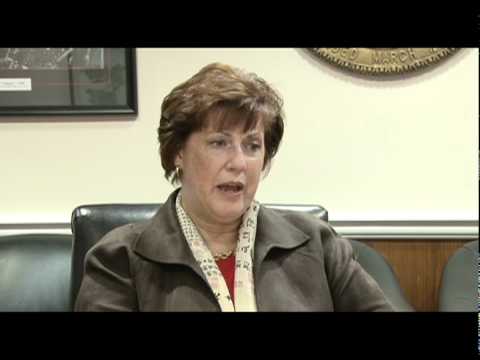
Watch the entire Science in the Triangle interview with Terri Lomax here:
Planting seeds and making them grow
Monday, June 1, 2009, 7:41 am No Comments | Post a CommentIt’s an encouraging historical fact that creativity rises when the economy tanks.
That means, the time to plant seeds for tomorrow’s innovation is now, when the global economy is shrinking, unemployment is rising and one of the world’s largest carmakers, General Moters, is about to restructure in the biggest industrial bankruptcy in U.S. history.
Governor wants incentives for entrepreneurs
Thursday, May 28, 2009, 4:10 pm No Comments | Post a CommentGov. Beverly Perdue used a ribbon cutting Thursday to propose state incentives to encourage scientists to become entrepreneurs.
Purdue seized the grand opening of Quintiles Transnational‘s new global headquarters in Durham to talk about a founder’s tax credit and small innovation research grants she said she wants legislators to pass during the ongoing session.
Science jobs: Where are they going?
Wednesday, May 13, 2009, 10:15 am No Comments | Post a CommentAre science jobs about to go the way manufacturing jobs have gone for years, which is to countries with lower labor costs?
It’s a question that more than 700 economic developers, economists, scientists, investors and business executives from around the world will explore at the three-day International Association of Science Parks conference that starts June 1 at the Raleigh Convention Center.


