Developing medicines is a minefield that Tranzyme Pharma has navigated well so far. But the Durham company is about to embark on one of its trickiest missions.
Posts Tagged ‘obesity’

Short and round and poor
Tuesday, November 23, 2010, 2:48 pm 1 Comment | Post a CommentWaist lines are expanding across the world, not just in the U.S., one of the countries leading the worldwide obesity epidemic. But while the additional calories are also boosting the average height of people in Asia and Latin America, Americans are becoming rounder and shorter.

John Komlos
What seems like a statistical error - considering too little, not too much, food tends to stunt growth - isn’t, according to John Komlos, an economist and professor at the University of Munich, who taught and researched at Duke University in the 1980s. He is currently a fellow at the National Humanities Center in Research Triangle Park.
“Within half a century a veritable metamorphosis in the shape of the American population took place without notice: from being the tallest in the world still around World War II, Americans have become one of the most obese at the onset of the 21st century,” Komlos wrote in a discussion paper that was published in 2003.
The average height of Americans rose about 2 inches in the past 150 years while the Dutch, for example, grew about 6 inches taller. In the past 20 to 30 years, American women and white American men actually shrunk a bit.
Komlos presented his research at the National Humanities Center a week before Thanksgiving, at the end of the same day that had started next door, at the N.C. Biotechnology Center, with a presentation by Barry Popkin, a professor at the University of North Carolina at Chapel Hill and the author of “The World is Fat.”
Komlos and Popkin are both trained economists, but the data they collect - Komlos on height and Popkin on weight - focus on human well-being rather than on a country’s output of goods and services. In the process, both redefine economics at a time when technology and cheap, processed foods are replacing physical labor and traditional diets worldwide.

Barry Popkin
Popkin is particularly alarmed by how quickly countries like China and Mexico are catching up and getting fatter. What has taken the U.S. about a century, happened in the past two to three decades in Asia and Latin America.
“It’s going fast, fast, fast,” Popkin said at the breakfast meeting of the Triangle Global Health Consortium. And similarly to the U.S., he added, the resulting burden of disease - diabetes, hypertension and heart disease - is shifting towards the poor.
Their research, which touches on disciplines as diverse as genetics and history, has come up with some surprising findings. But each researcher takes a different approach to what should be done to improve health and lower the burden of disease around the globe.
Komlos has scoured archives for more than a quarter century to collect hundreds of thousands of historic height measurements from military recruits, passport applicants, runaway slaves and indentured servants. (Read a feature in The New Yorker about his research here.)
The large data sets revealed trends that go beyond genetics and reflect the influence nutrition, medical care, education and family status and income can have on children and therefore on the well-being of entire population segments once those children become adults. Komlos called this approach “humanistic economics.”
“Height is important, because childhood health has a long reach into the rest of the life,” he said.
During the period before the Civil War, white Southerners were the tallest population segment in the U.S. because they had good access to food, Komlos found by looking at height records of Georgia prison convicts. At the same time, heights declined across Europe as people left the countryside and farming and moved to the cities to find jobs in the factories.
The Oliver Twists of industrializing England in the first half of the 19th century averaged 5-feet-1-inch at 18, Komlos said. Their contemporaries in the British gentry grew 9 inches taller on average.
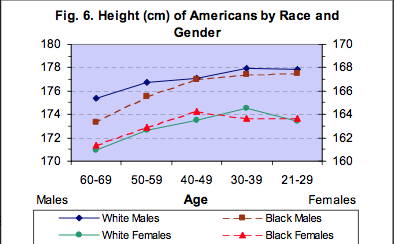
After World War II, Americans have not only become rounder, they've also started to get shorter.
By the end of the 19th century, Americans were the tallest, but average U.S. height stagnated as technological innovations such as cars, radios, television and computers boosted the U.S. gross national product during the 20th century.
At the same time, Americans started to gain weight. On average, Citadel military cadets are more than 25 pounds heavier today than they were after World War I, Komlos found.
And then, there’s the report card on child well-being in 21 rich countries that UNICEF published in 2007. The report card ranked the U.S. second to last. The Netherlands, home of the tallest people, came in first.
To close the height gap that is opening up in the U.S., Komlos suggested to bolster the social safety net, particularly prenatal care, and the access to nutritious food.
Popkin supports an approach that’s more grassroots and includes consumer education, particularly about caloric beverages that are loaded with sugar, and public health advocacy for healthier food options in schools, churches and at the workplace.
Already, more than 1 billion people worldwide are overweight or obese, according to figures by the World Health Organization. Every year, 10 million more join the group, Popkin said. A shift in how the world eats, drinks and moves is the reason, he said.
Fruits, vegetables and beans are being increasingly replaced by meats, dairy and processed, energy-dense but nutrient-poor, cheap foods that are available in supermarkets around the world.
More than half of these processed foods in supermarkets are made locally, not by the 10 to 15 largest multinational food companies, Popkin said. “Kraft, Nestle, Unilever are just the tip of the iceberg.”
The result? French fries are named by U.S. parents as the first vegetable to which they introduced their 7-month-olds. About one-third of Americans don’t know how to cook. The number of overweight children in the U.S. has doubled in the past 30 years. In North Carolina, about one-third of the children are overweight or obese.
And countries such as Mexico, China and India are catching up quickly. About two-thirds of Mexicans and one-third of Chinese are overweight or obese.
What’s worse, Popkin pointed out, populations who are getting fat and fatter quickly after centuries of malnutrition are more prone to develop diabetes, hypertension and heart diseases than Americans and Europeans.
Digging for the roots of diabetes
Wednesday, December 9, 2009, 7:58 pm No Comments | Post a CommentEvery year, the number of Americans with diabetes rises by about 1 million and genetic risk factors alone can be blamed for only a small portion of the cases. The 30 to 35 known diabetes genes, as researchers have dubbed them, account for only about 10 percent of the risk that a brother or sister of a diabetic will also develop the disease.

Dr. Ronald Kahn
To better understand the other 90 percent, said Dr. Ronald Kahn, a Harvard University medical professor and vice chairman of the Joslin Diabetes Center, “we have to look at the environment.” Read more…
Next: A crucial decision
Thursday, September 3, 2009, 8:23 am 1 Comment | Post a CommentThis is the last part. Continued from part 2.
Getting a ghrelin drug to market
Thursday, September 3, 2009, 8:20 am No Comments | Post a CommentThis is the second part of three. Continued from part 1.
Work on promising ghrelin medicines has gotten to a critical stage a decade after Japanese researchers discovered the hormone that stimulates hunger and is linked to insulin production.
Ghrelin: A new hormone is found
Thursday, September 3, 2009, 8:15 am No Comments | Post a CommentINTRODUCTION
Tranzyme Pharma is one of dozens of drug development companies in North Carolina’s Research Triangle area, a biotech hot spot that is ranked third in the nation by number of companies. The Durham company has diligently advanced therapies based on a hormone that was discovered a decade ago, a technology also used by two rivals. Now, Tranzyme’s Board of Directors has to decide how to pay for the final development step and get its drugs to market: Go public, sell the company or go back to its investors hat in hand one more time.
This is the first part of three.
Next: A crucial decision
Tuesday, July 28, 2009, 9:14 am No Comments | Post a CommentThis is the last part. Continued from part 2.
Developing medicines is a minefield that Tranzyme Pharma has navigated well so far. But the Durham company is about to embark on one of its trickiest missions.
Getting a ghrelin drug to market
Tuesday, July 14, 2009, 11:38 am No Comments | Post a CommentThis is the second part of three. Continued from part 1.
Work on promising ghrelin medicines has gotten to a critical stage a decade after Japanese researchers discovered the hormone that stimulates hunger and is linked to insulin production.
Ghrelin: A new hormone is found
Monday, July 6, 2009, 9:24 am No Comments | Post a CommentINTRODUCTION
Tranzyme Pharma is one of dozens of drug development companies in North Carolina’s Research Triangle area, a biotech hot spot that is ranked third in the nation by number of companies. The Durham company has diligently advanced therapies based on a hormone that was discovered a decade ago, a technology also used by two rivals. Now, Tranzyme’s Board of Directors has to decide how to pay for the final development step and get its drugs to market: Go public, sell the company or go back to its investors hat in hand one more time.
This is the first part of three.


