Posts Tagged ‘education’

Gaming in the Triangle gets serious
Thursday, August 19, 2010, 11:43 am 3 Comments | Post a Comment
Aten Inc.'s new free iPhone game Rhythmatical teaches students the connection between music and math.
Thomas Vaidhyan admits he can attribute much of what he’s learned about gaming to his young son.
When Vaidhyan, now the CEO of IT firm and game developer Aten Inc., first arrived in the Triangle, he realized quickly something was missing in the classroom.
“When I started getting involved with sending my son to schools here, I started researching quite a bit on that and found out very surprisingly, for me, a lot of the technologies and innovations that we’re getting incubated in our universities and developed in our industries weren’t necessarily percolating into our school systems,” he said.
To him, pulling gaming into the classroom was a no-brainer.
“It made a lot of simple common sense to use games for translating some of the abstract concepts in a very simple, easy-to-understand means to children,” he said.
That’s why his company, guided by a growing body of educational research, has been working to develop engines and applications in the rapidly expanding field of serious games, which teach and test users’ skills while they play.
Vaidhyan’s noticed the change in perception toward gaming, even in his daily life. After taking his son to a golf camp, he was surprised to learn the instructor rarely had to teach the complicated method of scoring anymore — his classes were already veterans of the fairways featured on Wii Sports.
“Five years ago when we were talking about it, people asked, ‘Are you crazy?’ But now everybody is understanding games can be a very effective tool,” he said.
The prevalence of devices like the iPad and smartphones is also expanding the potential playing field for educational games beyond the console and computer.
“You will see us moving more and more away from books and using devices like the iPhone and the iPad, where not only do you read, but that translates to a more visual and interactive experience,” Vaidhyan said.
Aten’s newest entry in the serious gaming field is a free iPhone app called Rhythmatical, which teaches about the connection between music and mathematics. It was created in collaboration with Virginia Tech and is targeted toward elementary school children.
It’s a far cry from blockbuster, next-generation franchises like Halo or Call of Duty: Modern Warfare, but Vaidhyan said that’s a good thing.
“Gaming companies and commercial games compete with movie productions — $10 million for one of those productions is considered to be cheap,” he said. “It definitely doesn’t scale to an educational environment.”
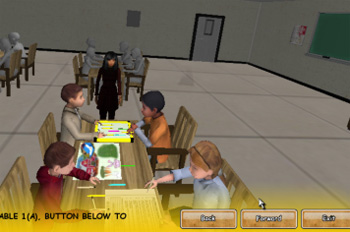
Other Aten titles, such as this classroom simulation, use virtual environments to educate users.
It’s that price point, Vaidhyan said, that’s keeping good serious games out of the fields of education and corporate training — but it’s also giving companies like his a unique opportunity.
“We’re able to get down to that and have a team and a framework where we can churn out these virtual environments at one-fourth or one-fifth of the cost that these gaming companies would take to create some of this,” he said. “One of the things that has kept us going in this field is the fact that we’ve brought ourselves to an attractive price point that can easily scale.”
Particularly in the case of 3-D gaming, some companies charge up to $250,000 just to license their game engines, or the software infrastructure that forms the foundation for different titles. The engines Aten uses, by comparison, can range from $1,500 to free.
For the average consumer, Vaidhyan said there’s a lack of good content on the market.
“The games that I’ve seen out there have been either gaming companies bringing them out themselves — which means commercially they’ll look good, they’re great games, but do not involve a lot of educational research background or aspects. Or, purely educational games that are boring,” Vaidhyan said.
He points out that demand is so high that teachers are learning to adapt existing games — like the multiplayer online role-playing game World of Warcraft — to their needs in the classroom.
But that dichotomy also presents a challenge for companies like Aten, which must balance a fun experience with applied learning.
“Where we could have a blend of this is where we can have success,” he said.
To do that, Aten pairs experienced game designers with experts from whatever field the title is trying to teach. The result should be what Vaidhyan jokingly termed “stealth learning.”

This Aten racing title requires players to learn more about car mechanics and engineering before modifying their vehicles.
“A successful education game is one where the user or the children don’t even know it’s educational,” he said. “They say it’s just another game.”
And like their commercial counterparts, serious games aren’t just for children.
Virtual Heroes, a serious gaming company also based in the Triangle, recently partnered with the Duke School of Medicine to develop a 3-D training game for the emergency room.
Aten’s also working on working with a major pharmaceutical company to create a simulated environment of their assembly line, allowing for virtual hands-on training without the risk.
“We have made it so simple for them that their assembly line workers can train themselves by pulling it out of their learning management system,” Vaidhyan said. “Here, they’d be doing exactly what they’d be doing on an assembly line, except they do it on a computer.”
Future corporations and classrooms could even implement a tracking component of the training and education module that would allow them to identify shortfalls — whether it’s a step of the production process or a mathematical concept.
“From a management perspective, you’re able to say, ‘This person is not getting this particular aspect,’” Vaidhyan said. “The management can give that person an individualized training.”
And solving the problem could happen almost instantly.
“You can give them formative feedback right in the virtual environment itself,” he added.
Outside the virtual environment, users of these technologies are learning something even more valuable — whether the game is serious or shoot-em-up. That’s another lesson Vaidhyan’s gleaned from his son, who often consults classmates when he’s stuck on a tough level.
“They are being forced to share best practices. They are talking to each other, figuring out how someone else is doing it and applying it,” Vaidhyan said. “That’s very valuable in the corporate world.”

Scientifica Gets Durham School Kids Excited about Science
Monday, August 16, 2010, 7:25 am 1 Comment | Post a Comment
Dr. Anu Sud talks to Robby Fisher, a Durham student participating in the Scientifica program she helped found.
Dr. Anu Sud’s two daughters were accomplished in science by the time they were in high school, in part thanks to coaching by their mother, who had been a cytogeneticist at UNC-Chapel Hill and at LabCorps. The older daughter attended the North Carolina School of Science and Mathematics, and the younger, Shivani, won a $100,000 scholarship in the Intel Science Talent Search and numerous other top science honors when she was a junior and senior at Jordan High School.
When Shivani went off to Princeton, Dr. Sud was like many professional women who interrupt their careers to raise kids: should she return to her former career or try a new path? Then Shivani said to her, “Mom, why not help other kids like you helped us?” Read more…

ScienceOnline2010 - interview with Russ Williams
Thursday, March 11, 2010, 12:19 pm No Comments | Post a CommentContinuing with the tradition from last two years, I will occasionally post interviews with some of the participants of the ScienceOnline2010 conference that was held in the Research Triangle Park, NC back in January. See all the interviews in this series here. You can check out previous years’ interviews as well: 2008 and 2009.
Today, I asked Russ Williams from North Carolina Zoological Society and the Russlings blog to answer a few questions:
ScienceOnline2010 - interview with Mark MacAllister
Thursday, March 4, 2010, 12:07 am No Comments | Post a CommentContinuing with the tradition from last two years, I will occasionally post interviews with some of the participants of the ScienceOnline2010 conference that was held in the Research Triangle Park, NC back in January. See all the interviews in this series here. You can check out previous years’ interviews as well: 2008 and 2009.
Today, I asked Mark MacAllister, Coordinator of On-Line Learning Projects at the North Carolina Zoological Society to answer a few questions:
ScienceOnline2010 - interview with Andrea Novicki
Monday, March 1, 2010, 6:24 pm 1 Comment | Post a CommentContinuing with the tradition from last two years, I will occasionally post interviews with some of the participants of the ScienceOnline2010 conference that was held in the Research Triangle Park, NC back in January. See all the interviews in this series here. You can check out previous years’ interviews as well: 2008 and 2009.
Today, I asked Andrea Novicki from the Duke CIT blog to answer a few questions:
ScienceOnline2010 - interview with Maria Droujkova
Tuesday, February 9, 2010, 10:18 am No Comments | Post a CommentContinuing with the tradition from last two years, I will occasionally post interviews with some of the participants of the ScienceOnline2010 conference that was held in the Research Triangle Park, NC back in January. See the interviews posted so far here. You can check out previous years’ interviews as well: 2008 and 2009.
Today, I asked Maria Droujkova to answer a few questions:

Does student financial aid work? RTI gets $70 million to find out
Tuesday, November 10, 2009, 5:57 am No Comments | Post a CommentCollege is expensive and about two-thirds of all students who continue their education past high school receive some type of financial aid. This year, the U.S. Department of Education will spend about $116 billion on student financial aid.
The investment reflects how important college degrees are to the economy, the labor pool and the standard of living in the U.S.
But does student financial aid work? What is the taxpayers’ return on the investment?
The U.S. Department of Education has awarded RTI International a $70 million contract to find out.


