Posts Tagged ‘IBM’

IBM Leads Country, State in Invention in 2010
Thursday, February 10, 2011, 8:30 am 1 Comment | Post a Comment
Cyber-criminals probe databases in ways that can be predicted and detected. That's the basis of newly patented IBM software that monitors access to databases for suspicious activity and then locks down critical data.
Burglars often act in predictable ways: they lurk in overgrown bushes, come to your door pretending to be service people, or check for unlocked doors. If you witness this kind of behavior outside your house, you’re likely to check your locks and perhaps arm your security system before calling the police.
Cyber-criminals are the same as physical ones, says IBM’s Dave Kaminsky. They probe databases in ways that can be predicted and detected. That’s the basis of U.S. patent no. 7,827,608: software that monitors access to databases for suspicious activity and then locks down critical data, preventing it from being downloaded. It is intended for use at banks, mortgage companies, and other companies that might keep your social security number or other private information in their databases.
Importantly, the software monitors realtime events, acting only if an intrusion appears to be imminent. As Kaminsky says, it would be counterproductive to forestall legitimate attempts to access information (such as for a credit check), just as you don’t want to overreact when someone comes to your house to clean your gutters.
Kaminsky is IBM’s Chief Patent Innovation Architect. Based at RTP, he is not only a frequently patented inventor, but he helps other inventors in the company navigate the “Alice in Wonderland” world of the patent process and contributes to decision-making about which innovations the company should patent. That last is important, because even though IBM received 5,896 patents in 2010, more than any other company, Kaminksy says just a fraction of the company’s eligible innovations go forward in the patent process.
IBM’s RTP site generated 570 patents, and those, combined with patents from Charlotte, made IBM the leading recipient of patents in the state, ahead of Cree, Red Hat, and the leading universities. Most of the patents from RTP are in software. They include a program that routes phone calls to either internet or traditional phone lines to incur cost savings (patent no. 7,710,946, Jim Silwa) and a GPS add-on that gives drivers of hybrid, electric, or other alt-fuel vehicles routing that will lead them to charging stations, thereby reducing their fossil fuel usage (patent no. 7,860,808, Mark Peters). Then there are hundreds more inventions that may not resonate with consumers, like a new caching algorithm, Kaminsky says, but that make our lives easier nonetheless.

Almost 100 years ago, IBM received its first patent. In 2010, it received 5,896, more than any other company
IBM encourages staff members to generate patentable ideas, Kaminsky says, through a financial incentive program and through career advancement: people who contribute to the intellectual property of the organization are likely to advance.
Contrary to the stereotype of the inventor as a lonely figure, most patents achieved at IBM come from ad hoc groups. Kaminsky led a team of four software engineers on the online security project, which took less than six months to complete but almost four years to patent. Ideas come from clients and from the inventors themselves, sometimes through conversations with collaborators and sometimes through “Aha” moments when people think of ways in which technology could solve a problem.
This was the 18th consecutive year that IBM has led the list of U.S. patents received. According to a company press release, “more than 7,000 IBM inventors residing in 46 different U.S. states and 29 countries generated the company’s record-breaking 2010 patent tally.”

IBM city sim highlights gaming’s problem-solving potential
Thursday, October 21, 2010, 12:05 pm 1 Comment | Post a CommentThe world is becoming a more complicated place – but that’s OK with people like Phaedra Boinodiris.
As the gaming and marketing manager at IBM, Boinodiris said she sees the potential for video games to help everyone from citizens to political decision-makers understand issues by breaking them down into simpler elements. By showing the interactions between those pieces, Boinodiris said games can be effective at educating the public.
“It’s hard to capture any other way,” Boinodiris said. “We’re living in a more complex world.”
Boinodiris and her team at IBM wanted to break down that complexity about six months ago when they began working on a game to detail the company’s work with “smart cities.” The result was CityOne, a free city-building simulation developed with Center Line Digital in Raleigh, N.C., and released in early October.
Players begin the game as the manager of a drab, grayscale city facing serious infrastructure and industry problems. Using a limited set of resources and input from a group of advisers, players choose how they should invest in solutions like alternative energy and supply chain management. Winning the game, and creating a more vibrant city, depends on the player’s ability to effectively improve everything from water distribution to business climate.
“The initial inspiration for it was looking for ways to explain system solutions and its impact on the market and in the industry,” Boinodiris said.
Aside from the education component, Boinodiris said the game is out to communicate what IBM can do.
“There is no press release, no white paper, no spokesperson that can explain these concepts like a serious game can,” she said.
Daren Brabham, a professor of public relations at UNC-Chapel Hill, agrees. Through his research on crowdsourcing, he said he’s learned the power of interactive marketing and its ability to show the simple connections in a big system.
“With games, all they really do is teach us how to problem solve,” Brabham said. “The question is: What should the problem be?”
The interactivity doesn’t even have to be complicated to be effective.

The Next Stop Design project crowdsourced bus stop designs for Salt Lake City, eventually selecting the “Sugarhouse Lounge” concept by Aaron Basil Nelson.
In 2009, Brabham began a research project to crowdsource a design for a better bus stop in Salt Lake City. After initially planning a Web-based interface that would have allowed users to allocate resources in the planning of a 3-D model, Brabham abandoned the approach in favor of a more open submission system that just required applicants to send in sketches and plans. All of those designs were posted online, where users could rate and comment on them.
With that $5,000 site, Brabham said users submitted 260 designs. And two-thirds of them had never participated in a planning process before.
“To be honest, traditional methods of engaging stakeholders at a meeting really could only tackle one thing at a time,” he said. “[The crowdsourced method] would be a lot more of a democratic process than the 10 people who show up to the planning meeting and yell at each other.”
Boinodiris said she’s seen that need to participate among the public. She said people want to know what it would take for a city like Raleigh to support a smart grid, electric vehicles or other sustainable solutions. To participate, they also need good information about how to move forward and what those actions would mean.
“I think people are asking those questions: Why aren’t we there yet?” she said. “[CityOne] tries to show those building blocks and the affects of those missteps.”
So far, Boinodiris said thousands of people worldwide from several different industries have already played CityOne.
And gamers want more. She said she’s already gotten requests to expand the game with more SimCity-style gameplay, effectively allowing players to build cities from scratch. Players even suggested integrating real-time city data to add to the challenge of preparing municipalities for the future.
“They’re really putting the gauntlet down,” Boinodiris said.
Although she said this was the company’s “very first small steps” into a city simulation, she didn’t leave out the possibility for future editions, pointing out that it’s “inevitable” that corporations will pursue this type of marketing to get their messages across.
“It’s not a ‘what if?’ or ‘will it happen?’” she said. “It’s already happening.”
But businesses aren’t the only ones interested. Game designers like Jane McGonigal, who delivered a speech at a TED conference in 2010, believe gaming’s ability to harness a player’s problem-solving ability will be useful when tackling complicated issues.
“We’ve evolved technology to a point where we can do some good,” Brabham said.
Brabham even imagines the potential for groups like the Republican and Democratic national committees to create games allowing voters to explore the long-term impacts on the country if candidates are elected. Ideas like this, he said, can be an effective way to hear through the chatter.
“[Gaming] really holds a lot of democratic potential,” Brabham said. “It’s such a productive way to get a lot of people engaged.”
Tyler Dukes is a freelance reporter and journalism adviser at N.C. State University. Follow him on Twitter as @mtdukes.
Female role in gaming industry grows
Friday, September 17, 2010, 11:59 am 3 Comments | Post a Comment
Phaedra Boinodiris says the Wii prompted a radical shift in traditional gaming industry marketing.
Women represent a huge portion of the market for the $10.5 billion video game industry. According to the Entertainment Software Association, females account for 40 percent of all players. At 33 percent of the gaming population, adult women even outnumber boys age 17 or younger. But despite those statistics, the male-dominated industry is still widely criticized for its portrayal of women.
But some female gamers, like IBM Gaming and Interactive Manager Phaedra Boinodiris, are working to change that portrayal – and get more women interest and playing and creating games. Science in the Triangle spoke with Boinodiris, the co-creator of WomenGamers.com, about the state of the industry and how it’s changing when it comes to women.
How did you first get into gaming?
My sister and I have been playing forever, ever since the days of Pong. I know that completely dates me – it’s scary. We knew we played and our friends played and our cousins played, but we’d open up most gaming magazines and look at gaming websites and they were targeted toward young men. So we decided to start a company, WomenGamers.com. That’s how we got the site of the ground.
How long did it take you when you were younger to notice how slanted the gaming industry is toward men?
It was gradual. I don’t know if you recall the first advertisements on television for the Atari or for ColecoVision, but if you take a look at what those looked like, you’d always see families playing together. Then there was this subtle shift in the kind of marketing that gaming companies were doing to focus more and more on a predominantly male audience. It was very interesting to us to note this shift.
So one day we were invited to a marketing to women online conference — this was back in the late 90s – and there was a panel on women in gaming. There was so much interest from big companies. Mattel, at the time, was really investing in that space. There was a lot of conversation about where this was going and how it was untapped. We just walked away thinking there was a lot of opportunity here to showcase this untapped market and really provide service.
Given the statistics about women gamers and gaming parents, why do you think the industry fails to market to women appropriately?
Because they have very few women working for them. If there were more women game designers, for example, if there were more women who were on staff working within these companies, you would see a bigger shift.
It wasn’t until Nintendo decided to make a play in that space to go after the more casual gamer that you would see huge changes in marketing and advertising. I remember before the Nintendo Wii, you would go to conferences like E3 – you would never see a poster of a woman actually playing a game. If you saw a woman, if she was depicted at all, she was typically in a chain mail bikini. But once the Nintendo Wii came out, there was a big push toward showing women playing.
They were on the frontier, and obviously they scored big with that. It wasn’t until after Nintendo made that big play that people started to wake up to this notion of the casual gamer and going after new blood. So you have more social games, like Farmville, mobile games, going after a bigger and bigger audience.

In Epic Games' upcoming Gears of War 3, communications officer Anya Stroud will hit the frontlines as a soldier. | Photo courtesy of Epic Games
Do you think the industry’s lack of female roles and often misogynistic overtones turn off female gamers who would otherwise want to play?
Absolutely. It perpetuates a stigma of what working within the game industry is like. It’s a shame because if women consider it as a boy’s club that’s really exclusionary, why would they ever try to, as their career, work there?
We really have a job to do to make sure the gaming industry itself is considered more inclusive so we can include more women who work there. This isn’t just to benefit women, by the way. You include women as game designers, you’re going to get whole new genres of games that don’t exist. I’m noticing with my daughter, she approaches certain games in a very different way. I’ve spoken with professors who teach game design and development classes who also remark upon the fact that the female students they have in their classes end up creating things that are really different from the status quo out on the market.
It will mean a lot more diversity in the market of games out there. Also, it means some serious profit for these game studios because they’re going after a larger and larger audience.

Intelligence officer Kat is second in command of Halo: Reach's Noble Team. | Photo courtesy Bungie/Microsoft Studios
In hardcore games, the female role does seem to be changing. We have female soldiers in the new Gears of War and Halo titles. Mass Effect 2 also has very prominent females as major players in the game. Are gaming companies starting to realize they need to put more females in these larger roles?
Actually, for the titles you mentioned, I don’t think they’re doing that to attract women necessarily. I think they’re primary reason for including women is for the men.
We’ve done a lot of studies and we’ve seen that a lot of the male game players prefer to play females, especially in [massively multiplayer online role playing games]. You ask them why, and they say, “Well they’re nicer to look at.” Secondly, they’ve found that when they’re playing a female character, a female avatar, others within the game will assume they’re a female playing. They’ve said they actually get a lot of free stuff – weaponry, swords, all kinds of things! It’s interesting to see the dynamic there in terms of the men choosing to play the female avatars.
Do you think one part of the solution here is sparking the interest of young women in math and science early on?
Absolutely, and my sister and I have done a lot of talks at elementary schools and middle schools about this subject. There’s been a huge drop in the number of women in math and science ever since the Bush era. One of the ways that we purport to be able to encourage women back into these fields is to encourage them to design games, early.
If you think about it, from my personal experience, the way that I got interested in math and science was absolutely because of games. It is a fun pursuit, especially the idea of designing your own. It’s play, if you will. What better way to get enthusiastic about subject matter than by playing in it to begin with? The idea is that you encourage young women, young girls to play these games, to design their own games, so hopefully they’ll be able to see why having a field in computer science or math or physics would be interesting.
Do universities have a role to play when it comes to encouraging women in science, technology, engineering and math fields?
Absolutely, but I think it’s a challenge. From an even earlier age than college, why is it that they’re being turned away from math and science? That question needs to be answered.
Whether it’s [creating] a game or a software application, it takes a lot more than programming. It takes good writing skills, good scripting, texture design, art, sound. In my case, for serious games, it takes a lot of business acumen and knowledge of complex systems.
For those women who think, “Programming is not really my thing,” that should not deter them from looking into this space anyway.
Was there a moment for you at some point in your childhood that you knew going into a science- or math-related field was for you?
It wasn’t a sudden thing. Both of my parents were retired IBMers and we had computers all the time in our house. They were very big on education and very big on math and science. It was something we always enjoyed and something we always loved and embraced. No one ever scared us off of that.
We were lucky to grow up in an environment that was very nurturing for us to like those fields and not feel like we’re eating our Brussels sprouts.
Looking forward, is there something that gives you hope about the future of the role of female gamers?
Everything I see. Look at the big push toward mobile gaming and casual gaming and what’s happening with the Nintendo Wii and how they’re outpacing everybody. It’s a huge wake-up call to companies. They’re really saying, “Gee, we really missed the boat. We really need to refocus on what we’re doing here. ”They’re looking at their staff and saying, “Who here knows how to target women? Who here knows how to make a gender inclusive game?”
They really are trying to learn at this point, not for good karma or altruistic feelings, but because it makes sense for the bottom line.
Tyler Dukes is a freelance reporter and journalism adviser at N.C. State University. Follow him on Twitter as @mtdukes.

Serious Gaming at Sigma Xi
Sunday, May 30, 2010, 10:33 pm No Comments | Post a CommentLast week I went to this season’s last American Scientist pizza lunch at Sigma Xi featuring Phaedra Boinodiris (Twitter, blog), Serious Games Product Manager at IBM.
I first saw Phaedra Boinodiris speak as the opening speaker at TEDxRTP (my review) back in March, but this was a different kind of talk, geared more towards scientists and science communicators.
I remember playing Pong when it first came out. I remember spending many hours back in 1980 or so playing The Hobbit on Sinclair ZX Spectrum. And I played many games at arcades (still not knowing which games started out as arcade games adapted to computers and which the other way round). Then I quit playing games for a couple of decades until my kids were ready for them. I loved Zoombinis - an amazing game of logic and a brilliant preparation for taking IQ tests! I loved Richard Scarry’s Busytown - the one and only game I know about infrastructure, where players build stuff and deliver it to others for the good of the town - from baking bread to paving roads - learning along the way how those things are done.
And sure, Phaedra Boinodiris started with a slide depicting Pong (to the chuckle of the audience) but soon got into the real stuff - the serious gaming and the story of how she got involved in developing such games, as well as about studies of gaming and how different kinds of games help develop different real-work skills, from eye-hand coordination to leadership to cooperation. Her first game - INNOV8 - was developed as a prototype, a proof of concept, in only three months and instantly became a huge hit. It is used by businesses and business schools around the world to teach Business Process Management. It is essentially a first person shooter game (without guns) in which the player is brought as an outside consultant into a company where s/he has to figure out the flow, the bottlenecks, etc. (including by interviewing employees, as well as data-sheets) and experiment in making it more efficient. The 2.0 version came soon after, adding such problems as traffic, customer service and supply chains.

The next game, recently announced and coming out in October 2010, will be a Sim-City-like serious game CityOne, designed to help city planners, town councils, citizens, and engineers plan better, more efficient infrastructure for their cities. Put in your city’s specs and start building new infrastructure, see how much it will cost, see what problems will arise, see what solutions are available - probably something you could not have thought of yourself and may be surprised.
As I am currently reading ‘On The Grid’ it occured to me that the developers of CityOne should read that book, and that Scott Huler should be given a test-run of the game, perhaps for him to review for Charlotte Observer and Raleigh News&Observer and the local NPR station. And for Science In The Triangle, of course.

3-D learning with fun and games
Saturday, May 15, 2010, 8:01 am No Comments | Post a Comment(Portions of this story were published May 3 in the Charlotte Observer and the News & Observer.)
PHOTO BY TODD SUMLIN - tsumlin@charlotteobserver.com: Northwest Cabarrus High student Brendon Schaumburg, left, works on his senior project with technology facilitator Julie LaChance.
Teens across the country are starting to play computer games in school - and their teachers encourage them.
It’s called three-dimensional learning, and it has little in common with the 1980s video arcades parents remember.
In North Carolina, high school students who take an elective called “Computer Applications 2″ get introduced to Second Life or ReactionGrid, 3-D virtual worlds in which each player has an avatar - like a digital sock puppet that the user controls. In at least one school district, middle school students sit down at computers to play 3-D games in math and language arts classes.
3-D learning makes immediate sense to anybody born after 1985, because the advances in computer technology that stripped video games of their less-than-wholesome image also made the Internet an integral part of everyday life. For teens growing up in a world of Twitter and Facebook and game consoles such as PlayStation and Xbox, it’s no stretch to slip into an avatar and learn about prime numbers, creative writing or citizenship. Read more…
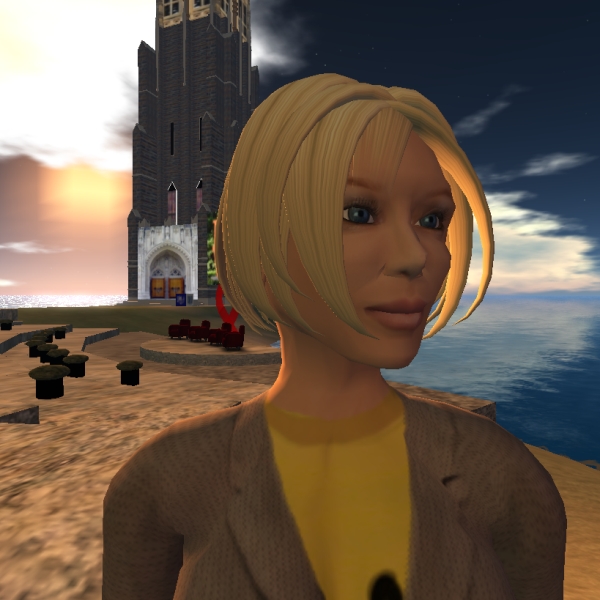
How much life is there in Second Life?
Sunday, April 4, 2010, 4:45 pm 5 Comments | Post a CommentMore than 2,000 researchers and educators from 69 countries attended the Virtual Worlds Best Practices in Education conference last month, including Tony O’Driscoll of Duke University and Brent Ward from RTI International in Research Triangle Park.
Like the other attendees, O’Driscoll and Ward didn’t travel to VWBPE in person. They sat in front of a computer and had their voice-activated avatars teleport to one of 20 specially constructed virtual islands, where the conference took place over 48 continuous hours. Some of the islands resembled the Guilin mountains in China, an Irish seaside cottage and Stonehenge, the famous English prehistoric monument.

Brent Werber
Wada Tripp, O’Driscoll’s avatar, gave a presentation on 3-D learning, which requires students to interact in simulated, or virtual, environments. Brent Werber, Ward’s avatar, moderated a panel at the conference.
O’Driscoll is a professor at Duke’s Fuqua School of Business and Ward provides RTI researchers technical assistance as the research institute’s director of commercialization. Both are professionals holding positions of responsibility, but neither thinks twice about slipping into his “digital sockpuppet,” a computer-generated persona that lives in Second Life, a three-dimensional virtual world maintained by Linden Lab of San Francisco. Read more…
RTP Weekahead 3/15
Sunday, March 14, 2010, 3:21 pm No Comments | Post a CommentEvents taking place the week of March 15 in the Research Triangle area that are open to the public: Read more…
RTP Wrapup 2/5
Friday, February 5, 2010, 12:13 am No Comments | Post a CommentGlaxoSmithKline wants to scale back research and development and the cuts could affect jobs at the British drugmaker’s U.S. headquarters in Research Triangle Park, IBM unveils the $360 million cloud computing center it established on its RTP campus and a Durham startup reels in $10.5 million in venture capital and a deal with Burlington-based medical testing giant LabCorp. Read more…


