Archive for the ‘Events’ Category
April 1st kicks off 5th annual SmartCommute@RTP Challenge
Monday, April 4, 2011, 1:59 am No Comments | Post a Comment
Originally published 3/24/11:
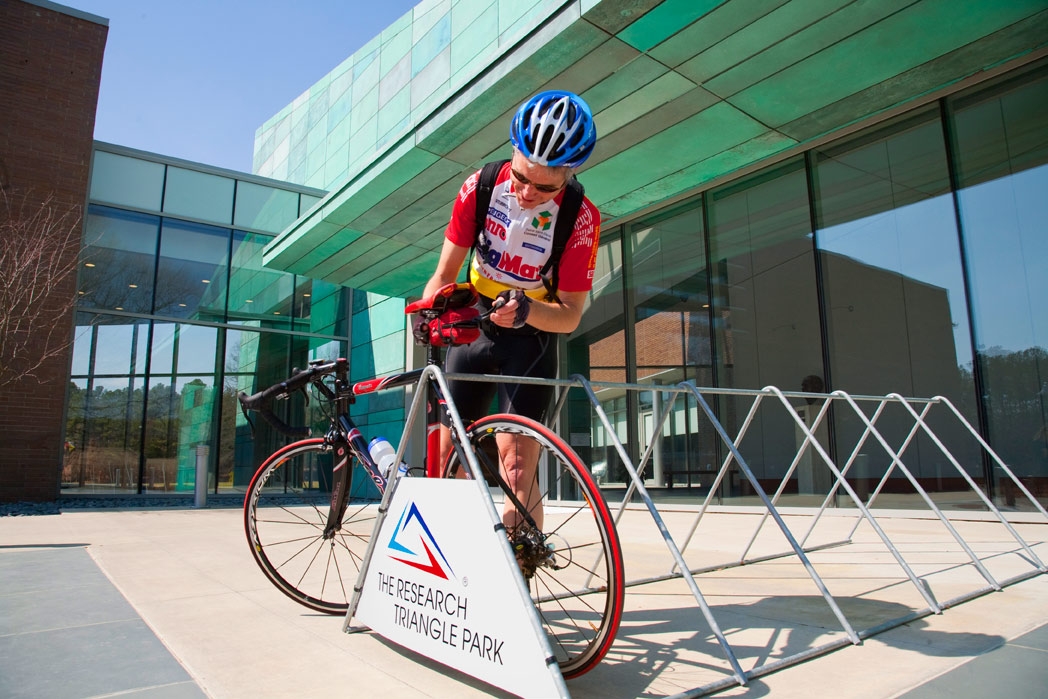
Saying Jim Miller likes to bike is an understatement.
The 55-year-old facility engineering manager at Research Triangle International said he rides his Cannondale road bike to and from work every day of the year, including winter.
“I’ve biked when it’s 15 degrees Fahrenheit outside, and I’ve biked when it’s 105,” Miller said.
He estimates that he’s cycled between thirty and forty thousand miles between work and errands in the last three years. So naturally, each year Miller pledges to participate in the RTP SmartCommute Challenge.
The 5th annual challenge, which runs from April 1st to June 1st, encourages residents and employees in Wake, Orange and Durham counties to explore alternative modes of transit to work. In addition to biking, popular options include walking, carpooling, taking the bus, and telecommuting.
“Telecommuting is the most popular SmartCommute alternative in the region,” said James Lim, director of RTP programs at the Research Triangle Foundation.
Lim helps coordinate SmartCommute. He said one of the major benefits of taking the challenge is reducing the number of vehicle miles traveled. Along with this comes improved air quality, which includes reductions in CO2, mono-nitrogen oxides (NOx), and volatile organic compounds (VOCs).
Lim and his colleagues on the SmartCommute committee have established two goals for this year’s challenge: trying to save around 18,000 gallons of gasoline and trying to recruit 12,500 pledges. He said last year’s goal of 10,000 pledges was met and surpassed.
But to talk the talk, Lim feels he must walk the walk, literally. He plans to jog seven miles to the RTF headquarters from Durham each morning over the course of the two months.
“Now that I’m saying this in print,” Lim said. “I have to do it.”
He also carpools with another Foundation coworker. It’s important that employers are supportive of their staffs’ efforts to join the challenge, he said. Some companies have flexible starting and leaving times for those who bike or walk; others issue carpool parking passes closer to the building.
Darren Danko, the information technology director at RTF, is an avid SmartCommute cyclist as well, though admittedly he’s not as hardcore as Miller.
“I’ll bike whenever it’s 60 degrees or above,” Danko joked. His 3.2-mile ride from Durham takes him about 20 to 25 minutes on his aged, 10-speed Schwinn street bike.
Danko also opts for eco-friendly transit even after the challenge is over.
“It’s important to let people know that there are other alternative ways to get to work,” he said. “People need to get off their butts and do some exercise.”
According to past survey data, 75 percent of SmartCommuters elect to maintain the challenge after it comes to an end, Lim said.
Their efforts aren’t without incentive. Lim’s committee sponsors a SmartCommute Challenge awards ceremony each summer wherein companies and employees who participate are honored for their achievement. Two grand prizes of $750 are handed out to a pair of individuals who distinguish themselves.
This year there are two prize pools: one for new pledges trying green transit for the first time and one for veterans who continue to reduce their carbon footprints to work.
SmartCommute is co-sponsored by GoTriangle, a regional collaborative of transit providers. Research Triangle-based corporations like IBM, Cisco and Miller’s RTI also donate to the program.
Miller bikes twelve miles from his home in Chapel Hill to RTI’s headquarters in Research Triangle Park, a 24-mile roundtrip per day. He said it takes him about 45 minutes each way. Over the course of last year’s challenge, Miller rode more than 612 miles. It’s a part of who he is.
“I biked a lot when I was in my early twenties,” he said. “And I started again after I divorced 13 years ago.” His biggest ride was a coast-to-coast excursion in 2003.
He doesn’t see any downside to leaving the car in the garage. The only the cycling becomes a problem, he said, is during right turns at intersections with drivers jetting out behind him.
“I’ve only been hit by a car one time,” Miller said. “No accident, though. They just hit me in my arm with their side view mirror.”
Practice Makes Perfect: NC TraCS sponsors first-ever practice-based research conference in the state
Thursday, March 10, 2011, 1:49 am No Comments | Post a CommentImproving health is a scientific process. For physicians to improve the way they deliver health care – to truly understand what works and what doesn’t — they have to study it. This idea of medicine as a work-in-progress was a theme of the first North Carolina Conference on Practice-Based Research, held Friday, March 4, in Chapel Hill.
Co-sponsored by the North Carolina Network Consortium (NCNC) and the NC Translational and Clinical Sciences (NC TraCS) Institute, home of the Clinical and Translational Science Awards (CTSAs) at UNC, the conference brought together over 100 primary care providers, clinic staff and research coordinators from across the state to discuss the kind of studies practice-based research networks can conduct to improve health care.
“The new treatments that come out all the time from drug companies, device makers, or even things we do in clinic, require testing and evaluation prior to widespread adoption,” said Rowena Dolor, M.D., M.H.S., director of the Duke Primary Care Research Consortium, one of six practice-based research networks in the NCNC. “What we do know though is once a new drug or device is out on the market, there is widespread variation in how it is used in clinical care. And despite good intentions, not all treatments benefit patients. For example, we didn’t realize the COX2 inhibitors that were meant to relieve arthritis pain would also increase the risk of heart attack or stroke. That is why research is necessary.”
Read more…

From fish to turtles to Facebook to starting a science camp at the age of 12
Wednesday, February 23, 2011, 10:12 pm 1 Comment | Post a CommentEditor’s note: Molly is an example of what can happen when girls are free to explore and supported as science activists - even when that means having a menagerie of 36 fish, salamanders, turtles, dogs, rabbits and other pets at home. She is a seventh grader at Resurrection Lutheran School in Cary and the founder of the Raleigh Aquatic Turtle Adoption. In this guest post, which she wrote with her mother, Molly describes how getting a pet fish led to planning a STEM summer camp at her school this year.
My name is Molly, I am 12 and I created STEM Leadership Camp.

Betta fish come in many colors. This is a green one.
When I was little I wanted tons of pets. My mom said I could have a betta fish if I took really good care of it. So I got Rainbow, who lived for two years. When I was 5, I got my first puppy, Zoe, who is my best friend.
Once we drove by a pond and I saw a turtle. I had seen one in a nature book, so I asked for a turtle. My mom and I looked up what kind of tank they like and where to get one.
Eventually, we adopted two turtles from an owner who couldn’t keep them. We decided to adopt more and realized we needed a permit to have more than four, so my mom applied for one and now we take care of many turtles.We also created Raleigh Aquatic Turtle Adoption (RATA) www.raleighaquaticturtleadoption.com and it has been running since 2006. RATA helps to get new homes for unwanted aquatic pet turtles.
I currently have about 20 fish, including 13 koi, three salamanders, 12 turtles, two dogs, two rabbits, one betta and three moon jellyfish, making a grand total of 36 pets. Read more…

Nonprofits and social media
Tuesday, February 1, 2011, 1:40 pm 1 Comment | Post a Comment“There’s something hopelessly quaint about the little piles of pens and paper on the tables at #scio11.”
“Best thing about #scio11 is that people will pull out an iPhone or iPad in the middle of a convo and they’re not rude; they’re live-blogging.”
 If these two tweets give the impression that ScienceOnline 2011 (or #scio11 in the Twitterverse) was a brave new world populated by geeky early adopters who have foresaken pens, paper, and print in favor of devices and Web 2.0, well, that’s partly true.
After all, it was a conference where it was normal to see panelists consulting notes on their iPads, where attendees did in fact live-blog and live-tweet, and where many sessions had a panelist devoted to monitoring Twitter for questions and comments from the audience. (One aggrieved camera operator told me that people watching the live webcast were tweeting complaints about camera angles!) Read more…

RTP Week Ahead: January 24-28
Tuesday, January 25, 2011, 9:59 am No Comments | Post a CommentMonday, January 24
Marketing Mondays
5:00-6:30 PM
RTP Headquarters
Brad Ball will discuss both the strategy and execution of loyalty marketing today. Loyalty Marketing is an approach to marketing in which an organization focuses on growing and retaining existing customers through incentive programs and targeted communications.
RSVP at http://marketingmondays.eventbrite.com/ ADMISSION IS FREE. Please visit us online at www.marketingmondays.org (our LinkedIn Group) or send an email to marketingmondays@quarry.com.
Tuesday, January 25
Building your SEO Strategy
6:30-9:30 PM
Cary, NC
Register and find more details here.
Wednesday, January 26
A Green Future for Economic Development: The Dollars and Sense of Open Space
8AM - 3PM
McKimmon Center, NCSU, Raleigh
Open space preservation promotes vibrant economic development and attracts the talented workforce we need for the region while saving money and improving the quality of place and the health of our regions’ citizens.
Learn more here.
 RTP IdeaLab
8-10:30 AM
Do you have an idea that could turn into the next Facebook, Sham Wow or Snuggie? Do you want expert help shaping your idea and finding out how viable it might be? Come join us for our next RTP Idea Lab meeting on January 26th at 8:00 AM at RTP Headquarters at 12 Davis Drive. Space is limited to the first 100, so go online to register and submit ideas at www.rtpidealab.org to request participation.
RSVP at www.rtpidealab.
Thursday, January 27
Global Innovation Series
11:30AM - 2PM
This series of events is focused on identifying & promoting globally the state’s most innovative companies, individuals & groups. This series of co-creation and collaboration luncheons brings together the big thinkers and doers in our regions to share their perspectives and ideas. Our speakers for this roundtable discussion include: Frank Plastima, President and CEO of Tekelec Dr. John Hardin, Executive Director of North Carolina Board of Science and Technology Timm Crowder, Director of Innovation of CoE, GSK.
Members: $25. Non-Members: $45
More details here.
For a complete listing of professional, networking, and tech-based events in the Research Triangle Region, please visit the Science in the Triangle events calendar.
Why scientists (should) blog
Tuesday, January 25, 2011, 9:17 am 2 Comments | Post a CommentLast weekend, the Triangle hosted ScienceOnline 2011, a lively annual conference spearheaded by the tireless bloggers Bora Zivkovik and Anton Zuiker. Now in its fifth year, the conference has become so popular that registration for 300 spaces sold out this year in less than a day. The participants, according to the conference website, are “scientists, students, educators, physicians, journalists, librarians, bloggers, programmers and others interested in the way the World Wide Web is changing the way science is communicated, taught and done.”
As a first-time attendee and representative of Science in the Triangle, I divided my time between chasing down interviewees and attending panels, which were organized by participants on an online wiki.
One of those interviewees, Katie Mosher of NC Sea Grant, told me that she’d observed a coming together of science blogging and science journalism in the three years since she’d started attending ScienceOnline. More journalists are using the blog form either to replace or to supplement their print or broadcast stories, she said, some of them writing in traditional journalistic objective form and some of them adopting a point of view. Some of those journalists were present at the conference, just as she sees bloggers now attending conferences hosted by organizations like the National Association of Science Writers.
But journalists appeared to be outnumbered at the conference by scientists who blog (or tweet, or both). As a professional writer who frequently covers science, I should perhaps see these scientist-bloggers as competition. Not at all. To me, they are representative of a welcome trend in academics to communicate with the public about scientific findings and (sometimes controversially) the public policy implications of these findings. A scientist-blogger who writes well (perhaps one who attended the panel by Carl Zimmer and Ed Yong on avoiding obfuscation in science writing) and who knows how to attract an audience can have an immediate impact on public understanding of breaking news, as has been the case with the scientists at Deep-Sea News who covered science surrounding the Gulf oil spill. (Bora Zivkovic explains why scientists are such good explainers.)
A scientist-blogger takes some professional risks. Although I was unable to attend “Perils of Blogging as a Woman under a Real Name,” panelist Kate Clancy provides a detailed writeup here, which alludes to the skepticism with which academic colleagues and tenure and promotion panels view blogging and similar “soft” activities.
A scientist-blogger has to deal with certain downsides of being an online presence, most notably “cranks . . . who come onto our sites and leave comments that foment dissension rather than productive commentary,” according to Rick MacPherson, interim executive director and conservation programs director at the Coral Reef Alliance. It happens wherever evolution or climate change are discussed, he said, and he is the target for negative comments every time he writes or is interviewed about the role of climate change in sea level rise and ocean acidification, both threats to coral reefs.
According to MacPherson, the negative commenters are evidence that the general public doesn’t understand the evidence-based nature of science. “People don’t understand how science works,” he said. “It’s not a democratic process. . . . not opinions.”
His sentiments were echoed in “Lessons from Climategate” by panelist Chris Mooney, coauthor of Unscientific America: How Scientific Illiteracy Threatens our Future, who listed these depressing statistics:
- only 18 percent of Americans know a scientist
- just 13 percent follow science and technology news
- 44 percent can’t name a scientific role model; those who can most frequently name Albert Einstein, Al Gore, and Bill Gates, two of whom are not scientists
- in every five hours of cable news, just one minute is devoted to science and technology
According to Mooney, the situation “is ripe for climate skeptics; they are well-trained, skilled communicators who exploit lack of public knowledge and are willing to fight hard in ways climate scientists are not.” His co-panelist Josh Rosenau, who works to defend the teaching of evolution at the National Center for Science Education, said that the language of the attacks against climate science has an eerie parallel in the attacks against evolution. “For 90 years we’ve been fighting same battle,” he said. “Public opinion has not moved. If that happens to climate change we are doomed.”
Mooney and Rosenau were joined on the panel by Thomas C. Peterson, chief scientist at NOAA’s National Climatic Data Center in Asheville. Peterson was one of the climate scientists whose emails were hacked and published just a few weeks before the 2009 Copenhagen Climate Summit. Although his role in the affair was minor, he was excoriated in blogs (Peterson reminds us that some “science” blogs are unsound scientifically), subjected to harassing calls and emails, and asked by a congressman to produce all emails on the topic (which he did, and which vindicated him). Yet he was still subsequently elected by his peers to be president of the World Meteorological Association’s Commission for Climatology. Clearly, in his professional circles, he is a rock star even if some of the public doesn’t think so.
For Peterson and his co-panelists, the implication is clearly that the public doesn’t understand scientists the way scientists do. Mooney said that the climate emails were taken out of context by people who don’t understand science or scientists. His solution: train “deadly ninjas of science communication”-people who can frame the message and convey science clearly to different constituencies. He wants good communicators to claim the vacancies created when CNN dumped its entire science reporting unit and when daily newspapers gradually reduced their science coverage.
That’s a space that good scientist-bloggers can occupy alongside professional writers: reporting on science from the trenches, bringing scientific research alive, demystifying the scientific method, and unveiling the wealth of unsound science out there.
Notes:
Read my colleague Sabine Vollmer’s post on credibility in science blogging here.
A great resource for finding science blogs is scienceblogging.org.
RTP Week Ahead: January 10-14
Monday, January 10, 2011, 9:30 am No Comments | Post a CommentWednesday – January 12th, 2011
4:00 - 5:o0 pm
RTP Headquarters, 12 Davis Drive
To RSVP click here
Topic: CREE: New Horizons in Energy, Environmental and Advance Cluster Sectors! by Rick Bain
Rick Bain is currently the Director of Business Development for Cree, a technology based company, is focusing on the LED lighting market and power systems.
Thursday, January 13, 2011
National Humanities Center Public Lecture: What is College For?
James Engell, Harvard University
5:00pm at the National Humanities Center
Thursday, January 13 - Saturday, January 15, 2011

- ScienceOnline 2011, Jan.13-15 in RTP

3-Day Event (ends 5:00pm Sat, 1/15)
Sigma Xi, RTP
2010 has been an exciting year in science, in the developments of the Web, and in the media (including science journalism). The past year’s events, coupled with the growing reputation of our conference around the world, prompted us to make the conference bigger than last year: we expect as many as 500 participants to convene over the three full days of exciting discussions, conversations and events.
As in all the previous years, the meeting will be held in an ‘Unconference’ style – the Program is built beforehand with the help of participants on the wiki, and the sessions are designed to foster conversations and discussions rather than a more traditional lecture approach.
To view a complete calendar of RTP community events, please visit the Science in the Triangle calendar.
A Growing Field
Tuesday, December 7, 2010, 6:44 pm No Comments | Post a CommentMaking entire organs from scratch – bladders, skin, hearts – may sound like the workings of science fiction, but the efforts of many institutions in North Carolina demonstrate that regenerative medicine is more than just a pipe dream. Researchers from UNC, Duke, Wake Forest and NC State got together on Friday, December 3, to share their experiences with stem cells and regenerative medicine and come up with ways to speed up the clinical applications of the science.
“The use of stem cells in regenerative medicine has the potential to transform the way a variety of disorders in both humans and animals are treated,” stated chair Jorge Piedrahita as he introduced the symposium. “But, like other technologies and approaches, it must cross that inevitable bridge between the bench and the clinics.”
Networks like the Center for Comparative Medicine and Translational Research (CCMTR) at NC State, which sponsored the symposium, the NC Translational and Clinical Sciences (NC TraCS) Institute at UNC-Chapel Hill and the North Carolina Biotechnology Center in RTP exist to help bridge that gap.
Anthony Atala, director of the Wake Forest Institute for Regenerative Medicine, explained that the field is not as young as many might think, since the first journal article on regenerative medicine appeared over sixty years ago. Today, he says scientists at his institute can grow 22 different organs and tissues, but tricky organs such the liver, pancreas and nerves continue to elude them.
Atala and his colleagues were the first to implant a laboratory-grown organ into humans, effectively replacing the defective bladders of children and teenagers with functional organs grown from their own cells. He is now working to correct other devastating congenital anomalies, testing experimental models to restore reproductive function in individuals born without their sexual organs.
“At the end of the day the promise of regenerative medicine is not about the technologies we use or the cells we choose, it is all about making our patients better,” said Atala, who is also chair and professor of urology at Wake Forest.
Read more…
Internet Summit RTP 2010
Tuesday, November 23, 2010, 2:19 pm 1 Comment | Post a CommentHow can you hate a conference headlined by Go Daddy and Playboy with the keynote panel moderated by a lady with the purple hair?! But it really wasn’t as early 90s ‘boys will be boys’ as all that. I recall back in the real, early 90s at the annual CED (Council for Entrepreneurial Development) Software Conference that most of the all-male attendees worried if the only way forward, meaning to make any money, was to obey the Microsoft juggernaut. Clearly not, because Google came along. And now there is concern of what Facebook really knows and do you have to love Apple to get cool technology?! Certainly not, which is why we get together to learn from and to measure one another.

I found this Conference to be interesting for many reasons that reflect the development and potential of our community, both technical and entrepreneurial. In addition to the reliable supporters from the area such as SAS and IBM, there were a range of marketing and advertising sorts; familiar service providers; smaller entities that grew up such as iContact and Bronto. The teams of those seeking to continue to shape the Internet as an advertising channel outnumbered those who seek to perpetuate the Internet as a disruptive force to the way that things are presently done. At the conference, the present class of disrupters were those who understand mobile devices and the new realm of of apps that run on them. Read more…

Science Cafe spreads understanding of bacteria over beers
Friday, November 12, 2010, 5:14 pm 2 Comments | Post a Comment
Sophia Kathariou talks microbes to a crowd at Mitch’s Tavern in Raleigh.| Photo by Tyler Dukes
Note: Story cross-posted from Scientific American.
Sophia Kathariou is the kind of scientist who can turn food-borne bacteria into great dinner conversation.
The associate professor of food science and microbiology at N.C. State University in Raleigh spoke about her work Thursday night at Mitch’s Tavern, a longtime haunt for professors and students alike. The talk was one of Sigma Xi’s Science Cafés, which aim to promote science among the public.
Over local craft brews, Greek salads and gumbo, Kathariou was quick to mention the softer side of bacteria. Whether we hear about them “attacking our immune system” or “weakening our defenses,” she said the militaristic tone of communication about microbes has to change.
“Society has been trained to think about microbes and bacteria as enemies. This could not be further from the truth,” she said. “They are part of who we are and what we do.” Read more…


