Archive for the ‘Gaming in the Triangle’ Category

$2.5M grant to help generate marine biotech jobs in eastern North Carolina
Tuesday, August 2, 2011, 12:28 pm No Comments | Post a CommentThe N.C. Biotechnology Center in Research Triangle Park announced today that it will spend $2.5 million to help generate marine biotech jobs in the eastern part of the state.
The four-year grant will establish a center of innovation - the fourth in the state - to develop commercial products from North Carolina’s marine life with the help of biotech tools.

John Chaffee
Coastal marine labs are doing research that could be applied in several areas, such as health, energy, aquatic foods and diagnostics, according to John Chaffee, director of the biotech center’s eastern office, which is the fiscal agent for the marine biotech consortium.
The biotech center already spent $100,000 to plan for the marine biotech center of innovation or MBCI. This first grant was used to develop a business plan. With the new award, the MBCI must meet business milestones and ultimately establish itself as an independent, self-sustaining entity. The first milestone will be the hiring of an executive director, who will lead the center in identifying and prioritizing key market sectors, said Chaffee.
The University of North Carolina at Wilmington, the UNC-CH Institute for Marine Science, N.C. State University’s Center for Marine Science and Technology and the Duke Marine Lab helped during the planning phase. East Carolina University technology transfer staff assisted with new innovation center’s business plan.

Guest perspective: Sony shines at E3
Friday, June 10, 2011, 7:38 am No Comments | Post a Comment

The new PlayStation Vita, announced this week at the E3 Expo. | Image courtesy of Sony Computer Entertainment Inc.
This year’s E3 Expo in Los Angeles saw plenty of big announcements from the world’s top gaming companies, including a few from firms right here in the Triangle. As the gaming industry’s premiere showcase wrapped up this week, Gaming in the Triangle reached out to Amanda d’Adesky, a local aspiring game developer, to get her thoughts on the most exciting news from an event often fraught with hype. Here’s her take.
Gamers, gadget geeks and tech heads alike all flocked to the Electronic Entertainment Expo in Los Angeles earlier this week in hopes of getting a glimpse at the future of digital entertainment. While most go to this event for the games, a lot of hardware gets showcased at E3, and this year was no exception.
Last year was all about motion controls, both with and without the use of actual controllers. Microsoft revealed the Kinect, Sony announced the Move, and Nintendo stayed mostly silent on the subject, ironically enough. This year, while motion controls were a big part of the proceedings, combining the various gimmicks already available with one another was the name of the game, and the company poised to do it best looks to be Sony.

Amanda d'Adesky
While Microsoft was pushing the Kinect (again) and Nintendo announced a whole new console, Sony hit some very stable middle ground by doing a bit of both.
The NGP, short for Next Generation Portable, made it’s formal debut as the PlayStation Vita Monday. PSVita combines the easy accessibility of touch-screen gaming with the functionality and comfort of a game controller. Sporting a 5-inch multitouch screen, back multitouch pad, dual analog sticks (a first for next-generation handhelds) and 3G/Wifi capability, it appears to be just like any other mobile gaming platform. What makes it stand out is the rear- and front fa-cing cameras, which allow for implementing augmented reality capabilities in upcoming games.
Speaking of augmented reality, many game developers who presented at Sony’s press conference mentioned they would be including this functionality in their upcoming titles thanks to the PlayStation Move camera. Granted, Microsoft and Nintendo had similar news in this same vein, but the ability to experience these alternate realities in 3D makes for some very exciting possibilities. Combine this with the workability of PlayStation Move, and it seems they’ve hit on a very unique scenario. Overlaying monsters, weapons and in-game objects with your real-world surroundings and seeing them truly jump into your personal space certainly sounds like a screaming good time.
Sony also unveiled some nice accessories to bring more people into the world of 3D. A PlayStation-branded, 24-inch 3D display will be released this fall, specifically designed to give consumers affordable access to the wonders of 3D functionality. While this, on it’s own, doesn’t seem like much of big deal, the company boasts that their display will optimize two-player mode by giving each player their own full-screen view in 1080p high-definition, eliminating the inconvenience of split-screen.
The first bundle to be released, containing the PlayStation 3D monitor, one set of active-shutter glasses, an HDMI cable and a copy of Resistance 3 (a Move/3D enabled title from the Insomniac Games, a company with offices in the Triangle) will go for a heartbeat-skipping $499. The price may seem to contradict the goal of an affordable entry-point and spurring further 3D adoption, but to be fair, it isn’t nearly as likely to bring about full-on cardiac arrest like the offering of 3D televisions currently on the market.
Additionally, the choice to offer active 3D viewing while still trying to lower the price point is a bold move, given that the electronics giant could have easily gotten away with offering simple passive 3D like most everyone else. Active-shutter makes for crisper images, and that makes for better viewing.
Though 3D gaming and motion control are nothing new, the seamless integration of the two could prove to be a potent and profitable combination for Sony. Only time will tell just how successful this will be, but one thing’s for sure: Nintendo and Microsoft have some catching up to do.
Amanda d’Adesky is an aspiring game developer, organizer of the Triangle Game Developers Meetup and a contributing writer for Bulletproof Pixel. Follow her blog at Cage Match Panda and her tweets as @amandadadesky.
Triangle game engines dominate market
Thursday, June 2, 2011, 8:41 am No Comments | Post a Comment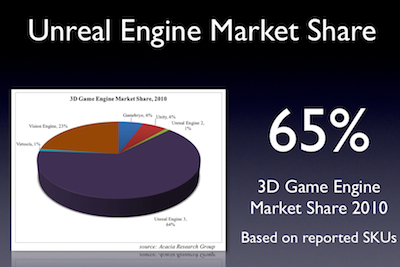
One game engine to rule them all. | Photo courtesy of TwitPic
Feast your eyes on this delicious pie chart.
Shared by Epic Games Vice President and Co-Founder Mark Rein via TwitPic, it shows a recent report from Acacia Research Corporation that puts the Cary-based gaming powerhouse far and above all of its competitors in the 3D engine market. With a whopping 65-percent market share in 2010, the company’s Unreal Engine outpaced its closest rival, the Austin, Texas-based Vision Engine, nearly threefold.
The company’s prominent market position is probably aided by its distribution strategy. The entire Unreal Development Kit, which game designers can use to create content on par with flagship titles like Gears of War and Mass Effect, is free for educational and non-commercial use. With a $99 licensing fee, developers can sell their games royalty-free until their sales exceed $50,000. The company has even sponsored several events in the local area, like Unreal University at the East Coast Game Conference, to spread the use of its engine.
But there’s more good news from this report for the Triangle. Another top engine, Gamebryo, was also developed by a Research Triangle Park company. With its product, Gamebase USA claims about 6 percent of the market, matching the share of another industry favorite, Unity.
All told, that means Triangle gaming technology is powering almost three-quarters of all 3D gaming titles. And when you’re talking about an industry that pulled in $18.6 billion in 2010, that’s no small matter.
Webby wins highlight gaming as lifestyle
Monday, May 23, 2011, 7:30 pm No Comments | Post a Comment Russ Pitts finds it hard to remember a time when he wasn’t playing video games.
From the Magnavox Odyssey to the Fairchild Channel F, Pitts embraced gaming as a kid in the 70s — and he hasn’t let go since.
“My whole childhood was filtered through this lens of games,” Pitts said.
That’s why it’s not a big surprise that Pitts is now at the helm of The Escapist, an online gaming magazine based in Durham. Now approaching its sixth-year anniversary, The Escapist competes for gamers’ attention with heavy hitters like IGN and Gamespot. Both sites — and others like them — are filled with reviews, walkthroughs and trailers to guide gaming consumers.
“Our challenge has been trying to find our footing as we grow to the size of these gargantuan companies,” Pitts said. “Our success has put us toe-to-toe with some of these giants.”
But The Escapist has a different strategy. Read more…
Gears of War 3 beta wraps up, but more for fans
Tuesday, May 17, 2011, 8:24 am No Comments | Post a Comment
Augustus "Cole Train" Cole blasts an enemy locust soldier to save wounded teammate Anya Stroud. Gears of War 3 was available in private beta until Sunday. | Photo courtesy of Epic Games
Cary-based Epic Games had more announcements this week for fans despondent over the end of the Gears of War 3 multiplayer beta.
The special preview of the anticipated title, which allowed a select few to battle each other to the death on new maps, ended Sunday night. While the full version of the game isn’t due out on store shelves until Sept. 20, Epic dropped another morsel in the lap of its fan base Monday: details about the coveted limited editions.
On top of the regular game, which will retail for $59.99, the special editions will include premium downloadable content and collectables — all available only in limited quantities. Here are the details, per Epic’s press release:
Epic Edition - $149.99
• A limited edition statue of main character Marcus Fenix, designed by Epic Games Art Director Chris Perna and crafted by the artisans at Triforce.
• The “Art and Design of Gears of War” by Tom Bissell, author of Extra Lives: Why Video Games Matter. The book is a behind-the-scenes glimpse into the game, with 96 pages of interviews, photos, concept artwork and more.
• Infected Omen Weapon Pack – custom multiplayer skins for the game’s five starting weapons; Lancer, Retro Lancer, Hammerburst, Sawed-off Shotgun and Gnasher Shotgun.
• Everything in the limited edition.
Limited Edition - $79.99
• An Octus Award Box with Octus Service Medal. A 1:1 match in size and weight, this zinc-alloy cog-shaped medal replicates the award given to Adam Fenix, father of the game’s main character, in recognition of his work on the Hammer of Dawn, a devastating weapon in the war against the Locust.
• Exclusive unlockable Adam Fenix Multiplayer character – Each Octus Service Medal replica is engraved with a unique Xbox LIVE code that is the only way to unlock Adam Fenix in multiplayer.
• A fabric Coalition of Ordered Governments (COG) Flag
• The personal effects of Adam Fenix, including his “Last Will and Testament,” the initial Hammer of Dawn schematic and other Fenix family mementos.
But Epic’s not likely done hyping the crown jewel of its trilogy, the first two parts of which sold more than 12 million copies since the saga began in 2006. Franchise Executive Producer Rod Fergusson announced on Twitter last week that if Gears of War 3 wins IGN’s Most Anticipated Game Award, they’ll run a week-long event granting players 30 times the points in the Gears of War 2 multiplayer during the E3 Conference June 6.
Can’t wait until then? Then satisfy your bloodlust with this gruesome execution montage, from IGN (warning: graphic). Cheers!
ECGC encourages designers to create
Friday, April 15, 2011, 1:58 pm 1 Comment | Post a Comment
Timothy Gregory, an aspiring game developer and student at Piedmont Community College, works with the Unreal Development Kit during the East Coast Game Conference Thursday. | Photo by Tyler Dukes
It was barely 10 a.m. Thursday and Timothy Gregory was already busy creating worlds.
With a few gestures, he willed the ground into existence, adding texture and flooding his environment with water. Minutes later, he added grim, metallic structures: from complex pillars to blinking machines with unknown functions. Then with a click of his mouse, he created light. Read more…
Gaming industry veteran: Things are getting interesting
Tuesday, April 12, 2011, 10:38 am No Comments | Post a CommentIn November, the gaming industry will celebrate its 40th birthday. With the release of Computer Space in 1971, the future founders of Atari set in motion a phenomenon that would change the way people look at entertainment, learning and even medical training.
And for 30 years, Mark Cerny’s been right in the middle of it.
The creator of classic titles like Marble Madness and more modern blockbusters like Crash Bandicoot and Spyro the Dragon, Cerny’s had his hands on almost every evolutionary form of the video game, from the coin-op arcade to the next-gen shooter.
Ahead of his Thursday keynote titled “The Long View” at the East Coast Game Conference in Raleigh, Science in the Triangle caught up with Cerny over the phone from his office in Burbank, Calif., where he runs his own consultancy firm Cerny Games.

Mark Cerny
Q: What do you think has been most significant about the change you’ve seen in the video game world in the last 30 years?
If you look at where it was when I joined the game industry in 1982, the center of the games industry was the video game arcade. Some of the most popular home games were versions of the arcade games.
If you look at the late 80s, the center of the world was the PC. That’s where all the creative action was. The GDC that we know today was actually the CGDC — the Computer Game Developers Conference.
By the late 90s, very console-centric, with either cartridges or CDs. Now it’s moved again: Facebook, iPhone, iPad have shown huge recent gains in market share.
Q: In the early 80s, we saw a market saturated with pretty terrible games, then a subsequent crash. Do you see parallels here with the emergence of so many mobile applications?
One thing we should be aware of is those games were terribly expensive back in the day. If you went to the store and bought a game from the store for $40 in 1980 or 1982, taking into account inflation, that’s about $100 today. I agree that not all the games demonstrated that much play value, but today, these games you’re talking about are games you can play for a buck, or maybe $3. I think it’s a much healthier market today.
Q: What do you think the fragmentation we’re seeing in the gaming market means for video games?
Certainly the core console gaming market is getting soft. We saw a 5 or 10 percent decline in 2009 and about the same in 2010. I’ve been through some of the great crashes, and it does make me wonder a bit if we are headed for one.
Q: So is it just a wait-and-see situation at this point?
The diversity we have right now is really healthy. It’s nice to see so many people who wouldn’t normally spend much time on electronic entertainment going out there and playing these games.
I was in London two years ago and my cab driver had just discovered the iPhone and he was going crazy over the number of 99p games that he could buy. This was a guy who had never played games before.
On the biggest-level picture, it’s healthy because the audience is broadening dramatically through the iOS games and Facebook games.
Now, if I’m going out there and I want to create a 20-hour single-player experience for console that’s going to cost $50 million to develop, yes, there are implications for that, and I’m not sure the economics of that are as healthy today as they were three years ago.
Q: What still excites you about working in the video game industry?
This is my 30th year of making games, and I have to say the first half of that was not as interesting as the second half.
Until the original PlayStation came out, it wasn’t really possible to create the kind of game I personally was interested in making. I was a hobbyist programmer in the 1970s. My brother and I were trying to make a real-time 3D action RPG. Now needless to say, that’s a terribly ambitious thing to go after. We had a couple hundred thousand dollars of university equipment we were borrowing to do this. We were programming in punch cards. When I finally saw the game we were trying to make, it was called Final Fantasy VII.
Ironically, I got into arcade games, where the games were three minutes long or five minutes long, so I didn’t have a chance to make the games I was interested in making until I started collaborating with Naughty Dog on the Crash Bandicoot series and Insomniac on the Spyro the Dragon series. From that standpoint, Spyro the Dragon, which had narrative in it, was much closer to the vision I had as a child of what I wanted to make. That was just 1996.
NVIDIA graphics wizard on Marcus Fenix and Minecraft
Monday, April 11, 2011, 10:50 am No Comments | Post a Comment

Tony Tamasi
From text-based adventure titles to dystopian 3D shooters, video game graphics have come a long way. But if people like Tony Tamasi have anything to do with it, that rapid progression won’t be stopping anytime soon.
NVIDIA‘s senior vice president for content and technology will be in Raleigh Wednesday for the East Coast Game Conference, when he’ll deliver his keynote address titled, “The Future of Graphics Processing.” Science in the Triangle caught up with Tamasi by e-mail to discuss where graphics are heading in the gaming world — and how gamers’ constantly changing palates will guide that growth.
Q: What role do you think graphics play in the quality of a game, especially when it comes to things like storytelling and gameplay?
Graphics is one of the core components of great games. Obviously graphics alone don’t make a great game, but great graphics can help to make a game better, more immersive and more enjoyable. For example, horror-style games would be significantly less scary if lighting and shadows couldn’t be done interactively. Seeing some creepy shadow approaching around a corner can really help to set the mood.
Q: How are technological advancements changing how game developers think about graphics?

Epic's "Samaritan" demo showcased the new Unreal Engine 3. | Image courtesy of Epic Games
The transition of graphics processors to these generally programmable devices has really allowed game developers to become much more creative and get much closer to the visions they have in their head. Some of the most recent advances in graphics processing with DirectX 11-class graphics processing units enable incredible levels of geometric richness through procedural tessellation, the ability of the GPU to create geometry from a higher-level surface representation or to extrude real geometry from displacement maps. Increased levels of geometric realism can help environments seem much more realistic, and characters much more lifelike as artists are less constrained to a small number of polygons, which ultimately leads to harsh silhouette edges that look more like a collection of polygons than something alive.
Q: Despite the explosion in power of both console and desktop gaming platforms, we’re seeing a surge in popularity for games with a more retro aesthetic — like Minecraft for example. What do you make of this movement?
It’s fantastic. We’re seeing a resurgence in innovative gameplay. Minecraft is a fantastic example of a creation/exploration type of game, and despite its retro look, can be incredibly addictive. I would expect that as before, as new gameplay or design mechanics are developed, over time they will evolve, and as future games incorporating these concepts are developed, they’ll layer on not only enhancements to gameplay, but improved visuals, physical simulations, more intelligent AI, etc. It’s incredibly important that the game development industry continues to be creative and innovative, since all of us gamers have a little bit of ADD in us and are always looking for something new to challenge or delight us.
Q: We’re seeing a huge shift as gamers embrace mobile gaming platforms. How do you think this fragmentation will affect the development of graphics processing?
Fragmentation can be a difficult problem for game developers to address. Happily, for things like the Android, iPhone, Xbox 360 and PS3, the core graphics capabilities aren’t that different (the horsepower obviously is). So from a core architecture perspective, it isn’t an intractable problem to design an engine that can span a very wide dynamic range of devices. Unity and Unreal Engine are obvious examples of the ability to have core engine technology with range. Epic’s latest demonstration of their engine’s capability, Samaritan, also shows that it’s possible to build incredibly stunning real-time graphics capabilities on this core technology.
There’s no doubt though that designing a game that pushes the envelope on today’s high end DX11-based GeForce GTX 580 will involve different art, assets and capabilities than a game that is targeting mobile devices. In many ways though, mobile device capability and horsepower isn’t that different from consoles from a few years back, so to some degree the industry’s already “learned” how to develop for that.
It’s an incredibly exciting time for game developers. Resurgence of mobile, a new renaissance of game design and creativity, revolutions in business models, pervasive connectivity, enormous increases in graphics capability and power, devices with huge numbers of input devices and sensors, and next-generation functionality and platforms – all mean the next decade should be a great time for creative developers to tap the enormous potential of our rapidly changing ecosystem. I can’t wait to see how awesome these new games are going to be!
Interested in the East Coast Game Conference? Science in the Triangle’s got you covered! Follow all our stories on the conference.
Sponsor boost lowers price of gaming conference passes
Thursday, April 7, 2011, 12:34 pm No Comments | Post a Comment
Attendees at last year's Triangle Game Conference listen to a speaker. | Photo courtesy of Capstrat
Good news for cash-strapped game developers looking for a way into next week’s East Coast Game Conference: Organizers slashed the price of professional passes more than $100 last week.
The $99 pass grants visitors access to all the sessions and keynotes, as well as access to the expo hall. Pass holders can also visit the career lounge, where they can speak with industry professionals, and Unreal University, where they’ll be able to get hands-on with Epic Games’ Unreal Development Kit.
The lower prices are a result of conference donors Epic, Joystick, ECU, Trailblazer, Wake Tech, Autodesk and Cinesys, which provided greater-than-expected donations for the rebranded event once known as the Triangle Game Conference.
“We had a number of companies step up in their sponsorships,” conference co-founder Troy Knight said. “That allowed us to take the money we made for the conference and lower the costs for smaller incubators and independent companies.”
The passes, once priced at more than $200, were “really a stretch” for many smaller and aspiring developers, according to conference co-founder John Austin. He said organizers have already seen an uptick in registrations as a result of the lower price.
Although it’s in its third year, Knight said the organizers are able to make conference funding go further because the Triangle Game Initiative, the trade group putting it all together, is a nonprofit focused on benefiting the local gaming industry.
“None of us gets paid to do the conference. The money goes back into a pool to do more events,” Knight said. “It’s really a helping handout for the local community.”
A week out from the event, Knight and Austin said registration numbers already match attendance last year, which was around 800 people. Organizers are aiming for more than 1,000 at this year’s conference.
Local gaming magazine’s ‘March Mayhem’ features local developers
Friday, March 18, 2011, 9:24 am No Comments | Post a Comment Tobacco Road may have its fair share of top-tier college sports teams, but now nearby gaming companies have the chance to compete in a little March Madness of their own.
The Escapist, an online gaming magazine based in Durham, is allowing users to vote for their favorite developers during its March Mayhem 2011 tournament. Among the bevy of 64 competitors are the Triangle’s own heavy hitters — Epic and Insomniac — which have already progressed to round two of the tournament.
Voting for round two ends Saturday at noon and the final round will wrap up April 4.
And what good would a tournament be if you can’t fill out a bracket for bragging rights and prizes? Although the deadline for filing a bracket was March 14, users can still vote for their favorite developers through the end of the tourney.
So when you’re done helplessly watching your teams and brackets crash and burn in the NCAA showdowns this month, pop on over to The Escapist and cast a vote for our home teams. It’ll feel better than yelling at the big screen.


