Archive for the ‘Science Museums’ Category

ScienceOnline2011 – interview with Kari Wouk
Saturday, July 23, 2011, 11:45 am No Comments | Post a CommentContinuing with the tradition from last three years, I will occasionally post interviews with some of the participants of the ScienceOnline2011 conference that was held in the Research Triangle Park, NC back in January 2011. See all the interviews in this series here.
Today I talk to Kari Wouk, Senior Manager of Presentations and Partnerships at the NC Museum of Natural Sciences in Raleigh.
Read more…

Couple documents evolution as it happens
Friday, April 15, 2011, 8:56 pm No Comments | Post a CommentIf Charles Darwin returned to the Galapagos Islands today, he would find all but one of the finch species that lived there during his visit in the 1830s. But he would also find birds that look and sound different.
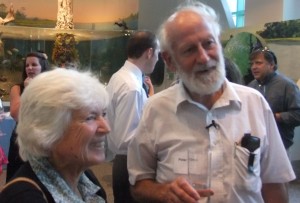
Rosemary and Peter Grant during a reception in their honor at the N.C. Museum of Natural Sciences
Peter and Rosemary Grant, husband-and-wife evolutionary biologists at Princeton University, have written about a medium ground finch that is heavier, has a broader beak and sings a different song than its closest relative.
The Grants have documented the emergence of this medium ground finch lineage since 1981, when they caught what they believe was an immigrant bird on Daphne Major, a tiny Galapagos island where they’ve measured, weighed and tagged ground finches several months every year since 1973.
The new lineage, which nobody has dared to call a new species yet, has been molded by droughts, above average rainfall and competition for food - factors that also affected other finches living on Daphne Major.
“In the 2000s, the birds are not the same as the ones that were on the island when we started,” Peter Grand told a crowd of more than 200 who had come to his and his wife’s presentation April 11 at the N.C. Museum of Natural Sciences in Raleigh.
That evolution can happen as researchers watch was unexpected. That the Grants documented the making of what might be a new species in 20 years has turned them into legends.Their research has won multiple awards and is featured prominently in biology textbooks and one Pulitzer-Prize-winning book.
The couple’s visit to North Carolina’s Research Triangle was the result of a collaboration of the museum, N.C. State University and the National Evolutionary Synthesis Center.
Thirteen species of ground finches live on the Galapagos archipelago, a cluster of more than a dozen islands located in the Pacific Ocean about 600 miles west of Equador. They are plain birds with brown, gray or black plumage that have been famous since they helped Darwin develop the theory of evolution.
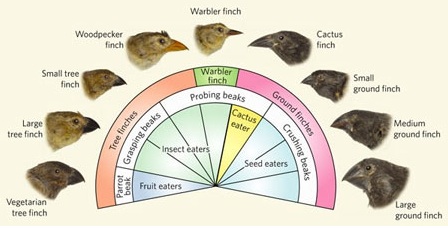
Darwin's finches
All descend from one species that lived on the South American mainland.
The smallest finch species on the Galapagos Islands weighs about one-fourth of the largest species and each species has developed a specific beak to eat a special diet.
The Warbler finch has a slender beak to probe for insects. Ground finches have broad beaks to crush seeds of various sizes. Cactus finches have long, curved beaks to probe flowers for nectar. The large tree finch has a powerful, curved beak to strip bark and extract insects and termites.
The diet has a lot to do with where a species lives. The medium tree finch, for example, can only be found on Floreana Island. The common cactus finch lives on all but the five Galapagos Islands that are inhabited by the large cactus finch.
Daphne Major is home to four species, the Grants reported. The couple caught small, medium and large ground finches and cactus finches, including some that had immigrated from neighboring islands.
The males of each species sing a different song, which male and female birds learn as nestlings listening to their fathers. Males and females of a species recognize each other by that song. Interbreeding can occur, Rosemary Grant said, for example, when the fatherly lesson gets garbled because the nest is close to the nest of another species in the same cactus bush.

Immigrant hybrid male the Grants caught in 1981. Source: Proceedings of the National Academy of Sciences
In 1981, the Grants caught a medium ground finch immigrant whose plumage was particularly glossy and black. The male bird was about 20 percent bigger than the biggest medium ground finch captured on Daphne Major and had a wider beak. It also sang an unusual song and a blood test determined that it carried cactus finch genes.
The immigrant hybrid male mated with a female hybrid that also carried genes of both species. Three generations of offspring - finches live up to 16 years - bred with local medium ground finches and other hybrids.
Then, all but two of the birds in the lineage died during a severe drought in 2003 and 2004. The remaining two birds, a sister and a brother, mated and their offspring has mated, but only with each other.
This has led to two distinct groups of medium ground finches on Daphne Major that do not mix, the Grants reported. They differ in weight, beak shape and song and breed in two different areas on the island.
(More in the Grants’ inaugural article in the 2009 Proceedings of the National Academy of Sciences.)

“Doctor Bugs” visits the Triangle
Wednesday, October 20, 2010, 11:11 am No Comments | Post a Comment
Cover of the Adventures Among Ants, by Dr. Mark W. Moffett.
Not many scientists beg perfect strangers to eat the species they study. But that’s just what “Doctor Bugs” did when visiting tourist-magnet ruins in Cambodia. Dr. Mark W. Moffett proffered a dish of scrumptious crackers topped with herbs and, um, plump ant larvae to passersby — at times literally pleading with them to try it. It’s just one of the ways the world-famed ecologist, and Smithsonian Institution research associate, gets people to stop and notice the trillions of ants that share our world.
Moffett’s comedic showman personality was on display in full force on Tuesday night as he entertained an auditorium full of people at the N.C. Museum of Natural Sciences with stories about ants. And boy does he have stories. There’s the time he snaked a small camera attached to a long cable into a nest of weaver ants, capturing engaging footage of the ants at work… the camera pushed farther and farther past hundreds of ants, until ants swarmed the other end of the cable and overran him. The footage ended abruptly with audio of Moffett yelping in pain. Then there’s the time he stepped barefoot on a pair of ant forceps in his camp and spent the day worrying he’d been bitten by a poisonous snake, a fair concern considering there was a nest within a foot of his hammock. And let’s not forget the time he actually did sit on the world’s most poisonous snake in South America, too engrossed with photographing ants to notice.”If you must sit on a poisonous snake, sit closest to their head,” Moffett deadpanned to the crowd. “It’s the best way. It’s the only way.”

National Geographic cartoon of Moffet squatting on a pit viper.
More often, Moffett’s stories are about the ants themselves — their diverse ways of sensing the world, interacting, and divvying up labor to achieve survival goals efficiently. Moffett’s high-energy slide show was centered around promoting his new book, Adventures Among Ants: A Global Safari With a Cast of Trillions, published by the University of California Press.
“Ants differ from us in that the individual doesn’t matter, it’s all about what’s good for the group,” Moffett said. But they’re colonies are a lot like our cities, he went on to explain, drawing analogies between small cities/small ant colonies and large cities/large ant colonies. In smaller colonies, where there is less specialization of labor, each ant has to be a jack-of-all-trades and perform a variety of tasks.”They have their toolboxes built-in to their faces,” Moffett said, flashing a picture of a type of trap-jaw ant with extra long pitch-fork tipped jaws. It uses the long levers to pick up struggling prey and carry it safely back to the nest. But a much smaller, second pair of jaws tucked closer to its mouth allows it to eat.
Larger colonies, like our larger cities, tend to have more job specialization, Moffett said. Scientists can often tell what role they play by their size. Sometimes the largest ants of the same species outweigh the smallest ones by 500 times. The goliath ants are often used to deliver the death blow (a sting, or a bite) in battles with other ants or interlopers, and even act as “school busses,” allowing smaller ants in their colony to hitch rides. “Basically, it’s more energy efficient for the colony if the smaller ants ride on the bigger ants,” Moffett explained.

Leaf cutter ants cooperate to bring leaf fragments to their underground nests, where "gardener" ants cultivate a fungus upon the decaying vegetation. The colony harvests and eats the fungus. (Photo by Dr. Mark W. Moffett)
He also talked about various ways that ants work together, like the free-diving ants in Borneo that live in pitcher plants. They fetch crickets out of the water pooling in a pitcher’s basin, then haul it to the lip of the pitcher where they stash it and have a feast. The crickets are often too large for the pitcher plants to digest, he explained, so the ants are doing the plant a favor by saving it from experiencing an overdose of acid as the cricket decays. “They’re basically antacids for the plant,” Moffett joked.”But they also must have the strongest toes in the world to carry these large crickets up the slope of the pitcher plant, which is made so that insects will fall into its trap.” Ants also form chains to create living bridges that they use to cross from one tree to another high amid the canopies of rainforest trees, hundreds of feet from the forest floor. And some ants will sacrifice themselves to fill “pot holes” along highways the colony uses to move things to and from their nest. Then there are the leaf cutter ants, which divvy up leaf harvesting and fungus cultivating duties like nobody’s business (see photo at right).
Moffett’s photographs have been widely published and he often contributes work to National Geographic magazine. He searches for images that tell a story within their frames, he said, like the one he took of a battle between two ant species that shows a Goliath ant fending off attacks from smaller ants, with the carnage of warfare in the background: headless ants frozen mid-stride, and ants with their torso’s chopped in two and legs torn asunder. He encouraged the kids in the audience to “not lose that weird point of view you have when young,” because it can be valuable to being a scientist. He credits his own path to biology and entomology with reading too many Jane Goodall adventure books when younger, and climbing too many trees.
Moffett’s talk deftly distilled insights about ant ecology and social interactions into anecdotes that enthralled kids and adults like me who are in touch with their inner kids. If you missed his talk, you did miss out — but don’t sweat it, you can always order the book.
MORE MOFFET, LINKS:
Moffett on NPR’s Fresh Air; June 17, 2010
The hidden world of ants, Smithsonian Magazine; July 2009
Science Communication Conference and Scienceblogging.org
Thursday, August 26, 2010, 9:46 pm 1 Comment | Post a Comment The first Science Communication Conference was held in Raleigh, at the North Carolina Museum of Natural Sciences last Saturday, organized by the Museum, SCONC (Science Communicators of North Carolina) and UNC-TV’s QUEST.
Read more…
Duke: How germs influenced the Civil War
Wednesday, April 14, 2010, 11:01 pm 2 Comments | Post a CommentNowhere are the medical advances of the past 150 years more obvious than during war. A U.S. soldier who is injured today on the battlefield in Iraq has about a 95 percent chance of survival. In World War II, the chance was 50 percent and during the Civil War it was 19 percent.
But the benefits of modern medicine go well beyond combat surgery.

Dr. Margaret Humphreys
Dr. Margaret Humphreys, a Duke University professor in the history of medicine and a fellow at the National Humanities Center in Research Triangle Park, issued a reminder Tuesday during a lecture at the N.C. Museum of History in Raleigh that germs bag a bigger punch than bullets.
“It wasn’t until World War I that more soldiers died from wounds than from disease,” Humphreys said during her lecture on the role malaria and yellow fever played during the Civil War. Read more…
ScienceOnline2010 - interview with Russ Williams
Thursday, March 11, 2010, 12:19 pm No Comments | Post a CommentContinuing with the tradition from last two years, I will occasionally post interviews with some of the participants of the ScienceOnline2010 conference that was held in the Research Triangle Park, NC back in January. See all the interviews in this series here. You can check out previous years’ interviews as well: 2008 and 2009.
Today, I asked Russ Williams from North Carolina Zoological Society and the Russlings blog to answer a few questions:
Megalodon and other sharks at Darwin Day
Saturday, February 13, 2010, 8:44 am 1 Comment | Post a CommentLast night, braving horrible traffic on the way there, and snow on the way back, I made my way to the N.C. Museum of Natural Sciences for the Darwin Day shark lecture co-organized by NESCent and the sneak preview of the Megalodon exhibit which officially opens today.
RTP Weekahead 2/8
Sunday, February 7, 2010, 5:24 pm No Comments | Post a CommentEvents taking place the week of Feb. 8 in the Research Triangle area that are open to the public: Read more…
N.C. Museum of Natural Sciences: a jewel in The Triangle
Saturday, January 16, 2010, 7:02 am 5 Comments | Post a Comment
NC Museum of Science whale skeletons. (Photo courtesy of NCMNS)
The decision to build Research Triangle Park was made about 230 million years ago in the Triassic period. At least, it was according to the director of exhibits at the N.C. Museum of Natural Sciences. Roy Campbell, leading a tour of participants in the ScienceOnline 2010 conference, pointed to a satellite image of the state and swept his hand across a swath of green that ran from Asheboro northeast to RTP. “The soil here is just awful, you can’t farm it,” he said. “This is the Triassic Basin, it used to be the poorest part of the state.” He pointed to breaks in the green canopy of land cover, noting where RTP was located as well as Duke University, UNC-Chapel Hill, and NC State University. “Today there is a think-tank here, here, here and here,” he said pointing out each university. “And now this is the richest part of the state, and one of the richest areas of the nation.” Read more…


