Archive for October, 2011

NC biotech industry eyes unique chance to shape the FDA
Saturday, October 15, 2011, 8:48 pm No Comments | Post a CommentGov. Beverly Perdue’s announcement that a California biotech will set up shop in North Carolina’s Research Triangle was a welcome but short-lived diversion Wednesday during the annual meeting of the North Carolina Biosciences Organization in Research Triangle Park.
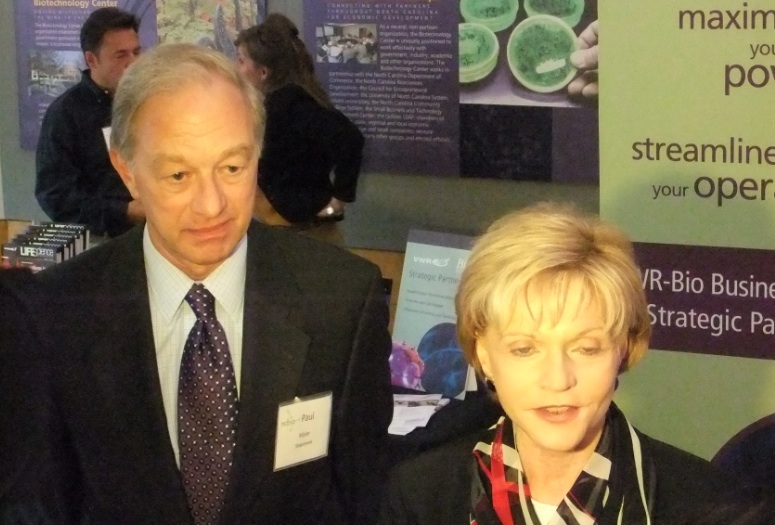
Paul Maier, Sequenom's chief financial officer, and Gov. Beverly Perdue face the TV cameras following Perdue's announcement that San Diego-based Sequenom will open a large lab in the Research Triangle.
Sequenom, a San Diego-based diagnostics company, plans to open a lab on Kit Creek Road next year and start analyzing blood samples from a new, prenatal blood test to detect Down Syndrome. The test would replace more invasive measures such as amniocentesis, which employs a long needle to sample amniotic fluid from inside the uterus.
Sequenom will invest $18.7 million and create up to 242 jobs.
The standing-room-only audience in the N.C. Biotechnology Center auditorium gave Paul Maier, Sequenom’s chief financial officer, a round of applause before Maier and Perdue faced the TV cameras and reporters outside.
Then, the biotech executives inside the auditorium went back to the unique chance that presents itself next year to shape the U.S. Food and Drug Administration.
Andrew von Eschenbach, former FDA commissioner and NCBIO’s keynote speaker, left no doubt that nothing short of a radical therapy will do.
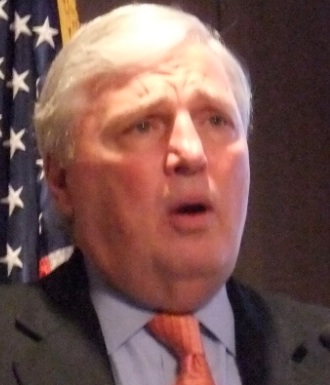
Andrew von Eschenbach
“We’re approaching a crisis situation [in the U.S.] as far as being at the forefront of innovation,” Eschenbach said. The FDA is “in need of a systematic, systemic and formal revision. The moment for modernization is now.”
The FDA has been under close public scrutiny since 2004, when Vioxx was linked to thousands of sudden cardiac deaths before Merck pulled the pain killer off the market.
In 2009, a report released by the Government Accountability Office, the investigative arm of Congress, listed the FDA at risk of failing to fulfill its mission. Chronic underfunding, expanding responsibilities and an aging workforce that wasn’t keeping up with the rapidly advancing science hobbled the agency.
In July, FDAImports.com, a blog written by regulatory consultants, published information that suggested FDA Commissioner Dr. Margaret Hamburg was restructuring the agency’s top management tier. As a Washington Post profile pointed out, Hamburg, a Harvard-trained physician and former New York City health commissioner, had no ties to the pharmaceutical industry when President Obama appointed her.
With changes already under way at the FDA, it could become a watershed year.
In 2012, renewal of the Prescription Drug User Fee Act, or PDUFA, is up. Enacted in 1992, PDUFA established a funding mechanism for the FDA to regulate new medical products and make sure they are effective and do no unnecessary harm. The federal law has been subject to changes every five years, when Congress had to renew it to keep the system going.
The potential for significant changes is particularly large in 2012, because PDUFA for the first time is due for renewal during a presidential election year. And what a turbulent election year it promises to be four years into stubbornly high unemployment, ongoing banking crises and steep government budget cuts.
“This is going to create some interesting politics in Congress,” said J.C. Scott, the head lobbyist for AdvaMed, a trade association representing the medical device and technology industry. Scott was one of several NCBIO speakers addressing regulatory policy recommendations for overhauling the FDA.
Lobbyists for the biotech, pharmaceutical and medical device industries are not about to pass up this opportunity.
Young and small companies are getting squeezed by a lack of innovation capital. (More on innovation that isn’t being funded here.) Facing stagnant research and development productivity and the expiration of valuable drug patents in the U.S., large drugmakers have been cutting jobs for years. (More on the lack of big pharma R&D productivity here.)
The Biotechnology Industry Organization, or BIO, has already drawn up a wish list of changes. According to Cartier Esham, BIO’s senior director of emerging companies, health and regulatory affairs, who also spoke at NCBIO’s annual meeting, policy items on the list include:
- a fixed six-year term for the commissioner,
- the use of electronic health records and smart phones in clinical trials,
- faster approval of products for unmet medical needs similar to how European regulators do it,
- improved advisory committees,
- the establishment of chief medical policy officer positions and
- setting up the FDA with an independent budget. (The FDA is now funded under the U.S. Department of Agriculture.)
“It is our intent,” Esham said, “to get as many of these [policy changes] enacted into legislation as possible.”
RTP biotech companies travel to Bay Area to pitch to investors
Friday, October 7, 2011, 12:16 pm No Comments | Post a CommentYoung biotech companies in North Carolina’s Research Triangle don’t have to read Ernst & Young’s 2011 industry report to know that early stage funding is down, that investors increasingly tranch their payments and make the tranches dependent on milestone accomplishments, that competition from other industries is growing fiercer for venture capital nationwide. (More on what isn’t being funded here.)
But sitting around and complaining doesn’t help, either. So, seven Research Triangle Park area biotech companies decided to do something. Last month, they traveled to the San Francisco Bay Area on their own dime to meet with potential investors.
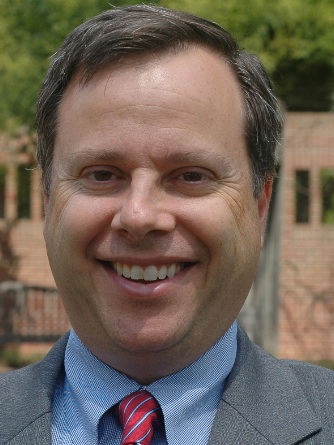
Peter Ginsberg
The trip to Palo Alto, Calif., was the first of its kind the N.C. Biotechnology Center organized, said Peter Ginsberg, the biotech center’s new vice president of business and technology development.
“We wanted to change the way Bay Area venture capitalists think about North Carolina companies,” Ginsberg said. “And maybe, maybe, down the line, knock, knock, knock, get them to open an office here.”
A report that the biotech center submitted to state legislators in January offers clues where investors from outside the state see shortfalls in the North Carolina biotech industry, which is centered in the RTP area and along the Interstate 85 corridor to Charlotte.
Even though in 2010 North Carolina was home to about 500 biotech companies that employed more than 225,000, ranking the state third behind California and Massachusetts, very few of the North Carolina companies generated revenue. Also, among the companies located in the state only 10 were publicly traded, according to Ernst & Young. That’s about 3 percent of all publicly traded biotech companies nationwide.
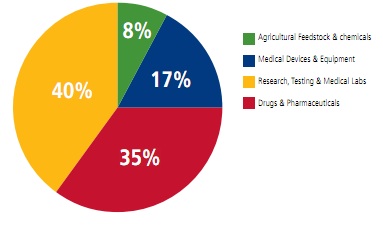
North Carolina's biotech employment is diverse.
Compared to other biotech hot spots, North Carolina lacks local life science entrepreneurs who successfully developed products and brought them to market and who financed multiple entrepreneurial ventures. (More on building entrepreneurial networks in the RTP area here and here.)
And the state’s many research institutions haven’t done a very good job translating their sponsored research into products.
As a former biotech analyst, institutional investor and company executive, Ginsberg has a good grasp of the fallout.
“We don’t have the breadth of life science venture capitalists as California or Massachusetts,” he said.
Add to that travel inconveniences.
The Bay Area is home to many venture capitalists, but without a non-stop flight to Raleigh-Durham International Airport most are reluctant to visit the RTP area, he added. “Venture capitalists travel a lot and it’s not easy for them to get here.”
So, traveling to Palo Alto for a day-long meet-and-greet with investors was similar to Muhammad going to the mountain to preach because the mountain wasn’t going to come to Muhammad.
The event was sponsored by Silicon Valley Bank, which has operations in the Triangle, and attracted more than a dozen venture capital firms, Ginsberg said. He declined to name them.
The seven biotech companies were traditional drug development companies, medical device and diagnostics companies and a company developing vaccines:
- Advanced Liquid Logic in Morrisville is working on a lab-on-a-chip based on nanotechnology developed at Duke University. Founded in 2004, the company has received $15 million in grants and $8.1 million in angel funding.
- CoLucid Pharmaceutical in Durham is testing a migraine drug in patients and working on therapies for chronic pain, Alzheimer’s disease and depression. Founded in 2005, the company has raised $42 million in venture capital.
- Heat Biologics, which relocated its headquarters from Miami to RTP this year, is working on therapeutic vaccines to combat a range of cancers and infectious diseases. Founded three years ago, the company has not released its funding.
- nContact in Morrisville develops and sells medical devices for minimally invasive treatment of heart arrhythmia. Founded in 2005, the company has raised more than $42 million.
- Scynexis in RTP is a drug discovery and development company that has delivered 11 drug candidates to customers in the past five years and is working on its own pipeline of experimental therapies. Founded in 2000, the company collaborates with Merck on a cancer drug and is part of a consortium working on the first pill to treat human African trypanosoniasis, also known as sleeping sickness.
- TearScience in Morrisville in July received regulatory approval to sell its first product, a medical device to treat dry eye patients in an outpatient procedure. Founded in 2005, the company has raised more than $60 million in venture capital. To bring the dry eye device to market, TearScience recently received $15 million in debt financing.
NCSU scientist chases tornadoes to better understand them
Sunday, October 2, 2011, 10:24 pm No Comments | Post a Comment
Matt Parker
Matt Parker, a N.C. State University associate professor, sounded almost nostalgic when he talked about the more than 700 tornadoes that were reported roaring across the South, Southeast and Midwest in April, about four times as many tornadoes as hit the U.S. during an average April.
Parker is an atmospheric scientist and has studied how tornadoes develop to help improve weather forecasts.
“This was a historic year,” Parker told science writers and educators during a Sept. 27 talk at Sigma Xi in Research Triangle Park.
A spring storm season like this year’s doesn’t come around often. That’s a good thing, considering the loss of life and the devastating destruction the tornadoes wrought.
 April 2011 ranks as the most active tornado month on record, according to the National Oceanic and Atmospheric Association. A storm system that moved across Oklahoma, Arkansas, Mississippi, Alabama, Georgia, North Carolina and Virginia in mid-April killed 43 people, 22 of them in North Carolina. One of the tornadoes it spawned April 16 cut a 180-foot-long track through suburban Wake County, Parker said.
A second storm system at the end of the month was even deadlier. It caused a super outbreak of tornadoes in the South that killed more than 300 people in four days, according to NOAA.
A month later, on May 22, a powerful tornado hit Joplin, Mo., killing 157 people. According to NOAA, the Joplin tornado packed winds of more than 200 miles per hour, it was nearly a mile wide and its track lasted 6 miles.
What about climate change? Could that be a cause for the historic outbreak of tornadoes this year?
“We really don’t know,” Parker said.
A tornado is a mere blip in a 100-year data set that tracks changes in the climate, he said. The increase in the number of reported tornadoes, he added, is likely due to better forecasting and warning systems, a higher population density and the increase in the number of storm chasers.
What was devastating and deadly to the people who lived in the tornados’ way could have provided scientists like Parker with a bevy of otherwise hard-to-come-by data.
In May and June of 2009 and 2010, Parker and his team of students were among about 100 scientists who tracked storms with radar, measured wind speeds, sent up weather balloons and fed the information to a database. The study, called VORTEX2, was one of the largest field studies to determine the origin of tornadoes and a follow-on to a more limited tornado hunt in 1994 and 1995. The teams had about $10 million worth of equipment at hand.
April 2011 was never part of VORTEX2′s data collection phase.
Working with tornadoes is often frustrating, Parker acknowledged. May and June 2009 were two very uneventful months - only two storm systems that generated tornadoes.
“Two thousand ten was much better,” Parker said. “On some days we had the pick of tornadoes.”
About 40 storm systems with the potential to generate a tornado, also known as super cells, and about 20 tornadoes occurred in May and June 2010, he said.
A super cell starts similarly to an ordinary thunderstorm. Warm, moist air rises amidst cooler surroundings and the moisture condensates. In an ordinary thunderstorm, the precipitation creates a cool downdraft that cuts off the warm, moist updraft within about 30 to 45 minutes. The storm dissipates.
A super cell thunderstorm develops when strong upper-level winds allow the warm, moist updraft to continue for up to six hours. The stage is set for the downdraft and the updraft to begin rotating.
But the process that produces a tornado in a super cell thunderstorm is not well understood, Parker said.
For example, strong super cells are not associated with tornadoes, he said. Storms with similar structures may differ in tornado production. And the relationship between near-ground wind fields and structural damage isn’t clear either.
Scientists hope that once the VORTEX2 data is crunched and analyzed and published, some of the questions will be answered, Parker said. Especially head-to-head comparisons of data collected from storms that generated tornadoes and storms that didn’t might be fruitful.
Goals of the VORTEX2 study are to extend the average lead time for tornado warnings from about 13 minutes currently to at least 35 minutes and reduce the false alarm rate, which is currently at about 70 percent.


