
RTI broadens energy research with federal greenbacks
Wednesday, July 14, 2010, 8:54 am 1 Comment | Post a CommentTechnologies that promise to lower greenhouse gas emissions and demand for U.S. oil imports are becoming more prominent on RTI International’s research smorgasbord, which has featured efforts in a related field, air pollution monitoring, as a reliable staple for the past 30 years.
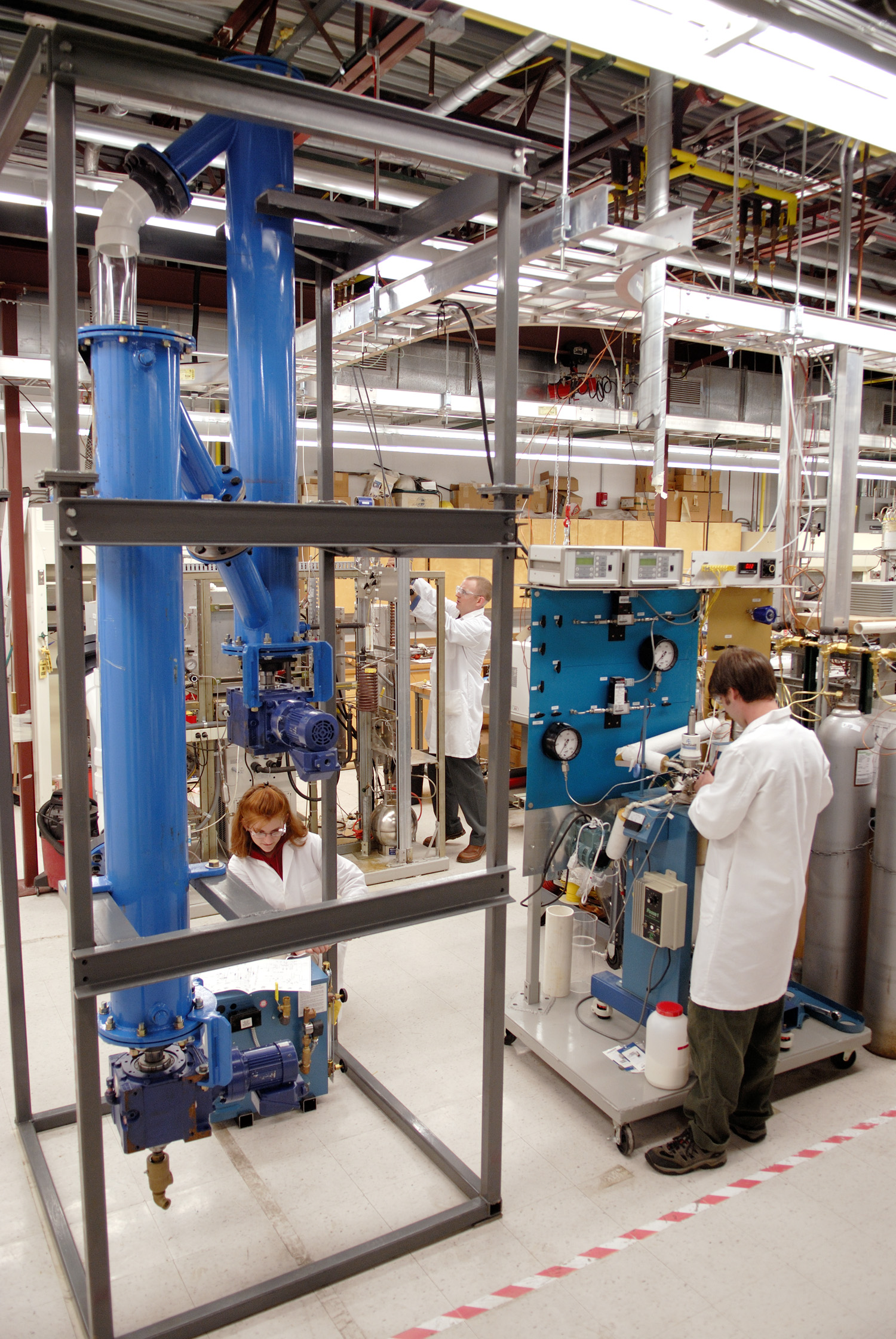
RTI energy lab (Photo courtesy of RTI)
One of the founding members of the Research Triangle Energy Consortium three years ago, RTI has scientists working on projects that include the capture and reuse of carbon dioxide - the most prominent greenhouse gas in the Earth’s atmosphere - production of bio-crude from organic waste and a nanotechnology light bulb that promises to be more energy efficient than a fluorescent light and doesn’t contain harmful mercury.
Stimulus funds the U.S. Department of Energy has awarded in the past year to help the economy recover fueled RTI’s stepped-up energy research. Of the institute’s $750 million in estimated revenue this year, energy research will contribute about $12.5 million, said RTI spokesman Patrick Gibbons.
That’s still a small amount, but as Gibbons pointed out during a tour of the Johnson Building last month, “Energy is growing tremendously.” The Johnson Building, which opened four years ago, is home to most of the environmental and energy research on the sprawling, 50-year-old RTI campus. The tour was organized by SCONC, a Triangle-based group of science writers.
The American Recovery and Reinvestment Act is funneling more than $35 billion into research projects nationwide. North Carolina universities, companies and institutes have been awarded about $1 billion - about $271 million from the National Institutes of Health for medical research and more than $800 million from the DoE for energy research, energy efficiency and renewable energy projects.
Federal research funding has long been a lifeblood of North Carolina’s universities, particularly in medical research. Duke University, the University of North Carolina at Chapel Hill and Wake Forest University garnered nearly 80 percent of North Carolina’s share of the $10 billion in stimulus funds the NIH awarded last year. RTI received about $5.6 million.
The state and the RTP area are not as well known for research into alternative energy and green technologies. About half of North Carolina’s share of the DoE’s more than $25 billion in stimulus funding so far has gone to the state’s two big utilities, Duke Energy and Progress Energy. RTI is involved in about a dozen energy research projects. Half of them were awarded in the past year with DoE commitments of about $7 million.
RTI had applied for more DoE funding, including a $120 million solar fuels center and a $20 million pilot plant to convert wood waste into liquid hydrocarbon with the help of high temperatures, high pressure and catalysts. The pilot plant was to be located at the N.C. Biofuels Center. But neither project was approved.

A bottle of bio-crude (Photo courtesy of RTI)
Much of RTI’s approved stimulus projects are also related to next-generation biofuels made by exposing cellulose-rich biomass, such as corn stover, wood chips and switchgrass, and other waste, such as hog manure, to high temperatures. Also known as pyrolysis, the technique is heavily used in the chemical industry and turns the waste into a gas or an oily liquid.
“Everything we do is high pressure, high temperature,” said David Dayton, director of the chemistry and biomass program at RTI’s Center for Energy Technology.
The gasified waste, also known as syngas, and the bio-crude must then be cleaned of impurities before they can be processed into liquid fuel. At RTI, researchers are testing a multitude of chemicals, or catalysts, that scrub contaminants.
In the next decade or so, Congress want to see domestically produced biofuels reduce U.S. oil imports by about 30 million barrels per year and eliminate more than 15 million tons of CO2 per year.
RTI researchers are also working on technologies to reduce CO2 emissions. Lora Toy, for example, oversees a project aimed at developing polymer membranes that capture up to 90 percent of the CO2 emissions from coal-fired power plants with the goal of increasing electricity costs by less than 20 percent.
On most of these projects, RTI is working with a corporate partner to develop the technology for commercial use.


[...] has also ramped up research into green technology and alternative fuels. (More about that here and here.) Some of that research has resulted in technologies that RTI would like to sell or bring to market [...]