Archive for August, 2011

Is the money that built RTP at risk of getting an academic pork barrel rep?
Tuesday, August 30, 2011, 8:49 pm No Comments | Post a CommentA month later than originally planned, researchers from Duke University, the University of North Carolina at Chapel Hill, RTI International and N.C. State University gathered Monday at the National Institute of Environmental Health Sciences in Research Triangle Park to talk about the benefits of federally funded research.
The NIEHS, one of 21 institutes under the National Institutes of Health and the only one outside Bethesda, Md., had planned the roundtable discussion in July, because support for research is under fundamental review. But then the date coincided with the debate that a month ago was raging in Congress over raising the national debt ceiling.
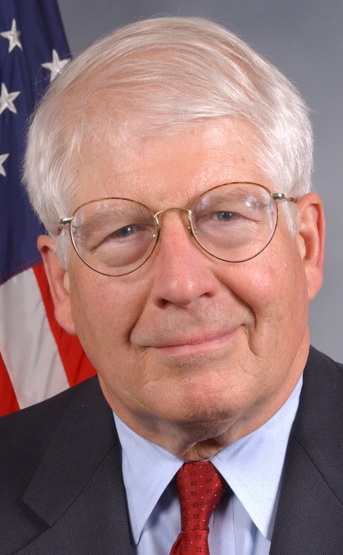
David Price
For roundtable member David Price, a Democratic Congressman who has represented North Carolina’s Research Triangle since 1987, the debt ceiling debate signaled the sentiment shift in Washington, D.C. that also affects research funding.
“There’s nothing in the world that comes close to the NIH’s 100-year history, though other countries aspire,” Price said, talking about the role the NIH have played in supporting health-related research at universities and institutes nationwide with federal tax dollars.
Federal funding for research in disciplines from medicine to engineering has been the foundation onto which Research Triangle Park and its more than 40,000 jobs were built over the past 50 years.
But, Price said, “things we might have taken for granted, parts of the RTP success story, may have to be redefined.”
In 2009, UNC-CH, Duke, NCSU and RTI spent about $2.5 billion on research, according to the latest figures from the National Science Foundation and RTI’s 2009 annual report. Federal tax dollars made up more than two-thirds of the money spent.
The expenditures represented nearly 2.9 percent of the Research Triangle’s gross product that year. In 2009, the metropolitan areas surrounding Raleigh and Durham generated services and goods worth about $86.9 billion, according to figures of the U.S. Bureau of Economic Analysis.
Sponsored research is a formidable economic engine in the Research Triangle, paying salaries and creating jobs when startup companies are formed around technologies that were developed at area universities or research institutes. (More on sponsored research in the Research Triangle here and here.)
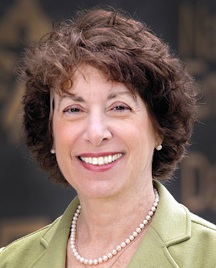
Linda Birnbaum
NIEHS injects about $200 million in federal tax dollars into the local economy per year, said Linda Birnbaum, NIEHS director and member of the roundtable discussion. About 1,400 employees work on the sprawling NIEHS campus in RTP.
“We’re really making an impact, not only economically, but scientifically,” Birnbaum said.
As proof, NIEHS had invited researchers from RTI, NCSU, UNC-CH and Duke to participate in the roundtable discussion. NIEHS has awarded grants to researchers at the three universities anchoring RTP and the research institute that started operations shortly after RTP was established in 1958.
Dr. John Hollingsworth, an associate professor of medicine at Duke, receives funding from the NIEHS to study whether environmental pollutants such as diesel exhaust and ozone cause genetic changes that affect how the immune system works.
His research is tracking the interaction of genetic and environmental factors behind inflammatory diseases such as asthma, especially during vulnerable periods like pregnancy. About 8 percent of the U.S. population suffers from asthma, Hollingsworth said, and his research could lead to new, innovative therapies.
Heather Patisaul, an assistant biology professor at NCSU, studies the effects of hormone-like substances on the developing brain. Among the environmental estrogens she’s tracking are genistein, which is in soy-based foods including soy baby formula, and bisphenol A, a chemical that is in metal food can linings and many plastic containers.
Genistein and BPA are suspected to impair fertility and trigger early puberty in girls.
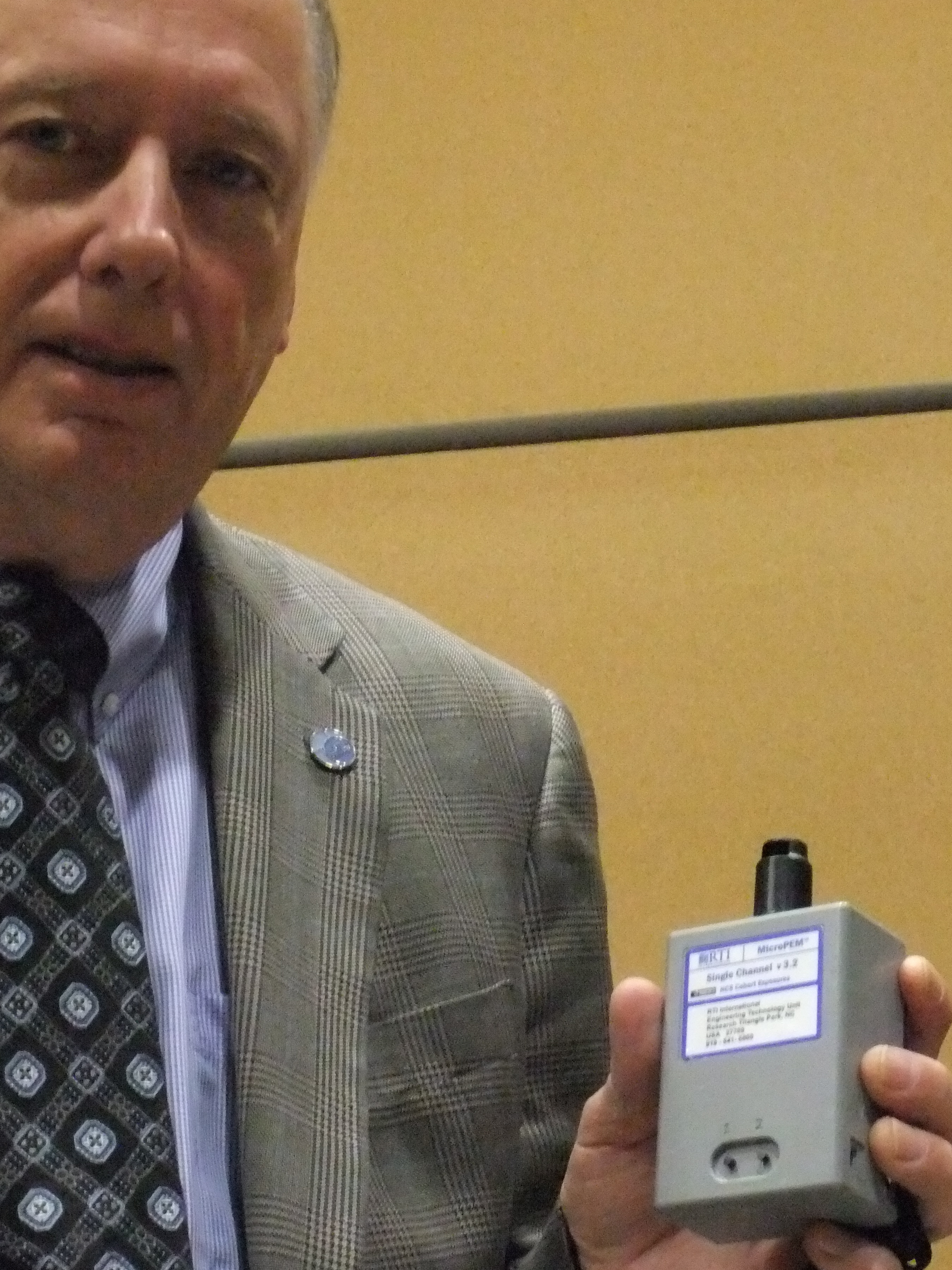
Charle Rhodes shows off the sensor RTI researchers developed to test air quality.
At RTI, researcher have received NIEHS grants to study air quality inside and outside of homes and diseases associated with poor air quality, said Charles Rhodes, a senior fellow at RTI.
Rhodes brought a sensor that RTI developed to run the air quality tests. Similar sensors will be used in a study that is scheduled to start next year in areas devastated by hurricane Katrina six years ago. The sensors will measure the air quality in trailers the Federal Emergency Management Agency provided residents whom Katrina rendered homeless. The trailers have been called “toxic tin cans,” for high formaldehyde levels in the air inside and health problems that have plagued many who have lived in the temporary housing.
UNC has worked with the NIEHS for a long time, training more than 500 researchers, looking for ways to determine susceptibility to environmental diseases, tracking how carcinogens and toxicants make people sick and how environmental toxins interact with human genes.
In the past decade, UNC has received about $112 million in research funding from the NIEHS, said James Swenberg, a UNC professor in environmental sciences and engineering.
Swenberg said he’s been trekking to Washington for 25 years to talk to federal lawmakers and lobby for research funding. In the past, lawmakers were generally eager to learn regardless of their politics.
“Research had never been a partisan issue,” he said. “It’s not going to be the same this time around. That’s really sad.
Republicans, especially in the House, and candidates running for President in next year’s election are “catering to extreme antigovernment views,” Price said. “We have to leave no doubt, that we’re good stewards of our tax dollars and that [research funding] is not some academic pork barrel.”

7-year-old dino digger strikes rare fossil gold
Thursday, August 25, 2011, 11:26 pm No Comments | Post a Comment
Jesse digging with his grandfather, Barry
Seven-year-old Jesse might have been enjoying his summer off from school, but on July 13, he uncovered a big lesson on science and paleontology.
Jesse was pawing through the dirt of the fossil dig site at the Museum of Life and Science in Durham when all the sudden he hit something big: a symphesial cow shark tooth.
This type of fossil is considered to be extremely rare, said museum marketing director Taneka Bennett.
How rare exactly?
“The cow shark tooth is believed to be between 10 and 15 million years old,” said Bennett. “Finding one in such pristine conditions is particularly unlikely, let alone at all.”
Best of all, everything visitors find in the dig site is theirs to keep. Jesse’s mother Amanda Duncan made sure her son took his newfound treasure home to Havelock, N.C. When they got there, Duncan said she researched the fossil on internet paleontology forums.
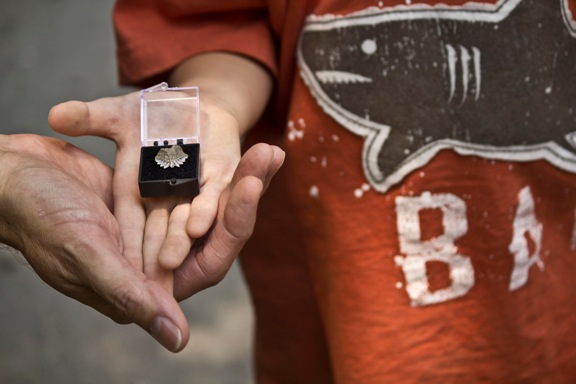
A symphesial cow shark tooth (above) in such good condition is extremely rare
“I posted an image along with a description where the fossil was found and responses poured in,” she said. “One collector described the piece as the ‘Holy Grail’ of sharks teeth. “
Jesse was offered $400 by one collector for said Grail, but his mother said it is too important to Jesse’s growing up to be sold. Currently, it’s on display at the museum. When it finally comes home to Havelock, it will reside in Jesse’s safe deposit box.
Bennett said even though summer is the busy season for the dig site, she has noticed a boon in visitors coming to ask about their fossil finds in hopes that they are also as valuable.
Dirt in the dig site is imported from the Aurora phosphate mine in Beaufort County, N.C. It is filled with fossils estimated to be between five and 25 million years old.
At one point in prehistoric development, part of North Carolina was believed to be covered by water. Thus, the cow shark fossil might have come from that portion of the Atlantic Ocean.

A keepsake for his childhood
When light damages the eyes
Tuesday, August 16, 2011, 9:52 am No Comments | Post a Comment
Joan Roberts
Regardless of how many birthday cards, T-shirts and magazines declare that 50 is the new 30, the organs in our bodies start showing their age after 40. One of the first organs to do so is the eye, said Joan Roberts, a visiting scientist at the National Institute of Environmental Health Sciences in Research Triangle Park.
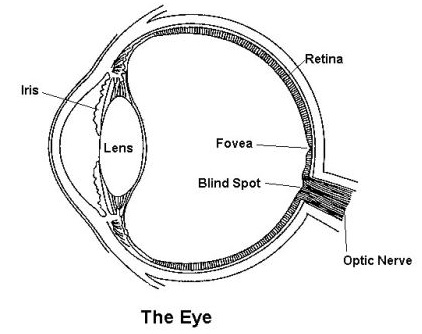
Presbyopia is what we notice - the eye’s lens loses elasticity, which makes it harder to focus on nearby objects and requires us to wear reading glasses. The chemical changes we don’t notice - at least not right away.
Between 40 and 50, the amount of protective antioxidants in our bodies decreases. That makes the eyes particularly vulnerable to damage from light, because it compounds a chemical change in the production of protective pigments that starts at about the same time.
The result, nearly 40 percent of Americans develop cataracts by the time they are 65 or older, according to data of the Centers for Disease Control and Prevention.
Cataracts, or clouding of the lens, can be treated with surgery. But when this increased vulnerability to light damages the retina, cells die and macular degeneration develops. This age-related disorder, which causes tunnel vision around a blurred spot in the center, affects about 5.6 percent of Americans 65 or older, according to CDC data.
Cataracts and macular degeneration aren’t avoidable, Roberts said, but their onset can be delayed.
 Roberts, a chemistry professor at Fordham University in New York City who for 15 years has done part of her research at NIEHS, has more than 25 years experience tracking the good and bad effects of light on the eye.
Ultraviolet radiation is largely responsible for the bad effects, as Roberts described in a 2009 research paper.
The cornea absorbs UV light with the most potential for damage. In adults, the lens absorbs the remainder of the UV light and only visible light reaches the retina. But the eye’s natural defenses start to break down after 40. The chemical changes in the pigments and the loss of antioxidants cause damage to the lens that adds up over time. Clear lenses get cloudy. Cataracts develop.
Drugs, such as the antibiotics Cipro and tetracycline, and medicinal herbs such as St. John’s Wort, can accelerate the lens damage. So can light reflecting off of sand and snow.
Roberts, who said, “It’s my job to turn that 70 into 100,” had several suggestions how to delay the onset of cataracts: Antioxidant boosts through nutrition. Fruit and vegetables high in vitamin E and lutein and green tea were high on her list. Wraparound sunglasses protect on the beach and in the mountains.
Macular degeneration can develop following UV damage to the retina at a very young age or following prolonged damage by visible light called short blue visible light. Age-related changes in the eye’s pigments after the age of about 50 can promote such prolonged damage.
Roberts’ suggestion to delay age-related macular degeneration are Eagle Eye sunglasses, which were developed by NASA and designed for astronauts to block short blue visible light.
$2.5M grant to help generate marine biotech jobs in eastern North Carolina
Tuesday, August 2, 2011, 12:28 pm No Comments | Post a CommentThe N.C. Biotechnology Center in Research Triangle Park announced today that it will spend $2.5 million to help generate marine biotech jobs in the eastern part of the state.
The four-year grant will establish a center of innovation - the fourth in the state - to develop commercial products from North Carolina’s marine life with the help of biotech tools.

John Chaffee
Coastal marine labs are doing research that could be applied in several areas, such as health, energy, aquatic foods and diagnostics, according to John Chaffee, director of the biotech center’s eastern office, which is the fiscal agent for the marine biotech consortium.
The biotech center already spent $100,000 to plan for the marine biotech center of innovation or MBCI. This first grant was used to develop a business plan. With the new award, the MBCI must meet business milestones and ultimately establish itself as an independent, self-sustaining entity. The first milestone will be the hiring of an executive director, who will lead the center in identifying and prioritizing key market sectors, said Chaffee.
The University of North Carolina at Wilmington, the UNC-CH Institute for Marine Science, N.C. State University’s Center for Marine Science and Technology and the Duke Marine Lab helped during the planning phase. East Carolina University technology transfer staff assisted with new innovation center’s business plan.


