Archive for August, 2010

RTP Week Ahead, Aug. 30 – Sept. 2
Friday, August 27, 2010, 2:51 pm No Comments | Post a Comment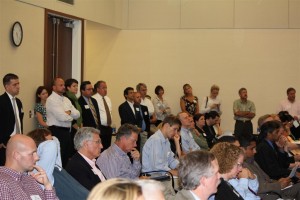 Full house for CED at RTP HQ
Monday, Aug. 30
Nanofiber Conference: N3M 2010 Program
Three-day conference (Mon. 8/30 – Wed. 9/1)
The Nonwovens Institute, 2401 Research Dr. Raleigh, NC 27695
The objective of the conference is to accelerate the adoption of nanofibers in a wide range of innovative functional products.
Register here.
BioNetwork Course: The Elements of Current Good Manufacturing Practices in Biomanufacturing Processes
Two-day course (8:00 am Mon. 8/30 – 5:00 pm Tues. 8/31)
Capstone Center, BioNetwork Capstone Center Rm #BTEC 250 B, 850 Oval Drive, Centennial Campus Raleigh, 27695
Expand your knowledge in the application of current good manufacturing practices (cGMP)in the production of biopharmaceuticals. An overview of topics will be covered from current regulations found in selctions of 210/211 of Title 21 of the Code of Federal Regulations (CFR), as well as the relevant ICH and FDA guidance documents. More.
Seminar: How reliable is the science behind the current mobile phone safety standards?
10:00am – 12:00pm
NIEHS, Rall Bldg. Rodbell B
Speaker: Dariusz Leszczynski, PhD, DSc – STUK-Radiation and Nuclear Safety Authority: Helsinki, Finland. Web.
Health Forum: Emerging Challenges in Keeping the Public Healthy
12:00 – 1:30pm
School of Nursing Auditorium, Duke University, 307 Trent Drive, Durham
Please join us for a lively lunchtime forum to explore and tackle the emerging issues in public health and hear from state, national, and international health leaders. For more, go here.
Tuesday, Aug. 31
Seminar: High-Performance qPCR and Cell-based Assay Technologies For Pathway-Focused Cell Biology Research
2:00 – 3:00pm
NIEHS, Keystone Room 2128
Series: NTP BIOMOLECULAR SCREENING BRANCH. Speaker: Curtis Alexander. More details!
Financing Health Care for All: the Taiwan Experience and the Relevance for US Reform
4:30 – 5:30pm
The North Carolina Biotechnology Center, 15 T.W. Alexander Drive, RTP, NC
The North Carolina Biotechnology Center, Duke University, Policy & Organizational Management Program and RTI International cordially invite you to “Financing Health Care for All: the Taiwan Experience and the Relevance for US Reform” presented by The Honorable Dr. Chih -Liang Yaung, Minister of Health, Department of Health, Taiwan, R.O.C.
Wednesday, Sept. 1
Carrboro Creative Coworking: West End Ruby Meetup
6:30 – 8:30pm
Carrboro Creative Coworking 205 Lloyd St Suite 101 Carrboro, NC 27510
Topic: Ruby Programming Language. Repeats every first Wednesday of the month at 6:30pm.
Thursday, Sept. 2
Durham Critical Mass Bike Ride
5:35 – 7:05pm
Ride Starts at the Bronze Bull Downtown Plaza, Durham
A monthly ride which calls attention to the rights of cyclist to the roads as a vital form of transportation.
——————————-
To view a complete calendar of RTP community events, please visit the Science in the Triangle calendar.

Science Communication Conference and Scienceblogging.org
Thursday, August 26, 2010, 9:46 pm 1 Comment | Post a Comment The first Science Communication Conference was held in Raleigh, at the North Carolina Museum of Natural Sciences last Saturday, organized by the Museum, SCONC (Science Communicators of North Carolina) and UNC-TV’s QUEST.
Read more…

New RTI biofeedback controller may be a game changer
Thursday, August 26, 2010, 11:29 am 1 Comment | Post a Comment
Barriers to entry?
It took about two years for me to rid my home of the redundant technology that is the DVD player.
During that time, these devices bit the dust one by one as my Xbox 360 sat underutilized in my entertainment center. But when the third and final DVD player refused to do my bidding, I was fed up.
Microsoft never had to convince me to use its next-generation console as the center of my entertainment setup. I’ve grown up with video games, so the idea of using a complicated controller to manipulate the playback of everything from music to movies never fazed me.
But for my wife, whose only foray into gaming was a brief flirtation with Donkey Kong Country, it was a bit of a hard sell.
Her hesitation is natural and understandable.
For all companies have done to recruit the “casual gamer,” be it immersive environments or intuitive gameplay, these 10-plus-button controllers still represent the final barriers to entry for the gaming world.
In 2006, Nintendo’s Wii remote was an attempt to mitigate that barrier to entry — and it certainly seems to be working. Worldwide, the Wii has sold 73.4 million units, according to the gaming tracking service VGChartz. That’s 6 million units short of Xbox 360 and PlayStation 3 sales combined.
Microsoft’s Kinect and PlayStation’s Move are new entries to the field due out this Christmas season.
But Research Triangle Park firm RTI International has something with the potential to change the controller game. It’s called Mindshift, and it was developed in collaboration with NASA’s Langley Research Center. From the release:
“Mindshift allows modulation of player inputs to a video game or simulation from a user interface device based on the player’s psychophysiological state. It exploits current wireless motion-sensing technologies to use physiological signals for input modulation, including heart rate, muscle tension and brain wave activity, among others.”
RTI’s press release says the technology has been “successfully prototyped” using the Wii remote and that researchers are also working on compatibility with Kinect and Move.
Developers will likely put that success to the test when they demo the technology at two separate events at the end of September, one for the public, the other for potential investors.
Regardless of how well Mindshift works, one thing is clear: there’s big incentive to breaking down gaming’s last barrier to entry.
Tyler Dukes is a freelance reporter and journalism adviser at N.C. State University. Follow him on Twitter as @mtdukes.

R&D billions are tectonic force in Research Triangle area
Wednesday, August 25, 2010, 8:27 pm 2 Comments | Post a CommentThe brainpower for which North Carolina’s Research Triangle area is known tends to hide inside buildings, behind tall trees or somewhere on sprawling university campuses.
Crossing Research Triangle Park on Interstate 40 or visiting Duke University, the University of North Carolina at Chapel Hill or N.C. State University provides little insight into what fuels one of the hottest U.S. research and development hubs.

Michael Walden
Sure, the Triangle was named the brainiest U.S. region and Raleigh the fastest growing metropolitan area last year. And the area’s vaunted labor pool continues to draw scientists and R&D companies from elsewhere, even though companies have closed shop or laid off employees in the past two years and the unemployment rate in the Triangle is nearly twice as high than before the economic downturn.
Mike Walden, an NCSU economist, doesn’t mince words when he assesses how important R&D is for the RTP area. “It’s one of our basic industries,” Walden said. “It’s one of the things that make us tick.”
But what sustains and boosts this industry that, it can be argued, flavors everything locally from schools to restaurants?
The credit usually goes to the three main research universities, Duke, UNC-CH and NCSU, and the hundreds of companies in and around RTP. But what specifically is it that they do to shape the RTP area? Is it the graduates they produce every year, the discoveries they spin off into local startup companies, or the money they spend on R&D? Read more…
Gaming in the Triangle gets serious
Thursday, August 19, 2010, 11:43 am 3 Comments | Post a Comment
Aten Inc.'s new free iPhone game Rhythmatical teaches students the connection between music and math.
Thomas Vaidhyan admits he can attribute much of what he’s learned about gaming to his young son.
When Vaidhyan, now the CEO of IT firm and game developer Aten Inc., first arrived in the Triangle, he realized quickly something was missing in the classroom.
“When I started getting involved with sending my son to schools here, I started researching quite a bit on that and found out very surprisingly, for me, a lot of the technologies and innovations that we’re getting incubated in our universities and developed in our industries weren’t necessarily percolating into our school systems,” he said.
To him, pulling gaming into the classroom was a no-brainer.
“It made a lot of simple common sense to use games for translating some of the abstract concepts in a very simple, easy-to-understand means to children,” he said.
That’s why his company, guided by a growing body of educational research, has been working to develop engines and applications in the rapidly expanding field of serious games, which teach and test users’ skills while they play.
Vaidhyan’s noticed the change in perception toward gaming, even in his daily life. After taking his son to a golf camp, he was surprised to learn the instructor rarely had to teach the complicated method of scoring anymore — his classes were already veterans of the fairways featured on Wii Sports.
“Five years ago when we were talking about it, people asked, ‘Are you crazy?’ But now everybody is understanding games can be a very effective tool,” he said.
The prevalence of devices like the iPad and smartphones is also expanding the potential playing field for educational games beyond the console and computer.
“You will see us moving more and more away from books and using devices like the iPhone and the iPad, where not only do you read, but that translates to a more visual and interactive experience,” Vaidhyan said.
Aten’s newest entry in the serious gaming field is a free iPhone app called Rhythmatical, which teaches about the connection between music and mathematics. It was created in collaboration with Virginia Tech and is targeted toward elementary school children.
It’s a far cry from blockbuster, next-generation franchises like Halo or Call of Duty: Modern Warfare, but Vaidhyan said that’s a good thing.
“Gaming companies and commercial games compete with movie productions — $10 million for one of those productions is considered to be cheap,” he said. “It definitely doesn’t scale to an educational environment.”
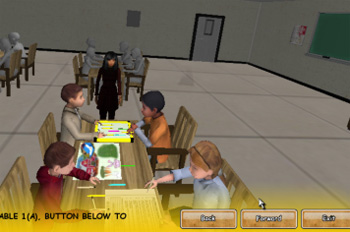
Other Aten titles, such as this classroom simulation, use virtual environments to educate users.
It’s that price point, Vaidhyan said, that’s keeping good serious games out of the fields of education and corporate training — but it’s also giving companies like his a unique opportunity.
“We’re able to get down to that and have a team and a framework where we can churn out these virtual environments at one-fourth or one-fifth of the cost that these gaming companies would take to create some of this,” he said. “One of the things that has kept us going in this field is the fact that we’ve brought ourselves to an attractive price point that can easily scale.”
Particularly in the case of 3-D gaming, some companies charge up to $250,000 just to license their game engines, or the software infrastructure that forms the foundation for different titles. The engines Aten uses, by comparison, can range from $1,500 to free.
For the average consumer, Vaidhyan said there’s a lack of good content on the market.
“The games that I’ve seen out there have been either gaming companies bringing them out themselves — which means commercially they’ll look good, they’re great games, but do not involve a lot of educational research background or aspects. Or, purely educational games that are boring,” Vaidhyan said.
He points out that demand is so high that teachers are learning to adapt existing games — like the multiplayer online role-playing game World of Warcraft — to their needs in the classroom.
But that dichotomy also presents a challenge for companies like Aten, which must balance a fun experience with applied learning.
“Where we could have a blend of this is where we can have success,” he said.
To do that, Aten pairs experienced game designers with experts from whatever field the title is trying to teach. The result should be what Vaidhyan jokingly termed “stealth learning.”

This Aten racing title requires players to learn more about car mechanics and engineering before modifying their vehicles.
“A successful education game is one where the user or the children don’t even know it’s educational,” he said. “They say it’s just another game.”
And like their commercial counterparts, serious games aren’t just for children.
Virtual Heroes, a serious gaming company also based in the Triangle, recently partnered with the Duke School of Medicine to develop a 3-D training game for the emergency room.
Aten’s also working on working with a major pharmaceutical company to create a simulated environment of their assembly line, allowing for virtual hands-on training without the risk.
“We have made it so simple for them that their assembly line workers can train themselves by pulling it out of their learning management system,” Vaidhyan said. “Here, they’d be doing exactly what they’d be doing on an assembly line, except they do it on a computer.”
Future corporations and classrooms could even implement a tracking component of the training and education module that would allow them to identify shortfalls — whether it’s a step of the production process or a mathematical concept.
“From a management perspective, you’re able to say, ‘This person is not getting this particular aspect,’” Vaidhyan said. “The management can give that person an individualized training.”
And solving the problem could happen almost instantly.
“You can give them formative feedback right in the virtual environment itself,” he added.
Outside the virtual environment, users of these technologies are learning something even more valuable — whether the game is serious or shoot-em-up. That’s another lesson Vaidhyan’s gleaned from his son, who often consults classmates when he’s stuck on a tough level.
“They are being forced to share best practices. They are talking to each other, figuring out how someone else is doing it and applying it,” Vaidhyan said. “That’s very valuable in the corporate world.”
Building entrepreneurial networks in the Internet age
Monday, August 16, 2010, 10:51 pm 1 Comment | Post a CommentTed Zoller has taken the educational adage about the village that raises the child and adapted it to entrepreneurship.
As Zoller, the executive director of the Center for Entrepreneurial Studies at the University of North Carolina’s Kenan-Flagler School of Business in Chapel Hill, sees it, it takes dealmaker networks to build companies based on research and technology.
One of the U.S. technopolies where these networks have developed is North Carolina’s Research Triangle area, ranked the brainiest area in the U.S. by the Daily Beast, an online publication that started the contest last year.
So, why isn’t the research Triangle Park area also the most entrepreneurial?
Zoller, an entrepreneur himself who teaches executives, scientists and budding entrepreneurs at UNC, attempts to answer that question in an interview with Science in the Triangle. He also addresses how the Internet is changing network building.
The video of the interview is interspersed with footage of Zoller teaching an executive MBA class at UNC:


Scientifica Gets Durham School Kids Excited about Science
Monday, August 16, 2010, 7:25 am 1 Comment | Post a Comment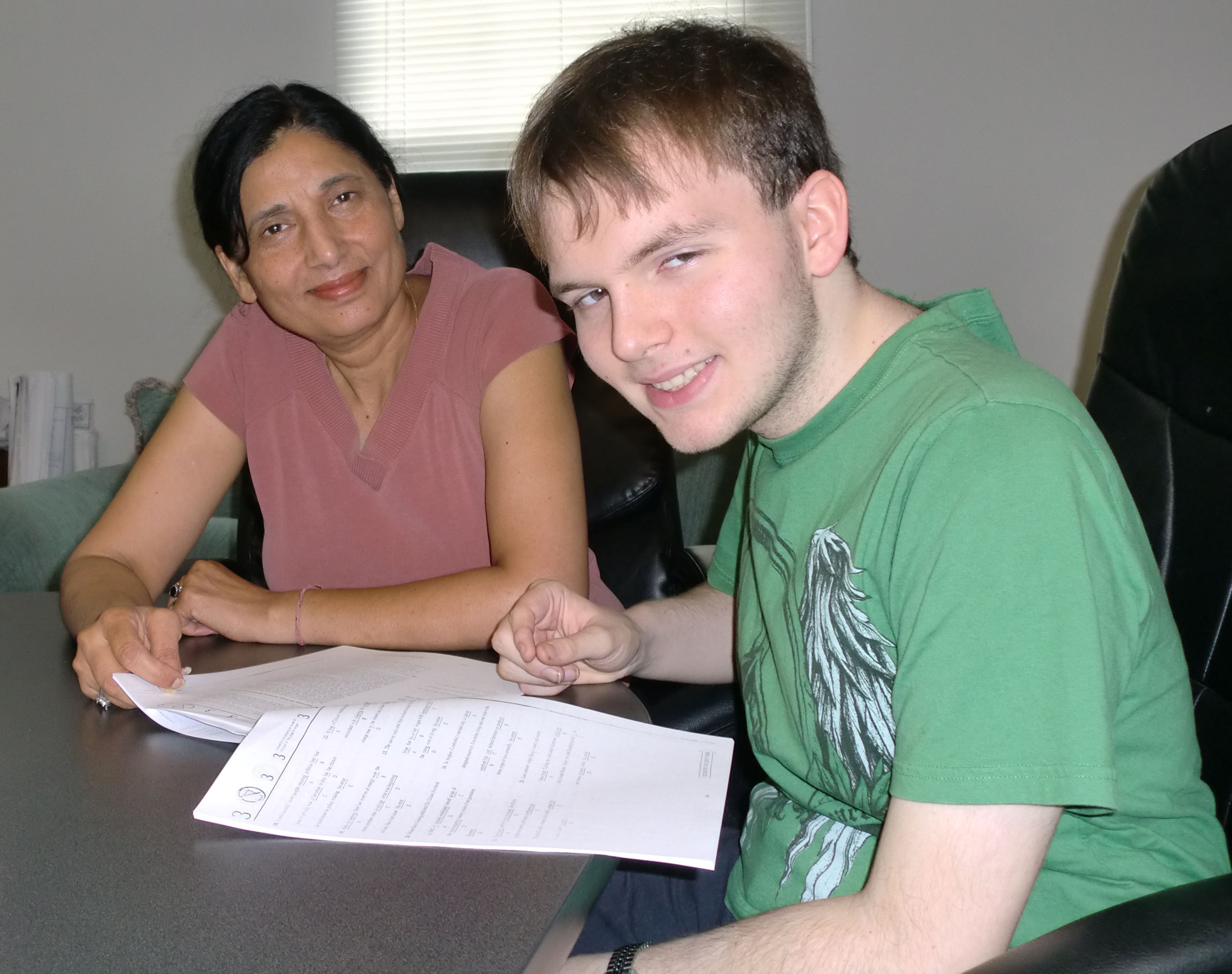
Dr. Anu Sud talks to Robby Fisher, a Durham student participating in the Scientifica program she helped found.
Dr. Anu Sud’s two daughters were accomplished in science by the time they were in high school, in part thanks to coaching by their mother, who had been a cytogeneticist at UNC-Chapel Hill and at LabCorps. The older daughter attended the North Carolina School of Science and Mathematics, and the younger, Shivani, won a $100,000 scholarship in the Intel Science Talent Search and numerous other top science honors when she was a junior and senior at Jordan High School.
When Shivani went off to Princeton, Dr. Sud was like many professional women who interrupt their careers to raise kids: should she return to her former career or try a new path? Then Shivani said to her, “Mom, why not help other kids like you helped us?” Read more…
Pro gamers head to Raleigh for showdown
Thursday, August 12, 2010, 7:13 am 2 Comments | Post a Comment If you’re looking for evidence that the Triangle has become a big player in the video gaming industry, consider the hundreds of pro gamers planning to converge on Raleigh Aug. 27 for the upcoming Major League Gaming tournament.
The event, which pits some of the most talented players in the world against one another in a professional sport-like atmosphere, is a first for the capital city.
And much like professional sports, spectators show up in droves. Ryan Moore, MLG’s PC tournament director, expects attendees to be in the thousands.
“A lot of people who are into gaming but can’t compete at that level get to watch these players,” Moore said.
The tournament lineup features several mainstays in competitive gaming: Bungie‘s Halo 3, Nintendo‘s Super Smash Bros. Brawl and Blizzard Entertainment‘s World of Warcraft. But Moore said the showdown in Raleigh will also include Blizzard’s newest strategy title, Starcraft II, for the first time in tournament play.
That’s big news for fans of the game, which sold 1.5 million copies in 48 hours.
Competitors are clamoring for spots on the bracket as well. The 32 coveted open spots for players sold out in two minutes, 19 seconds, Moore said (32 other spots were claimed by invitation only).
Gamers and organizers like Moore are out to make competitive gaming a sport like any other. That’s why MLG tournaments feature professional “sportcasters” and their Sunday matchups are even broadcast online on ESPN.
“Everybody’s hungry to push — we call it ‘e-sports’ — as hard as we can,” Moore said.
But it may be a while before a country acclimated to Monday Night Football will tune in to see gamers battle it out. Despite the rapid rise of gaming as an industry and an art form, there’s still a stigma attached — especially for those interested in “going pro.”
The stats, for one, are certainly different. Some of the best Starcraft players in the world can register 200 to 300 actions per minute, a value that determines how quickly they can overrun and outmaneuver their opponents on the virtual battlefield.
But competitive gaming going mainstream isn’t unheard of. Moore points out the U.S. is behind other markets like South Korea, which has several leagues and stadiums devoted to the “e-sports.” Many of the biggest tournaments there are even televised, something that has happened on occasion for MLG. Moore said more televised events are on the horizon.
The differences between competitive gaming and competitive sports are clear, sure. But it does seem feasible that watching these fierce matchups can become something of a draw to American audiences. While competitors aren’t necessarily showcasing their athletic skill, there’s certainly plenty to be said for the ultra-fast reaction times, pitch-perfect strategy and long hours of training.
That’s way more than you can say about other popular televised obsessions like Minute to Win It.
That’s why Moore said MLG is looking to find “familiar, marketable faces” who earn their championship titles at events like the one in Raleigh — the 50th such tournament for MLG.
“Video games are on the rise as compared with other media,” Moore said. “The more people accept it, the less of a stigma there will be.”
Canadian biotech will grow flu vaccine in RTP
Tuesday, August 10, 2010, 10:02 pm 1 Comment | Post a CommentMedicago, the Canadian biotech company that announced Tuesday that it picked Research Triangle Park as its production base, plans to introduce vaccine making with a couple of twists to an area that’s home to three large vaccine plants by heavyweights Pfizer, Merck and Novartis.
Medicago’s facility is projected to cost $24 million and create 85 production jobs - small compared to the $300 million plant Novartis opened in 2009 in Holly Springs and the $400 million plant Merck completed two years ago north of Durham. The plant in Sanford that Pfizer bought last year as part of its $68 billion acquisition of Wyeth has been open since the late 1980s and employs about 450.
But then, the Medicago plant isn’t going to be like the other vaccine plants in the area. Read more…
RTP Week Ahead, August 8-14
Monday, August 9, 2010, 8:59 am No Comments | Post a Comment Vanessa Woods, author of “Bonobo Handshake”, at Periodic Tables in Durham Tuesday night
Sunday, Aug. 8
13th Biennial Molecular and Cellular Biology of the Soybean Conference
All day, starting at 8:00am
Sheraton Imperial Hotel & Convention Center, 4700 Emperor Blvd. Durham, NC 27703
Will highlight the collaborative research among breeders, physiologists, and genomicists to bring the power of the complete soybean genomic sequence to bear on these fields of research.
More here.
Monday, Aug. 9
First Marketing Monday: New in RTP!
4:00 – 5:30pm
RTP HQ, 12 Davis Drive, RTP, NC 27709
What is location-based marketing, and how can it help you?
Location-based marketing helps you show how great your business is to members of your community and lets you reach out to new and existing customers who live and work in the same area as you. Come to Marketing Mondays and find out! Guest Speakers: Wayne Sutton and Lawrence Ingraham of TriOut, experts in location-based marketing.
Free! Click here to register.
Tuesday, Aug. 10
Periodic Tables: Bonobo Handshake: Love and Adventure in the Congo
7:00 – 9:00pm
Broad Street Cafe, Durham
Author, scientist, and SCONC contributor Vanessa Woods will discuss and sign copies of her new book, Bonobo Handshake: A Memoir of Love and Adventure in the Congo.
Details and more about Periodic Tables.
Wednesday, Aug. 11
Innovation@rtp: How EMC is leveraging Social Network Analysis as a Strategic Asset
4:00 – 5:00pm
RTP HQ, 12 Davis Drive, RTP, NC 27709
EMC provides the technologies and tools that can help you release the power of your information, helping you design, build, and manage flexible, scalable, and secure information infrastructures.
Free. More info.
Thursday, Aug. 12
Women In Business Awards
11:30am – 2:15pm
Sheraton Imperial RTP, I-40 Page Road/4700 Emperor Blvd., Durham/RTP
Triangle Business Journal and Presenting Sponsors Duke Raleigh Hospital and Durham Regional Hospital cordially invite you to attend the 2010 Women In Business Awards luncheon honoring the Triangle’s most dynamic professional women.
Make your reservation today!
Friday, Aug. 13
2nd Friday Art Walk, Chapel Hill/Carrboro
6:30 – 9:30pm
Carrboro and Chapel Hill
Carrboro Creative Coworking participates and usually has live music and new art. All Free! More info here.
Saturday, Aug. 14
Engineering Exploration Fair for Kids
9:00am – 5:00pm
Museum of Life & Science, Durham NC
Includes Lego Robotics workshops hosted by IBM
——————————-
To view a complete calendar of RTP community events, please visit the Science in the Triangle calendar.


