Posts Tagged ‘technology’

IBM Leads Country, State in Invention in 2010
Thursday, February 10, 2011, 8:30 am 1 Comment | Post a Comment
Cyber-criminals probe databases in ways that can be predicted and detected. That's the basis of newly patented IBM software that monitors access to databases for suspicious activity and then locks down critical data.
Burglars often act in predictable ways: they lurk in overgrown bushes, come to your door pretending to be service people, or check for unlocked doors. If you witness this kind of behavior outside your house, you’re likely to check your locks and perhaps arm your security system before calling the police.
Cyber-criminals are the same as physical ones, says IBM’s Dave Kaminsky. They probe databases in ways that can be predicted and detected. That’s the basis of U.S. patent no. 7,827,608: software that monitors access to databases for suspicious activity and then locks down critical data, preventing it from being downloaded. It is intended for use at banks, mortgage companies, and other companies that might keep your social security number or other private information in their databases.
Importantly, the software monitors realtime events, acting only if an intrusion appears to be imminent. As Kaminsky says, it would be counterproductive to forestall legitimate attempts to access information (such as for a credit check), just as you don’t want to overreact when someone comes to your house to clean your gutters.
Kaminsky is IBM’s Chief Patent Innovation Architect. Based at RTP, he is not only a frequently patented inventor, but he helps other inventors in the company navigate the “Alice in Wonderland” world of the patent process and contributes to decision-making about which innovations the company should patent. That last is important, because even though IBM received 5,896 patents in 2010, more than any other company, Kaminksy says just a fraction of the company’s eligible innovations go forward in the patent process.
IBM’s RTP site generated 570 patents, and those, combined with patents from Charlotte, made IBM the leading recipient of patents in the state, ahead of Cree, Red Hat, and the leading universities. Most of the patents from RTP are in software. They include a program that routes phone calls to either internet or traditional phone lines to incur cost savings (patent no. 7,710,946, Jim Silwa) and a GPS add-on that gives drivers of hybrid, electric, or other alt-fuel vehicles routing that will lead them to charging stations, thereby reducing their fossil fuel usage (patent no. 7,860,808, Mark Peters). Then there are hundreds more inventions that may not resonate with consumers, like a new caching algorithm, Kaminsky says, but that make our lives easier nonetheless.
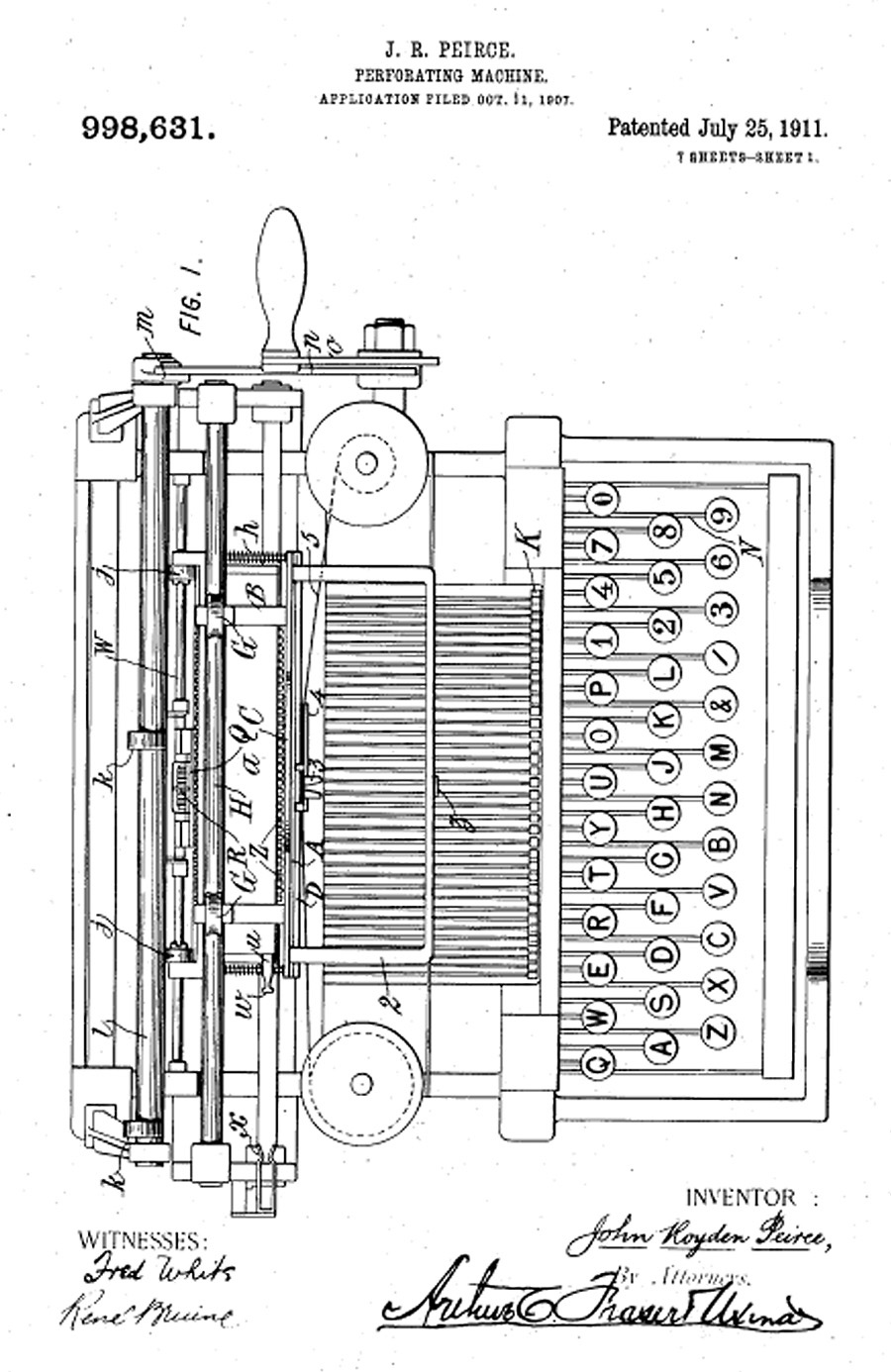
Almost 100 years ago, IBM received its first patent. In 2010, it received 5,896, more than any other company
IBM encourages staff members to generate patentable ideas, Kaminsky says, through a financial incentive program and through career advancement: people who contribute to the intellectual property of the organization are likely to advance.
Contrary to the stereotype of the inventor as a lonely figure, most patents achieved at IBM come from ad hoc groups. Kaminsky led a team of four software engineers on the online security project, which took less than six months to complete but almost four years to patent. Ideas come from clients and from the inventors themselves, sometimes through conversations with collaborators and sometimes through “Aha” moments when people think of ways in which technology could solve a problem.
This was the 18th consecutive year that IBM has led the list of U.S. patents received. According to a company press release, “more than 7,000 IBM inventors residing in 46 different U.S. states and 29 countries generated the company’s record-breaking 2010 patent tally.”
Engineering for Better Wastewater Treatment Results
Sunday, December 26, 2010, 3:02 pm 1 Comment | Post a Comment
Wayne Flournoy, president of Entex Technologies
A few weeks ago, I reported on water quality expert Kenneth Reckhow’s concern that we will be unable to achieve water quality standards set by states in response to the Clean Water Act. Municipal water treatment plants have been improved “to the limits of technology,” he said, and additional cleanup was going to have to happen with somewhat unlikely changes like limiting development, changing farming practices, and prohibiting lawn fertilizers.
Last week, I had the opportunity to discuss the challenges of cleaning wastewater from the perspective of an entrepreneur who has been working with municipalities and industry to improve treatment plant performance. Wayne Flournoy is cofounder and president of Entex Technologies, a Chapel Hill company that designs systems for upgrading wastewater treatment plants or for new plants. Read more…
Unleashing the power of 1100 suns
Friday, December 17, 2010, 2:19 pm No Comments | Post a Comment
An array using high-concentration photovoltaics from Semprius, Inc.
A year or so ago, Joseph Carr found himself on an elevator with a man wearing a Siemens polo shirt. Having once worked for a division of Siemens, Carr introduced himself as the CEO of Semprius, Inc., a company that makes very high-efficiency solar modules. At the end of a fourteen-floor ascent, the two men exchanged business cards. Within months, Semprius and Siemens announced a joint development agreement.
Yes, a true “elevator pitch” success story.
Yap, Inc., Brings Us the Speech Cloud
Friday, November 5, 2010, 8:37 am 1 Comment | Post a CommentTechnology and language are strange and occasionally wonderful bedfellows. The same field that gave us 802.11b to describe a common household wireless standard is also capable of whimsical and clever trademarks. (Quick: when I say “blackberry,” do you envision a smart phone or an old-fashioned fruit?)
One of the best flights of fancy that has come from the wireless revolution is the Cloud. Loosely speaking, the cloud is the Internet—all of those computers out there that connect us in the world wide web. But cloud computing also refers to applications and sometimes data that reside “out there” rather than on your own computer. It’s rather soothing to think about all of those bits of code bouncing around the stratosphere on a cumulus mattress rather than residing in earthbound bunkers of supercomputers.
I was charmed, therefore, when reading up on Yap, Inc., to learn about the Speech Cloud. Yap provides software-processed (rather than human-processed) speech recognition services, largely via partners like Microsoft and Sprint and other phone carriers. Voice mails, conference calls, and other bits of dictation are transported to Yap’s Speech Cloud and rendered into text by software and returned to the customer’s computer or device.
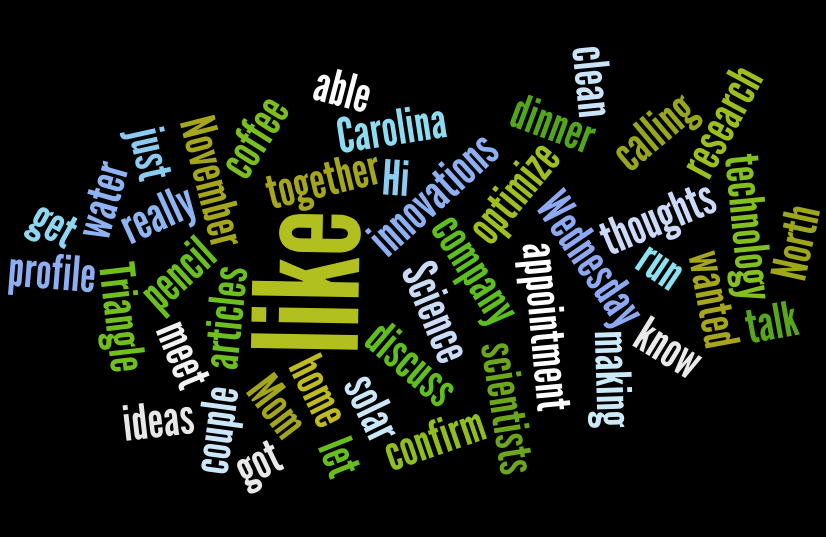
The Speech Cloud is a "stone soup" of voices from all over, that cumulatively contribute to Yap's speech recognition accuracy.

Books: ‘On The Grid’ by Scott Huler
Thursday, July 1, 2010, 10:47 pm 1 Comment | Post a Comment About a month ago, I told you about the book-reading event where Scott Huler (blog, Twitter, SIT interview) read from his latest book On The Grid (amazon.com). I read the book immediately after, but never wrote a review of my own. My event review already contained some of my thoughts about the topic, but I feel I need to say more, if nothing else in order to use this blog to alert more people about it and to tell everyone “Read This Book”.
What I wrote last month,
“I think of myself as a reasonably curious and informed person, and I have visited at least a couple of infrastructure plants, but almost every anecdote and every little tidbit of information were new to me. Scott’s point - that we don’t know almost anything about infrastructure - was thus proven to me.”
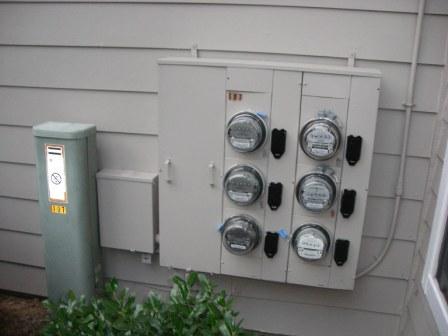 …was reinforced when I read the book itself: I don’t know anything about infrastructure. But after reading the book I can say I know a little bit, understand how much I don’t know, and realize how much more I’d like to know. I bet it was fun watching me as I was reading it, exclaiming on average five times per page “This is so cool”, and “Hey, this is neat” and “Wow, I had no idea!” and (rarely) “w00t! Here’s a tidbit I actually heard of before” and “Hey, I know where this is!” (as I lived in Raleigh for eleven years, I know the area well).
A few years ago, Scott was just as ignorant about infrastructure as most of us are. But then his curiousity got better of him and he started researching. He would start at his house in Raleigh and trace all the wires and cables and pipes going in and out of the house to see where they led. Sometimes there would be a crew on his street digging into the asphalt and fixing something and he would approach them and ask questions. At other times he would figure out where the headquarters are and who to ask to talk to:
‘On The Grid’ is coming in two days
Sunday, May 9, 2010, 6:00 pm 1 Comment | Post a Comment Scott Huler (blog, Twitter), the author of ‘Defining the Wind’, has a new book coming out this Tuesday. ‘On The Grid’ (amazon.com) is the story of infrastructure. For this book, Scott started with his own house (unlike me, Scott did the work) and traced where all those pipes, drains, cables and wires were coming from and going to, how does it all work, does it work well, where does it all come from historically, and how its current state of (dis)repair portends to the future.
You can read a review in Raleigh News & Observer, as well as an article by Scott in the same paper and another one at the Science In The Triangle blog.
Scott Huler has a book reading and signing event on Wednesday, May 12th at the Regulator in Durham, then another one on May 26th at Quail Ridge Books in Raleigh. I’ll try to make it to one or both of these - and you should, too.
From the blurb:
“Wires, pipes, roads, and water support the lives we lead, but the average person doesn’t know where they go or even how they work. Our systems of infrastructure are not only shrouded in mystery, many are woefully out of date. In On the Grid, Scott Huler takes the time to understand the systems that sustain our way of life, starting from his own quarter of an acre in North Carolina and traveling as far as Ancient Rome.
Each chapter follows one element of infrastructure to its source — or to its outlet. Huler visits power plants, watches new asphalt pavement being laid, and traces a drop of water backward from his faucet to the Gulf of Mexico and then a drop of his wastewater out to the Atlantic. Huler reaches out to guides along the way, bot the workers who operate these systems and the people who plan them.
Mesmerizing and often hilarious, On the Grid brings infrastructure to life and details the ins and outs of our civilization wigh fascinating, back-to-basics information about the systems we all depend on.”
ScienceOnline2010 - interview with Sabine Vollmer
Tuesday, April 6, 2010, 7:32 pm No Comments | Post a CommentContinuing with the tradition from last two years, I will occasionally post interviews with some of the participants of the ScienceOnline2010 conference that was held in the Research Triangle Park, NC back in January. See all the interviews in this series here. You can check out previous years’ interviews as well: 2008 and 2009.
Today, I asked Sabine Vollmer to answer a few questions:
ScienceOnline2010 - interview with Mark MacAllister
Thursday, March 4, 2010, 12:07 am No Comments | Post a CommentContinuing with the tradition from last two years, I will occasionally post interviews with some of the participants of the ScienceOnline2010 conference that was held in the Research Triangle Park, NC back in January. See all the interviews in this series here. You can check out previous years’ interviews as well: 2008 and 2009.
Today, I asked Mark MacAllister, Coordinator of On-Line Learning Projects at the North Carolina Zoological Society to answer a few questions:


