Archive for April, 2011

Adolescent binge drinking linked to permanent brain damage
Friday, April 29, 2011, 8:09 pm No Comments | Post a Comment Sobering news for underage drinkers: adolescent binge drinking can lead to irreparable brain damage as an adult.
That’s what a new study from the Bowles Center for Alcohol Studies at UNC-Chapel Hill’s School of Medicine found.
It also found striking figures as to just how many adolescents are binging when they drink. Forty-four percent of college students reported heavy alcohol intake in the last two weeks, 28 percent of twelfth grade seniors, 22 percent of tenth graders, and, finally, 12 percent of eighth graders.
Adolescence, between ages 12 and 20, is a period of critical growth for the human brain. The adolescent brain is much more sensitive to changes induced by alcohol than a fully matured one. With so many teens drinking, the country’s youth are at risk for under-developing their adult brains, said Dr. Fulton Crews, the director of the Bowles Center and the lead pharmacologist on the study.
“We found that alcohol exposure changes genes in the brain,” Crews said. “And actually shrinks part of the forebrain, resulting in a loss of acetylcholine molecules.”
Acetylcholine is a key neurotransmitter involved in both the central and peripheral nervous systems. He said alcohol can also heighten impulsivity in adolescents—not just in the moment of intoxication, but down the road.
“As you mature, you become less impulsive,” Crews said. “And if you’re drinking young, it seems to disrupt that maturation. If you started drinking as an adolescent, you’re more likely to get in a fight.”
However, Crews makes a distinction between impulsivity and aggression. Aggressive people, he said, are angry and violent, whereas impulsive people have a hard time controlling their immediate urges.
The next logical step, Crews said, is to examine whether adolescent binge drinking increases chances of depression, anxiety or personality disorders.
“I think it does, but right now we really don’t have the data to back it up,” he said. “What we do have makes us lean that way.”
The study can be found in the April 2011 edition of Alcoholism: Clinical and Experimental Research.
Dr. Martin Styner is the co-director of UNC’s Neuro Image Research and Analysis Laboratories (NIRAL). Styner helped Crews develop computer tools and MRI programs to measure which parts of the brain are affected by alcohol. The statistics on adolescent drinkers did not surprise him.
 “Adolescents would be more likely to drink because of the current social acceptance of it,” he said.
Currently, though, there have been no actual long-term tests on humans. All MRI data instead came from rats, Styner said. He claims the research with regards to adolescent binge-drinking is just beginning for him and his team. Next, they will investigate the connectivity between different parts of the brain and how drinking can spawn a chain collapse in neural networking.
Crews said he hopes this information will help prevent teens and adolescents from drinking so much. He also said it might motivate parents to see underage drinking as something more than what he called “transient intoxication”.
“I read stories where parents say, ‘the problem with underage drinking is the traffic accidents’,” Crews said. “‘And kids do it because it’s forbidden fruit, so I’m going to let them drink in my house’. But it’s also hurting their brain, and they need to hear that.”
Carrboro Police Sgt. Chris Atack said the hardest part of enforcing underage drinking laws is a general lack of adolescent supervision by parents.
“I do it myself with my 4-year-old,” Atack said. “You think they’re older or more mature than they really are.”
From a law enforcement standpoint, he said, it’s very difficult to control what goes on inside a private residence because officials are rarely alerted until it becomes a problem. Atack said he, too, was not stunned by the study’s statistics on how many adolescents binge drink.
“It is what it is,” he said. “In a lot of ways it’s unfortunate, but it’s not surprising.”
Crews said he absolutely supports the drinking age being 21, for medical reasons. Right now, the law is in place only because of the amount of how many people are killed by drunk driving, he said. It has nothing to do with biology or neurological effects, he said, and that’s something he wants to see change.
“I have kids of my own,” Crews said. “I’ve been lucky that they don’t have drinking problems. I’m not sure I can say I controlled all aspects of their development.”

Bayer continues to shift biotech seed development focus to U.S.
Thursday, April 28, 2011, 2:20 pm No Comments | Post a Comment
Rendering of Bayer CropScience's new greenhouse.
The 60,000-square-foot greenhouse that Bayer CropsScience is building in North Carolina’s Research Triangle Park represents a critical step in a strategic shift the German Bayer Group initiated two years ago.
The two-story greenhouse is projected to cost $20 million and will quadruple the greenhouse space Bayer Cropscience has in RTP.
Biotech crop seeds have long been part of Bayer CropScience’s business. Much of the trait development - work in the lab and greenhouse to come up with genes that improve crop yield and make corn, soybean, cotton and canola plants more resistant to insects and more tolerant to herbicides, drought and stress - has been done at Bayer’s plant technology innovation center in Ghent, Belgium.
When Bayer stepped up investment in plant technology research and development in 2009, it could have just added on to the Ghent facilities. Instead, the company shifted its focus from Europe to the U.S., where consumers are more accepting of genetically modified crops. So far, Bayer has announced close to $400 million in investments to boost biotech trait development near Bayer CropScience’s U.S. headquarters in RTP.
“We see that as a logical place,” Bayer CropScience spokesman Jack Boyne said from his RTP office.
The number of biotech crop seeds on the market has been rising steadily. In 2007, biotech seeds accounted for about $22 billion in worldwide sales with the top 10 sellers garnering about 68 percent of the global market, according to a report. Bayer CropScience came in seventh, behind Syngenta and market leader Monsanto.
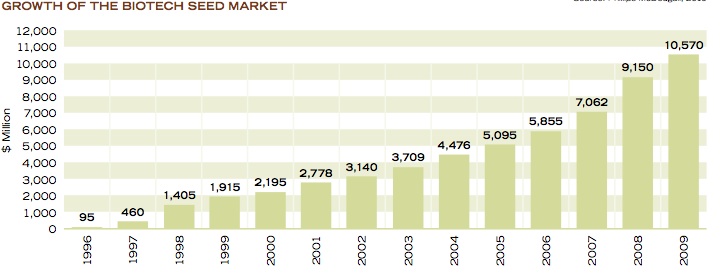
U.S. biotech seed sales
The RTP area, a U.S. biotech hotspot, is home to agricultural biotech operations of four of the large companies - Monsato, Syngenta, Bayer and BASF - and several smaller companies and startups. (More about research at Syngenta’s corporate biotech research center here.)
Eager to catch up, Bayer CropScience in 2009 bought a smaller RTP neighbor with an enviable collection of crop seed traits for $365 million. Athenix, which had research collaborations with Monsato and Syngenta, is now part of Bayer CropScience. So are Athenix’s 65 employees, but Bayer CropScience continues to hire to add a total of 125 employees by 2015. (More about the Athenix acquisition here.)
“We are making an increased investment in bioscience,” Boyne said. “We see this area as a strong growth opportunity.”
So do Monsanto, DuPont and Syngenta.
In 2009, Syngenta bought Monsanto’s hybrid sunflower seed business for about $160 million. In 2010, Monsanto broke ground to expand a soybean seed production facility in North Dakota. And DuPont announced in February that it will invest $50 million to expand its agricultural biotech research center in Delaware.
DuPont expected sales of its ag unit to rise 8 percent to 10 percent per year through 2015.
RTP oncology startup gears up to launch first product
Wednesday, April 20, 2011, 7:15 pm No Comments | Post a CommentEditor’s note: North Carolina’s Research Triangle is home to hundreds of young companies. Scientists and entrepreneurs started them to develop technologies and medicines for better detection and treatment of diseases. Some of the companies work on innovations that are the result of research done at one of the area’s universities. Others are outgrowths of established companies. CivaTech Oncology, a startup that’s been around since 2006, employs two full-time and three part-time and is about to launch its first product, is one of those young companies.
Much of the furniture in the about 2,500-square-feet that CivaTech occupies at Park Research Center, a 13-building complex in Research Triangle Park, is second-hand. As the company’s two full-time employees, Suzanne Troxler Babcock and Seth Hoedl have important-sounding titles - Babcock is executive chairwoman and Hoedl is chief science officer - but they rely on a team of part-time employees and consultants.

Suzanne Troxler Babcock
Like many startups, CivaTech operates on a tight budget. Since its inception, the company has raised about $2 million from private investors, most of them live in the RTP area.
But things are about to change, said Babcock.
“We think we’ll look quite different as an organization by the end of this year,” she said.
CivaTech is looking for a partner to start selling its first product, a next-generation alternative to radioactive seeds that have been used for about 20 years to help reduce tumors in the prostate, breast and cervix.
The Food and Drug Administration has already approved the product, called Civa-String, and Babcock said the first prostate cancer patient is expected to get a Civa-String implant this fall.
That would make the start-up a competitor in a growing market already occupied by some large, publicly traded companies.
Brachytherapy products, which is what the radioactive seeds are, generated $240 million in U.S. sales in 2008, according to a 2009 report by Bio-Tech Systems, a market research firm in the healthcare field. But by 2016, the market is projected to increase to about $2 billion in sales.
Radioactive seeds to treat prostate cancer accounted for about half of the 2008 sales, Bio-Tech Systems reported.
The biggest suppliers of the seeds are C.R. Bard, a New Jersey-based company that is publicly traded and reported $2.7 billion in sales last year; Oncura, a division of General Electric; and Theragenics, an Atlanta-based company with about $80 million in annual revenue.
The radioactive seeds are about the size of rice kernels - cylinders made of titanium and filled with radioactive material, iodine-125 or palladium-103. Worldwide, about 15,000 prostate cancer patients receive the seeds every year.
The radioactive seeds have side effects, frequent bathroom visits and sensitivity to many fruits and other foods. But the biggest problem with the seeds is that they can migrate, Hoedl said. About 120 seeds are implanted in a prostate for a therapeutic dose, he said. If one or two of them migrate, they can end up in the patient’s lung or kidney and do damage.
Civa-Strings shouldn’t migrate. They’re cheaper to make, because they require half the radioactive material to deliver the same therapeutic dose, Hoedl said. They dispense the radiation more uniformly and they’re made with palladium-103, an isotope that works more than three times faster than iodine-125.

A Civa-String, filled with palladium-103 and gold markers. The gold helps the doctor find the strip once it is implanted. Courtesy: CivaTech
The strings are flexible plastic tubes about the thickness of an angelhair spaghetti noodle that are loaded with palladium-103 and gold pellets. Depending on the dose prescribed for each patient, they come in lengths from less than an inch to about 2.5 inches. Radiation oncologists place the loaded strings with the same kind of 8-inch-long needle as the seeds.

Seth Hoedl
Instead of about 120 seeds, a prostate cancer patient would require only 20 to 25 of the strings, Hoedl said.
CivaTech worked with the N.C. State University’s nuclear engineering department to make sure the palladium-103 doesn’t leach out.
If the launch happens as planned, Babcock expected to hire four more full-time employees this year.
Meanwhile, development of the next product, a sheet with palladium-103 loaded strips, continues. The sheet is aimed at shrinking cancers in the lung, colon and esophagus. Last year, CivaTech received $200,000 from the National Institutes of Health to work on the sheet.
Couple documents evolution as it happens
Friday, April 15, 2011, 8:56 pm No Comments | Post a CommentIf Charles Darwin returned to the Galapagos Islands today, he would find all but one of the finch species that lived there during his visit in the 1830s. But he would also find birds that look and sound different.
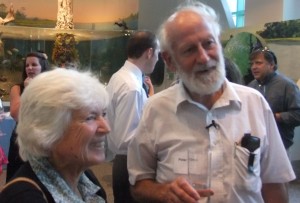
Rosemary and Peter Grant during a reception in their honor at the N.C. Museum of Natural Sciences
Peter and Rosemary Grant, husband-and-wife evolutionary biologists at Princeton University, have written about a medium ground finch that is heavier, has a broader beak and sings a different song than its closest relative.
The Grants have documented the emergence of this medium ground finch lineage since 1981, when they caught what they believe was an immigrant bird on Daphne Major, a tiny Galapagos island where they’ve measured, weighed and tagged ground finches several months every year since 1973.
The new lineage, which nobody has dared to call a new species yet, has been molded by droughts, above average rainfall and competition for food - factors that also affected other finches living on Daphne Major.
“In the 2000s, the birds are not the same as the ones that were on the island when we started,” Peter Grand told a crowd of more than 200 who had come to his and his wife’s presentation April 11 at the N.C. Museum of Natural Sciences in Raleigh.
That evolution can happen as researchers watch was unexpected. That the Grants documented the making of what might be a new species in 20 years has turned them into legends.Their research has won multiple awards and is featured prominently in biology textbooks and one Pulitzer-Prize-winning book.
The couple’s visit to North Carolina’s Research Triangle was the result of a collaboration of the museum, N.C. State University and the National Evolutionary Synthesis Center.
Thirteen species of ground finches live on the Galapagos archipelago, a cluster of more than a dozen islands located in the Pacific Ocean about 600 miles west of Equador. They are plain birds with brown, gray or black plumage that have been famous since they helped Darwin develop the theory of evolution.

Darwin's finches
All descend from one species that lived on the South American mainland.
The smallest finch species on the Galapagos Islands weighs about one-fourth of the largest species and each species has developed a specific beak to eat a special diet.
The Warbler finch has a slender beak to probe for insects. Ground finches have broad beaks to crush seeds of various sizes. Cactus finches have long, curved beaks to probe flowers for nectar. The large tree finch has a powerful, curved beak to strip bark and extract insects and termites.
The diet has a lot to do with where a species lives. The medium tree finch, for example, can only be found on Floreana Island. The common cactus finch lives on all but the five Galapagos Islands that are inhabited by the large cactus finch.
Daphne Major is home to four species, the Grants reported. The couple caught small, medium and large ground finches and cactus finches, including some that had immigrated from neighboring islands.
The males of each species sing a different song, which male and female birds learn as nestlings listening to their fathers. Males and females of a species recognize each other by that song. Interbreeding can occur, Rosemary Grant said, for example, when the fatherly lesson gets garbled because the nest is close to the nest of another species in the same cactus bush.

Immigrant hybrid male the Grants caught in 1981. Source: Proceedings of the National Academy of Sciences
In 1981, the Grants caught a medium ground finch immigrant whose plumage was particularly glossy and black. The male bird was about 20 percent bigger than the biggest medium ground finch captured on Daphne Major and had a wider beak. It also sang an unusual song and a blood test determined that it carried cactus finch genes.
The immigrant hybrid male mated with a female hybrid that also carried genes of both species. Three generations of offspring - finches live up to 16 years - bred with local medium ground finches and other hybrids.
Then, all but two of the birds in the lineage died during a severe drought in 2003 and 2004. The remaining two birds, a sister and a brother, mated and their offspring has mated, but only with each other.
This has led to two distinct groups of medium ground finches on Daphne Major that do not mix, the Grants reported. They differ in weight, beak shape and song and breed in two different areas on the island.
(More in the Grants’ inaugural article in the 2009 Proceedings of the National Academy of Sciences.)

ECGC encourages designers to create
Friday, April 15, 2011, 1:58 pm 1 Comment | Post a Comment
Timothy Gregory, an aspiring game developer and student at Piedmont Community College, works with the Unreal Development Kit during the East Coast Game Conference Thursday. | Photo by Tyler Dukes
It was barely 10 a.m. Thursday and Timothy Gregory was already busy creating worlds.
With a few gestures, he willed the ground into existence, adding texture and flooding his environment with water. Minutes later, he added grim, metallic structures: from complex pillars to blinking machines with unknown functions. Then with a click of his mouse, he created light. Read more…
Gaming industry veteran: Things are getting interesting
Tuesday, April 12, 2011, 10:38 am No Comments | Post a CommentIn November, the gaming industry will celebrate its 40th birthday. With the release of Computer Space in 1971, the future founders of Atari set in motion a phenomenon that would change the way people look at entertainment, learning and even medical training.
And for 30 years, Mark Cerny’s been right in the middle of it.
The creator of classic titles like Marble Madness and more modern blockbusters like Crash Bandicoot and Spyro the Dragon, Cerny’s had his hands on almost every evolutionary form of the video game, from the coin-op arcade to the next-gen shooter.
Ahead of his Thursday keynote titled “The Long View” at the East Coast Game Conference in Raleigh, Science in the Triangle caught up with Cerny over the phone from his office in Burbank, Calif., where he runs his own consultancy firm Cerny Games.
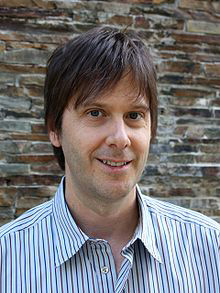
Mark Cerny
Q: What do you think has been most significant about the change you’ve seen in the video game world in the last 30 years?
If you look at where it was when I joined the game industry in 1982, the center of the games industry was the video game arcade. Some of the most popular home games were versions of the arcade games.
If you look at the late 80s, the center of the world was the PC. That’s where all the creative action was. The GDC that we know today was actually the CGDC — the Computer Game Developers Conference.
By the late 90s, very console-centric, with either cartridges or CDs. Now it’s moved again: Facebook, iPhone, iPad have shown huge recent gains in market share.
Q: In the early 80s, we saw a market saturated with pretty terrible games, then a subsequent crash. Do you see parallels here with the emergence of so many mobile applications?
One thing we should be aware of is those games were terribly expensive back in the day. If you went to the store and bought a game from the store for $40 in 1980 or 1982, taking into account inflation, that’s about $100 today. I agree that not all the games demonstrated that much play value, but today, these games you’re talking about are games you can play for a buck, or maybe $3. I think it’s a much healthier market today.
Q: What do you think the fragmentation we’re seeing in the gaming market means for video games?
Certainly the core console gaming market is getting soft. We saw a 5 or 10 percent decline in 2009 and about the same in 2010. I’ve been through some of the great crashes, and it does make me wonder a bit if we are headed for one.
Q: So is it just a wait-and-see situation at this point?
The diversity we have right now is really healthy. It’s nice to see so many people who wouldn’t normally spend much time on electronic entertainment going out there and playing these games.
I was in London two years ago and my cab driver had just discovered the iPhone and he was going crazy over the number of 99p games that he could buy. This was a guy who had never played games before.
On the biggest-level picture, it’s healthy because the audience is broadening dramatically through the iOS games and Facebook games.
Now, if I’m going out there and I want to create a 20-hour single-player experience for console that’s going to cost $50 million to develop, yes, there are implications for that, and I’m not sure the economics of that are as healthy today as they were three years ago.
Q: What still excites you about working in the video game industry?
This is my 30th year of making games, and I have to say the first half of that was not as interesting as the second half.
Until the original PlayStation came out, it wasn’t really possible to create the kind of game I personally was interested in making. I was a hobbyist programmer in the 1970s. My brother and I were trying to make a real-time 3D action RPG. Now needless to say, that’s a terribly ambitious thing to go after. We had a couple hundred thousand dollars of university equipment we were borrowing to do this. We were programming in punch cards. When I finally saw the game we were trying to make, it was called Final Fantasy VII.
Ironically, I got into arcade games, where the games were three minutes long or five minutes long, so I didn’t have a chance to make the games I was interested in making until I started collaborating with Naughty Dog on the Crash Bandicoot series and Insomniac on the Spyro the Dragon series. From that standpoint, Spyro the Dragon, which had narrative in it, was much closer to the vision I had as a child of what I wanted to make. That was just 1996.
NVIDIA graphics wizard on Marcus Fenix and Minecraft
Monday, April 11, 2011, 10:50 am No Comments | Post a Comment

Tony Tamasi
From text-based adventure titles to dystopian 3D shooters, video game graphics have come a long way. But if people like Tony Tamasi have anything to do with it, that rapid progression won’t be stopping anytime soon.
NVIDIA‘s senior vice president for content and technology will be in Raleigh Wednesday for the East Coast Game Conference, when he’ll deliver his keynote address titled, “The Future of Graphics Processing.” Science in the Triangle caught up with Tamasi by e-mail to discuss where graphics are heading in the gaming world — and how gamers’ constantly changing palates will guide that growth.
Q: What role do you think graphics play in the quality of a game, especially when it comes to things like storytelling and gameplay?
Graphics is one of the core components of great games. Obviously graphics alone don’t make a great game, but great graphics can help to make a game better, more immersive and more enjoyable. For example, horror-style games would be significantly less scary if lighting and shadows couldn’t be done interactively. Seeing some creepy shadow approaching around a corner can really help to set the mood.
Q: How are technological advancements changing how game developers think about graphics?

Epic's "Samaritan" demo showcased the new Unreal Engine 3. | Image courtesy of Epic Games
The transition of graphics processors to these generally programmable devices has really allowed game developers to become much more creative and get much closer to the visions they have in their head. Some of the most recent advances in graphics processing with DirectX 11-class graphics processing units enable incredible levels of geometric richness through procedural tessellation, the ability of the GPU to create geometry from a higher-level surface representation or to extrude real geometry from displacement maps. Increased levels of geometric realism can help environments seem much more realistic, and characters much more lifelike as artists are less constrained to a small number of polygons, which ultimately leads to harsh silhouette edges that look more like a collection of polygons than something alive.
Q: Despite the explosion in power of both console and desktop gaming platforms, we’re seeing a surge in popularity for games with a more retro aesthetic — like Minecraft for example. What do you make of this movement?
It’s fantastic. We’re seeing a resurgence in innovative gameplay. Minecraft is a fantastic example of a creation/exploration type of game, and despite its retro look, can be incredibly addictive. I would expect that as before, as new gameplay or design mechanics are developed, over time they will evolve, and as future games incorporating these concepts are developed, they’ll layer on not only enhancements to gameplay, but improved visuals, physical simulations, more intelligent AI, etc. It’s incredibly important that the game development industry continues to be creative and innovative, since all of us gamers have a little bit of ADD in us and are always looking for something new to challenge or delight us.
Q: We’re seeing a huge shift as gamers embrace mobile gaming platforms. How do you think this fragmentation will affect the development of graphics processing?
Fragmentation can be a difficult problem for game developers to address. Happily, for things like the Android, iPhone, Xbox 360 and PS3, the core graphics capabilities aren’t that different (the horsepower obviously is). So from a core architecture perspective, it isn’t an intractable problem to design an engine that can span a very wide dynamic range of devices. Unity and Unreal Engine are obvious examples of the ability to have core engine technology with range. Epic’s latest demonstration of their engine’s capability, Samaritan, also shows that it’s possible to build incredibly stunning real-time graphics capabilities on this core technology.
There’s no doubt though that designing a game that pushes the envelope on today’s high end DX11-based GeForce GTX 580 will involve different art, assets and capabilities than a game that is targeting mobile devices. In many ways though, mobile device capability and horsepower isn’t that different from consoles from a few years back, so to some degree the industry’s already “learned” how to develop for that.
It’s an incredibly exciting time for game developers. Resurgence of mobile, a new renaissance of game design and creativity, revolutions in business models, pervasive connectivity, enormous increases in graphics capability and power, devices with huge numbers of input devices and sensors, and next-generation functionality and platforms – all mean the next decade should be a great time for creative developers to tap the enormous potential of our rapidly changing ecosystem. I can’t wait to see how awesome these new games are going to be!
Interested in the East Coast Game Conference? Science in the Triangle’s got you covered! Follow all our stories on the conference.
Jane Goodall says “hello” to Duke University
Sunday, April 10, 2011, 8:14 pm No Comments | Post a CommentThe greeting was embracing but inquisitive. It emanated from deep within Jane Goodall and got louder, higher in pitch and more urgent with each bellow.

Jane Goodall
Goodall, the British primatologist considered the world’s foremost expert on chimpanzees, often starts her talks the way chimpanzees greet a new day in Gombe Stream National Park, the Tanzanian reserve where Goodall began her research in 1960 and where the institute she founded in 1977 still has a research project under way.
The greeting, Goodall has said, translates to, “Here I am. Who’s out there?”
Just six days short of her 77th birthday, Goodall stood on stage at the sold-out, 1,200-seat Page Auditorium at Duke University and again greeted her audience in Chimpanzeese.
But this time, she received in-kind answers from the audience. This welcome was special.
The March 28 Duke visit, Goodall’s third since 2007, followed two high-profile recruitments.
A year ago, Anne Pusey, a former field researcher for Goodall in Africa, joined Duke to head the evolutionary anthropology department. Pusey came from the University of Minnesota, home of the Jane Goodall Institute’s research archive since 1995. The archive is a daily expanding compilation of field notes, videos and photos and includes about 22 cabinets of paper files with many of the notes written by Goodall herself.
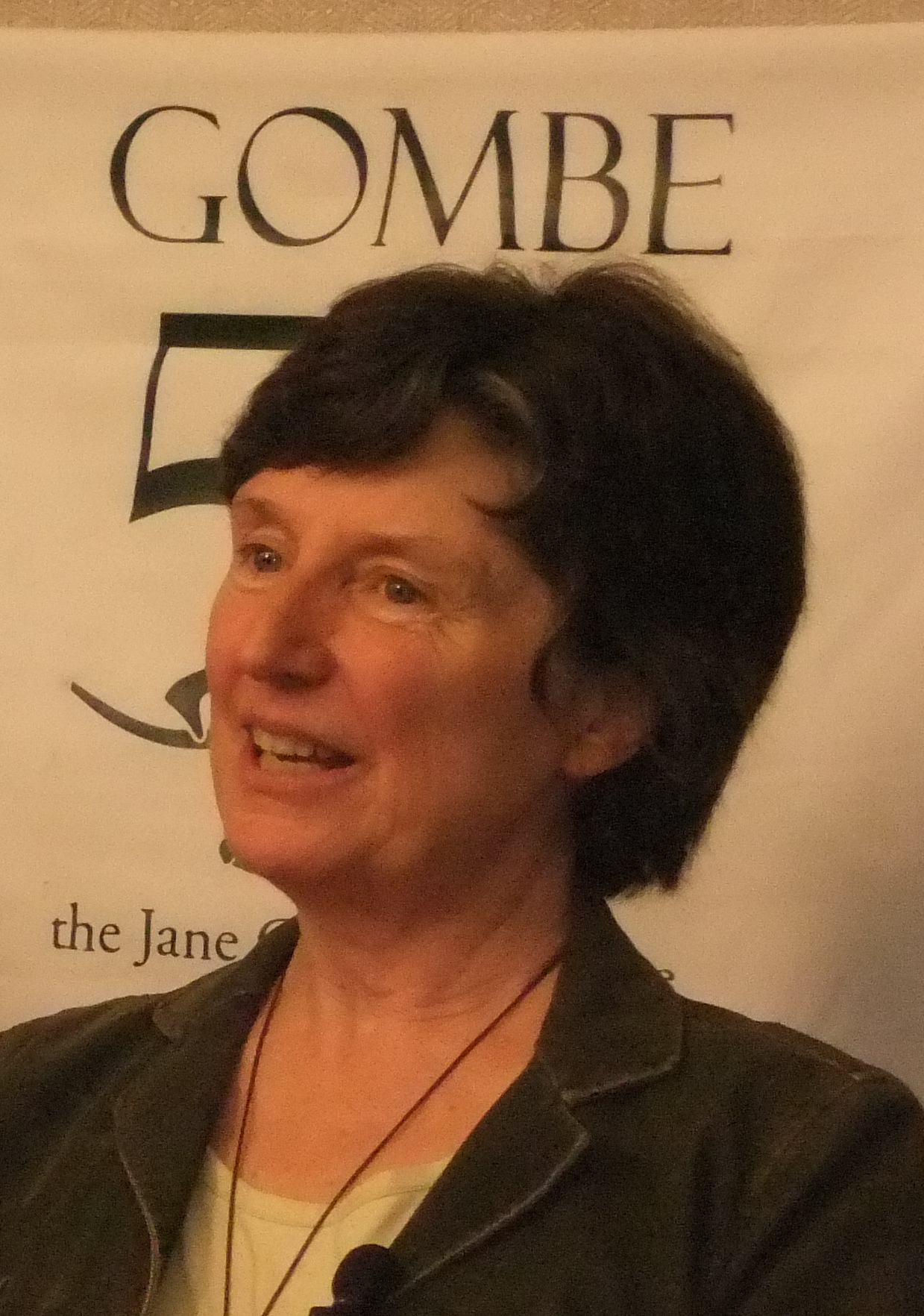
Anne Pusey
On March 17, Duke announced that the archive would follow Pusey to North Carolina and 11 days later, Goodall spent a very public day on the Duke campus, meeting journalists, visiting school children and talking about what she learned in the past 50 years.
In Minnesota, Pusey’s departure revived speculations that Goodall’s support for animal rights had ruffled feathers at the University of Minnesota, where researchers do extensive testing on animals, including on monkeys. Animal testing is also done at Duke, including invasive surgery testing on macaques. But joining Duke gained Pusey a distinguished, endowed professorship and a departmental chairmanship. At the University of Minnesota, she held the title of adjunct professor, usually a non-tenured, non-salaried position.
Also, Duke and the Jane Goodall Institute are exploring further collaborations, said Maureen Smith, the institute’s president. Environmental and humanitarian programs Goodall has started since the mid-1980s to preserve the chimpanzees’ rain forest habitat and improve the lives of neighboring villagers may offer research opportunities for Duke’s Nicholas School of the Evironment and Earth Sciences and the Duke Global Health Institute.
When asked at the press conference how she felt about the archive moving, Goodall answered, “I was happy for it to go where it needed to go.”
It was clear she didn’t want to talk about the archive’s 1,000-mile move. The woman, who showed a male-dominated academic world that humans aren’t the only ones using tools and that chimpanzees hunt prey and eat meat, preferred to talk about the encounters she’s had with “the animals that are most like us.”
Goodall’s favorites include stories about Fifi, Little Mama and Jojo.

Fifi
Fifi was about 2 when Goodall started her Gombe field research in 1960. Monkeys and humans age similarly, as Duke primatologists have found. (More about that here.) And chimpanzees can get as old as humans. But Goodall said that none of the chimpanzees she met in the early 1960s - she called them “her old friends” - are alive anymore. Fifi, the last surviving old friend, died in 2004.
“She almost made it,” Goodall said.
Like her mother, Flo, Fifi was popular with the male chimpanzees and a very successful and caring mother. She gave birth to nine sons and daughters, according to the Jane Goodall Institute a Gombe record. Fifi attained a very high rank in the group and so did several of her sons.
Flo, Fifi and Fifi’s offspring helped Goodall learn a lesson that in retrospect she called one of the most interesting of her career.
“There’s good mothers and bad mothers in chimp society,” Goodall said. “The offspring who have good mothers do better.”
Whether there’s a special relationship between male chimpanzees and their offspring is one of the questions that the field data in the archive may answer, she said. “Who knows what we’re going to find analyzing 50 years of data.”

Little Mama
Little Mama is an example of how old chimpanzees can get. Born in 1938, the chimpanzee is just four years younger than Goodall and the oldest chimpanzee living in a zoo. The two have known each other for about 30 years and Goodall still visits Little Mama at the Lion Country Safari near West Palm Beach.
It’s usually easy to find Little Mama, Goodall said. She likes to wear a piece of cloth over her head.
To keep audience members from feeling like hugging the next best chimpanzee, Goodall also had a story about violent gang war between two groups of chimpanzees that used to be one. Males of one group didn’t rest until they had killed the males of the other group, she said, and compared the situation to the American Civil War.
Considering how dangerous male chimpanzees can be makes the story of Jojo particularly stunning. Goodall frequently ends her talks with this story and did so at Duke.
An essay Goodall wrote for Science in 1998 included this version of the Jojo story:
One of the unexpected rewards that I have found as I become increasingly involved in conservation and animal welfare issues, has been meeting so many dedicated, caring, and understanding people. I cannot close this without sharing a story that, for me, has a truly symbolic meaning. The hero in this story is a human being named Rick Swope who visits the Detroit zoo once a year with his family.
One day, as he watched the chimpanzees in their big new enclosure, a fight broke out between two adult males. Jojo, who had been at the zoo for years, was challenged by a younger and stronger newcomer, and Jojo lost. In his fear he fled into the moat which was brand new, and Jojo did not understand water. He had gotten over the barrier erected to prevent the chimpanzees from falling in—for they cannot swim—and the group of visitors and staff that happened to be there watched in horror as Jojo began to drown. He went under once, twice, three times. Rick Swope could bear it no longer. He jumped in to try to save the chimp, despite onlookers yelling at him about the danger. He managed to get Jojo’s dead weight over his shoulder, and then crossed the barrier and pushed Jojo onto the bank of the island.
Rick held him there—the bank was very steep and if he were to let go Jojo would slide back into the water—even when the other chimps charged toward him, screaming in excitement. Rick held Jojo until he raised his head, took a few staggering steps, and collapsed on more level ground.
The director of the institute called Rick. “That was a brave thing you did. You must have known how dangerous it was. What made you do it?”
“Well, I looked into his eyes. And it was like looking into the eyes of a man. And the message was, ‘Won’t anybody help me?’”
Another visitor at the Detroit Zoo caught the rescue on videotape. Here’s the TV news report with footage of the rescue:
Only 8% of asthmatic children using inhalers properly, finds UNC study
Friday, April 8, 2011, 1:48 pm No Comments | Post a CommentOriginally published: 3/31/11

Only eight percent of children with asthma are using their metered dose inhalers properly, finds a new UNC study.
That figure alone is enough to make parents short of breath. However, the study also found that kids aren’t using their inhalers properly because their primary care physicians aren’t showing them how.
The findings appear in the March edition of the online journal Pediatrics.
Dr. Karin Yeatts, an assistant professor of epidemiology at the UNC Gillings School of Global Public Health, was involved in the study. She cautioned asthma users to make sure they know how their medicine works.
“If you’re not taking it properly, then a lot less of that medication is reaching your lungs and reducing the inflammation,” she said. Yeatts said physicians and pediatricians need to spend more time demonstrating inhaler techniques with younger patients.
“Often the parent gets shown, but we found that the more competent the child is, the more likely he or she is to inhale the medicine correctly,” she said. “Sometimes the parents aren’t around when they need to take it and the people at school might not know.”
There is a proper technique to taking asthma medication, said study co-author Dr. Stephanie Davis of the UNC Division of Pediatric Pulmonology. Davis’s instructions were:
 1. Shake the medicine canister.
2. Exhale completely.
3. Connect spacer and place in mouth.
4. Seal lips around spacer.
5. Take a big breath and hold for 10 seconds.
6. Exhale, wait, and repeat.
Davis said how many puffs you take depends on how severe your reaction is at the time. Most asthmatic children take the medicine twice a day. If you’re about to go running, Davis said you’d take it right before warming up.
The spacer, she said, is what makes all the difference. Spacers are small plastic tubes that connect to the inhaler to better corral the spray down into the lungs. The most common problem without a spacer is hitting the back of the mouth and not getting the actual dose of medicine to the airways. Even though Davis said spacers aren’t always necessary, she gives them to every child in her pulmonary clinic, whether six or eighteen.
“I ALWAYS recommend a spacer,” she said. “In fact, I have asthma and I always use an inhaler with a spacer, as well.”
Davis and Yeatts agree that the overriding reason primary care pediatricians aren’t showing kids how the inhalers work is because they are too busy.
“That’s sort of the reality of clinical practices these days,” Yeatts said. “Pediatricians have so many things to do every day that it’s not that high up there for them. But still, why don’t they?”
Dr. Janelle Shumate just finished her residency at UNC Hospitals. Now she’s a full-time pediatrician at Village Pediatrics in Chapel Hill. Shumate said she and her colleagues always sit down with asthma patients and show them how to take their medicine.
“It only takes five to 10 minutes,” she said. “And usually closer to five.”
Shumate said Village Pediatrics has sample spacers and inhalers that kids can test out or watch a demonstration on.
Jonathan Fowler works alongside Shumate as the clinic’s practice manager. He said not showing patients how the treatment devices work is not only poor care service but a violation of the American Medical Association’s protocol guidebook. Village’s policy is always to show kids how, he said, and they’re able to because they see less patients.
“We’re spending more time with the kids than other pediatric offices,” Fowler said. “A lot are trying to see 6 or 7 an hour. It’s not like they wouldn’t do it if they had the time. But they don’t have the time.”
Taking the extra time pays off, too, he said. Insurance companies reimburse them for instruction time as a measure to lessen chances of hospitalizations down the road.
“Not only do we teach them, we bill for it,” Fowler said.
Still, Davis sees rising customer demands and health care rates as the barrier to entry for thorough asthma medication instruction.
“As we currently buckle down on costs, it’s going to be harder and harder to be able to do that,” she said. But because asthma is so prevalent in the pediatric population, she said it’s critical.
“I’m biased because I’m a specialist and I always have the means to do so. But many others don’t.”
Sponsor boost lowers price of gaming conference passes
Thursday, April 7, 2011, 12:34 pm No Comments | Post a Comment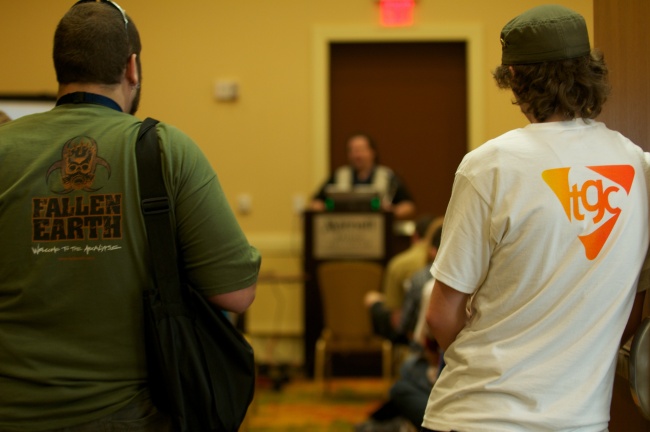
Attendees at last year's Triangle Game Conference listen to a speaker. | Photo courtesy of Capstrat
Good news for cash-strapped game developers looking for a way into next week’s East Coast Game Conference: Organizers slashed the price of professional passes more than $100 last week.
The $99 pass grants visitors access to all the sessions and keynotes, as well as access to the expo hall. Pass holders can also visit the career lounge, where they can speak with industry professionals, and Unreal University, where they’ll be able to get hands-on with Epic Games’ Unreal Development Kit.
The lower prices are a result of conference donors Epic, Joystick, ECU, Trailblazer, Wake Tech, Autodesk and Cinesys, which provided greater-than-expected donations for the rebranded event once known as the Triangle Game Conference.
“We had a number of companies step up in their sponsorships,” conference co-founder Troy Knight said. “That allowed us to take the money we made for the conference and lower the costs for smaller incubators and independent companies.”
The passes, once priced at more than $200, were “really a stretch” for many smaller and aspiring developers, according to conference co-founder John Austin. He said organizers have already seen an uptick in registrations as a result of the lower price.
Although it’s in its third year, Knight said the organizers are able to make conference funding go further because the Triangle Game Initiative, the trade group putting it all together, is a nonprofit focused on benefiting the local gaming industry.
“None of us gets paid to do the conference. The money goes back into a pool to do more events,” Knight said. “It’s really a helping handout for the local community.”
A week out from the event, Knight and Austin said registration numbers already match attendance last year, which was around 800 people. Organizers are aiming for more than 1,000 at this year’s conference.


