
Homegrown innovation: MegaWatt Solar
Monday, April 19, 2010, 10:28 am 1 Comment | Post a Comment
A concentrated photovoltaic "solar tree" designed by MegaWatt Solar. (Image from MegaWatt Solar web site.)
I recently wrote a two-part post here reporting on a forum in Research Triangle Park which focused on barriers to homegrown global business innovation in the Triangle and in North Carolina. While contemplating the themes of the forum, and skimming today’s science news, I stumbled across this article in Popular Mechanics magazine which looks into the advances in concentrated photovoltaics over the past few years — and leads with the example of MegaWatt Solar, a renewable energy start-up in our own backyard. The company was formed by three professors at the University of North Carolina at Chapel Hill who seek to create utility-scaled concentrated photovoltaic systems to supplement fossil fuels-based energy production. (They’ve also been featured in UNC’s Endeavors research magazine, and have landed a story or two in the News & Observer, no longer available in their web archives.)
It struck me that MegaWatt Solar is a good example of the applied research that our area universities can generate to solve real-world problems, and also of the links that can be established between professors with marketable ideas and business-savvy entrepreneurs that can help carry the ideas from the research bench to the bank. Their story is truly one of homegrown innovation, though to be fair they are still in the pilot study phase and working out some kinks.
Because I’ve already written this story, I’m not going to write it again… Below is a reprint of the cover story article I penned about the people behind MegaWatt Solar, and their mission, for the fall 2009 issue of UNC College of Arts & Sciences magazine. It is reprinted here with full permission from the editors.
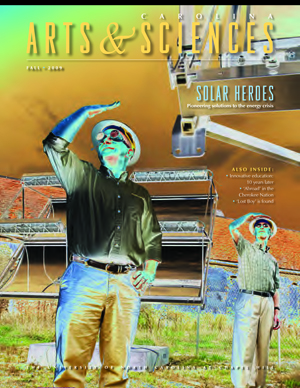
UNC Arts & Science cover, fall 2009, with MegaWatt Solar founders.
The Power of 20 Suns
MegaWatt Solar is a small start-up energy company in Hillsborough, N.C., backed by $17 million from Norwegian venture capitalists and mentally powered by three researchers in UNC’s College of Arts and Sciences. Tucked away in a brick textile-mill-turned-office-park, the company is poised to bring a new concentrated photovoltaic system to market that could provide the cheapest large-scale renewable source of electricity available anywhere.
But they didn’t design it for your home. They designed it for your utility company, to offset peak energy demand, which tends to coincide with the sunniest portions of the solar day. The term MegaWatt describes their goal of producing one megawatt of electricity from over a thousand solar “trees” spread across about 10 acres. The solar trees rotate on a dual axis mount that tracks the sun across the sky vault. One megawatt of electricity — one million watts — is enough to power about 800 homes.
MegaWatt Solar was founded by astrophysicist Chris Clemens, theoretical physicist Charles Evans, computer scientist Russ Taylor and a private sector power-grid systems engineer, Dan Gregory. They built their alpha version in spring 2006 in Evans’ driveway from what he describes as “an aluminum erector set for adults,” with parts bought off E-Bay, cheap advertising signboard and a highly reflective material scavenged from the interior of a Solotube skylight.
The best part? It worked.
“Boy, it was bright, “Evans said. “Everyone ran to get their sunglasses.”
They measured its electrical output and knew they were on to something red hot. The alpha reflector had a concentrating factor of 24:1. However, the team reduced this to 20:1 in their final design, to balance limitations from excessive heat buildup with low-cost solutions. Still, the power of 20 suns is impressive.
Since that weekend science project, the researchers have ruthlessly honed their design in an iterative process. They are on their fourth version, which uses four trough-shaped mirrors to produce about 0.75 kilowatts, and Clemens thinks they are nearing the finish line. He believes they will have a marketable product within a year that produces 1 kilowatt. A power utility would need to install about 1,000 of the concentrated solar trees, which Taylor estimates would take about 10 acres, to produce one megawatt. From the get-go, the trio wanted the design to be as low-cost as possible.
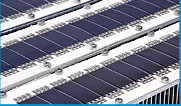
Rows of photovoltaic cells engineered to receive 20 times the concentration of normal sunlight. (Image from MegaWatt Solar web site.)
They have one pilot project in Caswell County, where Piedmont Electric Membership Corporation has installed sixteen 12-mirror solar trees. The team is retro-fitting the units to address wind demands, but they expect the new solar plant to be online by December, when they will begin field-testing them. A second pilot project is planned in Florida. They are also field testing six units that are located a stone’s throw from their Hillsborough office. MegaWatt’s solar trees are modular in design, to allow for periodic upgrades in a fast-paced technological world. Clemens, whose background is in astronomical instrumentation, designed the rough concept for the unit, and Evans focused on perfecting the light collecting and concentrating system.
“One of our mantras was that because the mirrors are the component that would cover a lot of ground, they had to pretty much be cheaper than dirt,” Evans said. They settled on an inexpensive exterior signboard material called Dibond, topped with a 3M film. Clemens jokes that it is the “cheapest mirror known to man,” but its 94 percent reflectivity and extremely light-weight aluminum frame are no joke. Taylor and his team worked on the computing that drives the dual-axis mechanical and optical tracking system. His team designed software that learns and anticipates where the reflectors need to be, and directs them there. This software allows the units to be installed anywhere on earth, he said, and within three days the unit will learn all it needs to know to track the sun and keep the reflectors in the right place.
Clemens and Evans extensively researched other concentrated photovoltaic projects and picked the best elements from them. A central key to their process was using existing technologies and materials, which kept costs down. MegaWatt Solar does not plan to mass produce the solar trees. Rather, they plan to work directly with interested utilities, license the design to large engineering firms, and advise local contractors on the construction and parts-purchasing.
They’re not the first to propose concentrating light to make more efficient use of photovoltaic cells. But they may be the first to do it cheaply, reliably and at a utility scale.


This is excellent. I need to tell my pals at Earth & Industry about this.