Author Archive

“Doctor Bugs” visits the Triangle
Wednesday, October 20, 2010, 11:11 am No Comments | Post a Comment
Cover of the Adventures Among Ants, by Dr. Mark W. Moffett.
Not many scientists beg perfect strangers to eat the species they study. But that’s just what “Doctor Bugs” did when visiting tourist-magnet ruins in Cambodia. Dr. Mark W. Moffett proffered a dish of scrumptious crackers topped with herbs and, um, plump ant larvae to passersby — at times literally pleading with them to try it. It’s just one of the ways the world-famed ecologist, and Smithsonian Institution research associate, gets people to stop and notice the trillions of ants that share our world.
Moffett’s comedic showman personality was on display in full force on Tuesday night as he entertained an auditorium full of people at the N.C. Museum of Natural Sciences with stories about ants. And boy does he have stories. There’s the time he snaked a small camera attached to a long cable into a nest of weaver ants, capturing engaging footage of the ants at work… the camera pushed farther and farther past hundreds of ants, until ants swarmed the other end of the cable and overran him. The footage ended abruptly with audio of Moffett yelping in pain. Then there’s the time he stepped barefoot on a pair of ant forceps in his camp and spent the day worrying he’d been bitten by a poisonous snake, a fair concern considering there was a nest within a foot of his hammock. And let’s not forget the time he actually did sit on the world’s most poisonous snake in South America, too engrossed with photographing ants to notice.”If you must sit on a poisonous snake, sit closest to their head,” Moffett deadpanned to the crowd. “It’s the best way. It’s the only way.”

National Geographic cartoon of Moffet squatting on a pit viper.
More often, Moffett’s stories are about the ants themselves — their diverse ways of sensing the world, interacting, and divvying up labor to achieve survival goals efficiently. Moffett’s high-energy slide show was centered around promoting his new book, Adventures Among Ants: A Global Safari With a Cast of Trillions, published by the University of California Press.
“Ants differ from us in that the individual doesn’t matter, it’s all about what’s good for the group,” Moffett said. But they’re colonies are a lot like our cities, he went on to explain, drawing analogies between small cities/small ant colonies and large cities/large ant colonies. In smaller colonies, where there is less specialization of labor, each ant has to be a jack-of-all-trades and perform a variety of tasks.”They have their toolboxes built-in to their faces,” Moffett said, flashing a picture of a type of trap-jaw ant with extra long pitch-fork tipped jaws. It uses the long levers to pick up struggling prey and carry it safely back to the nest. But a much smaller, second pair of jaws tucked closer to its mouth allows it to eat.
Larger colonies, like our larger cities, tend to have more job specialization, Moffett said. Scientists can often tell what role they play by their size. Sometimes the largest ants of the same species outweigh the smallest ones by 500 times. The goliath ants are often used to deliver the death blow (a sting, or a bite) in battles with other ants or interlopers, and even act as “school busses,” allowing smaller ants in their colony to hitch rides. “Basically, it’s more energy efficient for the colony if the smaller ants ride on the bigger ants,” Moffett explained.

Leaf cutter ants cooperate to bring leaf fragments to their underground nests, where "gardener" ants cultivate a fungus upon the decaying vegetation. The colony harvests and eats the fungus. (Photo by Dr. Mark W. Moffett)
He also talked about various ways that ants work together, like the free-diving ants in Borneo that live in pitcher plants. They fetch crickets out of the water pooling in a pitcher’s basin, then haul it to the lip of the pitcher where they stash it and have a feast. The crickets are often too large for the pitcher plants to digest, he explained, so the ants are doing the plant a favor by saving it from experiencing an overdose of acid as the cricket decays. “They’re basically antacids for the plant,” Moffett joked.”But they also must have the strongest toes in the world to carry these large crickets up the slope of the pitcher plant, which is made so that insects will fall into its trap.” Ants also form chains to create living bridges that they use to cross from one tree to another high amid the canopies of rainforest trees, hundreds of feet from the forest floor. And some ants will sacrifice themselves to fill “pot holes” along highways the colony uses to move things to and from their nest. Then there are the leaf cutter ants, which divvy up leaf harvesting and fungus cultivating duties like nobody’s business (see photo at right).
Moffett’s photographs have been widely published and he often contributes work to National Geographic magazine. He searches for images that tell a story within their frames, he said, like the one he took of a battle between two ant species that shows a Goliath ant fending off attacks from smaller ants, with the carnage of warfare in the background: headless ants frozen mid-stride, and ants with their torso’s chopped in two and legs torn asunder. He encouraged the kids in the audience to “not lose that weird point of view you have when young,” because it can be valuable to being a scientist. He credits his own path to biology and entomology with reading too many Jane Goodall adventure books when younger, and climbing too many trees.
Moffett’s talk deftly distilled insights about ant ecology and social interactions into anecdotes that enthralled kids and adults like me who are in touch with their inner kids. If you missed his talk, you did miss out — but don’t sweat it, you can always order the book.
MORE MOFFET, LINKS:
Moffett on NPR’s Fresh Air; June 17, 2010
The hidden world of ants, Smithsonian Magazine; July 2009
The science of forgetting
Thursday, July 29, 2010, 4:12 pm No Comments | Post a Comment
In my house, if I don't write it down then it doesn't get done. Period.
Day-dreaming during work often means you miss out on what is going on around you while your mind drifts, but a new study suggests that day-dreaming may also impair your ability to retain information acquired just prior to embarking on your mental mini-journey.
Peter Delaney, a professor of psychology at the Univ. of N.C.-Greensboro, led a team of researchers in probing what’s called the “amnesic effect” of day-dreaming by doing two simple experiments with college students.
In the first experiment, the team asked the students to memorize word lists, then they asked them to day-dream about their parents’ house or about their own house. In the second experiment, they asked them to memorize word lists and then day-dream about either an international or a domestic vacation. In each experiment, the disparity in the cognitive meanderings was set up to test whether mental distance had any effect upon the mind’s ability to recall the word lists.
The results are intriguing because the students whose thoughts dawdled on long-distance vacations performed much worse at recalling the word lists than those that thought of domestic getaways. Likewise, the students who lingered on thoughts of their parents home tended to also fare worse at the memory recall tasks than those who day-dreamed about their own homes.
What might explain this disparity? According to the authors, the experiment did not test only physical distance. Rather, it was set up to test mental distance from the reality of a moment, whether that distance was induced by geography, time or even cultural context. Psychologists dub this the “context-change account” of directed forgetting. The authors explain, “The context-change account proposes that shifting one’s thoughts to something different such as a diversionary thought sets up a new mental context in which subsequent items are encoded.” And this mental-context shift causes your mind to peter out at recalling the information acquired from the previous mental context.
Because past research shows that physically moving from one environment to another can produce forgetting, the researchers wanted to look at what happens when people travel through mental space and time. They hypothesized that merely imagining a change in physical location might induce forgetting because people tend to “immerse themselves in the context of that event.” And they figured that the more difference there was between the reality of where a person is in space and time, and where they travel to mentally, then the greater degree of recently encoded information that might be nixed.
With the amount of day-dreaming that I do daily, this makes me wonder how I manage to remember anything at all. Oh yes, post-it notes. Lots of post-it notes.
Moral of the story? If you day-dream at work, and wish to keep your job, try to anchor that drifting mind closer to your cubicle.
NOTES:
Peter F. Delaney, Lili Sahakyan, Colleen M. Kelley, and Carissa A. Zimmerman. 2010. Remembering to Forget: The Amnesic Effect of Daydreaming. Psychological Science. 21(7) 1036–1042. DOI: 10.1177/0956797610374739.
On the future of personal genomics and the law…
Friday, July 2, 2010, 1:51 pm No Comments | Post a Comment
Dan Vorhaus
Dan Vorhaus is a lawyer with Robinson Bradshaw and Hinson in Charlotte, N.C. where a portion of his practice comprises the growing field of personal genomics law. Given the interest in personal genomics in the Triangle, I thought I’d create an expanded version of the short question-and-answer interview I did with him for an up-coming issue of the Sci-Tech section in the Charlotte Observer and the Raleigh News and Observer (be on the lookout for that next Monday in print and online), and post it here. Vorhaus also authors the Genomics Law Report, a blog about the legal side of personal genomics, and he will be giving testimony to the Food and Drug Administration in the near future as the agency attempts to sort out particulars of how it plans to regulate genomic diagnostic testing.
How did you become interested in concentrating on personal genomics as an area of the law?
I have a master’s in bioethics; I did that degree before I went to law school. So as I started thinking about the areas of law and policy that were most interesting to me, that was clearly one of them. And it seemed like there was a tremendous opportunity for a field that is developing and emerging and creating all sorts of new and exciting legal issues. And it’s something that I’ve always had an interest in the underlying science and technology, and I was fortunate enough in law school to start working with some real pioneers in the field, specifically George Church in the personal genome field. Everything sort of built from there. Now, it’s how I make my living, it’s my career. And I love it. It’s something new and fascinating every single day and I can’t get enough of it.
Homegrown innovation: MegaWatt Solar
Monday, April 19, 2010, 10:28 am 1 Comment | Post a Comment
A concentrated photovoltaic "solar tree" designed by MegaWatt Solar. (Image from MegaWatt Solar web site.)
I recently wrote a two-part post here reporting on a forum in Research Triangle Park which focused on barriers to homegrown global business innovation in the Triangle and in North Carolina. While contemplating the themes of the forum, and skimming today’s science news, I stumbled across this article in Popular Mechanics magazine which looks into the advances in concentrated photovoltaics over the past few years — and leads with the example of MegaWatt Solar, a renewable energy start-up in our own backyard. The company was formed by three professors at the University of North Carolina at Chapel Hill who seek to create utility-scaled concentrated photovoltaic systems to supplement fossil fuels-based energy production. (They’ve also been featured in UNC’s Endeavors research magazine, and have landed a story or two in the News & Observer, no longer available in their web archives.)
It struck me that MegaWatt Solar is a good example of the applied research that our area universities can generate to solve real-world problems, and also of the links that can be established between professors with marketable ideas and business-savvy entrepreneurs that can help carry the ideas from the research bench to the bank. Their story is truly one of homegrown innovation, though to be fair they are still in the pilot study phase and working out some kinks.
Because I’ve already written this story, I’m not going to write it again… Below is a reprint of the cover story article I penned about the people behind MegaWatt Solar, and their mission, for the fall 2009 issue of UNC College of Arts & Sciences magazine. It is reprinted here with full permission from the editors.

UNC Arts & Science cover, fall 2009, with MegaWatt Solar founders.
The Power of 20 Suns
MegaWatt Solar is a small start-up energy company in Hillsborough, N.C., backed by $17 million from Norwegian venture capitalists and mentally powered by three researchers in UNC’s College of Arts and Sciences. Tucked away in a brick textile-mill-turned-office-park, the company is poised to bring a new concentrated photovoltaic system to market that could provide the cheapest large-scale renewable source of electricity available anywhere.
But they didn’t design it for your home. They designed it for your utility company, to offset peak energy demand, which tends to coincide with the sunniest portions of the solar day. The term MegaWatt describes their goal of producing one megawatt of electricity from over a thousand solar “trees” spread across about 10 acres. The solar trees rotate on a dual axis mount that tracks the sun across the sky vault. One megawatt of electricity — one million watts — is enough to power about 800 homes.
MegaWatt Solar was founded by astrophysicist Chris Clemens, theoretical physicist Charles Evans, computer scientist Russ Taylor and a private sector power-grid systems engineer, Dan Gregory. They built their alpha version in spring 2006 in Evans’ driveway from what he describes as “an aluminum erector set for adults,” with parts bought off E-Bay, cheap advertising signboard and a highly reflective material scavenged from the interior of a Solotube skylight.
The best part? It worked.
“Boy, it was bright, “Evans said. “Everyone ran to get their sunglasses.”
They measured its electrical output and knew they were on to something red hot. Read more…
Wanted: Global innovation (part 2)
Saturday, April 17, 2010, 12:13 pm 1 Comment | Post a Comment… Continued from Part I of this two-part series:
While it would be impossible to separate the global from the state-level issues discussed at the forum, some of the local business people offered examples for specific challenges to innovation that they faced.
Alexander Macris is the president of Themis Group which is based in Durham, N.C. and is a strong example of the power of a science park like RTP to attract additional tech-based businesses to the region. Macris said that the Triangle region is one of the largest concentrations of gaming companies in the U.S. Most of the innovation potential in gaming is at the gaming engine and software level, he said, and the average median income of someone in the gaming industry is about $75,000. He expects to see about 300 to 400 new gaming-related jobs in the area over the next three to five years, he said, because the industry is growing in the double digits. But at the same time, the cost of game development is going up – whereas a decade ago it may have cost $1 million to develop a game, it costs $20 to $30 million to do so today, Macris said. Foreign countries give more tax credits to their gaming companies, he said, which makes them more competitive in the global field and is hurting U.S.-based gaming companies. “Targeted tax credits are a huge attractant to small and start-up businesses in the gaming industry,” Macris said. “And cool downtowns, the creative class really likes a vibrant downtown too.”
While deeper tax credits may help some start-ups get a toe-hold in emerging markets, retaining the best talent is necessary to sustain them over time. And while uber cool downtowns like the American Tobacco District in Durham are one component of enticements to retain the best brains, it’s a smaller part of the issue. Read more…
Wanted: Global innovation (part 1)
Saturday, April 17, 2010, 11:39 am 4 Comments | Post a CommentRepresentatives of businesses and research organizations in the Triangle met Friday April 16 at Research Triangle Foundation Headquarters to explore the role of government in spurring homegrown global innovation. The meeting was the first of a handful planned by the National Foreign Trade Council, a Washington DC-based organization that advocates for both domestic and foreign trade policies favorable to its member businesses.
“We’re here today to learn from you so that we can go back to Washington and do what we do,” said NFTC president Bill Reinsch in his opening remarks. “We want to build relationships with companies and open a conversation with them to develop stronger links.” Reinsch said that his group was traveling to technology-innovation clusters like RTP and Silicon Valley to find out first-hand from companies what sort of policies were encumbering them from doing business globally, which were helping, and what sort of ideas they had for the future.
How to create and sustain jobs and businesses is a question that both federal and local governments have wrestled with sharply and frequently since the economic downturn. Research Triangle Park, NC has long been a technology-hub and economic engine for the state, noted RTP CEO Rick Weddle, and the area has excelled in life sciences, information technology, and biotech markets, but capturing emerging markets like gaming and clean energy technologies will be vital to RTP maintaining its vitality in the future. But how can science parks like RTP, and the states they’re rooted in, cultivate homegrown small businesses (and they jobs and economic resilience they generate) in emerging and established markets, especially when the banks are slow to lend — if they lend at all — and cash is plain hard to come by? Read more…
Innovation, America and Engineering: NAE Grand Challenges Summit
Friday, March 5, 2010, 4:42 pm 5 Comments | Post a Comment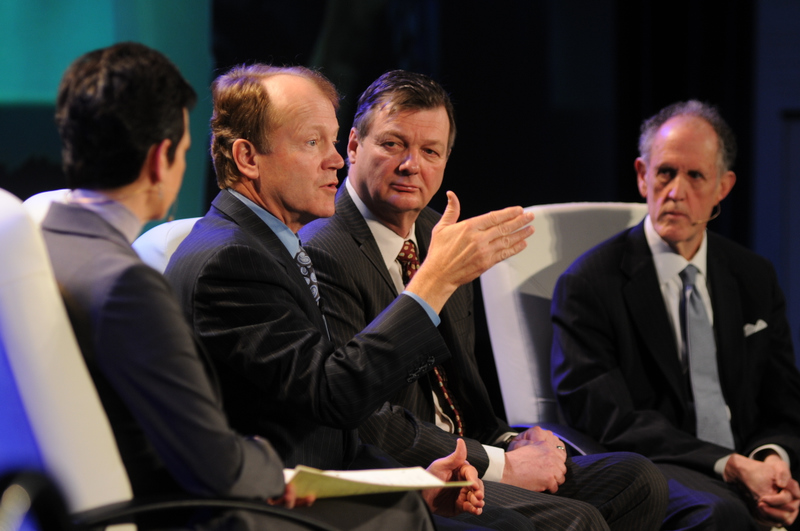
Panelists at the NAE Grand Challenges Summit, Innovation in America. Left to right, Lynn Soby, vice president of innovation and commercialization at RTI International; John Chambers, CEO of CISCO; Jeff Wadsworth, CEO of Battelle Memorial Institute; and Senator Ted Kaufman (D-Delaware). Photo by Roger Winstead/NCSU.
RALEIGH — You may be familiar with the idea that American businesses – especially those tied to technology and engineering – fret that our country is losing its innovative edge on the global stage. And because innovation drives technological advancement and economic growth – one might even say, hegemony – it’s a looming threat that many in the science, technology, engineering and mathematics (STEM) fields are scrambling to address.
But STEM fields are facing a crisis of their own – fewer graduates in the jobs pipeline compared to industry demands, and companies hiring foreigners for STEM jobs because they are better qualified.
Friday morning in Raleigh, a group of engineers from industry, academia and even government met to discuss the threat of America losing its global lead in innovation. The panel discussion was part of a Summit on the National Academy of Engineering Grand Challenges sponsored by N.C. State and Duke universities. (To learn more about the NAE Grand Challenges, go here.) Titled “American Innovation and Competitiveness,” the panel was chaired by Lynn Soby, vice president of innovation and commercialization at RTI International in Research Triangle Park. It was one of seven sessions spanning March 4-5. Read more…
Citizen science: a little birdie told me…
Wednesday, February 24, 2010, 11:34 am 5 Comments | Post a Comment
Female northern cardinal, N.C.'s state bird, and the most-reported bird for the Great Backyard Bird Count, a citizen science project. (Wikki Commons image)
The Great Backyard Bird Count is perhaps one of North America’s most popular citizen science projects. It’s been on-going since 1998, and uses the power of citizen’s eyes and interest to create a snapshot of what kinds of birds are where, and in what abundance, in mid-February.
The 2010 four-day count wrapped up last week on Feb. 15th with citizens across the nation reporting 90,898 checklists tallying 10,587,907 individual birds representing 597 species.* The most frequently reported bird was our state bird, the Northern Cardinal. North Carolinian’s sent in 4,722 checklists, resulting in our state ranking third among total number of checklists submitted. (Mine was among them.) Visit this map of N.C. state results to see species tallies for what your fellow citizens reported.
But one thing the checklists did not capture was a rare winter migrant wandering south through The Triangle. Rick Bonney, director of program development and evaluation at the Cornell Lab of Ornithology visited Sigma Xi in Research Triangle Park on Tuesday and imparted hard-won words of advice to the Science Communicators of North Carolina about developing citizen science projects, Read more…
International climate scientist visits UNC
Tuesday, February 2, 2010, 9:20 am 1 Comment | Post a CommentDr. James Hansen
Just as the snow was beginning to melt after one of the worst winter storms to hit the Triangle in recent memory passed, climate scientist James Hansen visited the Univ. of N.C. at Chapel Hill to talk about – you guessed it – global warming.
It’s probably not the first time he’s delivered a speech during wacky weather, and it likely won’t be the last.
Hansen directs NASA’s Goddard Institute for Space Studies, and he is an adjunct professor in the department of earth and environmental sciences at Columbia University. His visit to the Triangle was courtesy of UNC’s Frey Foundation distinguished visiting professor lecture series. Read more…
Rebooting science journalisTS
Sunday, January 17, 2010, 7:24 am 26 Comments | Post a CommentWhat will become of science journalism, and the good ‘ole days when a writer could actually make a career from writing for mainstream media about science? Four panelists wrestled with this question in the “Rebooting science journalism” panel on Saturday at ScienceOnline 2010. Budding science writer that I am, my feet carried me to the talk like a moth flapping to a flame.
Ed Yong, who writes Not Exactly Rocket Science, a blog that has made an international splash, talked about the future of science journalism as a blending of old and new: retaining the best skills from the specialized training journalists receive and blending it with new mediums like blogging. He also compared the shifting landscape to that of filling a new set of niches in an ecosystem that had just undergone a significant disturbance, you can read his eloquent explanation here. I have to point out though that he talked about the role of science journalism in society, but less so the preservation of that one keystone endangered species: the science journalisT. Read more…


