
Text-based game challenges homeless stereotypes
Monday, February 14, 2011, 10:39 am No Comments | Post a Comment
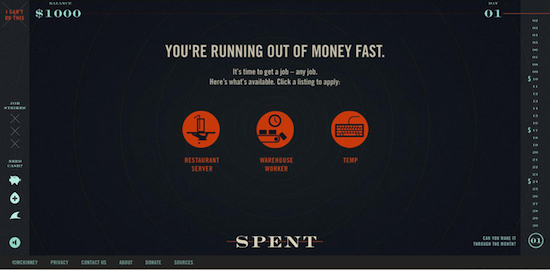
In Spent, players begin by choosing low-paying jobs to get them and their families through the month. | Image courtesy of McKinney
A new game from a Durham nonprofit is raising awareness about homelessness by challenging players to make a quickly dwindling bank account last a month.
Spent, developed by the advertising firm McKinney for Urban Ministries of Durham, puts players in the shoes of a jobless worker forced to make tough decisions about supporting a family with only $1,000 left. The text-based interface, which also employs a social media element, is designed to help users understand the causes of homelessness — and how close some people are to losing everything.
“People make choices based on the economic reality of the moment,” Patrice Nelson, executive director of UMD, said. “From the outside, you can be judgmental about those decisions, but while you’re playing the game you see things differently.”
The project is the second of two pro-bono campaigns McKinney engineered for UMD. The first, using traditional print and TV advertising, didn’t quite resonate with McKinney game designer Jenny Nicholson.
“I remember thinking, ‘This isn’t going to do it. This isn’t going to reach people in a way that makes a difference,’” Nicholson said.
She said she was inspired by the simplicity of old-school games like Oregon Trail and newer, more social iterations like Farmville, where users cultivate virtual crops on Facebook with the help of friends. Although she said she was almost nervous to suggest the idea, she felt it was the “right cultural moment” for a title like this to succeed, given the poor economy and the dominance of social media.
“We figured if people are spending this time farming virtual sweet potatoes, what if we took the same mechanism and created something real?” she said.
Using fair market rent values in Durham, designers let players weigh their housing options based on rent and the commute. | Image courtesy of McKinney
And accurately reflecting that reality — how homelessness and poverty affect real people — was central to the game’s authenticity. The game’s job ads were culled from Craigslist. Housing costs were based on statistics from Durham’s fair market rent values. Even some of the situations that pop up during gameplay, like tough choices about groceries or extracurricular opportunities for your children, were inspired by the experiences of the developers.
“We took a good number of situations from my own life. It was very important,” Nicholson said. “There’s a world out there where $15 for a field trip just can’t happen.”
By pairing those highly emotional scenarios with related statistics about the larger homelessness problem, developers say the game is able to connect human stories with otherwise abstract data.
“The face of homelessness isn’t the person on the corner holding a sign,” UMD Marketing and Development Manager Deanna Kleiss said. “It’s you or me, one hardship away from needing to come to Urban Ministries for help.”
Released Tuesday, the game has already garnered a sizable response. As of Friday morning, the site saw 91,000 unique visitors who started 145,000 different games. It’s even drawn the attention of the popular social media news site Mashable.
And that increased awareness is important, Nelson said, because of the dramatic increase in demand many organizations like hers have experienced during the recession. Two years ago, UMD served about 180 households a month — they’re now up to 425.
“With this, now we can have someone in Ireland or Brazil thinking about homelessness in Durham — or in Ireland and Brazil for that matter,” Nelson said.
Along with the support in the form of volunteers and donations, the game has also drawn some criticism for heaping misfortune upon players. One Mashable commenter suggested McKinney rename it the “Extremely Bad Luck Game.”
Both Nicholson and Nelson admit it’s not typical for those at risk for homelessness to face so much hardship all at once, but they said it was necessary to condense these experiences, which typically occur over the course of months or years, to fit the purposes of the game. Nicholson said making gameplay encompass a year instead of a month wasn’t possible, so developers were challenged to balance personal responsibility with bad luck.
“We were going for realistic situations, that feeling of, ‘I’m damned if I do, damned if I don’t,’” Nicholson said.
Nicholson pointed out that in many situations, the ability to make good choices only goes so far. Through her research, she found overqualified, unemployed workers have a tough time finding even minimum-wage gigs — like at fast food restaurants, for example — because companies know their newly trained employees will bail as soon as the economy turns around.
“Some of these perceptions people have about personal power just aren’t true,” she said.
The game does allow players to ask for help, which is where game designers integrated social media. When your car breaks down, for example, you can pay to fix it, lose hours of work taking the bus or use Facebook to ask a friend to give you a ride. Developers say this option allows users to spread the game organically through their social networks. But it also forces many players to face their own hesitance to give up their self-reliance — something Nicholson said doesn’t happen when they ask friends to feed their chickens in Farmville.
“People have no problem asking for help with these ridiculous things, but the experience of asking for help for real things is much different,” Nicholson said. “We live in a culture where there’s a stigma against asking for help or admitting you can’t do it on your own.”
Developers and staff at UMD say they hope Spent will help fight that stigma. And with the game’s thousands of players staying on the site an average of 9 minutes per visit, McKinney Director of Digital Strategy Jim Russell said it’s already going a long way toward reaching that goal.
“That’s a lot of hours and days in deep interaction with the brand,” Russell said. “If the objective is to educate about homelessness, mission accomplished.”
Tyler Dukes is a freelance science writer and full-time journalism adviser at North Carolina State University. Follow him on Twitter as @mtdukes.


