
Global health: What’s in it for the Research Triangle?
Wednesday, February 16, 2011, 5:25 pm No Comments | Post a CommentTravel can spread diseases as seafaring Europeans proved about 500 years ago, delivering smallpox, influenza and the bubonic plague to the Americas and in return bringing syphilis back with them to Europe.
So it shouldn’t come as a surprise that a biotech hot spot like North Carolina’s Research Triangle, where scientists are taking aim at diseases like HIV/AIDS, diabetes and cancer, is also a hub for global health research - an emerging academic discipline that has gained significance as international travel, trade and finance have picked up.
North Carolina’s global health sector supports at least 7,000 jobs, according to a Duke University study that was based on 2007 data and published last year. The sector generates more than $500 million in annual salaries and wages and more than $18 million in annual tax revenue. Most of the jobs are in the Triangle, home to three large universities, multiple research institutes and nonprofits dedicated to boost health and health care and hundreds of businesses involved in research and development.
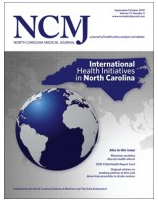
Cover of the North Carolina Medical Journal's latest issue.
The accumulation of brainpower makes the Research Triangle one of the few places in the U.S. where emerging diseases will be researched, medicines to treat them will be developed and programs to improve people’s wellbeing at home and abroad will be established.
“Global health involves highly interdisciplinary and interconnected areas that include human and animal health, medicine, law, engineering, economics, environmental science, agriculture and the social and biological sciences,” as four Duke researchers write in the North Carolina Medical Journal’s latest issue.
Their point of view is part of the NCMJ’s global health forum, which takes up much of the issue.
More than two dozen contributors, including nurses, doctors, community advocates, economists, a veterinarian, a lawyer and a pharmacist, explore what role North Carolina health care professionals and institutions play in global health and the benefits the state is reaping in return.
The forum’s premise follows much the same lessons we learned from the seafaring Europeans: Global health oftentimes is local health.
Today, HIV/AIDS has replaced the bubonic plague. Air travel spreads new influenza strains like H1N1. An obesity epidemic is threatening a rise in diabetes worldwide. Rising temperatures, an effect of global warming, are changing not only growing conditions for plants but also living conditions for animals that carry diseases.
North Carolina is feeling the effects of all these global developments:
- The number of people living with HIV/AIDS in North Carolina and in the Raleigh-Cary area is higher than the national average, according to the U.S. Centers for Disease Control and Prevention.
- Children ages 10 to 17 in North Carolina are among the most obese in the U.S., according to a 2009 report of the N.C. Department of Health and Human Services.
- Chronic disease and infant mortality rates in some eastern North Carolina are comparable to those in developing countries such as Malaysia, Thailand and Nicaragua, according to figures of the N.C. State Center for Health Statistics. The eastern part of the state also faces a particular shortage of health workers.
- North Carolina is getting warmer from the beaches through the Piedmont and across the mountains, according to the Arbor Day Foundation. Since 1990, much of North Carolina has switched from a zone where plants must survive temperatures as low as 0 degrees Fahrenheit to a zone where temperatures don’t dip below 10 degrees Fahrenheit. North Carolina has a long history of tick-borne diseases and research has shown milder winters increase tick-borne encephalitis among humans.
But North Carolina also stands to benefit from the work done in the Research Triangle to address global health issues:
- Researchers at the University of North Carolina at Chapel Hill and Family Health International, a Durham nonprofit, helped test a vaginal gel that contained 1 percent of the Gilead HIV/AIDS drug tenofovir. The test involved South African women and demonstrated that the gel reduced the risk of an HIV infection by up to 59 percent, according to results first published last year.
- RTI International, a research institute in Research Triangle Park, has developed a behavioral program to reduce the likelihood that at-risk women will get infected with HIV. The program is recognized by the CDC and implemented globally and locally.
- The UNC-CH chapter of Engineers without Borders has been involved in improving water quality in communities in Eastern Europe, Latin America and just outside Chapel Hill. Tests in a historically black neighborhood that borders the Orange County landfill showed that nine of 11 wells did not meet federal water quality standards.
- In 2009, UNC and CDC started a program in eastern North Carolina that used global models of mircofinance. It helps women start in business and provides health education.
- Nurses, physicians and dentists educated in India, the Philippines, Nigeria and Columbia are easing the health worker shortage in North Carolina. In the Research Triangle, about 15 percent percent of the physicians, 5.8 percent of nurses and less than 1 percent of dentists were educated outside of the U.S., according to an analysis by a postdoctoral fellow in the UNC School of Nursing that was based on unpublished data from the 2008 North Carolina Professions Data System.
Read all of the contributions to the NCMJ’s global health forum here.
Read here why in 2009 the Research Triangle was the first stop in the U.S. global health revamp.


