
UNC neuroscientists tackle head trauma issues in football players
Thursday, February 17, 2011, 3:05 pm No Comments | Post a CommentOriginally published: 2/10/11
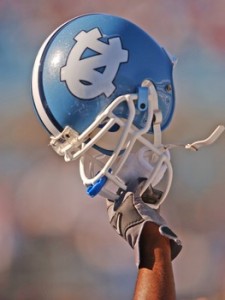 A record 111 million people tuned in for Super Bowl XLV Sunday night, analyzing everything from the agility of the running backs to the facial theatrics of the coaches.
What many likely did not consider is how dangerous the hits and tackles can be to players’ heads. In many cases, it can result in concussions and permanent brain damage.
This is not uncommon, either. In fact, the average UNC football player sustains 950 hits to the head per season, says Dr. Kevin Guskiewicz, chair of the school’s exercise and sports science department. He and fellow neuroscientists at the Matthew A. Gfeller Sport-Related Traumatic Brain Injury Research Center, located on UNC’s campus, are making it easier to monitor high impact head knocks on the field.
This could prove invaluable in learning how long-term exposure to hits can rupture the brain, said Guskiewicz.
What they’re doing, he said, is outfitting players’ helmets with small accelerometers: microsensors no bigger than a dime that measure the severity of the collision. There are six sensors scattered throughout each helmet. They provide instantaneous feedback to computers on the sidelines.
The accelerometers can gauge two forms of movement: linear acceleration and angula, or rotational, acceleration. Linear measures movement within one plane, or unidirectional motion. Rotational measures movement across several planes, generally in more of a diagonal.
“The lay way to describe it is the rate of change,” Guskiewicz said. “How quickly the head accelerates and decelerates upon impact.”
In effect, head collisions cause concussions, which harm brain cells and throw off the balance of ions important to brain function. It hurts, and it leaves its mark; memory can be lost, vision blurred, and blood flow reduced. In some cases, it could end up causing players’ brains to behave like those of Alzheimer’s patients.
Dr. Jason Mihalik, an assistant professor at the Gfeller Research Center, works closely with Guskiewicz on the project. He said there’s still much work to be done before any conclusions can be drawn. One thing that’s safe to say is that concussions come in all shapes, sizes, and severities.
“It’s not necessarily the bigger hits that cause the harshest or most permanent damage,” Mihalik said. “It might be other things like the number of hits. That’s what we’re still trying to figure out.”
However, some positions might be more liable to hard head injuries than others.
“What we do know,” said Guskiewicz. “Is there are more concussions on special teams plays than we see on regular plays. Also, there are more when they’re lowering their heads instead of hitting with the chest.”
The average acceleration of a head collision in football is about 23 gravitational force units (g). The mystery is where the threshold for injury lies. Some sustain concussions at 55g whereas some get up and walk away from blows at 100g.
Jason Freeman is the assistant equipment manager for the UNC football team. He said both offensive and defensive players wear helmets with the sensors. Quarterbacks, tight ends, linemen, safeties— any position can play with them, if they choose.
“It’s really just a comfort thing,” Freeman said. “Less whether they’re physically comfortably, but rather if they’re comfortable wearing them for the study. The players don’t actually feel the sensors at all.”
In total, Guskiewicz said, about 60 to 65 UNC players wear them each season. This is mainly because each unit can cost up to $1,000.
“Obviously we’d love to cover everybody,” he said. “But it’s just too expensive.”
When buying for the team in bulk, however, they’re able to get each unit for much less, somewhere between $350 and $450. A normal helmet costs $182. That money comes from various grant donors, including the Centers for Disease Control and Prevention (CDC) and the National Operating Committee for Standards in Athletic Equipment (NOCSAE).
Virginia Tech was the first school to utilize the sensor technology. The next was UNC, which has been using it since 2004. Other users include Dartmouth and Oklahoma.
Now it’s about to make its professional debut. This fall, the NFL will start outfitting players with collision sensors as part of the ongoing study. This is a big step forward to Guskiewicz, who’s the acting chair of the NFL subcommittee for safety equipment and rule changes.
“We’re looking at a number of issues with helmets,” he said. “We’ll start with trials of several players from different teams, looking at whether rules should be changed to minimize damage to head.”
At UNC, at least, it’s had a positive influence on players’ field strategies. Sometimes, Guskiewicz said, they will pull players aside and show them why lowering the neck or attacking with the crown of the head makes them more liable to long-term damage.
After they watch themselves on videotape, athletes tend to modify their behavior drastically. Also, when players complain of headaches and dizziness, it helps determine if it’s really concussive or simply dehydration.


