
Tackling the challenges of climate change modeling
Monday, February 21, 2011, 12:44 am 2 Comments | Post a CommentTrue to its mission, the Statistical and Applied Mathematical Sciences Institute in Research Triangle Park took on a tricky data- and model-driven scientific challenge in the first public talk it organized for a lay audience.

Douglas Nychka
SAMSI, a collaboration of the RTP area’s three main universities, the RTP-based National Institute of Statistical Sciences and the National Science Foundation, picked climate change as a topic for the talk on Feb. 15 and invited Douglas Nychka, a leading statistician and climate expert at the National Center for Atmospheric Research in Boulder, Colo., as its inaugural speaker.
Nychka didn’t go into the depths of the criticism that has dogged data-driven climate change modeling for more than a decade and has left most Americans convinced they can’t do anything to change global warming.
Only 18 percent of Americans strongly believe global warming is real, harmful and caused by humans, according to the 2008 American Climate Values Survey.
“This is an argument about cause and effect,” Nychka said.
He did, however, say that it was very difficult to statistically reproduce the global warming trend without including greenhouse gases from fossil fuel consumption.
Ample data exists that temperatures worldwide have been rising over the past 50 years to 100 years, according to two reports. One was issued in 2006 by a committee the National Research Council assembled upon a Congressional request, the other followed the next year and was authored by the Intergovernmental Panel on Climate Change, an international scientific organization also known as IPCC. (Read the reports here and here.)
The Earth warmed about 1 degree Fahrenheit in the 20th century and the years from 1995 to 2006 were the 12 warmest since the instrumental record of global mean surface temperatures began in 1856. Temperatures in oceans, the top permaforst layers and the lowest part of the atmosphere have followed the warming trend.
At the same time, the amount of Arctic sea ice has shrunk (about 8 percent since 1978) and glaciers and mountain snow cover have decreased (about 7 percent since 1990). The average global sea levels have risen at least 3 inches since 1960. Heat waves, heavy downpours and extreme high sea levels have become more frequent. North of the equator, spring comes earlier, plants have increased their pollen production and the number of heat-related deaths in Europe is on the rise.
“The average northern hemisphere temperatures during the second half of the 20th century were very likely higher than during any other 50-year period in the last 500 years and likely the highest in at least the past 1,300 years,” the IPCC report read.
The conclusion is based on surface temperature reconstructions that look back 1,000 years or more. The first of these reconstructions was published in 1999. It is known as the “hockey stick” for veering up at the beginning of the 20th century and Nychka featured it in his SAMSI talk.
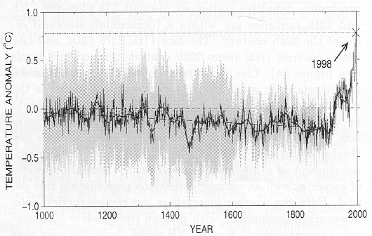
Source: Michael Mann, Raymond Bradley: Northern Hemisphere Temperatures During the Past Millennium; Geophysical Research Letters; March 1999
Michael Mann and Raymond Bradley, the fathers of the hockey stick, used a variety of measurements to reconstruct temperature patterns, including tree ring and ice core records. They noted that the data available was sparser for the earliest four centuries than for the period after 1400.
The centuries for which they had less data included a warm period in the North Atlantic that lasted until the 13th century and was followed by a cooler period during the 17th century and the 18th century for which more data was available.
Reconstructing temperature patterns hundreds and thousands of years ago provide climate scientists with yard sticks to assess temperature patterns during the 20th century, when an increase in fossil fuel consumption produced more and more greenhouse gases. Man-made carbon dioxide emissions increased about 80 percent from 1970 to 2004.
Global warming skeptics do not necessarily question that the Earth is getting warmer, but they do question that the warming is unprecedented in the past 1,000 years and that it is man-made.
Stephen McIntyre, a retired Canadian minerals prospector and mathematician, and Ross McKitrick, an economist at the Canadian University of Guelph, were among the first critics of the hockey stick and McIntyre has continued his critique on a blog called Climate Audit. Proponents of man-made global warming promote their views on blogs like RealClimate, which is written by climate scientists.
McIntyre and McKitrick found fault with the statistical analysis that produced the hockey stick. They also suggested that Mann and Bradley cherry-picked ring records of a tree that underwent a peculiar growth spurt in the 20th century and that the warm period more than 800 years ago - before fossil fuel consumption produced greenhouse gases - was warmer than the 20th century.
The committee put together by the National Research Council agreed with some of the points McIntyre and McKitrick made.
Then, the committee repeated the statistical analysis with the adjustments McIntyre and McKitrick suggested. The result was that the early 15th century was a fraction of a degree warmer than Mann and Bradley had figured. But the spaghetti plot, so named because of the multiple lines representing measurements from tree ring width to cave deposits, still followed the general shape of a hockey stick.
Source: National Research Council: Surface Temperature Reconstruction for the Last 2,000 years; 2006
The committee determined that the surface temperatures of the 20th century are “a well documented, globally coherent warming trend that is happening north, south, east and west; at low altitudes and high altitudes; over land and over - and into - the sea.”
McIntyre also criticized the spaghetti plot, saying it is based on similar measurements as the hockey stick. Nychka, who featured the spaghetti plot in his talk as well, acknowledged that some uncertainty remains. But he suggested that using different statistical methods to test the man-made global warming findings again and again is the best response.
As an example, he presented an unpublished Bayesian approach he and two collaborators, Caspar Ammann of the National Center for Atmospheric Research and Bo Li of Purdue University, worked on.
Sources: The Hockey Stick and the 1990s: A statistical Perspective on Reconstructing Hemispheric Temperatures; Tellus, 2007; and The Value of Multi-Proxy Reconstruction of Past Climate; Journal of the American Statistical Association, 2010.
The Bayesian approach, which measures probability based on what is known, shows a more pronounced cooling period in the 17th century followed by a warming trend that takes off at the beginning of the 20th century and is clearly unprecedented in 1,000 years.
For most climate scientists, the question whether the warming trend that started in the 20th century is man-made has been answered unequivocally. They are moving on to predicting climate trends in the 21st century based on variables gleaned from temperature patterns in the past.
Models that look ahead may not give deep detail, Nychka said, but they could provide useful information when their predictions are pooled.
Combining two climate models developed at the U.S. Geophysical Fluid Dynamics Lab near Princeton, N.J., for example, Nychka said, results in a prediction that temperatures in North Carolina are likely to warm 5 degrees to 7 degrees Fahrenheit from 2040 to 2070.


[...] This post was mentioned on Twitter by Hamner Institutes, ScienceintheTriangle. ScienceintheTriangle said: National institute in RTP tackles climate change modeling in its inaugural public lecture. http://bit.ly/efupFu #SITT [...]
Nice job!
Two comments:
You spend much space on the hockey stick but it is important to emphasize it is not the primary evidence for humans causing the recent warming. This is done based on extensive use of climate models — numerical experiments based on physical equations.
In terms of how many Americans believe in global warming you pitch that as a percentage that is low. But I suspect that that many significant science topics are not held or understood by most Amercians. You might contrast the 18% with how many Americans support the theory of evolution as it applies to humans.