
R&D billions are tectonic force in Research Triangle area
Wednesday, August 25, 2010, 8:27 pm 2 Comments | Post a CommentThe brainpower for which North Carolina’s Research Triangle area is known tends to hide inside buildings, behind tall trees or somewhere on sprawling university campuses.
Crossing Research Triangle Park on Interstate 40 or visiting Duke University, the University of North Carolina at Chapel Hill or N.C. State University provides little insight into what fuels one of the hottest U.S. research and development hubs.

Michael Walden
Sure, the Triangle was named the brainiest U.S. region and Raleigh the fastest growing metropolitan area last year. And the area’s vaunted labor pool continues to draw scientists and R&D companies from elsewhere, even though companies have closed shop or laid off employees in the past two years and the unemployment rate in the Triangle is nearly twice as high than before the economic downturn.
Mike Walden, an NCSU economist, doesn’t mince words when he assesses how important R&D is for the RTP area. “It’s one of our basic industries,” Walden said. “It’s one of the things that make us tick.”
But what sustains and boosts this industry that, it can be argued, flavors everything locally from schools to restaurants?
The credit usually goes to the three main research universities, Duke, UNC-CH and NCSU, and the hundreds of companies in and around RTP. But what specifically is it that they do to shape the RTP area? Is it the graduates they produce every year, the discoveries they spin off into local startup companies, or the money they spend on R&D?
Looks like the money spent on R&D is most important, according to a 2009 Federal Reserve Bank of New York staff report by Jaison R. Abel and Richard Deitz.
Nationwide, federal funds pay for a considerable amount of R&D to boost public knowledge and inform public policy. Especially universities and nonprofit institutes rely on research grants from the National Institutes of Health, including the National Institute of Environmental Health Sciences in RTP, and other branches, such as the Department of Energy and the Department of Defense.
Foundations, patient advocacy groups, wealthy individuals and large companies also pitch in.
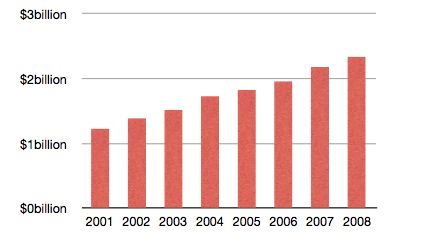
R&D spending in the Triangle
In 2008, the Triangle’s three research universities and RTI International, an RTP-based research institute, spent about $2.34 billion on R&D, according to a survey by the National Science Foundation and RTI’s annual report.
That’s about double their 2001 R&D spending. The steep increase reflects a doubling of the NIH budget in the first half of the decade and emphasizes the importance of the life sciences in the area.
The $2.34 billion - the actual investment in R&D would be slightly higher if hard-to-come-by corporate R&D expenditures were included - represented about 2.7 percent of the area’s gross product that year. In 2008, the metropolitan areas surrounding Raleigh and Durham generated services and goods worth about $86 billion, according to figures by the U.S. Bureau of Economic Analysis.
The same year, retail contributed about 4.5 percent of the area’s gross product, BEA figures show.
Economists have long known about universities long reach locally, Abel and Deitz, the two staffers at the Federal Reserve Bank of New York, pointed out in their report. Universities generate the innovation and the educated labor force needed to drive a knowledge-based economy.
What Abel and Deitz added was the empirical evidence that degree generation was less important than R&D spending and the spillover from lots of research, meaning start-up companies that capture the most innovative technologies coming out of universities.
The two Federal Reserve staffers concluded that “research-intensive metropolitan areas tend to have larger shares of the most highly skilled occupations (e.g., those in the categories life, physical and social sciences; legal; computer and math; architecture and engineering; business and financial operations) and smaller shares of the lower skilled occupations (e.g., those in food preparation and serving; production).”


[...] RTP working on new master plan and R&D billions are tectonic force in Research Triangle area [...]
[...] Meanwhile, R&D spending in the Research Triangle about doubled. [...]