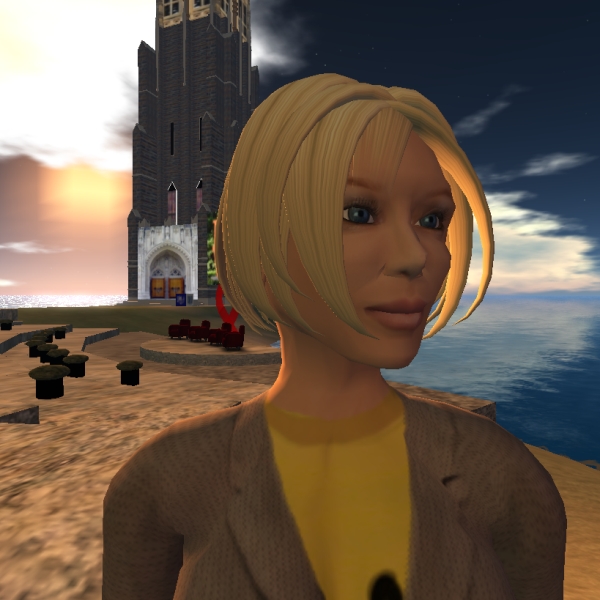
How much life is there in Second Life?
Sunday, April 4, 2010, 4:45 pm 5 Comments | Post a CommentMore than 2,000 researchers and educators from 69 countries attended the Virtual Worlds Best Practices in Education conference last month, including Tony O’Driscoll of Duke University and Brent Ward from RTI International in Research Triangle Park.
Like the other attendees, O’Driscoll and Ward didn’t travel to VWBPE in person. They sat in front of a computer and had their voice-activated avatars teleport to one of 20 specially constructed virtual islands, where the conference took place over 48 continuous hours. Some of the islands resembled the Guilin mountains in China, an Irish seaside cottage and Stonehenge, the famous English prehistoric monument.
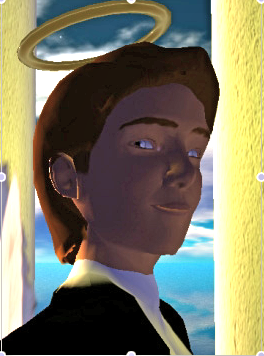
Brent Werber
Wada Tripp, O’Driscoll’s avatar, gave a presentation on 3-D learning, which requires students to interact in simulated, or virtual, environments. Brent Werber, Ward’s avatar, moderated a panel at the conference.
O’Driscoll is a professor at Duke’s Fuqua School of Business and Ward provides RTI researchers technical assistance as the research institute’s director of commercialization. Both are professionals holding positions of responsibility, but neither thinks twice about slipping into his “digital sockpuppet,” a computer-generated persona that lives in Second Life, a three-dimensional virtual world maintained by Linden Lab of San Francisco.
Wada Tripp
“We’re members of a community who is waiting for the rest of the world to commit to the obvious,” Wada Tripp, a younger looking version of O’Driscoll that speaks with his voice, said at the beginning of the VWBPE presentation. “The immersive Internet is the next wave of the Net,” O’Driscoll himself later added in a phone interview.
How much life is there in virtual worlds?
More and more people around the world are committing to the obvious. The population in virtual worlds such as Second Life has grown to tens of millions in the past decade, which should come as no surprise to those 35 or younger, technology nerds of all ages and anybody who can no longer imagine making a living without the Internet.
Virtual worlds are the product of the same advances in computer technology that brought us Google, eBay and Craigslist. They offer similar benefits: Fast and convenient access to ever more sophisticated information. They come with similar, built-in hurdles: You have to have a computer powerful enough to run the software and you need to adapt to new rules. And they raise similar questions: What should be public and free? What is proprietary and needs to be private and secured behind a firewall?
What’s different about virtual worlds is the out-of-body experience that defies the laws of nature.
Avatars walk, talk, fly and teleport. Some are lookalikes of their real-life counterparts, others are plants, animals or fantasy creatures. They socialize and drink virtual beer, ski on virtual snow and relax on a virtual beach. They meet in virtual conference centers that may look like castles or a moon base. They spend and earn virtual money in virtual economies.
Their virtual worlds are called There, World of Warcraft, Vivaty and Entropia Universe. They use virtual currency such as Therebucks, World of Warcraft gold and Linden dollars that can be converted to real-life currencies like U.S. dollars or euros. Some of the virtual worlds are more game, with guidelines set for role playing. Others are more social world, where avatars are free to be what they want to be.
Launched in 2003, Second Life is one of the most popular virtual worlds.
User-to-user transactions in Second Life topped $500 million in 2009. Its virtual real estate totals about 500,000 acres. Real-life people have full-time jobs in Second Life and some have even become real-life millionaires.
Last month, the Second Life community counted more than 1 million residents - that’s what Linden Lab calls real-life people who go inworld, which means they log in to activate their avatars. More than 1,400 corporations, universities, government agencies and the U.S. military own virtual property in Second Life.
“They’ve got the best game in town right now, if you care about innovation, collaboration, education and community,” Ward said.
What sets Second Life apart is the ability to build and create content.
RTP goes virtual
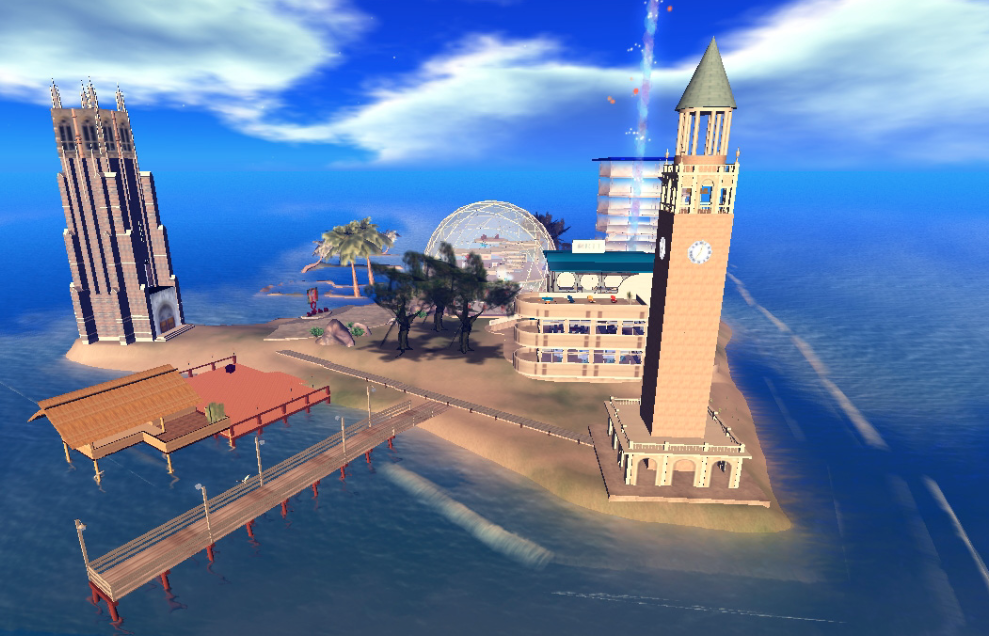
Half a year ago, RTI bought some land from Linden Lab and built an island called Global Research Park. The shape of the island mirrors the real-life shape of RTP. Towers rise up in three points of the island to represent Duke, the University of North Carolina at Chapel Hill and N.C. State University. Other structures on the island include buildings for RTI and the Research Triangle Foundation.
Avatars can take a lofty ride in the Wright flyer, complete a real-life survey in the RTI building or teleport to the Story Quest, an island dedicated to HIV/AIDS education.
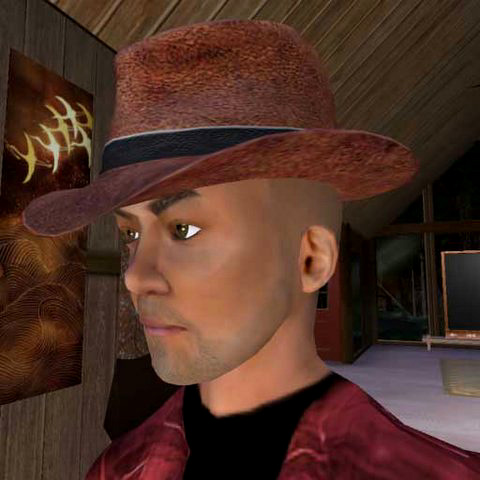
Marty Snowpaw
Story Quest takes you into the house of Uncle D, where you can listen to his phone messages, read his journal or watch his videos. You can record your reactions and use Facebook, Twitter or Flickr to make these recordings part of the story. Story Quest is the brainchild of Jena Ball, a Los Angeles-based storyteller better known as her avatar, Jenaia Moraine, and Marty Keltz, a former English teacher who co-founded the company that produces the Magic School Bus.
In Second Life, Keltz becomes Marty Snowpaw.
Entering a virtual world as an avatar “sounds so alien,” Keltz said. “But when you do it the worlds become porous. You get a sense of participation. You’re co-creating.”
Lynda Aiman-Smith, an associate professor in NCSU’s College of Management, holds office hours and discusses projects with her MBA students in Second Life. In her management and technology class, she has used it as an educational tool for three years.
DrLAS Emmons, her avatar, recently took the class on a field trip to the virtual IBM Green Data Center, which sits on one of the Second Life islands in the IBM archipelago. The center is open to the public and staffed 24 hours a day, five days a week. Visiting avatars can learn about energy efficient technologies, solve problems and design solutions for energy and cooling challenges in a data center.
“This wasn’t a computer game,” Aiman-Smith said about the Second Life field trip to the data center. “They were conducting business.”
Duke’s School of Nursing has a presence in Second Life, where students who don’t live in the RTP area can attend class with the help of their avatars. The UNC Center for AIDS Research records HIV 101, a spring course that attracts 400 to 500 students, and provides access to the recordings on Second Life.
“My hope was to reach a population I wasn’t able to reach otherwise,” said Vanessa White, who manages the community outreach for the UNC Center for AIDS Research. “Second Life was the perfect medium to erase the stigma associated with learning more about HIV/AIDS, because it provides a platform for anonymity.”
White, who is Vanie MacBeth in Second Life, wants to send all HIV 101 students on the Story Quest next year, but the UNC information technology department has to first unblock access to Second Life on campus.
Virtual bothers
Access limitations can be justified despite the rules of conduct that exist in Second Life. There’s a red-light district and even Main Street can be a bit trashy in appearance sometimes.
Also, Second Life isn’t free from bothers, some of them virtual. Just ask Michael Rowe, a gamer who works for IBM Software in RTP.
Big Blue, which has one of the largest corporate presences inworld, got into Second Life in 2006. Rowe was part of a now-dissolved group that tested how well virtual worlds are suited for business and collaboration. One of the projects he worked on was to establish a virtual store for retailer Sears in Second Life.
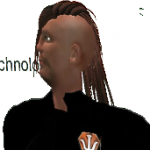
Ultravox Freeman
As a manager in the group, Rowe made presentations to customers and IBM colleagues in Second Life. During one such virtual presentation a nude avatar suddenly appeared next to Rowe’s avatar, Ultravox Freeman, greeted him and stayed for a while.
“Can you imagine this happening while you’re meeting with a customer?” Rowe said. Luckily, only IBM colleagues attended his presentation, he remembered.
Second Life offered corporations private spaces, sort of like gated communities, in an otherwise public virtual world. Many companies used those private spaces to build virtual prototypes of products. But the privacy didn’t always keep prying eyes away, Rowe said. In a world where the possibilities are only matched by the residents’ creativity, avatars that are locked out of a gated community can detach their eyes and use them as hovering cameras.
“There’s a lot of stuff that still has to be worked on to make virtual worlds Fortune 500 friendly,” Rowe said.
In November, Linden Lab came up with a solution to privacy problems. It launched SL Enterprise, a behind-the-firewall world that cannot be accessed from Second Life. Pricing starts at $55,000, compared to an initial set-up cost of $1,000 to establish a presence in Second Life.
At the launch of SL Enterprise, 14 companies had signed up, including IBM, Case Western Reserve University and The New Media Consortium, an international consortium of universities, museums and companies that are exploring new media as learning tools.
At least one Linden Lab competitor has had a similar idea.
The American Research Institute, a Morrisville software company that employs about 30, came out with its own virtual world learning tool six months ago. It’s secure, custom-built, scenario-based and can be used for meetings and training. The customer determines the ratio of game to social interaction, said Richard Kristoff, chief executive of the American Research Institute.
“It’s not an open, wild Wild West,” Kristoff said. “I didn’t want to create another situation where you had thousands of users and you had out-of-control behavior.”
When the product launched, the American Research Institute didn’t have to explain much. Potential customers had already gained an understanding of virtual worlds from Second Life.


Yes… my dear, we are not in Kansas anymore! VWBPE was an amazing experience.
I saw this coming 3 years ago, and as an educator wanting to be on the cutting edge I have learned and developed skills for SL.
I am still waiting for my school district to get on board.
In the mean time, I mentor new educators mostly at the college level, in basic stuff, and yearn to bring my students into experiences which offer this kind of immersion and collaboration.
[...] the question remains posed in this other article: How much life is there in Second Life? More and more people around the world are committing to the obvious. The population in virtual [...]
[...] that regularly go “inworld” (i.e., log in and activate an avatar). In addition, there are over 1,400 organizations in Second Life ranging from colleges to mainstream corporations to government agencies. Many of these [...]
[...] at local universities and some schools extensively use Second Life as a teaching tool. Szabo said she manages three Second Life islands as part of her job at Duke, but she’s not [...]
I have a SL visitor for only a short time but have already encountered classrooms and libraries and other learning resources that I intend to explore further. It must be hard to be a champion of such resources on a campus that has not yet grasped the possibilities posed by such programs.