
If the U.S. falls off the flat earth, so does RTP
Sunday, April 11, 2010, 5:41 pm No Comments | Post a CommentNeal Lane, a physicist who in the late 1990s was President Clinton’s top science advisor, worries when he looks at federal spending on research and development.
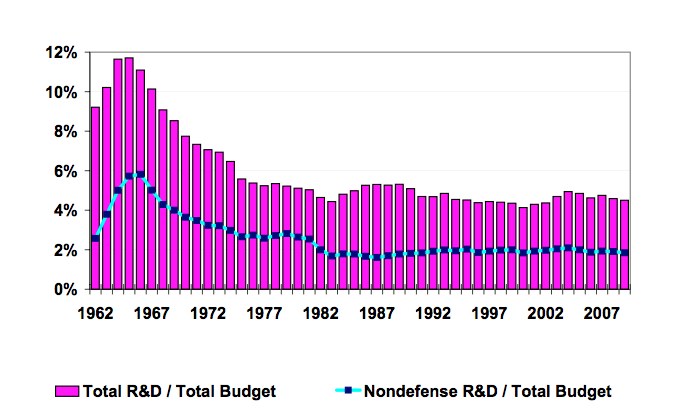
R&D spending as percentage of federal budget, FY 1962-2009
Sure, federal spending on R&D more than tripled in the past 50 years to about $147 billion in fiscal year 2009, as Lane pointed out Saturday in a talk at N.C. State University. But R&D’s share of all federal spending has been shrinking from nearly 12 percent during the height of the Apollo program in the late 1960s to about 5 percent in 2009, according to numbers from the American Association for the Advancement of Science.
Lane, a professor at Rice University and a senior fellow at the James A. Baker III Institute for Public Policy, is particularly concerned about federal funding for research in physics, mathematics and engineering, the disciplines that brought forth computers, the Internet and mobile devices such as the cell phone.
AAAS numbers show that much of the increase in federal R&D spending over the past 30 years has gone to biomedical disciplines. Last year, funding for the National Institutes of Health made up about half of all federal spending for basic research and for R&D that was not aimed at defending the U.S.
“We do have a president who cares about science,” Lane said. He called the scientists whom President Obama appointed as scientific advisors and government administrators a “terrific team.” But considering the rising federal deficit, budget shortfalls and polarized political leadership, Lane added, “I’m worried that federal research spending will get squeezed.”
Lane visited NCSU on invitation of the College of Physical and Mathematical Sciences, or PAMS, which celebrates its 50th anniversary this year. But his talk had significance beyond PAMS, even beyond NCSU, one of many U.S. universities tasked with educating tomorrow’s scientists, furthering technological development and feeding the U.S. knowledge economy.
Federal R&D spending is the lifeblood of the entire Research Triangle area, a state economic engine and national R&D hot spot that is known around the world.
Research Triangle Park, which has NCSU, Duke University and the University of North Carolina at Chapel Hill as its corners, reflects the federal R&D funding evolution that began during World War II. Work to establish RTP began in 1957, the same year the Soviet Union launched Sputnik, the first earth-orbiting satellite. The science park opened in 1959, just as the space race between the Soviet Union and the U.S. got under way.
In the past 30 years, RTP’s development has mirrored the shift in federal R&D funding priorities from the space age with its focus on national security to the age of medicine and a new focus on health. Today, first signs are emerging that RTP, which employs more than 40,000, is tapping into the next phase in federal R&D funding, a phase that focuses on renewable energy, reduction in greenhouse gas emissions and technologies that reduce the U.S. dependence on oil.
This phase rests on climate changes that remain controversial even though scientists have tracked them for years.
“The threat of climate change is out there,” Lane said. “But it’s less urgent than the economy, jobs and health. The message is muddled. There’s some work for us to do out there.”
About 60 percent of all Americans consider public funding for R&D essential, according to a 2009 survey report from the Pew Research Center. More than 70 percent say that government investments in basic research and engineering and technology pay off in the long run.
Despite the broad support, Lane said, “science has never really emerged to be important at the ballot box.”
Scientists have to do a better job conveying this public support to the politicians, he added. “We have to figure out how to be more helpful, how to interact better with the public.”
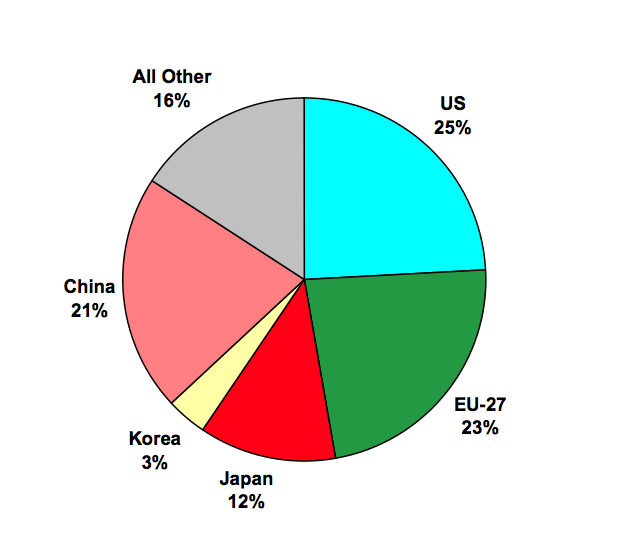
Where are the scientists and engineers?
Why? Because it could help the U.S. remain a technology exporter in a world where emerging countries such as China and India are gaining ground.
“China is a rising player,” Lane said, pointing to AAAS numbers that show about one-quarter of the world’s 5.8 million scientists and engineers were in the U.S. in 2006. China had about 21 percent and the number was rising, Lane said.
A similar picture is emerging in R&D spending. The U.S. still spends more on R&D than any other country, but Asian countries are turning up the heat.
To bolster his argument that the U.S. is in danger of falling behind, Lane referred to writings by Norman Augustine, retired chairman of Lockheed Martin. In a 2007 essay called “Is America falling off the flat earth?” Augustine quotes UNC President Erskine Bowles:“Think about this: in the past four years, our 15 schools of education at the University of North Carolina turned out a grand total of three physics teachers. Three. And we’re going to compete with those guys in Asia? Come on – not that way.”


