
Bayer continues to shift biotech seed development focus to U.S.
Thursday, April 28, 2011, 2:20 pm No Comments | Post a Comment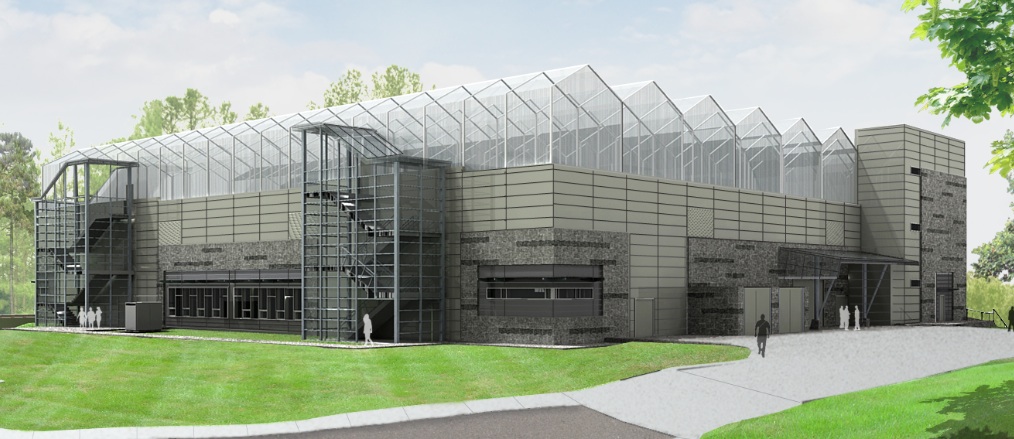
Rendering of Bayer CropScience's new greenhouse.
The 60,000-square-foot greenhouse that Bayer CropsScience is building in North Carolina’s Research Triangle Park represents a critical step in a strategic shift the German Bayer Group initiated two years ago.
The two-story greenhouse is projected to cost $20 million and will quadruple the greenhouse space Bayer Cropscience has in RTP.
Biotech crop seeds have long been part of Bayer CropScience’s business. Much of the trait development - work in the lab and greenhouse to come up with genes that improve crop yield and make corn, soybean, cotton and canola plants more resistant to insects and more tolerant to herbicides, drought and stress - has been done at Bayer’s plant technology innovation center in Ghent, Belgium.
When Bayer stepped up investment in plant technology research and development in 2009, it could have just added on to the Ghent facilities. Instead, the company shifted its focus from Europe to the U.S., where consumers are more accepting of genetically modified crops. So far, Bayer has announced close to $400 million in investments to boost biotech trait development near Bayer CropScience’s U.S. headquarters in RTP.
“We see that as a logical place,” Bayer CropScience spokesman Jack Boyne said from his RTP office.
The number of biotech crop seeds on the market has been rising steadily. In 2007, biotech seeds accounted for about $22 billion in worldwide sales with the top 10 sellers garnering about 68 percent of the global market, according to a report. Bayer CropScience came in seventh, behind Syngenta and market leader Monsanto.
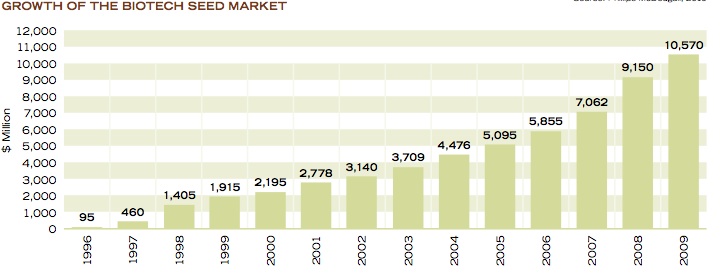
U.S. biotech seed sales
The RTP area, a U.S. biotech hotspot, is home to agricultural biotech operations of four of the large companies - Monsato, Syngenta, Bayer and BASF - and several smaller companies and startups. (More about research at Syngenta’s corporate biotech research center here.)
Eager to catch up, Bayer CropScience in 2009 bought a smaller RTP neighbor with an enviable collection of crop seed traits for $365 million. Athenix, which had research collaborations with Monsato and Syngenta, is now part of Bayer CropScience. So are Athenix’s 65 employees, but Bayer CropScience continues to hire to add a total of 125 employees by 2015. (More about the Athenix acquisition here.)
“We are making an increased investment in bioscience,” Boyne said. “We see this area as a strong growth opportunity.”
So do Monsanto, DuPont and Syngenta.
In 2009, Syngenta bought Monsanto’s hybrid sunflower seed business for about $160 million. In 2010, Monsanto broke ground to expand a soybean seed production facility in North Dakota. And DuPont announced in February that it will invest $50 million to expand its agricultural biotech research center in Delaware.
DuPont expected sales of its ag unit to rise 8 percent to 10 percent per year through 2015.


