Posts Tagged ‘clean energy’

RTI broadens energy research with federal greenbacks
Wednesday, July 14, 2010, 8:54 am 1 Comment | Post a CommentTechnologies that promise to lower greenhouse gas emissions and demand for U.S. oil imports are becoming more prominent on RTI International’s research smorgasbord, which has featured efforts in a related field, air pollution monitoring, as a reliable staple for the past 30 years.
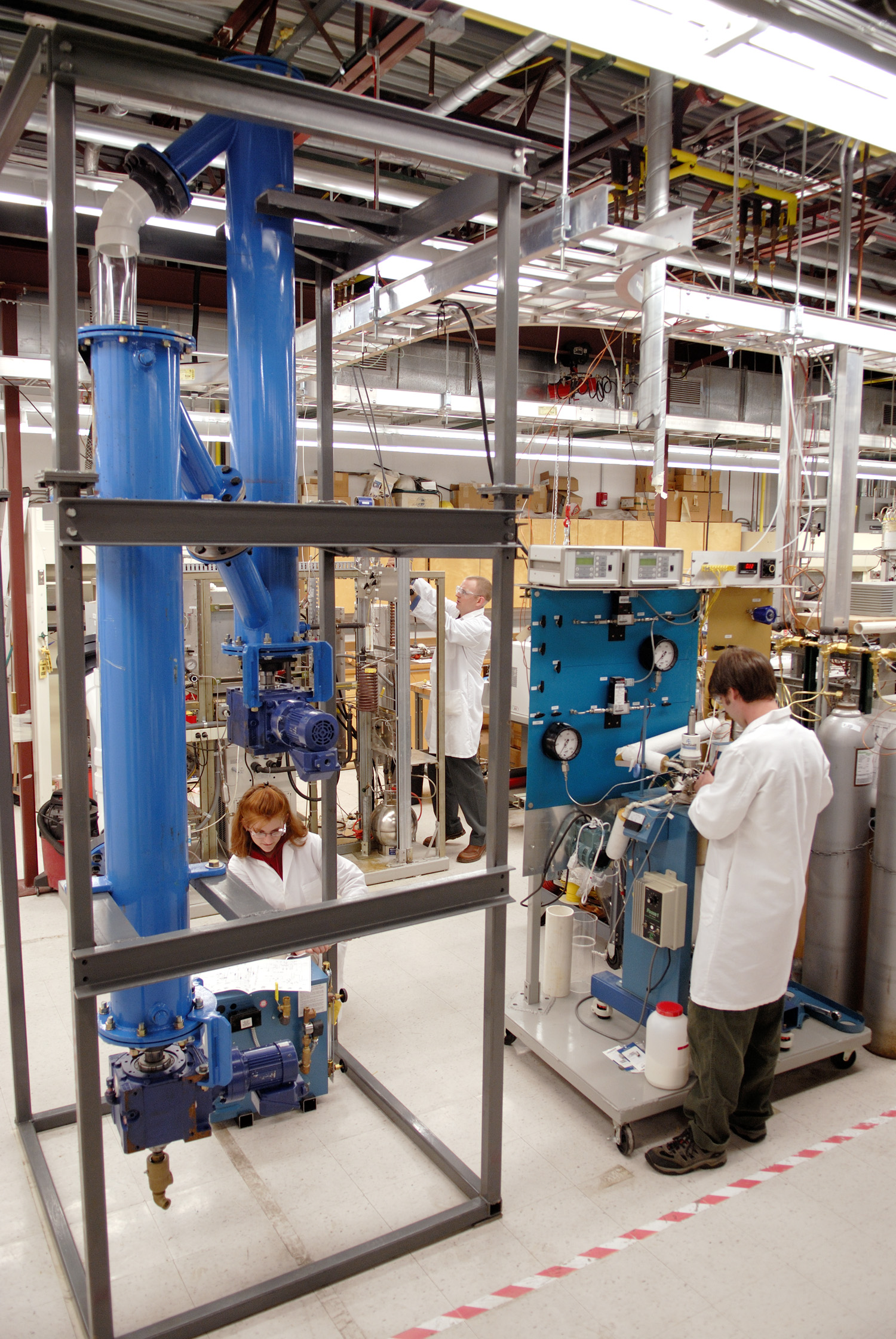
RTI energy lab (Photo courtesy of RTI)
One of the founding members of the Research Triangle Energy Consortium three years ago, RTI has scientists working on projects that include the capture and reuse of carbon dioxide - the most prominent greenhouse gas in the Earth’s atmosphere - production of bio-crude from organic waste and a nanotechnology light bulb that promises to be more energy efficient than a fluorescent light and doesn’t contain harmful mercury.
Stimulus funds the U.S. Department of Energy has awarded in the past year to help the economy recover fueled RTI’s stepped-up energy research. Of the institute’s $750 million in estimated revenue this year, energy research will contribute about $12.5 million, said RTI spokesman Patrick Gibbons.

Homegrown innovation: MegaWatt Solar
Monday, April 19, 2010, 10:28 am 1 Comment | Post a Comment
A concentrated photovoltaic "solar tree" designed by MegaWatt Solar. (Image from MegaWatt Solar web site.)
I recently wrote a two-part post here reporting on a forum in Research Triangle Park which focused on barriers to homegrown global business innovation in the Triangle and in North Carolina. While contemplating the themes of the forum, and skimming today’s science news, I stumbled across this article in Popular Mechanics magazine which looks into the advances in concentrated photovoltaics over the past few years — and leads with the example of MegaWatt Solar, a renewable energy start-up in our own backyard. The company was formed by three professors at the University of North Carolina at Chapel Hill who seek to create utility-scaled concentrated photovoltaic systems to supplement fossil fuels-based energy production. (They’ve also been featured in UNC’s Endeavors research magazine, and have landed a story or two in the News & Observer, no longer available in their web archives.)
It struck me that MegaWatt Solar is a good example of the applied research that our area universities can generate to solve real-world problems, and also of the links that can be established between professors with marketable ideas and business-savvy entrepreneurs that can help carry the ideas from the research bench to the bank. Their story is truly one of homegrown innovation, though to be fair they are still in the pilot study phase and working out some kinks.
Because I’ve already written this story, I’m not going to write it again… Below is a reprint of the cover story article I penned about the people behind MegaWatt Solar, and their mission, for the fall 2009 issue of UNC College of Arts & Sciences magazine. It is reprinted here with full permission from the editors.
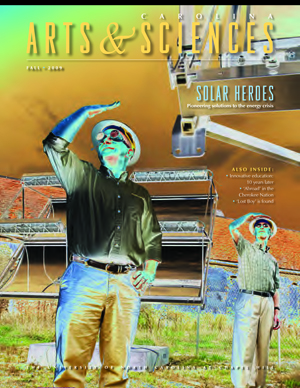
UNC Arts & Science cover, fall 2009, with MegaWatt Solar founders.
The Power of 20 Suns
MegaWatt Solar is a small start-up energy company in Hillsborough, N.C., backed by $17 million from Norwegian venture capitalists and mentally powered by three researchers in UNC’s College of Arts and Sciences. Tucked away in a brick textile-mill-turned-office-park, the company is poised to bring a new concentrated photovoltaic system to market that could provide the cheapest large-scale renewable source of electricity available anywhere.
But they didn’t design it for your home. They designed it for your utility company, to offset peak energy demand, which tends to coincide with the sunniest portions of the solar day. The term MegaWatt describes their goal of producing one megawatt of electricity from over a thousand solar “trees” spread across about 10 acres. The solar trees rotate on a dual axis mount that tracks the sun across the sky vault. One megawatt of electricity — one million watts — is enough to power about 800 homes.
MegaWatt Solar was founded by astrophysicist Chris Clemens, theoretical physicist Charles Evans, computer scientist Russ Taylor and a private sector power-grid systems engineer, Dan Gregory. They built their alpha version in spring 2006 in Evans’ driveway from what he describes as “an aluminum erector set for adults,” with parts bought off E-Bay, cheap advertising signboard and a highly reflective material scavenged from the interior of a Solotube skylight.
The best part? It worked.
“Boy, it was bright, “Evans said. “Everyone ran to get their sunglasses.”
They measured its electrical output and knew they were on to something red hot. Read more…
RTP Weekahead 11/30
Sunday, November 29, 2009, 4:17 pm No Comments | Post a CommentEvents taking place the week of Dec. 30 in the Research Triangle area that are open to the public:


