Archive for the ‘University Research’ Category

RTP panels address rogues gallery of multidrug-resistant bacteria
Tuesday, March 1, 2011, 2:29 pm No Comments | Post a CommentHow to prevent bacterial infections associated with poor hygiene in hospitals, nursing homes and day care centers has become a necessary though rarely pleasant topic for healthcare providers.
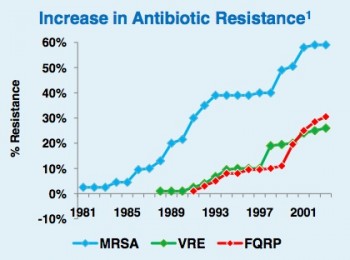
Source: Centers for Disease Control and Prevention
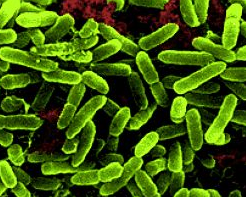
Every year, an estimated 5 percent of all hospitalized Americans, or about 1.7 million, are treated for a healthcare-associated infection. About 90,000 of them die, according to numbers reported by the Centers for Disease Control and Prevention. The infections are caused by multiple bacteria that can be traced back to healthcare settings and 14 percent involve a superbug, methicillin-resistant staphylococcus aureus or MRSA.
After rising rapidly in the 1990s, the number of MRSA cases began to decrease in the past decade, but following in MRSA’s footsteps are superbug wannabes such as floroquinolone-resistant pseudomonas aeruginosa (FQRP), vancomycin-resistant enterococci (VRE) and clostridium difficile, a bacterium that wreaks havoc after antibiotics wipe out healthy gut flora.
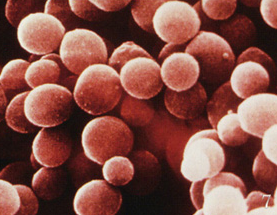
Staphylococcus aureus
Efforts to reduce healthcare-associated infections received boosts in the past few years.
In 2008, the Centers for Medicare and Medicaid Services stopped paying hospitals for infections they considered “serious complications that should never occur in a hospital” and private health insurers began to follow suit. The following year, the federal stimulus bill provided states with about $50 million to establish surveillance and prevention programs.
North Carolina’s state plan to monitor and prevent healthcare-associated infections, which took effect in January and relies on voluntary reporting, is such a program.
“It’s not inevitable that you go into the [intensive care unit] and you get a [central line-associated] bloodstream infection,” said Dr. Megan Davies, chief of the N.C. Division of Public Health’s epidemiology section.
Davies was one of five infectious disease experts in the Research Triangle who addressed healthcare-associated infections and the rogues gallery of multi-drug resistant bacteria. The Feb. 22 panel discussion was put together by Duke University and Becton Dickinson, a New Jersey-based medical instruments company whose corporate innovation center is in Research Triangle Park.

Enterococci faecium
Healthcare-associated infections add an estimated $28 billion to $33 billion in national healthcare costs every year, according to a report the CDC published in 2009.
Avoidable infections can enter the body at a surgical site or through a catheter, a ventilator or a central line used to supply medication, blood and fluids directly into the bloodstream.
In North Carolina, large programs to collect infection data and improve infection control have existed since 1997: the Statewide Program for Infection Control and Epidemiology, or SPICE, at the University of North Carolina School of Medicine and the Duke Infection Control Outreach Network, or DICON, that linked the Duke University School of Medicine and 39 community hospitals.
Central line-associated bloodstream infections and cases involving MRSA have decreased in the past decade due to efforts by SPICE and DICON.
But direct costs from dealing with healthcare-associated infections statewide are estimated to still exceed $280 million per year, according to the N.C. Department of Health and Human Services.
Innovations to prevent these infections such as special cleaning and medical supplies exist, said William Rutala, director of SPICE and one of the five infectious disease experts on the panel. But better compliance with more basic prevention tools such a hand hygiene would be an important first step.
 Only an average 40 percent of healthcare workers washed their hands in accordance with CDC guidelines, studies conducted in the 1990s showed. And other studies show that only about one-third of the surfaces at high risk of harboring infectious bacteria in hospital rooms were thoroughly cleaned before new patients came in, Rutala said.
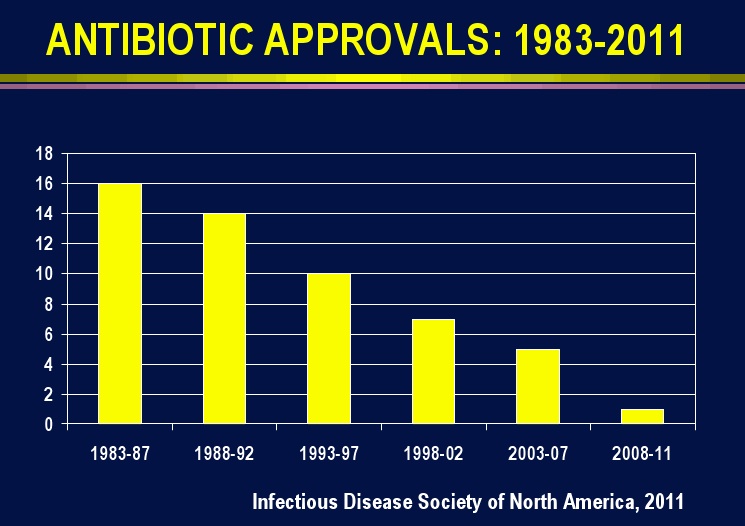
Fewer and fewer new antibiotics to battle the multi-drug resistant bacteria is yet another problem, said Dr. David Weber, associate chief of staff at UNC Health Care who was another infectious disease expert on the panel.
Years of antibiotic overuse and patients cutting short antibiotic treatments are driving forces behind the rogues gallery - not only in healthcare settings but maybe also in livestock farming.
About two-thirds of the MRSA central-line bloodstream infections in hospitals involve bacteria that came from outside the hospital but whose origin isn’t clear, according to Dr. Vance Fowler, an infectious disease specialist at Duke University.
Antibiotics are used extensively to promote growth in livestock farming, said Jorge Ferreira, a graduate student at the N.C. state University College of Veterinary Medicine. Daily use of antibiotics is also normal in dairy cows.
Fowler and Ferreira are collaborating on research to find out more about MRSA and whether the superbug is transmitted from animals to humans. They presented some of their findings as part of a panel discussion at the N.C. Biotechnology Center in RTP, a few hours after the infectious disease panel met in Durham.
So far, Ferreira reported, MRSA strains have been found in pigs, cows, dogs, cats and even hamsters.
Tackling the challenges of climate change modeling
Monday, February 21, 2011, 12:44 am 2 Comments | Post a CommentTrue to its mission, the Statistical and Applied Mathematical Sciences Institute in Research Triangle Park took on a tricky data- and model-driven scientific challenge in the first public talk it organized for a lay audience.

Douglas Nychka
SAMSI, a collaboration of the RTP area’s three main universities, the RTP-based National Institute of Statistical Sciences and the National Science Foundation, picked climate change as a topic for the talk on Feb. 15 and invited Douglas Nychka, a leading statistician and climate expert at the National Center for Atmospheric Research in Boulder, Colo., as its inaugural speaker.
Nychka didn’t go into the depths of the criticism that has dogged data-driven climate change modeling for more than a decade and has left most Americans convinced they can’t do anything to change global warming.
Only 18 percent of Americans strongly believe global warming is real, harmful and caused by humans, according to the 2008 American Climate Values Survey.
“This is an argument about cause and effect,” Nychka said.
He did, however, say that it was very difficult to statistically reproduce the global warming trend without including greenhouse gases from fossil fuel consumption. Read more…
Of lizards, female choice and male competition
Friday, February 4, 2011, 2:50 pm 2 Comments | Post a Comment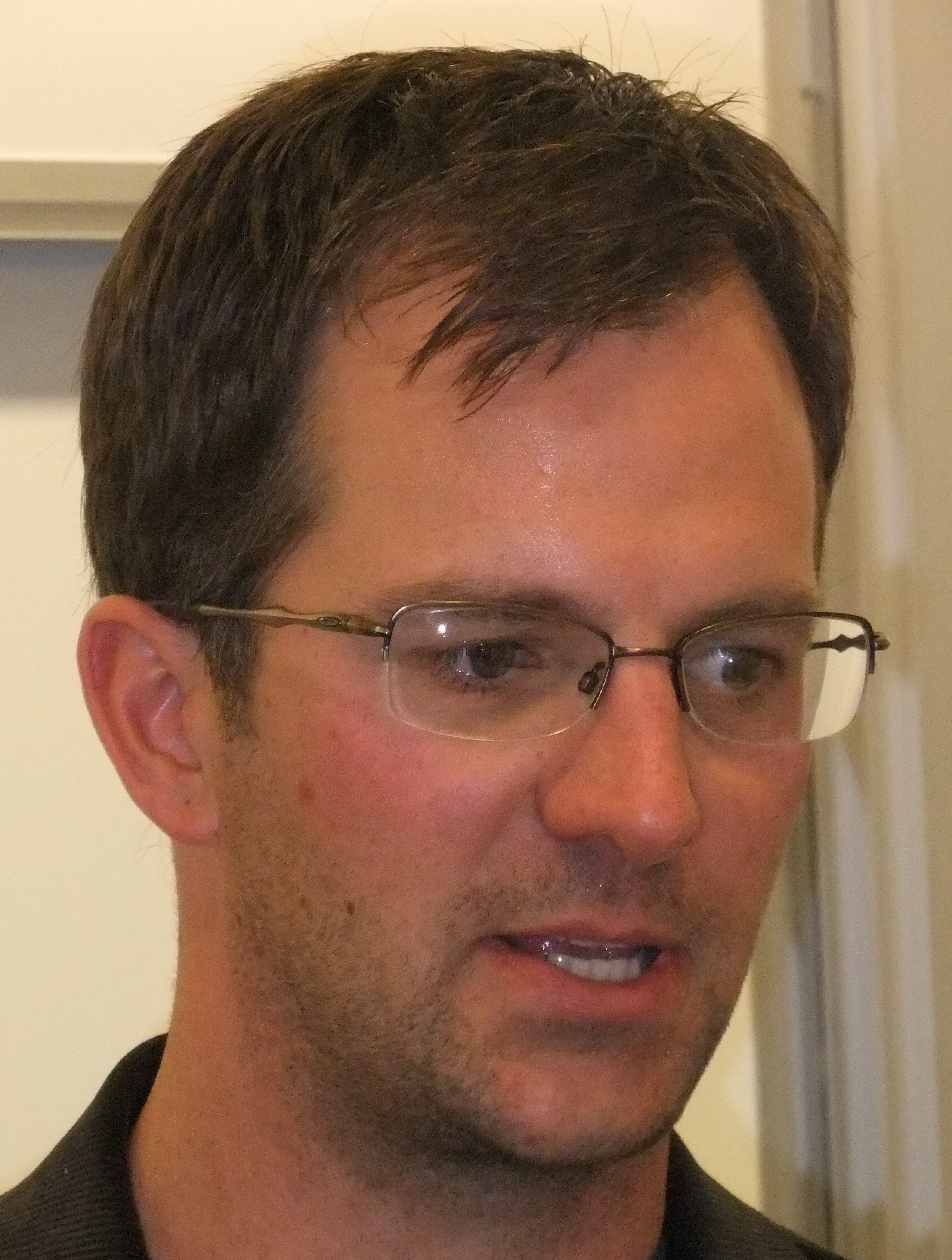
Ryan Calsbeek
I didn’t feel kinship with female lizards until I listened to Ryan Calsbeek talk about women having a say in whether their children will be boys or girls.
Calsbeek has studied natural selection among lizards and spoke about his research Thursday at N.C. State University’s biology department. He is an assistant professor of biological sciences at Dartmouth College and a visitor at the National Evolutionary Synthesis Center in Durham where he is working on a book.
Experiments he and his team have run with brown anoles, lizards native to Cuba and the Bahamas, suggest that the female lizards sort sperm to have the fittest males father more male offspring. It’s unclear how female brown anoles do that, Calsbeek said, but they’re not the only ones doing it.
“It’s even true in humans,” he said.
The remark generated quips from the audience about the exclusively female offspring of three consecutive U.S. presidents and the girl that Calsbeek’s pregnant wife is expecting. But Calsbeek argued that statistically four examples don’t mean much. Throughout history, women whose mates were presidents and kings tended to overproduce sons, he said.
Still, why should I care about sperm sorting among reptiles the size of my finger? Because brown anoles are, as Calsbeek put it, “the drosophila of lizards.” Both are model organisms. Just as the drosophila fruit fly has been extensively used to understand genetics, brown anoles can tell us something about the role female choice plays in the evolution of organisms, including ours, Calsbeek said.
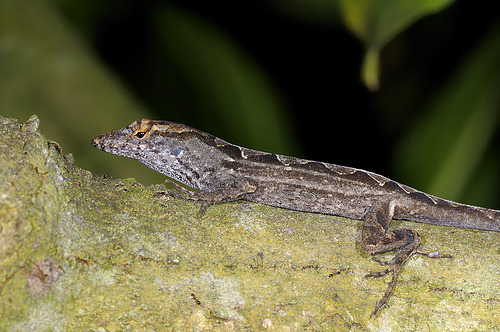
Brown anole
More than 150 years ago, Charles Darwin picked up on female behavior patterns that ensure reproductive fitness down the generations.
Nature is full of examples. To a peacock hen lustrous tail feathers on a male signal he’s not parasite-ridden. Size and strength help male elephant seals drive away competitors and attract harems of up to 100 cows. Size is also important for female brown anoles to determine male fitness.
After World War II, another Brit, Angus Bateman, determined through drosophila experiments that female choice makes sense, because the number of offspring a female fruit flies can produce is limited more by how many eggs she generates than by how many mates she has. Bateman concluded that eggs are more precious than sperm, Calsbeek said.
Calsbeek and his team conducted breeding experiments with brown anoles to learn more about the choices the female lizards made. The findings they reported last year suggested the dams were very sophisticated.
The experiments showed that the size of the father only played a role in the number of male offspring that hatched.
Males are either losers or winners while females do pretty well regardless, Calsbeek said. “If you’re a loser in the animal kingdom, you’re probably a male. Sorry guys.”
To rein in dengue fever, researchers go after the virus and mosquitoes
Thursday, February 3, 2011, 12:29 am No Comments | Post a CommentThe high-pitched hum of a mosquito increasingly carries the threat of disease in many parts of the world.
Mosquitoes can transmit West Nile, malaria, yellow fever, chikungunya and other viral diseases when they bite. The infections kill more than 1 million people every year.
Researchers in North Carolina’s Research Triangle are working on stemming the spread of mosquito-borne diseases, particularly dengue fever.
Globalization and poorly planned urbanization has increased the number of dengue infections more than four-fold since 1970s, putting two-fifths of the world population at risk, according to the World Health Organization. Along with the spread of the virus to about 60 countries, the risk of hemmorrhagic dengue fever has gone up. The severe form of the disease has become a leading cause of hospitalization and death among children in Southeast Asia.

Aravinda de Silva
“Dengue is a huge problem in the tropics,” said Aravinda de Silva, assistant professor of microbiology and epidemiology at the University of North Carolina at Chapel Hill.
U.S. travelers to Southeast Asia, Latin America and Africa can get infected - four cases of dengue fever were reported in North Carolina last summer - but local mosquitoes rarely pass on the virus outside of Hawaii and the Florida Keys.
De Silva spoke Tuesday at a forum on emerging infectious diseases at the N.C. Biotechnology Center. Other speakers were Katia Koelle, assistant professor of biology at Duke University, and Fred Gould, professor of agriculture at N.C. State University. The three talked about research under way to prevent dengue and possibly other mosquito-borne diseases. Read more…
Bed bugs make entomologists itch, too
Tuesday, January 25, 2011, 10:56 pm 1 Comment | Post a Comment
bed bug
Anything that sucks our blood while we lie in bed sleeping is bound to stir strong feelings. Think vampires and the many movies they have inspired even though vampires are at best folkore.
Bed bugs are real. They’re nocturnal but will come out during the day if they’re really hungry. They cannot live without human blood. They’re small but still visible. And as six-legged creepy crawlies their ick factor outranks any of the 170 movie versions of Count Dracula.
They’re also on the rebound.
A century ago, “Sleep tight, don’t let the bed bugs bite,” was not a children’s book. It was something parents said when they tucked in their children at night, and they meant it. Then the insects stopped being a pest in the U.S.
In the early 1990s, they were back in hotels, motels and private homes. Two decades later, the insects are becoming a nightmare in low-income housing, nursing homes and apartment buildings, said Coby Schal, an entomologist at N.C. State University who is a bed bug and cockroach expert.
“But it’s just the beginning of the problem,” Schal said Tuesday during a pizza lunch talk he gave at Sigma Xi in Research Triangle Park. Read more…
“Dude, you make bananas happen,” or why humans are apes
Saturday, January 22, 2011, 1:44 am No Comments | Post a CommentWhat Brian Hare says might rub people who quibble about evolution the wrong way.

Brian Hare
Hare, an assistant professor of evolutionary anthropology at the Duke Institute for Brain Sciences, says humans are apes.
Indeed, on the timeline that tracks the evolution of hominids, we are between chimpanzees and bonobos on the left and gorillas and orangutans on the right.
“Humans are slap dab in the middle of the great ape clade,” Hare said during a talk he gave Friday at N.C. State University’s biology department.
But wait a minute. We may share 98.7 percent of our genetic material with apes, but we’ve accomplished a lot more than they have. We speak and write books. We pray. We build cities and pay with money that’s part of a global financial system. We join different groups. We depose dictators. Apes live in trees. They grunt and scream. Their allegiances tend to be with one group only and they usually follow a strict ranking system.
To figure out how we humans got to be that way, researchers have begun to set up experiments with chimpanzees and bonobos, the apes most closely related to us. Hare’s research is based on these experiments. At Duke, for example, he has access to two sanctuaries, the Tchimpounga Natural Reserve in the Republic of Congo and Lola y Bonobo in the neighboring Democratic Republic of Congo, a country formerly known as Zaire. Read more…
Dr.David Kroll: scientist, musician, mensch
Thursday, January 13, 2011, 12:46 pm No Comments | Post a CommentDr. David Kroll is a man who wears many hats: researcher, professor, science blogger, and musician. His life seems to tie together all these separate parts into one cohesive theme of giving back to the community and enriching the lives of others.
 Kroll grew up on a neighborhood perched on a hill that afforded a direct view of the Roche tower in Nutley, New Jersey. Growing up looking at the Roche tower every day lead him to take an interest in pharmacology and the drug industry. He went to college as a first generation student and majored in Toxicology at Philadelphia College of Pharmacy and Science, following his dream of someday being able to help others by working in that same tower.
Throughout his career, Kroll kept in mind that knowledge can be used inclusively or exclusively. He wanted to use his knowledge of pharmacology to help regular people navigate the drugs that they were taking, but wasn’t very prepared for the discovery that science could be a profession so isolated from the public at large. He starting blogging as an outlet for his desire to educate the wider public on drugs, supplements, and pharmacology in general. Kroll recently
celebrated his fifth year of blogging in December 2010, blogging for ScienceBlogs, the American Chemical Society’s CENtral Science, and for PLoS Blogs over the years.
The path of Kroll’s educational and musical career intersect at many points in his life. He started playing guitar at the age of fourteen as a way to escape being labeled as a “real dork in high school.” However, the release of The Police’s Outlandos D’Amour and Joe Jackson’s Look Sharp lead him to an appreciation of the bass, which he switched to a year after picking up the guitar. This step proved to be successful as he went on to play bass in his first band with his high school girlfriend, his high school friend, his guidance counselor, and his high school history teacher. Kroll cites his history teacher as being a huge influence on getting him interested in the history of social injustice and specifically the history of science. His first band played bars and clubs around town throughout Kroll’s high school years.
In college, he played mostly solo but would occasionally play with his old high school band while visiting home. Around the time he was finishing college, Tom Petty and the Heartbreaker’s “Southern Accents” was released and proved to be yet another pivotal album in his life. This Tom Petty album release was right around the time of his acceptance into a pharmacology doctorate program at the University of Florida in Gainesville, the hometown of the Heartbreakers. Tom Rowe, his advisor at UF, was supportive of a work/life balance, and this freedom allowed him to play in a U2 tribute band for two years in graduate school.
After finishing his Ph.D., he landed an offer for a postdoc position at Roche, the original setting of his dream of working in pharmacology. He was literally within days of accepting when he got offered a position at the University of Colorado in Denver. He ended up taking the position in Denver instead, where he worked on the transcriptional regulation of the CREB protein and a shortly afterward went on to land an Assistant Professor position in the School of Pharmacology at the University of Colorado Health Sciences Center.
The move to Denver proved to be fortuitous to his musical life as well. One day he was typing up an abstract in the main office of the Division of Endocrinology, Metabolism, and Diabetes at the Univ of Colorado Health Sciences Center when a endocrinology fellow walked in to answer a page for a gig he was playing later that evening. Kroll struck up a conversation, mentioning that he was a bass player, and got invited to jam with Dan Bessesen, and his bandmate, Jay Reusch, a cardiologist whose wife was also an endocrinology fellow. These jam sessions evolved into Dogs in the Yard, an adult alternative band that lasted for eleven years, from 1990 - 2001. They played gigs at the medical center, fundraisers, and even the endocrine department Christmas party. They released two CDs, one in 1997 entitled “Sunday Afternoon” and one in 2001, “Til the Summer Fades Away.” About eight years into the band, EMI called and offered them a move to LA to pursue the possibility of a record deal. But as all of the people in the band had work and family obligations, they decided to turn it down.

Eleven years is an ancient time in band years, but all good things must come to an end. Kroll left Dogs in the Yard after he met his now-wife at a cancer research conference in Colorado. She was a Duke oncology physician-scientist who lead him to doing a sabbatical at Duke that eventually lead to a job offer in the North Carolina Research Triangle at RTI International. Despite the loss of the band, he continued his musical career with other scientists, playing with
Nick Oberlies, a chemistry postdoc, scientific collaborator at RTI, and DJ at Duke University station WXDU. He also played with Cole Guerra, a psychology graduate student at Duke who Kroll contacted after reading an article featuring him in the local Triangle Independent Weekly. Kroll joined his band on bass for shows at Cafe Driade and Local 506 in Chapel Hill. However, at RTI he missed the joy of teaching students and moved to take a professorship at North
Carolina Central University in Durham.

Kroll has continued to keep in touch with music at NCCU, playing the annual Faculty Talent Show and working on solo projects. Lately, he’s been writing songs under his own name in preparation to record a solo album called “From Denver to Durham.” The namesake of his album comes from the fact that both cities have an interstate exit numbered 284 that leads to the international airport, a testament to the myriad levels of interconnectivity in both his scientific and musical career.
At the BlogTogether bash in Durham in October, he debuted a song called “Minister of the Ether” that pays tribute to Anton Zuiker in celebration of his 10th year of blogging and to all his work in the blogging community. Check out an exclusive video below of Kroll giving an acoustic performance of the song under the bull statue in Durham’s city center.

Test your flu preparedness
Wednesday, January 12, 2011, 12:35 am 2 Comments | Post a CommentThe H1N1 virus that fueled the 2009/2010 flu pandemic was less deadly than initially feared, but it carried enough punch to infect more than 1.4 million and kill about 25,000 worldwide.
Dr. Anne Schuchat
Also, five months after the World Health Organization declared the end of the pandemic, the virus lives on as part of the seasonal flu. In the United Kingdom, the season geared up with an outbreak caused by the H1N1 virus that emerged in 2009.
With the flu season upon the U.S., Duke University invited Dr. Anne Schuchat, U.S. assistant surgeon general, to talk about influenza preparedness at its winter forum. The two-day forum starts at the beginning of the semester and allows about 100 undergraduate students to work through a global issue and what people can do about it.
Schuchat, who kicked off the forum Sunday, spoke about the intense media attention during the pandemic and how vital information sharing and transparency was in the public health response. Her talk inspired these questions and answers to test your flu preparedness. Read more…
Dr. Robert Gallo talks about finding a cure for HIV/AIDS
Friday, January 7, 2011, 2:36 pm 1 Comment | Post a CommentAfter a presentation in front of a crowd of about 140, Dr. Robert Gallo sat in an empty auditorium at RTI International and compared the human immunodeficiency virus to Mount Everest.

Dr. Robert Gallo, courtesy J. W. Crawford/RTI International
Gallo, director of the Institute of Human Virology at the University of Maryland School of Medicine in Baltimore, has studied HIV for nearly 30 years.
In 1983, he was locked in a controversial race with French virologist Luc Montagnier to identify HIV as the cause of AIDS. The research results earned Gallo a 1986 Lasker award, also known as America’s Nobel. Montagnier received the Nobel Prize for Medicine in 2008.
The HIV discoveries by Gallo and Montagnier led to an antibody test that helped rid blood banks of the retrovirus and aided in the development of AZT, the first AIDS medicine, at Burroughs Wellcome in Research Triangle Park.
During a presentation Gallo gave Thursday at RTI - during his latest visit to RTP, long a hot spot for HIV/AIDS research - he outlined the clues he followed on the path to identify HIV and the work he’s doing now to develop a vaccine. Read more…

Unleashing the power of 1100 suns
Friday, December 17, 2010, 2:19 pm No Comments | Post a Comment
An array using high-concentration photovoltaics from Semprius, Inc.
A year or so ago, Joseph Carr found himself on an elevator with a man wearing a Siemens polo shirt. Having once worked for a division of Siemens, Carr introduced himself as the CEO of Semprius, Inc., a company that makes very high-efficiency solar modules. At the end of a fourteen-floor ascent, the two men exchanged business cards. Within months, Semprius and Siemens announced a joint development agreement.
Yes, a true “elevator pitch” success story.