
“Dude, you make bananas happen,” or why humans are apes
Saturday, January 22, 2011, 1:44 am No Comments | Post a CommentWhat Brian Hare says might rub people who quibble about evolution the wrong way.

Brian Hare
Hare, an assistant professor of evolutionary anthropology at the Duke Institute for Brain Sciences, says humans are apes.
Indeed, on the timeline that tracks the evolution of hominids, we are between chimpanzees and bonobos on the left and gorillas and orangutans on the right.
“Humans are slap dab in the middle of the great ape clade,” Hare said during a talk he gave Friday at N.C. State University’s biology department.
But wait a minute. We may share 98.7 percent of our genetic material with apes, but we’ve accomplished a lot more than they have. We speak and write books. We pray. We build cities and pay with money that’s part of a global financial system. We join different groups. We depose dictators. Apes live in trees. They grunt and scream. Their allegiances tend to be with one group only and they usually follow a strict ranking system.
To figure out how we humans got to be that way, researchers have begun to set up experiments with chimpanzees and bonobos, the apes most closely related to us. Hare’s research is based on these experiments. At Duke, for example, he has access to two sanctuaries, the Tchimpounga Natural Reserve in the Republic of Congo and Lola y Bonobo in the neighboring Democratic Republic of Congo, a country formerly known as Zaire.
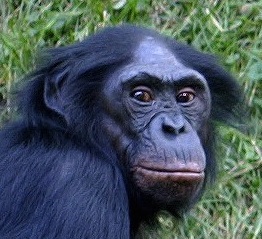
bonobo
What these first experiments suggest is that bonobos often behave differently than chimps and we sometimes behave like chimps and sometimes like bonobos.
When we go to a casino and gamble, we act like chimps. Unlike bonobos, chimps are risk-takers, according to a study published in 2008 and co-authored by Hare and two Duke students. When we share our ice cream cone, we act like bonobos. Hare and a Lola y Bonobo researcher found out not only humans voluntarily share their food, bonobos do, too, and they published the finding last year.
Evolutionary anthropologists believe we accomplished much of what we did as a species because we were particularly good at cooperating. In other words, we helped each other out, were tolerant of each other, knew how to negotiate and form relationships.
“It doesn’t matter that you’re super smart if you can’t get along,” is how Hare described it.
A study published in 2006 that Hare also co-authored looked at how good chimps are at cooperating even though they cannot talk to each other.
The experiments used bananas, a favorite food. To get the bananas, two chimps in a cage had to simultaneously pull a rope, one at each end. Chimps who wanted all of the bananas themselves ended up with a rope. Pairs who were willing to share got bananas, as video recordings of the experiments showed.
The experiments also tested how aware chimps are of a joint effort and whether they can remember the best partner. In a series of trials, one chimp could either open a door to a second cage and let a partner in to share the bananas, or he could eat all of the bananas himself. A chimp left empty-handed after another partner had shared the bananas with him was clearly upset about the lack of cooperation. He jumped around flailing his arms.
“You make me lose my bananas,” Hare commented the video showing the upset chimp. He remembered a better partner and Hare’s commentary of the memory was, “Dude, you make bananas happen.”
Chimps can also negotiate, according to a study co-authored by Hare and published in 2009. Presented with a choice of equal or unequal portions of bananas, dominant chimps let subordinate chimps have an equal portion in up to 56 percent of the trials.
But present just one portion of bananas and chimps can’t solve the problem, Hare said. Bonobos can.


