
Biotech innovation: What isn’t funded
Tuesday, June 28, 2011, 11:35 pm No Comments | Post a CommentInnovation capital, money to turn some of today’s most innovative discoveries into tomorrow’s medical treatments, is getting so scarce in the U.S., politicians, economic developers and entrepreneurs in regions specializing in early stage biotech research and development are scrambling.
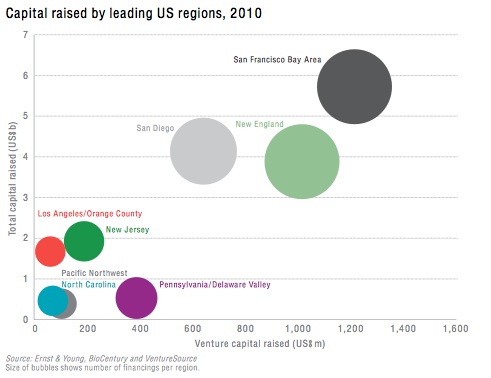
North Carolina, a hub for young biotech companies, trailed other U.S. biotech hot spots in venture capital raised last year, according to an Ernst & Young report.
North Carolina’s Research Triangle, the third largest U.S. biotech hub, is one of those regions.
Some of the world’s largest R&D companies have operations in the Triangle, including GlaxoSmithKline, Novartis and Bayer. But the lifeblood of the area has long been young, early stage companies in pursuit of ideas developed at local research universities such as Duke University, the University of North Carolina at Chapel Hill and N.C. State University or hatched by researchers who used to work in corporate labs in Research Triangle Park.
A little more than two years after a deregulated U.S. banking industry stumbled in the fall of 2008, investors are increasingly shying away from early stage biotech companies, a high-stakes, high-rewards gamble in the best of times. Innovation capital is drying up in the U.S., according to a 2011 report the U.S. accounting firm Ernst & Young published this month.
One consequence, a Research Triangle venture capital investor said, is “deals are dying on the vine.”
“More and more small, really good startups are having problems finding money,” said Norris Tolson, chief executive of the N.C. Biotechnology Center. “We’re about the only game in town for early stage biotech companies.”
The biotech center, which offers grants and loans up to $250,000, has seen the number of funding requests increase by about 10 percent, Tolson said. In the past year, about 280 applicants asked for financial support. About 130 were approved.
Traditionally, young biotech companies have relied on private investors, often venture capital investors, to kick their R&D into gear.
U.S. biotech companies raised $5.5 billion in venture capital in 2007, about twice as much as in 2000, according to Ernst & Young. But in the past three years, the amount has stagnated at about $4.5 billion annually and venture capitalists have begun to hold money back until companies reach certain milestones.
Total capital raised by biotech companies in the U.S. bounced back to $20.7 billion last year, from about $13 billion in 2008, according to Ernst & Young. But much of that capital went to mature companies. Young, early stage companies, which work on the most innovative technologies and generate more jobs than large, established companies, actually received about 20 percent less in capital than the year before.
In Europe, capital raised was more evenly distributed among startups and mature companies. In Singapore, China and India, governments are ratcheting up efforts to bolster biotech innovation. And in Latin America, Brazil’s already strong agricultural biotechnology sector is gaining attention.
But politicians, economic developers and university administrators in the Research Triangle have come up with ideas to encourage the formation of R&D startups despite the early stage funding crunch

The planned Alexandria Ag-Tech Center.
The biotech center teamed up with Alexandria Real Estate Equities, a Pasadena, Calif.-based real estate investment trust, to attract young companies working in agricultural biotech research. Alexandria, which already owns lab buildings in the Triangle, will build a $13.5 million business incubator with about 18,000-square-feet of greenhouse space near RTP.
Several universities and the Council for Entrepreneurial Development are working with the charitable arm of the Blackstone Group, a global investment firm, to turn more technologies developed at universities into companies and bolster the Triangle’s existing entrepreneurial network.
The chancellors at UNC-CH and NCSU have set up innovation funds to further support spinoffs.
And state legislators are again considering establishing a nonprofit that can loan young companies money. The legislation has come up twice before and would use about $100 million an out-of-state investor is willing to provide, Tolson said. Initially, only life science companies could benefit, but recently state lawmakers suggested that information technology and green technology companies should also be included.
“There’s a huge need for startup capital across the U.S.,” Tolson said. In North Carolina, “a lot of people are understanding the need.”


