Archive for April, 2011

Proposed global health spending cuts raise concerns in Research Triangle
Wednesday, April 6, 2011, 10:45 pm No Comments | Post a CommentAt a global health conference in Chapel Hill, the tug-of-war over budget cuts on Capitol Hill landed smack-dab in North Carolina’s Research Triangle.
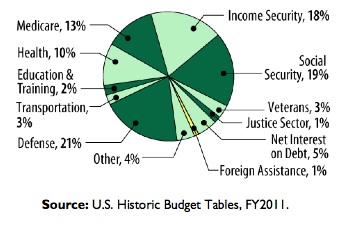
In 2010, foreign assistance accounted for 1 percent of all U.S. spending.
While Republicans and Democrats are negotiating about getting a handle on the federal deficit, concerns about proposed federal funding cuts are rising in states with global health research hubs, such as North Carolina, California and Washington.
House Republicans have proposed cutting international affairs and foreign assistance spending by a total of 44 percent over the next five years, including 29 percent in 2012. They’re also pushing for an 11 percent funding cut for global health programs during the remaining months of the current fiscal year, which would scale back malaria programs and reduce immunizations, the number of skilled birth attendants and other basic health services worldwide, Dr. Rajiv Shah, head of the U.S. Agency for International Development, told a House appropriations subcommittee.
At the conference, which took place April 1 at the University of North Carolina Friday Center in Chapel Hill, experts from USAID and the Center for Strategic and International Studies in Washington, D.C., and the Centers for Disease Control and Prevention in Atlanta addressed the future of global health and development.
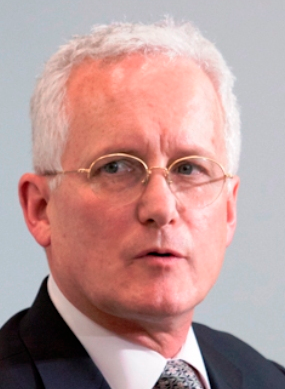
Stephen Morrison
“We’re now in an era of austerity, uncertainty and flattening or declining budgets,” said Stephen Morrison, director of the CSIS Global Health Policy Center.
Morrison didn’t foresee a catastrophic collapse of global health budgets. But the days of double-digit annual increases are gone, he said.
From 1990 to 2010, international spending for global health rose from about $6 billion to an estimated $27 billion, according to a report by Chris Murray of the University of Washington Institute for Health Metrics and Evaluation. About one-third of last year’s funding came from the U.S.
U.S. spending on foreign aid and global health more than doubled in the past 10 years and the increase benefited Africa and parts of Asia.
The Bush administration started an initiative to battle HIV/AIDS in Africa, contributed to an International Monetary Fund effort aimed at boosting education, health status, nutrition and gender equality in poor countries and increased security-related assistance to Afghanistan and Pakistan.
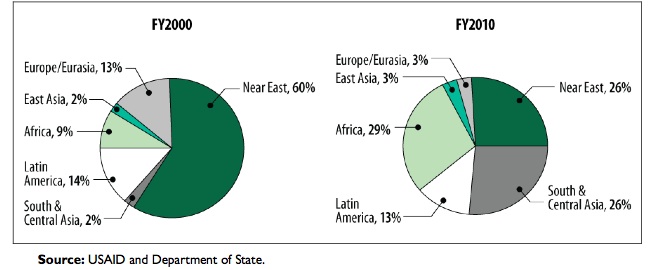
Regional distribution of U.S. foreign aid in FY 2000 and FY2010
In fiscal year 2010, the U.S. spent $39.4 billion on foreign aid, according to a Congressional report. Nearly 90 percent of that money was funneled through USAID. Still, foreign aid accounted for only about 1 percent of all U.S. spending.
Domestically, the funding increases boosted grant revenue at research institutes and created jobs at universities.
In the Research Triangle, RTI International was one of the biggest beneficiaries. RTI increased funding from USAID from $165.9 million in 2006 to $265.4 million in 2010. Another local research institute that benefited was Family Health International. FHI’s annual revenue rose about 40 percent from $224 million in 2005 to $370 million in 2009. About 70 percent of the global health funding FHI secured in 2009 came from USAID.
The UNC Gillings School of Global Public Health and the Duke Global Health Institute trained the workforce needed to implement the new initiatives.
In 2009, a Duke University study determined that North Carolina’s global health sector supported more than 7,000 jobs and $508 million in annual salaries and wages. The sector’s impact on the state’s economy was nearly the same as the textile industry’s, according to the study.
Similar economic impact studies have been done in California, where global health supports about 350,000 jobs that generate $19.7 billion in annual salaries, wages and benefits, and in Washington state, where global health supports 13,700 jobs that generate $1.7 billion in annual salaries, wages and benefits.
At the conference, Morrison encouraged global health professionals in the audience to lobby their House representatives, but he was convinced that global health would take a disproportional hit no matter how the budget negotiations would turn out.
“This is a moment of wake-up for us,” he said.
Offering a hand-up to student entrepreneurs
Tuesday, April 5, 2011, 5:24 pm No Comments | Post a CommentScott Kelly followed a long tradition with Startup Madness, a showcase of entrepreneurship and innovation in North Carolina’s Research Triangle.
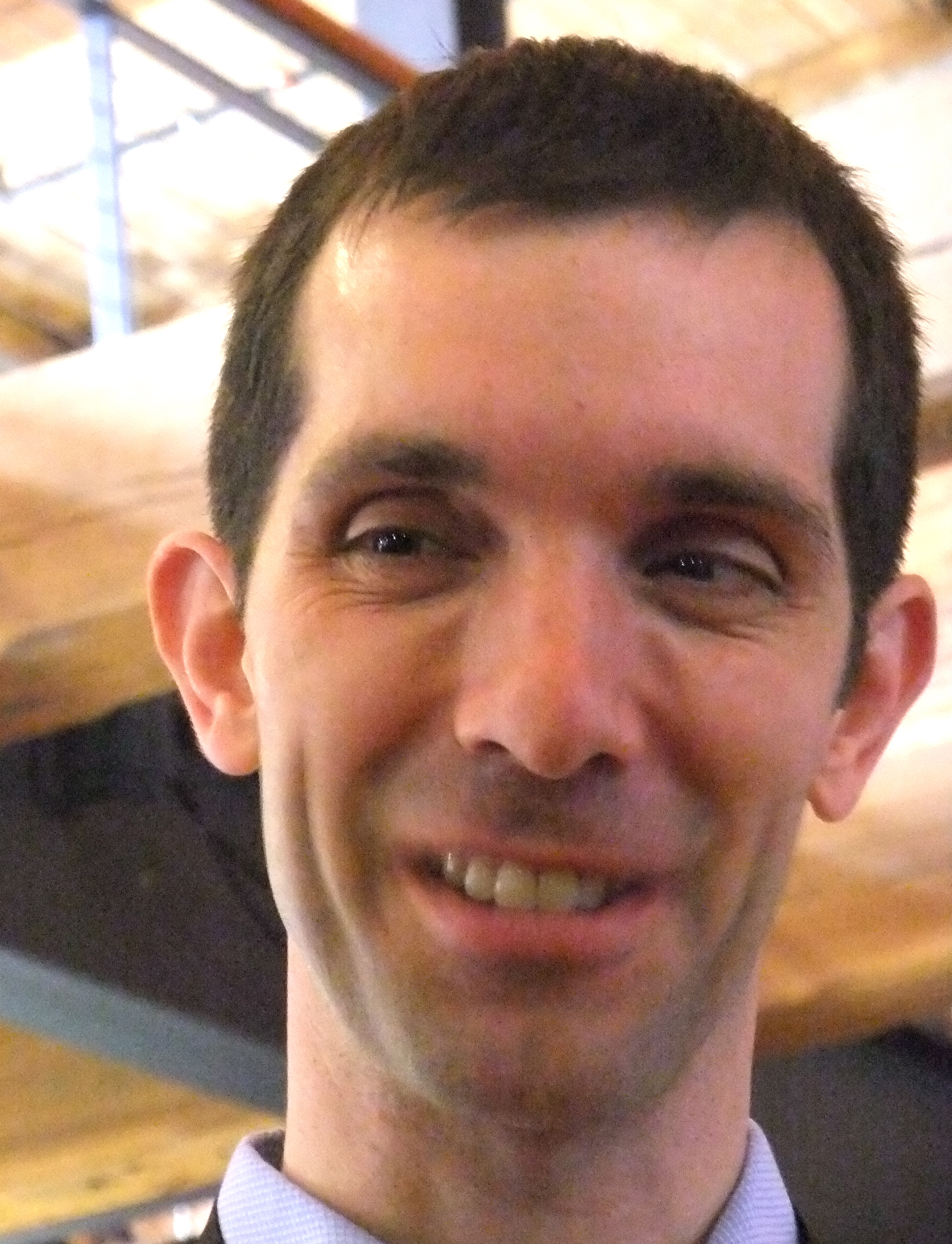
Scott Kelly
Kelly, an investment banker at KeySource Bank who has worked in Internet marketing and sales, recognized the enormous job creation potential of a three-county area dotted with universities - just like economic developers, academics and businessmen did in the 1950s when they established Research Triangle Park on wooded land that was flanked by Duke University in Durham, the University of North Carolina at Chapel Hill and N.C. State University in Raleigh.
Just like the RTP supporters, Kelly focused on Duke, UNC and NCSU students.
Startup Madness, which took place March 31 on the American Tobacco Campus in downtown Durham, introduced student entrepreneurs to the Research Triangle’s investor and business community. The goal, Kelly said, was to encourage innovative young minds to stay and to retain the startup businesses that are born here on university campuses.
“We have the universities. We have young talent, possibly more than anybody else,” Kelly said. “It would be a shame if they leave.”
Startup Madness was the third entrepreneurial showcase Kelly has organized in the past year. The first took place in May 2010, three months after the recession pushed North Carolina’s unemployment rate to 11.4 percent. In the Triangle, more than 8 percent of the labor force was out of work at the time.
Considering that about three-fourths of U.S. jobs tend to be in businesses with fewer than 100 employees, Kelly thought that helping student entrepreneurs start companies in the Triangle would be a good idea to address the unemployment rate.
At Startup Madness, three student entrepreneurs, one each from Duke, UNC and NCSU, pitched business ideas. The crowd picked the most popular idea. The winner, Kelly said, would get lunch with local business leaders and venture capital and angel investors.
The pitches were:
- An infrared glove that monitors blood glucose levels in children with Type 1 diabetes continuously. The glove is worn at night and replaces repeated finger pricks, said Kyle Foti, one of eight NCSU undergraduate students working on a prototype. Currently, children with Type 1 diabetes must be woken several times at night and tested to prevent hyperglycemia, which can damage the brain and organs. The glove is not only more accurate, but it would also wake parents and children only when there’s a problem.
- Unfiltered voice messages from professional athletes that fans can receive on their mobile phones. Gridiron Grunts plans to start with messages from NFL football players and then go on to NASCAR drivers, said Jeb Terry, a UNC business student who spent five years playing football professionally. Revenue would come from subscriptions, Terry said.
- Internet discounts on merchandise that local businesses offer college students. After its launch a few weeks ago Sidewalk already had 1,000 users across Internet platforms, said Brian Laker, a Duke business student. The merchants pay Sidewalk a fee for the services.
And the winner was: The infrared glove to prevent hyperglycemia, the first product being developed by Diagnostic Apparel.
April 1st kicks off 5th annual SmartCommute@RTP Challenge
Monday, April 4, 2011, 1:59 am No Comments | Post a Comment
Originally published 3/24/11:
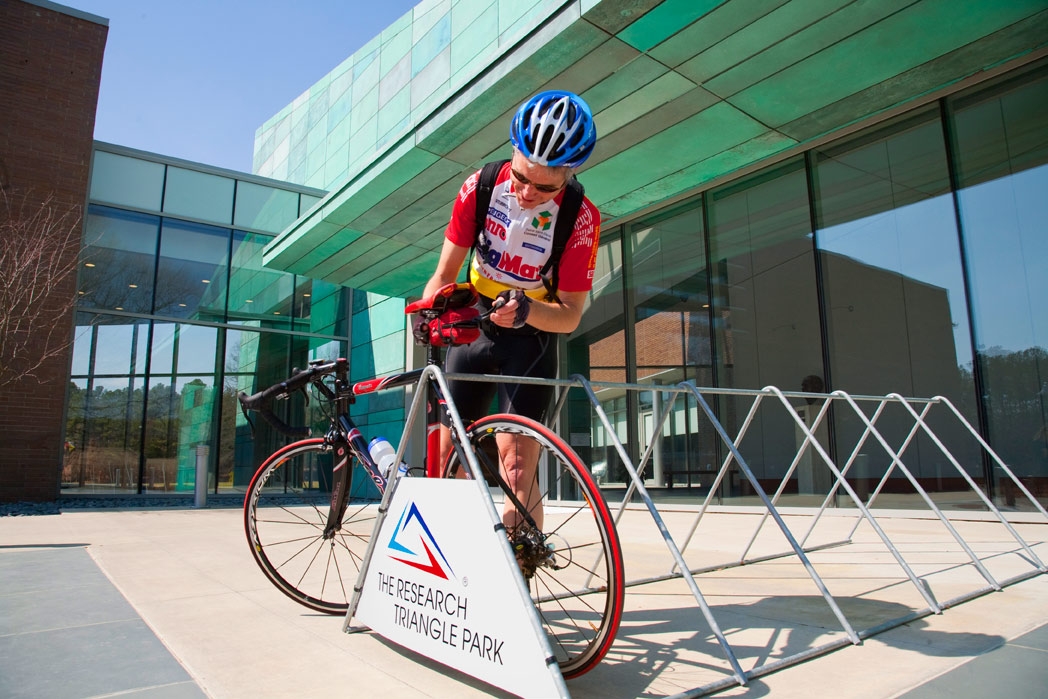
Saying Jim Miller likes to bike is an understatement.
The 55-year-old facility engineering manager at Research Triangle International said he rides his Cannondale road bike to and from work every day of the year, including winter.
“I’ve biked when it’s 15 degrees Fahrenheit outside, and I’ve biked when it’s 105,” Miller said.
He estimates that he’s cycled between thirty and forty thousand miles between work and errands in the last three years. So naturally, each year Miller pledges to participate in the RTP SmartCommute Challenge.
The 5th annual challenge, which runs from April 1st to June 1st, encourages residents and employees in Wake, Orange and Durham counties to explore alternative modes of transit to work. In addition to biking, popular options include walking, carpooling, taking the bus, and telecommuting.
“Telecommuting is the most popular SmartCommute alternative in the region,” said James Lim, director of RTP programs at the Research Triangle Foundation.
Lim helps coordinate SmartCommute. He said one of the major benefits of taking the challenge is reducing the number of vehicle miles traveled. Along with this comes improved air quality, which includes reductions in CO2, mono-nitrogen oxides (NOx), and volatile organic compounds (VOCs).
Lim and his colleagues on the SmartCommute committee have established two goals for this year’s challenge: trying to save around 18,000 gallons of gasoline and trying to recruit 12,500 pledges. He said last year’s goal of 10,000 pledges was met and surpassed.
But to talk the talk, Lim feels he must walk the walk, literally. He plans to jog seven miles to the RTF headquarters from Durham each morning over the course of the two months.
“Now that I’m saying this in print,” Lim said. “I have to do it.”
He also carpools with another Foundation coworker. It’s important that employers are supportive of their staffs’ efforts to join the challenge, he said. Some companies have flexible starting and leaving times for those who bike or walk; others issue carpool parking passes closer to the building.
Darren Danko, the information technology director at RTF, is an avid SmartCommute cyclist as well, though admittedly he’s not as hardcore as Miller.
“I’ll bike whenever it’s 60 degrees or above,” Danko joked. His 3.2-mile ride from Durham takes him about 20 to 25 minutes on his aged, 10-speed Schwinn street bike.
Danko also opts for eco-friendly transit even after the challenge is over.
“It’s important to let people know that there are other alternative ways to get to work,” he said. “People need to get off their butts and do some exercise.”
According to past survey data, 75 percent of SmartCommuters elect to maintain the challenge after it comes to an end, Lim said.
Their efforts aren’t without incentive. Lim’s committee sponsors a SmartCommute Challenge awards ceremony each summer wherein companies and employees who participate are honored for their achievement. Two grand prizes of $750 are handed out to a pair of individuals who distinguish themselves.
This year there are two prize pools: one for new pledges trying green transit for the first time and one for veterans who continue to reduce their carbon footprints to work.
SmartCommute is co-sponsored by GoTriangle, a regional collaborative of transit providers. Research Triangle-based corporations like IBM, Cisco and Miller’s RTI also donate to the program.
Miller bikes twelve miles from his home in Chapel Hill to RTI’s headquarters in Research Triangle Park, a 24-mile roundtrip per day. He said it takes him about 45 minutes each way. Over the course of last year’s challenge, Miller rode more than 612 miles. It’s a part of who he is.
“I biked a lot when I was in my early twenties,” he said. “And I started again after I divorced 13 years ago.” His biggest ride was a coast-to-coast excursion in 2003.
He doesn’t see any downside to leaving the car in the garage. The only the cycling becomes a problem, he said, is during right turns at intersections with drivers jetting out behind him.
“I’ve only been hit by a car one time,” Miller said. “No accident, though. They just hit me in my arm with their side view mirror.”