Posts Tagged ‘ECGC’

ECGC encourages designers to create
Friday, April 15, 2011, 1:58 pm 1 Comment | Post a Comment
Timothy Gregory, an aspiring game developer and student at Piedmont Community College, works with the Unreal Development Kit during the East Coast Game Conference Thursday. | Photo by Tyler Dukes
It was barely 10 a.m. Thursday and Timothy Gregory was already busy creating worlds.
With a few gestures, he willed the ground into existence, adding texture and flooding his environment with water. Minutes later, he added grim, metallic structures: from complex pillars to blinking machines with unknown functions. Then with a click of his mouse, he created light. Read more…
Gaming industry veteran: Things are getting interesting
Tuesday, April 12, 2011, 10:38 am No Comments | Post a CommentIn November, the gaming industry will celebrate its 40th birthday. With the release of Computer Space in 1971, the future founders of Atari set in motion a phenomenon that would change the way people look at entertainment, learning and even medical training.
And for 30 years, Mark Cerny’s been right in the middle of it.
The creator of classic titles like Marble Madness and more modern blockbusters like Crash Bandicoot and Spyro the Dragon, Cerny’s had his hands on almost every evolutionary form of the video game, from the coin-op arcade to the next-gen shooter.
Ahead of his Thursday keynote titled “The Long View” at the East Coast Game Conference in Raleigh, Science in the Triangle caught up with Cerny over the phone from his office in Burbank, Calif., where he runs his own consultancy firm Cerny Games.

Mark Cerny
Q: What do you think has been most significant about the change you’ve seen in the video game world in the last 30 years?
If you look at where it was when I joined the game industry in 1982, the center of the games industry was the video game arcade. Some of the most popular home games were versions of the arcade games.
If you look at the late 80s, the center of the world was the PC. That’s where all the creative action was. The GDC that we know today was actually the CGDC — the Computer Game Developers Conference.
By the late 90s, very console-centric, with either cartridges or CDs. Now it’s moved again: Facebook, iPhone, iPad have shown huge recent gains in market share.
Q: In the early 80s, we saw a market saturated with pretty terrible games, then a subsequent crash. Do you see parallels here with the emergence of so many mobile applications?
One thing we should be aware of is those games were terribly expensive back in the day. If you went to the store and bought a game from the store for $40 in 1980 or 1982, taking into account inflation, that’s about $100 today. I agree that not all the games demonstrated that much play value, but today, these games you’re talking about are games you can play for a buck, or maybe $3. I think it’s a much healthier market today.
Q: What do you think the fragmentation we’re seeing in the gaming market means for video games?
Certainly the core console gaming market is getting soft. We saw a 5 or 10 percent decline in 2009 and about the same in 2010. I’ve been through some of the great crashes, and it does make me wonder a bit if we are headed for one.
Q: So is it just a wait-and-see situation at this point?
The diversity we have right now is really healthy. It’s nice to see so many people who wouldn’t normally spend much time on electronic entertainment going out there and playing these games.
I was in London two years ago and my cab driver had just discovered the iPhone and he was going crazy over the number of 99p games that he could buy. This was a guy who had never played games before.
On the biggest-level picture, it’s healthy because the audience is broadening dramatically through the iOS games and Facebook games.
Now, if I’m going out there and I want to create a 20-hour single-player experience for console that’s going to cost $50 million to develop, yes, there are implications for that, and I’m not sure the economics of that are as healthy today as they were three years ago.
Q: What still excites you about working in the video game industry?
This is my 30th year of making games, and I have to say the first half of that was not as interesting as the second half.
Until the original PlayStation came out, it wasn’t really possible to create the kind of game I personally was interested in making. I was a hobbyist programmer in the 1970s. My brother and I were trying to make a real-time 3D action RPG. Now needless to say, that’s a terribly ambitious thing to go after. We had a couple hundred thousand dollars of university equipment we were borrowing to do this. We were programming in punch cards. When I finally saw the game we were trying to make, it was called Final Fantasy VII.
Ironically, I got into arcade games, where the games were three minutes long or five minutes long, so I didn’t have a chance to make the games I was interested in making until I started collaborating with Naughty Dog on the Crash Bandicoot series and Insomniac on the Spyro the Dragon series. From that standpoint, Spyro the Dragon, which had narrative in it, was much closer to the vision I had as a child of what I wanted to make. That was just 1996.
NVIDIA graphics wizard on Marcus Fenix and Minecraft
Monday, April 11, 2011, 10:50 am No Comments | Post a Comment

Tony Tamasi
From text-based adventure titles to dystopian 3D shooters, video game graphics have come a long way. But if people like Tony Tamasi have anything to do with it, that rapid progression won’t be stopping anytime soon.
NVIDIA‘s senior vice president for content and technology will be in Raleigh Wednesday for the East Coast Game Conference, when he’ll deliver his keynote address titled, “The Future of Graphics Processing.” Science in the Triangle caught up with Tamasi by e-mail to discuss where graphics are heading in the gaming world — and how gamers’ constantly changing palates will guide that growth.
Q: What role do you think graphics play in the quality of a game, especially when it comes to things like storytelling and gameplay?
Graphics is one of the core components of great games. Obviously graphics alone don’t make a great game, but great graphics can help to make a game better, more immersive and more enjoyable. For example, horror-style games would be significantly less scary if lighting and shadows couldn’t be done interactively. Seeing some creepy shadow approaching around a corner can really help to set the mood.
Q: How are technological advancements changing how game developers think about graphics?

Epic's "Samaritan" demo showcased the new Unreal Engine 3. | Image courtesy of Epic Games
The transition of graphics processors to these generally programmable devices has really allowed game developers to become much more creative and get much closer to the visions they have in their head. Some of the most recent advances in graphics processing with DirectX 11-class graphics processing units enable incredible levels of geometric richness through procedural tessellation, the ability of the GPU to create geometry from a higher-level surface representation or to extrude real geometry from displacement maps. Increased levels of geometric realism can help environments seem much more realistic, and characters much more lifelike as artists are less constrained to a small number of polygons, which ultimately leads to harsh silhouette edges that look more like a collection of polygons than something alive.
Q: Despite the explosion in power of both console and desktop gaming platforms, we’re seeing a surge in popularity for games with a more retro aesthetic — like Minecraft for example. What do you make of this movement?
It’s fantastic. We’re seeing a resurgence in innovative gameplay. Minecraft is a fantastic example of a creation/exploration type of game, and despite its retro look, can be incredibly addictive. I would expect that as before, as new gameplay or design mechanics are developed, over time they will evolve, and as future games incorporating these concepts are developed, they’ll layer on not only enhancements to gameplay, but improved visuals, physical simulations, more intelligent AI, etc. It’s incredibly important that the game development industry continues to be creative and innovative, since all of us gamers have a little bit of ADD in us and are always looking for something new to challenge or delight us.
Q: We’re seeing a huge shift as gamers embrace mobile gaming platforms. How do you think this fragmentation will affect the development of graphics processing?
Fragmentation can be a difficult problem for game developers to address. Happily, for things like the Android, iPhone, Xbox 360 and PS3, the core graphics capabilities aren’t that different (the horsepower obviously is). So from a core architecture perspective, it isn’t an intractable problem to design an engine that can span a very wide dynamic range of devices. Unity and Unreal Engine are obvious examples of the ability to have core engine technology with range. Epic’s latest demonstration of their engine’s capability, Samaritan, also shows that it’s possible to build incredibly stunning real-time graphics capabilities on this core technology.
There’s no doubt though that designing a game that pushes the envelope on today’s high end DX11-based GeForce GTX 580 will involve different art, assets and capabilities than a game that is targeting mobile devices. In many ways though, mobile device capability and horsepower isn’t that different from consoles from a few years back, so to some degree the industry’s already “learned” how to develop for that.
It’s an incredibly exciting time for game developers. Resurgence of mobile, a new renaissance of game design and creativity, revolutions in business models, pervasive connectivity, enormous increases in graphics capability and power, devices with huge numbers of input devices and sensors, and next-generation functionality and platforms – all mean the next decade should be a great time for creative developers to tap the enormous potential of our rapidly changing ecosystem. I can’t wait to see how awesome these new games are going to be!
Interested in the East Coast Game Conference? Science in the Triangle’s got you covered! Follow all our stories on the conference.
Sponsor boost lowers price of gaming conference passes
Thursday, April 7, 2011, 12:34 pm No Comments | Post a Comment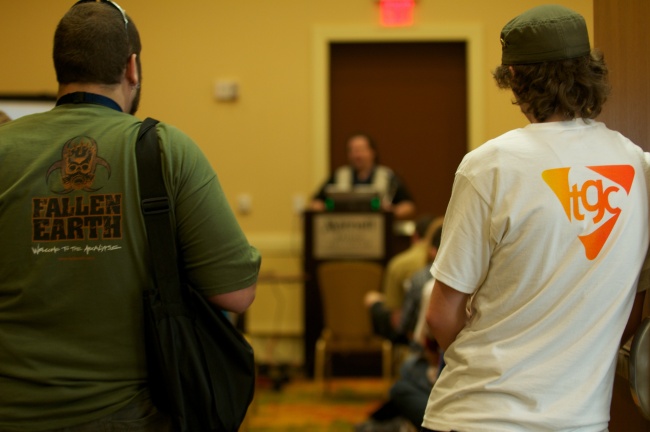
Attendees at last year's Triangle Game Conference listen to a speaker. | Photo courtesy of Capstrat
Good news for cash-strapped game developers looking for a way into next week’s East Coast Game Conference: Organizers slashed the price of professional passes more than $100 last week.
The $99 pass grants visitors access to all the sessions and keynotes, as well as access to the expo hall. Pass holders can also visit the career lounge, where they can speak with industry professionals, and Unreal University, where they’ll be able to get hands-on with Epic Games’ Unreal Development Kit.
The lower prices are a result of conference donors Epic, Joystick, ECU, Trailblazer, Wake Tech, Autodesk and Cinesys, which provided greater-than-expected donations for the rebranded event once known as the Triangle Game Conference.
“We had a number of companies step up in their sponsorships,” conference co-founder Troy Knight said. “That allowed us to take the money we made for the conference and lower the costs for smaller incubators and independent companies.”
The passes, once priced at more than $200, were “really a stretch” for many smaller and aspiring developers, according to conference co-founder John Austin. He said organizers have already seen an uptick in registrations as a result of the lower price.
Although it’s in its third year, Knight said the organizers are able to make conference funding go further because the Triangle Game Initiative, the trade group putting it all together, is a nonprofit focused on benefiting the local gaming industry.
“None of us gets paid to do the conference. The money goes back into a pool to do more events,” Knight said. “It’s really a helping handout for the local community.”
A week out from the event, Knight and Austin said registration numbers already match attendance last year, which was around 800 people. Organizers are aiming for more than 1,000 at this year’s conference.


