Posts Tagged ‘serious games’

Local technology drives mobile medical sim
Monday, March 14, 2011, 11:50 am No Comments | Post a Comment
Watch Virtual Heroes developer Juan Collado demonstrate HumanSim on an iPad. | Video by Tyler Dukes
As he piloted his Army Apache toward his landing zone, Jerry Heneghan knew he was in trouble.
Without warning, one of his helicopter’s twin engines began belching flame into the night sky, threatening to set the entire aircraft ablaze. Without thinking, he acted in the pitch black of the cockpit, flipping switches by feel and following procedures as he’d done hundreds of times before. There was no hesitation, no surge of adrenaline.
At least until he landed.
“It was only afterwards when I got the aircraft on the ground that I was like, ‘Oh my God, what just happened? I could have turned extra crispy up there,’” Heneghan said.
His survival had nothing to do with good fortune. Before ever stepping foot in a $20 million cockpit, he underwent an intensive training regimen that spanned a gamut of learning techniques from low-tech cockpit posters to full-motion flight simulators housed in gymnasium-sized facilities.
“I know that being in a simulator for thousands of hours over a 15-year career saved my life,” he said. “The time that I should have been most panicked, I was very calm.”
Heneghan, now the managing director of Raleigh-based game developer Virtual Heroes, is out to bring that simulated training approach to doctors, nurses and even combat medics. And he wants to put this training in their pockets. By building on local gaming technology and medical expertise, Virtual Heroes’ upcoming HumanSim aims to allow medical professionals at all levels to hone their skills almost anywhere — whether it’s on the iPad or the PC. Read more…
Text-based game challenges homeless stereotypes
Monday, February 14, 2011, 10:39 am No Comments | Post a Comment

In Spent, players begin by choosing low-paying jobs to get them and their families through the month. | Image courtesy of McKinney
A new game from a Durham nonprofit is raising awareness about homelessness by challenging players to make a quickly dwindling bank account last a month.
Spent, developed by the advertising firm McKinney for Urban Ministries of Durham, puts players in the shoes of a jobless worker forced to make tough decisions about supporting a family with only $1,000 left. The text-based interface, which also employs a social media element, is designed to help users understand the causes of homelessness — and how close some people are to losing everything. Read more…
IBM city sim highlights gaming’s problem-solving potential
Thursday, October 21, 2010, 12:05 pm 1 Comment | Post a CommentThe world is becoming a more complicated place – but that’s OK with people like Phaedra Boinodiris.
As the gaming and marketing manager at IBM, Boinodiris said she sees the potential for video games to help everyone from citizens to political decision-makers understand issues by breaking them down into simpler elements. By showing the interactions between those pieces, Boinodiris said games can be effective at educating the public.
“It’s hard to capture any other way,” Boinodiris said. “We’re living in a more complex world.”
Boinodiris and her team at IBM wanted to break down that complexity about six months ago when they began working on a game to detail the company’s work with “smart cities.” The result was CityOne, a free city-building simulation developed with Center Line Digital in Raleigh, N.C., and released in early October.
Players begin the game as the manager of a drab, grayscale city facing serious infrastructure and industry problems. Using a limited set of resources and input from a group of advisers, players choose how they should invest in solutions like alternative energy and supply chain management. Winning the game, and creating a more vibrant city, depends on the player’s ability to effectively improve everything from water distribution to business climate.
“The initial inspiration for it was looking for ways to explain system solutions and its impact on the market and in the industry,” Boinodiris said.
Aside from the education component, Boinodiris said the game is out to communicate what IBM can do.
“There is no press release, no white paper, no spokesperson that can explain these concepts like a serious game can,” she said.
Daren Brabham, a professor of public relations at UNC-Chapel Hill, agrees. Through his research on crowdsourcing, he said he’s learned the power of interactive marketing and its ability to show the simple connections in a big system.
“With games, all they really do is teach us how to problem solve,” Brabham said. “The question is: What should the problem be?”
The interactivity doesn’t even have to be complicated to be effective.

The Next Stop Design project crowdsourced bus stop designs for Salt Lake City, eventually selecting the “Sugarhouse Lounge” concept by Aaron Basil Nelson.
In 2009, Brabham began a research project to crowdsource a design for a better bus stop in Salt Lake City. After initially planning a Web-based interface that would have allowed users to allocate resources in the planning of a 3-D model, Brabham abandoned the approach in favor of a more open submission system that just required applicants to send in sketches and plans. All of those designs were posted online, where users could rate and comment on them.
With that $5,000 site, Brabham said users submitted 260 designs. And two-thirds of them had never participated in a planning process before.
“To be honest, traditional methods of engaging stakeholders at a meeting really could only tackle one thing at a time,” he said. “[The crowdsourced method] would be a lot more of a democratic process than the 10 people who show up to the planning meeting and yell at each other.”
Boinodiris said she’s seen that need to participate among the public. She said people want to know what it would take for a city like Raleigh to support a smart grid, electric vehicles or other sustainable solutions. To participate, they also need good information about how to move forward and what those actions would mean.
“I think people are asking those questions: Why aren’t we there yet?” she said. “[CityOne] tries to show those building blocks and the affects of those missteps.”
So far, Boinodiris said thousands of people worldwide from several different industries have already played CityOne.
And gamers want more. She said she’s already gotten requests to expand the game with more SimCity-style gameplay, effectively allowing players to build cities from scratch. Players even suggested integrating real-time city data to add to the challenge of preparing municipalities for the future.
“They’re really putting the gauntlet down,” Boinodiris said.
Although she said this was the company’s “very first small steps” into a city simulation, she didn’t leave out the possibility for future editions, pointing out that it’s “inevitable” that corporations will pursue this type of marketing to get their messages across.
“It’s not a ‘what if?’ or ‘will it happen?’” she said. “It’s already happening.”
But businesses aren’t the only ones interested. Game designers like Jane McGonigal, who delivered a speech at a TED conference in 2010, believe gaming’s ability to harness a player’s problem-solving ability will be useful when tackling complicated issues.
“We’ve evolved technology to a point where we can do some good,” Brabham said.
Brabham even imagines the potential for groups like the Republican and Democratic national committees to create games allowing voters to explore the long-term impacts on the country if candidates are elected. Ideas like this, he said, can be an effective way to hear through the chatter.
“[Gaming] really holds a lot of democratic potential,” Brabham said. “It’s such a productive way to get a lot of people engaged.”
Tyler Dukes is a freelance reporter and journalism adviser at N.C. State University. Follow him on Twitter as @mtdukes.
Gaming in the Triangle gets serious
Thursday, August 19, 2010, 11:43 am 3 Comments | Post a Comment
Aten Inc.'s new free iPhone game Rhythmatical teaches students the connection between music and math.
Thomas Vaidhyan admits he can attribute much of what he’s learned about gaming to his young son.
When Vaidhyan, now the CEO of IT firm and game developer Aten Inc., first arrived in the Triangle, he realized quickly something was missing in the classroom.
“When I started getting involved with sending my son to schools here, I started researching quite a bit on that and found out very surprisingly, for me, a lot of the technologies and innovations that we’re getting incubated in our universities and developed in our industries weren’t necessarily percolating into our school systems,” he said.
To him, pulling gaming into the classroom was a no-brainer.
“It made a lot of simple common sense to use games for translating some of the abstract concepts in a very simple, easy-to-understand means to children,” he said.
That’s why his company, guided by a growing body of educational research, has been working to develop engines and applications in the rapidly expanding field of serious games, which teach and test users’ skills while they play.
Vaidhyan’s noticed the change in perception toward gaming, even in his daily life. After taking his son to a golf camp, he was surprised to learn the instructor rarely had to teach the complicated method of scoring anymore — his classes were already veterans of the fairways featured on Wii Sports.
“Five years ago when we were talking about it, people asked, ‘Are you crazy?’ But now everybody is understanding games can be a very effective tool,” he said.
The prevalence of devices like the iPad and smartphones is also expanding the potential playing field for educational games beyond the console and computer.
“You will see us moving more and more away from books and using devices like the iPhone and the iPad, where not only do you read, but that translates to a more visual and interactive experience,” Vaidhyan said.
Aten’s newest entry in the serious gaming field is a free iPhone app called Rhythmatical, which teaches about the connection between music and mathematics. It was created in collaboration with Virginia Tech and is targeted toward elementary school children.
It’s a far cry from blockbuster, next-generation franchises like Halo or Call of Duty: Modern Warfare, but Vaidhyan said that’s a good thing.
“Gaming companies and commercial games compete with movie productions — $10 million for one of those productions is considered to be cheap,” he said. “It definitely doesn’t scale to an educational environment.”
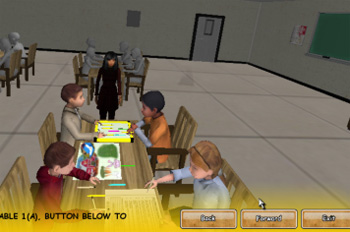
Other Aten titles, such as this classroom simulation, use virtual environments to educate users.
It’s that price point, Vaidhyan said, that’s keeping good serious games out of the fields of education and corporate training — but it’s also giving companies like his a unique opportunity.
“We’re able to get down to that and have a team and a framework where we can churn out these virtual environments at one-fourth or one-fifth of the cost that these gaming companies would take to create some of this,” he said. “One of the things that has kept us going in this field is the fact that we’ve brought ourselves to an attractive price point that can easily scale.”
Particularly in the case of 3-D gaming, some companies charge up to $250,000 just to license their game engines, or the software infrastructure that forms the foundation for different titles. The engines Aten uses, by comparison, can range from $1,500 to free.
For the average consumer, Vaidhyan said there’s a lack of good content on the market.
“The games that I’ve seen out there have been either gaming companies bringing them out themselves — which means commercially they’ll look good, they’re great games, but do not involve a lot of educational research background or aspects. Or, purely educational games that are boring,” Vaidhyan said.
He points out that demand is so high that teachers are learning to adapt existing games — like the multiplayer online role-playing game World of Warcraft — to their needs in the classroom.
But that dichotomy also presents a challenge for companies like Aten, which must balance a fun experience with applied learning.
“Where we could have a blend of this is where we can have success,” he said.
To do that, Aten pairs experienced game designers with experts from whatever field the title is trying to teach. The result should be what Vaidhyan jokingly termed “stealth learning.”

This Aten racing title requires players to learn more about car mechanics and engineering before modifying their vehicles.
“A successful education game is one where the user or the children don’t even know it’s educational,” he said. “They say it’s just another game.”
And like their commercial counterparts, serious games aren’t just for children.
Virtual Heroes, a serious gaming company also based in the Triangle, recently partnered with the Duke School of Medicine to develop a 3-D training game for the emergency room.
Aten’s also working on working with a major pharmaceutical company to create a simulated environment of their assembly line, allowing for virtual hands-on training without the risk.
“We have made it so simple for them that their assembly line workers can train themselves by pulling it out of their learning management system,” Vaidhyan said. “Here, they’d be doing exactly what they’d be doing on an assembly line, except they do it on a computer.”
Future corporations and classrooms could even implement a tracking component of the training and education module that would allow them to identify shortfalls — whether it’s a step of the production process or a mathematical concept.
“From a management perspective, you’re able to say, ‘This person is not getting this particular aspect,’” Vaidhyan said. “The management can give that person an individualized training.”
And solving the problem could happen almost instantly.
“You can give them formative feedback right in the virtual environment itself,” he added.
Outside the virtual environment, users of these technologies are learning something even more valuable — whether the game is serious or shoot-em-up. That’s another lesson Vaidhyan’s gleaned from his son, who often consults classmates when he’s stuck on a tough level.
“They are being forced to share best practices. They are talking to each other, figuring out how someone else is doing it and applying it,” Vaidhyan said. “That’s very valuable in the corporate world.”

Serious Gaming at Sigma Xi
Sunday, May 30, 2010, 10:33 pm No Comments | Post a CommentLast week I went to this season’s last American Scientist pizza lunch at Sigma Xi featuring Phaedra Boinodiris (Twitter, blog), Serious Games Product Manager at IBM.
I first saw Phaedra Boinodiris speak as the opening speaker at TEDxRTP (my review) back in March, but this was a different kind of talk, geared more towards scientists and science communicators.
I remember playing Pong when it first came out. I remember spending many hours back in 1980 or so playing The Hobbit on Sinclair ZX Spectrum. And I played many games at arcades (still not knowing which games started out as arcade games adapted to computers and which the other way round). Then I quit playing games for a couple of decades until my kids were ready for them. I loved Zoombinis - an amazing game of logic and a brilliant preparation for taking IQ tests! I loved Richard Scarry’s Busytown - the one and only game I know about infrastructure, where players build stuff and deliver it to others for the good of the town - from baking bread to paving roads - learning along the way how those things are done.
And sure, Phaedra Boinodiris started with a slide depicting Pong (to the chuckle of the audience) but soon got into the real stuff - the serious gaming and the story of how she got involved in developing such games, as well as about studies of gaming and how different kinds of games help develop different real-work skills, from eye-hand coordination to leadership to cooperation. Her first game - INNOV8 - was developed as a prototype, a proof of concept, in only three months and instantly became a huge hit. It is used by businesses and business schools around the world to teach Business Process Management. It is essentially a first person shooter game (without guns) in which the player is brought as an outside consultant into a company where s/he has to figure out the flow, the bottlenecks, etc. (including by interviewing employees, as well as data-sheets) and experiment in making it more efficient. The 2.0 version came soon after, adding such problems as traffic, customer service and supply chains.

The next game, recently announced and coming out in October 2010, will be a Sim-City-like serious game CityOne, designed to help city planners, town councils, citizens, and engineers plan better, more efficient infrastructure for their cities. Put in your city’s specs and start building new infrastructure, see how much it will cost, see what problems will arise, see what solutions are available - probably something you could not have thought of yourself and may be surprised.
As I am currently reading ‘On The Grid’ it occured to me that the developers of CityOne should read that book, and that Scott Huler should be given a test-run of the game, perhaps for him to review for Charlotte Observer and Raleigh News&Observer and the local NPR station. And for Science In The Triangle, of course.


