
Local technology drives mobile medical sim
Monday, March 14, 2011, 11:50 am No Comments | Post a Comment
Watch Virtual Heroes developer Juan Collado demonstrate HumanSim on an iPad. | Video by Tyler Dukes
As he piloted his Army Apache toward his landing zone, Jerry Heneghan knew he was in trouble.
Without warning, one of his helicopter’s twin engines began belching flame into the night sky, threatening to set the entire aircraft ablaze. Without thinking, he acted in the pitch black of the cockpit, flipping switches by feel and following procedures as he’d done hundreds of times before. There was no hesitation, no surge of adrenaline.
At least until he landed.
“It was only afterwards when I got the aircraft on the ground that I was like, ‘Oh my God, what just happened? I could have turned extra crispy up there,’” Heneghan said.
His survival had nothing to do with good fortune. Before ever stepping foot in a $20 million cockpit, he underwent an intensive training regimen that spanned a gamut of learning techniques from low-tech cockpit posters to full-motion flight simulators housed in gymnasium-sized facilities.
“I know that being in a simulator for thousands of hours over a 15-year career saved my life,” he said. “The time that I should have been most panicked, I was very calm.”
Heneghan, now the managing director of Raleigh-based game developer Virtual Heroes, is out to bring that simulated training approach to doctors, nurses and even combat medics. And he wants to put this training in their pockets. By building on local gaming technology and medical expertise, Virtual Heroes’ upcoming HumanSim aims to allow medical professionals at all levels to hone their skills almost anywhere — whether it’s on the iPad or the PC.
“It doesn’t matter what platform we want to deliver the content on, same thing,” Heneghan said. “We want to prevent needless, dumb errors, we want to increase patient safety, we want to ultimately make people in the health care profession more proficient.”
And there’s growing scientific evidence that such training methods may mean better care for patients.
UNREAL REALISM
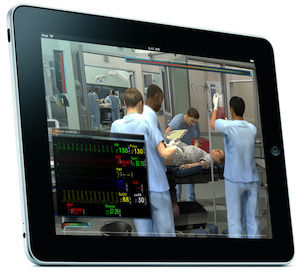
HumanSim, a medical training simulation by Virtual Heroes, will track performance as medical professionals play. | Image courtesy of Applied Research Associates
To get this kind of value out of a video game, Heneghan’s team set out to create a title that could match the graphics capability of today’s top commercial games. That’s a difficult proposition for a smaller developer like Virtual Heroes, which has about 40 employees in its Raleigh office.
It’s not just about making HumanSim look pretty. Without a high level of fidelity, developers wouldn’t be able to replicate the nuances necessary for an accurate medical scenario.
“It’s not like a lot of games where you push a button and some abstract animation happens,” Heneghan said. “We actually have to stick a needle in an arm or open up an eye and see the pupils dilated. It’s got to be pretty crisp.”
That’s where Cary-based Epic Games comes in. Using Epic’s Unreal Engine — the same software that powers blockbuster titles like Mass Effect, Gears of War and BioShock — Virtual Heroes designers can layer their own technology and gameplay on top without worrying so much about issues like rendering, networking and cross-platform development.
“We don’t necessarily want to solve those problems,” Heneghan said. “We’re using their technology to springboard so we can do what we consider the things we’re excited about.”
The company’s relationship with Epic meant it was one of four or five studios to get access to the development toolkit for the iPad, iPhone and iPod Touch — even before Epic released its first mobile title, Infinity Blade, on Dec. 9. Virtual Heroes is now using that technology to develop HumanSim for Apple’s mobile devices and is hoping for an iTunes release in December.
Heneghan said he’s already seeing demand for applications like these, especially from those who aren’t always close to an average PC.
“The military is asking for content across all these platforms, including iOS, iPod Touch, iPad,” Heneghan said. “Maybe they’re flying on a C-17 somewhere. They can be training while they’re sitting there in the seat.”
CREATING ‘VIRTUAL HUMANS’
By using Epic’s technology as a foundation, Virtual Heroes created character models that go beyond good aesthetics. These “dynamic virtual humans,” in company parlance, are powered by a separate physiology engine layered in clothing or armor, skin, muscles and organs.
“Each little virtual human is the equivalent of an airplane in a flight simulator,” Heneghan said. “It’s a complex series of algorithms and models.”
And unlike medical mannequins, Heneghan said the software can scale up easily. One of his programmers was able to load 800 virtual patients in a triage scenario on a quad-core processor — the same sort of chip consumers buy with ordinary desktop computers.
“Every patient that you walked up to had a different set of vital signs, different conditions, whether they were in shock or had a traumatic amputation,” Heneghan said. “As a triage person, you’ve got to quickly make assessments on who’s green, who’s black and who gets moved somewhere else.”
Whether it’s one virtual patient or 100, medical trainers would have fine-grain control of the 120 parameters that dictate the inner workings of each patient’s cardiovascular, drug transport and gas transport system.
“You’re setting up a patient that will react in a specific way,” said Rachel Clipp, a biomedical researcher with Virtual Heroes. “It’s patient-individualized to a degree, and then you have mathematical equations that represent each system.”
With the help of seasoned medical professionals from Duke University, Virtual Heroes is also running the simulations to ensure the reactions of these virtual patients reflect reality.
“We want to make sure to the greatest extent possible that there is real science behind the content we’re producing,” Heneghan said. “It can be validated, it can be tested. And to the greatest extent possible, we’re modeling human systems.”
GRADING VIRTUAL LEARNING
Making sure virtual patients bleed like we bleed is important, but what doctors really want to know is whether this virtual training is truly effective. Finding out is Dr. Jeff Taekman’s job. The director of Duke University’s Human Simulation and Patient Safety Center completed a study examining how previous versions of Virtual Heroes software size up to lectures and mannequin training when it comes to skills like teamwork and communication.
The study has not yet been published and the results aren’t available, but Taekman says the evidence shows promise for games-based learning.
“What we’re finding is that long-term changes in behavior [with virtual training] are much more effective than lecture-based,” Taekman said.
If this evidence continues to grow, Taekman said games like HumanSim can speed up the time it takes for medical discovery to become medical practice — and keep doctors and nurses up to date.
“The reason why games are more effective is that they’re interactive,” Taekman said. “With the lectures, they’ve been a mainstay for a long time, but they’re just not going to cut it anymore.”
There are still plenty of drawbacks with medical training on devices like the iPad. Taekman points out that a medical professional’s motor control, or sense of touch, would be slowest to develop in a virtual environment. But when used in tandem with other training techniques, he says the profession would gain a valuable weapon to fight medical mistakes.
“I don’t think games-based learning is a replacement for what we’re doing,” he said. “It’s an addition to our library of tools.”
And Heneghan agrees.
“Certainly it’s not a silver bullet, and it doesn’t solve all the problems, but we think it’s a necessary, currently unmet market need that’s out there,” Heneghan said.
As an iPad user himself, Taekman says similar devices hold enormous potential for the field — he already uses his to review everything from medical literature to clinical information. And despite medicine’s traditionally conservative nature, he said embracing these virtual environments may one day be a valuable solution for managing the rapid expansion of information that guides every doctor’s actions.
“As the haptics get better and we get closer to the fidelity of the real world, we can consider doing all our training in these environments,” Taekman said. “That’s a long way away.”
Until they get there, Heneghan said his team will keep refining HumanSim to help medical professionals learn to save lives the same way he learned to save his own.
“If you prevent one unnecessary major boo-boo from happening, the software pays for itself,” Heneghan said. “People get that.”
Tyler Dukes is a freelance reporter and journalism adviser at N.C. State University. Follow him on Twitter as @mtdukes.


