Posts Tagged ‘BIO2011’

The BIO message: India, China, Brazil are on the move
Friday, July 8, 2011, 10:49 pm No Comments | Post a CommentForget about the Bay Area and Boston. North Carolina’s Research Triangle, anchor of the third largest U.S. biotech hub, needs to look beyond continental shores if it wants to measure itself against some of the most innovative regions in the world. In China, India and Brazil, emerging biotech industries are stirring restlessly.
This came across so loud and clear at BIO 2011, the international biotechnology convention that from June 27 to June 30 brought companies, economic development recruiters, lobbyists and analysts from across the world to Washington, D.C., the message took on a measure of self-evidence.
The annual state-of-the-industry report, which Ernst & Young presented at the convention, provided supporting numbers:
- $61 billion, China’s drug market, which ranked second behind the U.S. last year and is projected to double in size by 2015.
- $1.8 billion, Brazil’s share of global investments in biofuel production last year. The U.S. ranked second and Europe was third.
- 70 percent to 75 percent, developing countries’ projected share of worldwide deaths from heart disease, stroke and diabetes in 2020.
- 25 percent, amount by which research and development investments in U.S., Europe, Canada and Australia decreased in the past two years.

Fareed Zakaria
What is happening, commentator and book author Fareed Zakariah said, is that “the landscape of innovation is shifting around the world.” Zakariah moderated a panel discussion with experts from India, Malaysia and China at BIO to explore the situation in those countries. Hundreds of BIO attendees came to listen.
To set the stage, Zakariah explained how the U.S. became the nation that sent the first man to the moon, developed vaccinations for childhood diseases such as polio and invented the personal computer.
In the 1920s and 1930s, Germany was the most innovative country, he said. During and after World War II, some of the brightest and most talented German scientists, many of them Jews, were part of a mass exodus that headed for the U.S.
“The U.S. benefited enormously from this inflow of talent,” Zakariah said.
The Immigration and Nationality Act of 1965 opened America’s gates to a similar mass inflow of talent from Asia. Buoyed by generous funding of basic sciences, nascent companies and public university systems during the Cold War, the U.S. became a worldwide dominating innovation power. But in the 1980s, the rest of the world started to catch up, Zakariah said. Economies developed, incomes and living standards rose - first in Japan, then in Singapore, Hongkong, South Korea and Taiwan, also known as the four Asian tigers, and most recently in India and China.
In the U.S., the housing market collapsed and the banking industry faltered. Research and development jobs started to move to low-cost countries, where many U.S. manufacturing jobs had already gone. Rising incomes and demand in developing countries convinced companies to pay more attention to consumers there.
“Now we face the question: Where does the U.S. go,” Zakariah said.

Anula Jayasuriya
Companies like the manufacturer that sells its portable EKG machine in India for a fraction of the price General Electric charges for its EKG machines is driving frugal innovation, said Anula Jayasuriya, an Indian life science investor and a member on Zakariah’s panel.
The Indian manufacturer is considering bringing its portable EKG machine to the U.S., Jayasuriya said.
Health care problems will be solved where the need is biggest, which is in developing countries, said Georg Baeder, Asia life science business leader of the strategic consulting group Monitor and also a member on Zakariah’s panel. And at costs that are customary in developing countries.

George Baeder
The Chinese government is spending about $125 billion to upgrade and stimulate life science research. In India, the government is trying to help early stage companies. In Singapore, the government is expected to invest $12.5 billion on life science research innovation over the next five years, according to the Ernst & Young report.
And about 80,000 researchers and entrepreneurs who left China for a college education in the U.S. and Europe are returning to China, Baeder said.
A score card that Scientific American magazine developed for BIO in concert with the biotech industry’s trade organization showed that China, India, Brazil still have some catching up to do before they become serious challengers to a still dominant U.S. But a ranking of the top 48 countries capable to generate innovation in biotech worldwide, the score card lists Singapore ninth, Malaysia 28th, China 30th, Brazil 42nd, and India 44th.
Biotech innovation: What isn’t funded
Tuesday, June 28, 2011, 11:35 pm No Comments | Post a CommentInnovation capital, money to turn some of today’s most innovative discoveries into tomorrow’s medical treatments, is getting so scarce in the U.S., politicians, economic developers and entrepreneurs in regions specializing in early stage biotech research and development are scrambling.
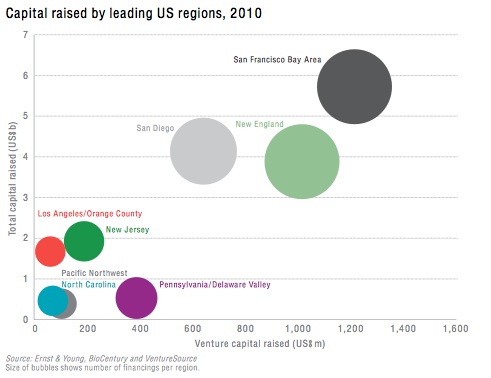
North Carolina, a hub for young biotech companies, trailed other U.S. biotech hot spots in venture capital raised last year, according to an Ernst & Young report.
North Carolina’s Research Triangle, the third largest U.S. biotech hub, is one of those regions.
Some of the world’s largest R&D companies have operations in the Triangle, including GlaxoSmithKline, Novartis and Bayer. But the lifeblood of the area has long been young, early stage companies in pursuit of ideas developed at local research universities such as Duke University, the University of North Carolina at Chapel Hill and N.C. State University or hatched by researchers who used to work in corporate labs in Research Triangle Park.
A little more than two years after a deregulated U.S. banking industry stumbled in the fall of 2008, investors are increasingly shying away from early stage biotech companies, a high-stakes, high-rewards gamble in the best of times. Innovation capital is drying up in the U.S., according to a 2011 report the U.S. accounting firm Ernst & Young published this month.
One consequence, a Research Triangle venture capital investor said, is “deals are dying on the vine.”
“More and more small, really good startups are having problems finding money,” said Norris Tolson, chief executive of the N.C. Biotechnology Center. “We’re about the only game in town for early stage biotech companies.”
The biotech center, which offers grants and loans up to $250,000, has seen the number of funding requests increase by about 10 percent, Tolson said. In the past year, about 280 applicants asked for financial support. About 130 were approved.
Traditionally, young biotech companies have relied on private investors, often venture capital investors, to kick their R&D into gear.
U.S. biotech companies raised $5.5 billion in venture capital in 2007, about twice as much as in 2000, according to Ernst & Young. But in the past three years, the amount has stagnated at about $4.5 billion annually and venture capitalists have begun to hold money back until companies reach certain milestones.
Total capital raised by biotech companies in the U.S. bounced back to $20.7 billion last year, from about $13 billion in 2008, according to Ernst & Young. But much of that capital went to mature companies. Young, early stage companies, which work on the most innovative technologies and generate more jobs than large, established companies, actually received about 20 percent less in capital than the year before.
In Europe, capital raised was more evenly distributed among startups and mature companies. In Singapore, China and India, governments are ratcheting up efforts to bolster biotech innovation. And in Latin America, Brazil’s already strong agricultural biotechnology sector is gaining attention.
But politicians, economic developers and university administrators in the Research Triangle have come up with ideas to encourage the formation of R&D startups despite the early stage funding crunch
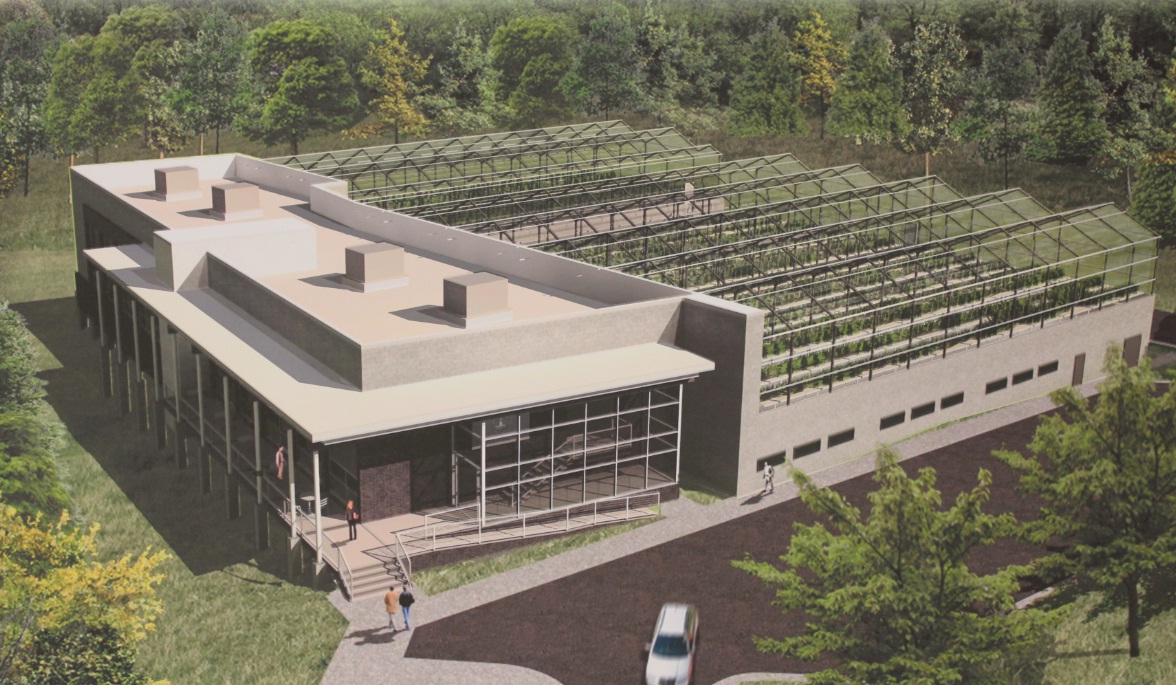
The planned Alexandria Ag-Tech Center.
The biotech center teamed up with Alexandria Real Estate Equities, a Pasadena, Calif.-based real estate investment trust, to attract young companies working in agricultural biotech research. Alexandria, which already owns lab buildings in the Triangle, will build a $13.5 million business incubator with about 18,000-square-feet of greenhouse space near RTP.
Several universities and the Council for Entrepreneurial Development are working with the charitable arm of the Blackstone Group, a global investment firm, to turn more technologies developed at universities into companies and bolster the Triangle’s existing entrepreneurial network.
The chancellors at UNC-CH and NCSU have set up innovation funds to further support spinoffs.
And state legislators are again considering establishing a nonprofit that can loan young companies money. The legislation has come up twice before and would use about $100 million an out-of-state investor is willing to provide, Tolson said. Initially, only life science companies could benefit, but recently state lawmakers suggested that information technology and green technology companies should also be included.
“There’s a huge need for startup capital across the U.S.,” Tolson said. In North Carolina, “a lot of people are understanding the need.”


