
North Carolina adds another renewable to its energy sources
Tuesday, May 3, 2011, 10:56 pm No Comments | Post a Comment
Wind turbines
North Carolina is on the way to become a state with one of the largest photovoltaic solar farms and one of the largest wind farms in the U.S.
The N.C. Utilities Commission Tuesday approved plans of a Spanish company to build up to 150 turbines, each about 400 feet tall, near Elizabeth City in the northeastern corner of the state. If the $600 million project gets the necessary federal, state and local permits, it will be another large source of renewable energy that is produced in North Carolina.
About 270 miles west of Elizabeth City, near High Point, construction of the final phase of a $173 million solar farm with 63,000 photovoltaic panels is under way on about 200 acres.
The electricity the two projects are expected to generate - enough to provide power to about 62,000 homes per year - would become part of the energy blend that residential, commercial and industrial consumers in the state already receive from the power grid. The utilities commission has been goosing North Carolina power companies and cooperatives for three years to add energy generated from renewables to the mix.

Steve Kalland
This regulatory pressure and industry incentives are key to successfully reduce America’s dependence on oil and lower the amount of harmful greenhouse gas emissions, Steve Kalland, executive director of the N.C. Solar Center, said during a recent meeting of the Triangle Area Research Directors Council in Research Triangle Park.
“It’s not a technology question anymore,” Kalland said. “Financing and regulatory are the two biggest barriers to move technologies forward.”
Energy from renewables is still more expensive than energy from traditional sources, such as oil and coal, Kalland said, but oil prices are going up and the price for green technology is coming down. “The trendlines say time is working in our favor.”
For the second time in three years, crude oil prices are above $100 a barrel and gas prices at the pump are closing in on $4 per gallon. Meanwhile, the cost to get solar panels installed in North Carolina has dropped 49 percent since 2007.
“Everytime oil goes up, we get a policy opportunity,” Kalland said. What he means by that is legislation that supports renewable energies, particularly federal legislation that deals with the differences in regulations from state to state. “Fifty states have 50 regulatory commissions, it’s something that cries out for federal intervention,” he said. But an array of special interests have so far foiled attempts to get anything done nationally.
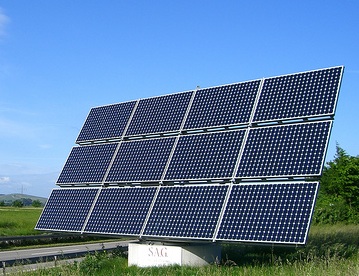
Photovoltaic solar panels.
The North Carolina legislature has done more for renewable energy supporters.
In 2007, state lawmakers established renewable portfolio standards that the utilities commission tracks by making power suppliers file compliance reports. The standards say that by 2021, 12.5 percent of the energy that investor-owned utilities like Duke Energy supply must be generated from renewable sources. Solar, wind, biomass, tidal energy, landfill gas, swine and poultry waste all qualify and consumers must pay for part of the costs.
North Carolina is one of 32 states with such standards, according to information collected by the U.S. Department of Energy.

Swine waste.
For several years, the state has also offered a 35 percent renewable energy investment tax credit as an incentive to install solar, wind, geothermal and other renewable energy technology. Last year, the legislature added a tax credit for businesses and homeowners who install combined heat-and-power systems. CHP systems are up to twice as efficient than traditional heating and cooling systems.
If 20 percent of U.S. households installed CHP systems by 2030, the amount of energy consumed by U.S. households would be cut in half, the U.S. Department of Energy estimated.

Wood biomass
The carrot-and-stick approach has boosted the number of solar water heating installations and photovoltaic installations in North Carolina, ranking the state in the top 10 nationwide. In 2010, more than 100 solar energy companies operated in the state, employing more than 1,500, according to a report by the N.C. Solar Center.
The N.C. Sustainable Energy Association estimated that last year about 12,500 job in North Carolina were green.
SunEdison completed construction of the photovoltaic farm near High Point in January. Duke Energy has a 20-year contract to buy all of the power generated by the farm - about 17 megawatt, or enough to supply 2,600 homes per year.

Wave energy.
The wind farm that the U.S. subsidiary of the Spanish Iberdrola Renewables wants to build on about 20,000 acres in northeastern North Carolina is projected to produce up to 300 megawatt, or enough to supply 60,000 homes per year. The wind farm could start operations as soon as January 2013.
There’s potential for more to come off the coast.
A 9-month feasibility study that the University of North Carolina published in 2009 recommended that North Carolina pursue wind energy production aggressively. The study looked at locations offshore and in the Pamlico and Albermarle sounds and found 2,800 square miles within 50 miles of the coastline particularly well suited and worthy of further investigation.
Hurricanes are a threat to offshore wind farms, Kalland acknowledged during his TARDC talk. But insurance companies have no problem insuring the turbines.


