
Brainweek@Duke: Following the tracks of autism and anorexia
Wednesday, March 17, 2010, 1:15 pm No Comments | Post a CommentHow can honeybees help us better understand neuropsychiatric diseases such as autism, schizophrenia or anorexia?
A beehive functions like a fine, Swiss clockwork. Worker bees collaborate seamlessly. Why? Partly because they’re all closely related. That means, social skills must be hard-wired in honeybees. But is that also true for other animals?
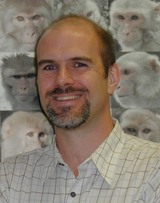
Michael Platt
Experiments that involved monkeys and Duke University students suggest so. Michael Platt, director of Duke’s Center for Cognitive Neuroscience, presented some of the results Tuesday during a lecture that was part of Brain Awareness Week, a research showcase the Duke Institute for Brain Sciences is putting on for the first time.
A better understanding of how genes, brain cells and learning are connected could lead to better and more individualized treatments of neuropsychiatric diseases, said Platt, who is already collaborating with physicians treating anorexia.
“That’s one of the potential hopes,” he said. “But we’re a long way off.”
Questions about hard-wired and acquired social skills, which are central to the argument of nature versus nurture, have driven researchers for thousands of years.
Experiments in which babies were socially isolated for years to study how language is acquired go back more than 2,000 years. Some of these social deprivation experiments had severe consequences. Able-bodied children who missed hearing human voices during a critical period of their development never learned to speak.
More recent experiments that did not harm the children suggested that babies are born with the ability to interpret facial features. A newborn’s vision is pretty fuzzy, but she has a clear picture of her mother’s eyes, nose and mouth from about a foot away, which is where her mother’s breasts are.
A study that was published in February in the Proceedings of the National Academy of Sciences went a step further. The study results suggested that oxytocin, a hormon that induces labor and stimulates the production of breast milk, may help people with Asperger’s Syndrome, an autism spectrum disorder.
Experiments researchers run in Platt’s lab study the basic building blocks of social behavior and their underlying biology. Study results include measurements of brain activity in macaque monkeys and Duke students while the study subjects responded to social cues.
One experiment let macaques gamble on getting large or small squirts of juice and measured how their brains responded to feelings of success and regret.
Measurements of the monkeys’ brain activity showed that the same neurons sprung into action when they picked correctly and got a large squirt of juice and when they were shown where they would have received a large reward had they not missed.
Another experiment involved 20 male and 20 female Duke students and measured how the students evaluated images of attractive members of the opposite sex. The students could choose an image or the sound of money pouring into a slot machine. Results showed that male students were more motivated by images and female students by the sound of money. But whatever the students were attracted to, as long as they valued it more their brain response increased.
Platt also talked about the natural and intuitive ability of people and monkeys to follow the gaze of others. Neurons that control muscles get active when monkeys see an image of another monkey gazing one direction or another, according to a study published in the Proceedings of the National Academy of Sciences.
In people, the inability to follow another person’s gaze and read where their emotions are directed is a telltale sign of autism. A study that involved researchers from Duke and the University of North Carolina at Chapel Hill found biological underpinnings in the parts of the brain involved in gaze processing.
More on nature versus nurture:


