
Engineering for Better Wastewater Treatment Results
Sunday, December 26, 2010, 3:02 pm 1 Comment | Post a Comment
Wayne Flournoy, president of Entex Technologies
A few weeks ago, I reported on water quality expert Kenneth Reckhow’s concern that we will be unable to achieve water quality standards set by states in response to the Clean Water Act. Municipal water treatment plants have been improved “to the limits of technology,” he said, and additional cleanup was going to have to happen with somewhat unlikely changes like limiting development, changing farming practices, and prohibiting lawn fertilizers.
Last week, I had the opportunity to discuss the challenges of cleaning wastewater from the perspective of an entrepreneur who has been working with municipalities and industry to improve treatment plant performance. Wayne Flournoy is cofounder and president of Entex Technologies, a Chapel Hill company that designs systems for upgrading wastewater treatment plants or for new plants.
Flournoy gave me a quick and revealing introduction to the history of wastewater treatment. Essentially, every system designed since the British began treating water in the nineteenth century uses some form of microorganism or “beneficial biomass” to clean contaminants out of water. Those contaminants are primarily carbon, nitrogen and phosphorus, which Flournoy pointed out are nutrients in agriculture or horticulture but contaminants when they run off into water.
Typical treatment plants grow the waste-eating microorganisms in aerated tanks, settle them out, and concentrate them into what Flournoy calls “ a slurry of microorganisms or beneficial biomass.”
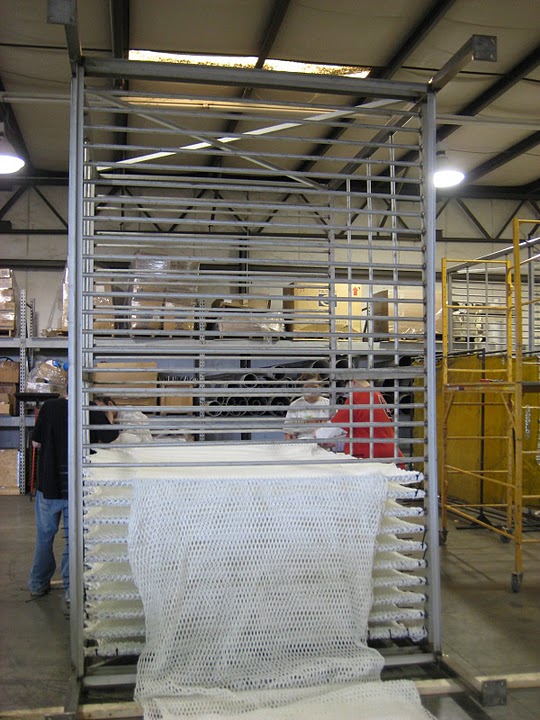
Wastewater treatment module using bioweb, a substrate that looks like a soccer goal, is able to clean more contaminants from water than traditional systems.
If you can enable your system to sustain a larger mass of “biology,” your system will be more efficient. That’s what Entex does. It provides two substrates that allow more of the beneficial microorganisms to grow and that allow them to stay in the treatment tanks longer. One, BioWeb, is a fabric that looks much like a soccer net, which Entex licenses from its manufacturer, and the other, BioPortz, is a floating medium that looks a lot like rotelle pasta. It’s all about “creating an environment that the right kind of biology likes,” said Flournoy. He added, “The real magic is . . . in manipulating the microbial environment to maximize the beneficial biology while minimizing the nuisance organisms.”
Systems designed with these media can host more biomass and therefore process more wastewater in the same amount of space. They can also provide enhanced levels of treatment, that is, getting a greater percentage of the contaminants out.
Aside from potentially doubling the amount of waste a plant can handle, it turns out that the ability Entex technology to keep the microorganisms in the treatment tanks longer has some additional benefits. Flournoy told me about an Owens-Corning plant in Ohio that needed to remove color dyes from its wastewater, and about a pilot project in Durham for removing a class of drugs called endocrine disruptors that arrived in sewage. These and other pharmaceutical compounds often arrive in treatment plants after being flushed or washed down the drains in households-sometimes as part of human waste and sometimes in as a result of efforts to dispose of surplus drugs.
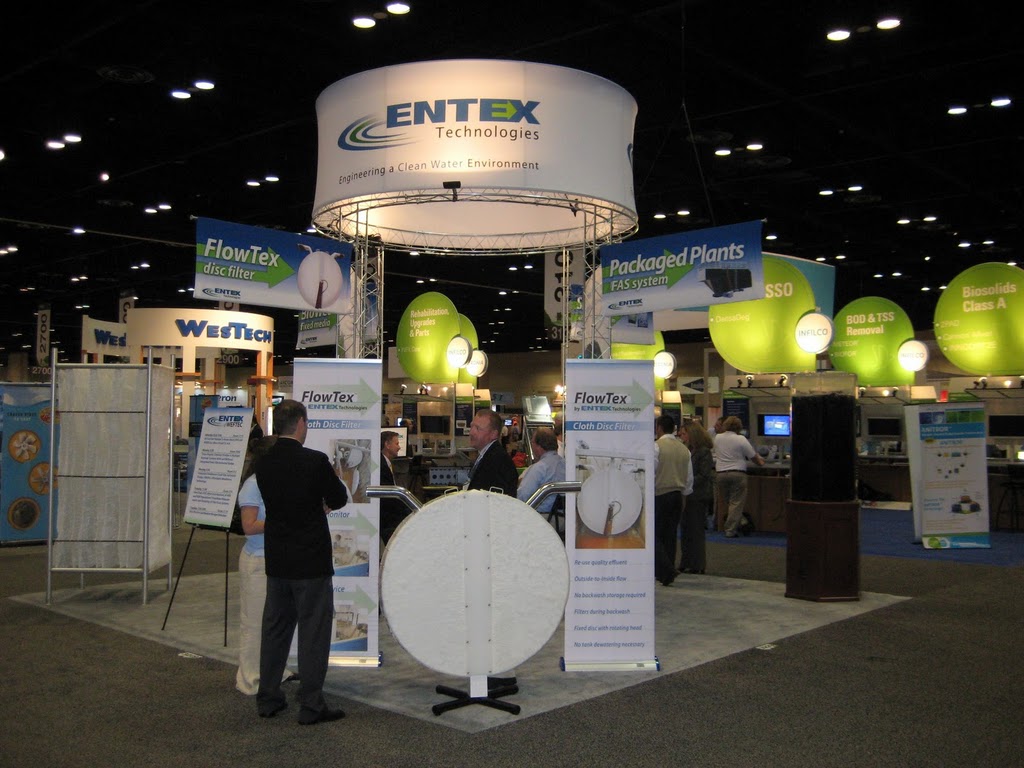
Entex Technologies showcases FlowTex and other products at the 2009 Water Environment Federation Technical Exhibition and Conference
In both cases-the color dyes and the pharmaceuticals-the ability to keep the biomass sludge in the tanks for longer periods of time helped accomplish the goals. The Durham project, done in collaboration with Duke engineering professors Andrew Shuler and Claudia Gunsch and funded by the North Carolina Biotechnology Center, is important as greater attention is paid to pharmaceutical byproducts that arrive in our water treatment plants. Traditional technology does not remove those compounds. At the moment, they are not regulated, but Flournoy said, “I have no doubt that that will become an issue.”
I asked Flournoy what was the next big thing in wastewater treatment. His response was an echo of Kenneth Reckhow’s statement that we’ve reached “the limits of technology” on wastewater treatment. “To reach low levels of nitrogen,” Flournoy said, “you can’t do it all biologically.” Entex has exclusive rights to a cloth filter that they are marketing in a product called FlowTex for even more thorough removal of contaminants. It’s part of Entex’s plan to grow into a bigger company poised to handle evolving challenges in water treatment.
Entex was incorporated in 2004 and has eight employees, all with a science or engineering background. In October, it was named one of 25 North Carolina Companies to Watch by CED.


Interesting piece. Topic is taken for granted.