Archive for the ‘Events’ Category

“Doctor Bugs” visits the Triangle
Wednesday, October 20, 2010, 11:11 am No Comments | Post a Comment
Cover of the Adventures Among Ants, by Dr. Mark W. Moffett.
Not many scientists beg perfect strangers to eat the species they study. But that’s just what “Doctor Bugs” did when visiting tourist-magnet ruins in Cambodia. Dr. Mark W. Moffett proffered a dish of scrumptious crackers topped with herbs and, um, plump ant larvae to passersby — at times literally pleading with them to try it. It’s just one of the ways the world-famed ecologist, and Smithsonian Institution research associate, gets people to stop and notice the trillions of ants that share our world.
Moffett’s comedic showman personality was on display in full force on Tuesday night as he entertained an auditorium full of people at the N.C. Museum of Natural Sciences with stories about ants. And boy does he have stories. There’s the time he snaked a small camera attached to a long cable into a nest of weaver ants, capturing engaging footage of the ants at work… the camera pushed farther and farther past hundreds of ants, until ants swarmed the other end of the cable and overran him. The footage ended abruptly with audio of Moffett yelping in pain. Then there’s the time he stepped barefoot on a pair of ant forceps in his camp and spent the day worrying he’d been bitten by a poisonous snake, a fair concern considering there was a nest within a foot of his hammock. And let’s not forget the time he actually did sit on the world’s most poisonous snake in South America, too engrossed with photographing ants to notice.”If you must sit on a poisonous snake, sit closest to their head,” Moffett deadpanned to the crowd. “It’s the best way. It’s the only way.”

National Geographic cartoon of Moffet squatting on a pit viper.
More often, Moffett’s stories are about the ants themselves — their diverse ways of sensing the world, interacting, and divvying up labor to achieve survival goals efficiently. Moffett’s high-energy slide show was centered around promoting his new book, Adventures Among Ants: A Global Safari With a Cast of Trillions, published by the University of California Press.
“Ants differ from us in that the individual doesn’t matter, it’s all about what’s good for the group,” Moffett said. But they’re colonies are a lot like our cities, he went on to explain, drawing analogies between small cities/small ant colonies and large cities/large ant colonies. In smaller colonies, where there is less specialization of labor, each ant has to be a jack-of-all-trades and perform a variety of tasks.”They have their toolboxes built-in to their faces,” Moffett said, flashing a picture of a type of trap-jaw ant with extra long pitch-fork tipped jaws. It uses the long levers to pick up struggling prey and carry it safely back to the nest. But a much smaller, second pair of jaws tucked closer to its mouth allows it to eat.
Larger colonies, like our larger cities, tend to have more job specialization, Moffett said. Scientists can often tell what role they play by their size. Sometimes the largest ants of the same species outweigh the smallest ones by 500 times. The goliath ants are often used to deliver the death blow (a sting, or a bite) in battles with other ants or interlopers, and even act as “school busses,” allowing smaller ants in their colony to hitch rides. “Basically, it’s more energy efficient for the colony if the smaller ants ride on the bigger ants,” Moffett explained.

Leaf cutter ants cooperate to bring leaf fragments to their underground nests, where "gardener" ants cultivate a fungus upon the decaying vegetation. The colony harvests and eats the fungus. (Photo by Dr. Mark W. Moffett)
He also talked about various ways that ants work together, like the free-diving ants in Borneo that live in pitcher plants. They fetch crickets out of the water pooling in a pitcher’s basin, then haul it to the lip of the pitcher where they stash it and have a feast. The crickets are often too large for the pitcher plants to digest, he explained, so the ants are doing the plant a favor by saving it from experiencing an overdose of acid as the cricket decays. “They’re basically antacids for the plant,” Moffett joked.”But they also must have the strongest toes in the world to carry these large crickets up the slope of the pitcher plant, which is made so that insects will fall into its trap.” Ants also form chains to create living bridges that they use to cross from one tree to another high amid the canopies of rainforest trees, hundreds of feet from the forest floor. And some ants will sacrifice themselves to fill “pot holes” along highways the colony uses to move things to and from their nest. Then there are the leaf cutter ants, which divvy up leaf harvesting and fungus cultivating duties like nobody’s business (see photo at right).
Moffett’s photographs have been widely published and he often contributes work to National Geographic magazine. He searches for images that tell a story within their frames, he said, like the one he took of a battle between two ant species that shows a Goliath ant fending off attacks from smaller ants, with the carnage of warfare in the background: headless ants frozen mid-stride, and ants with their torso’s chopped in two and legs torn asunder. He encouraged the kids in the audience to “not lose that weird point of view you have when young,” because it can be valuable to being a scientist. He credits his own path to biology and entomology with reading too many Jane Goodall adventure books when younger, and climbing too many trees.
Moffett’s talk deftly distilled insights about ant ecology and social interactions into anecdotes that enthralled kids and adults like me who are in touch with their inner kids. If you missed his talk, you did miss out — but don’t sweat it, you can always order the book.
MORE MOFFET, LINKS:
Moffett on NPR’s Fresh Air; June 17, 2010
The hidden world of ants, Smithsonian Magazine; July 2009

‘Companies to Watch’ Honors 25 Job-Creating, Revenue-Producing Firms in N.C.
Tuesday, October 19, 2010, 1:03 pm 3 Comments | Post a CommentStartup companies make for good storytelling. Entrepreneurial lore is filled with tales involving a couple of college dropouts, a garage, and a Big Idea. Some of them fail, and some of them morph into industry giants.
But along the way from startup to giant, those companies go through a second stage of growth, during which they add employees and revenue but are still growing fairly quickly. It’s these second-stage companies that are the unsung heroes of North Carolina’s economy, according to Penny Lewandowski of the Edward Lowe Foundation. In 2008, the last year for which figures are available, 9.7 percent of the resident companies in the state were second stage, but they accounted for almost 35 percent of the state’s jobs.

Two science events in the Triangle: Fossil Penguins and Images of Darwin
Thursday, October 7, 2010, 2:45 pm 1 Comment | Post a CommentScience Cafe Raleigh - March of the Fossil Penguins
“Wednesday, October 20, 2010
6:30-8:30 p.m. with discussion beginning at 7:00 followed by Q&A
Tir Na Nog, 218 South Blount Street, Raleigh, 833-7795
RSVP to kateyDOTahmannATncdenrDOTgov
Penguins are familiar faces at zoos and aquariums, but they evolved long before humans. These fascinating birds have been around for more than 60 million years, during which they survived dramatic changes in climate, wholesale re-arrangements of the continents, and the rise of new mammalian competitors. Thanks to their dense bones, penguins have left behind a rich fossil record that we can use to trace their geographical expansion and morphological evolution. In this Science Cafe we will get to know some of the diverse cast of extinct penguins, including primitive species from the deep past, spear-billed penguins from Peru, and giants that would have towered over today’s Emperor Penguins.
About our Speaker:
Dr. Daniel Ksepka (blog) is a paleontologist at North Carolina State University and a research associate at the North Carolina Museum of Natural Sciences. His research focuses on reconstructing the evolutionary tree of birds and understanding the transition from aerial flight to underwater wing-propelled diving in groups like penguins and the now extinct plotopterid birds. Ksepka has traveled to South America and New Zealand to collect and study fossil penguins. He is the author of numerous scientific papers on penguin evolution as well as the science blog “March of the Fossil Penguins.”"
For the coverage of Dr.Ksepka’s latest paper, see How the Penguin Got His Tuxedo and Inkayacu – Peru’s Giant Fossil Penguin and the Stories Its Feathers Tell, Giant extinct penguin skipped tuxedo for more colorful feathers, How the penguin got its tuxedo and A fossil penguin gets its colours.
Watch Dr. Ksepka discuss his research: March of the Fossilized Penguins
Sigma Xi pizza lunch lecture: Images of Darwin and the Nature of Science
From Sigma Xi:
“Join us at noon, Tuesday, Oct. 19 here at Sigma Xi to hear NC State University evolutionary biologist Will Kimler talk about “Images of Darwin and the Nature of Science.” Prof. Kimler researches the history of evolutionary ideas in natural history, ecology, genetics and behavior.
Thanks to a grant from the N.C. Biotechnology Center, American Scientist Pizza Lunch is free and open to science journalists and science communicators of all stripes. Feel free to forward this message to anyone who might want to attend. RSVPs are required (for the slice count) to cclabby@amsci.org
Directions to Sigma Xi, the Scientific Research Society in RTP, are here “
What will ScienceOnline2011 be?
Tuesday, October 5, 2010, 7:51 am 3 Comments | Post a Comment ScienceOnline2011 is the fifth annual international meeting on Science and the Web. On January 13-15th, 2011 the Research Triangle area of North Carolina will once again host scientists, students, educators, physicians, journalists, librarians, bloggers, programmers and others interested in the way the World Wide Web is changing the way science is communicated, taught and done.
2010 has been an exciting year in science, in the developments of the Web, and in the media (including science journalism). The past year’s events, coupled with the growing reputation of our conference around the world, prompted us to make the conference bigger than last year: we expect as many as 500 participants to convene over the three full days of exciting discussions, conversations and events.
One of the most interesting developments in the second half of 2011 is the explosive growth of the science blogosphere, especially formation of new blogging networks (one of which will be developed by one of us). To help you navigate the new science blogging ecosystem, we started developing a website that aggregates it all in one place: Scienceblogging.org.
As in all the previous years, the meeting will be held in an ‘Unconference’ style - the Program is built beforehand with the help of participants on the wiki, and the sessions are designed to foster conversations and discussions rather than a more traditional lecture approach.
You can get prepared ahead of time and help us make the conference great by looking around the site, volunteering to help, or volunteering to lead sessions. You can also follow us on Twitter - either the hashtag #scio11 or our official account @scio11 - or join the discussion in our official FriendFeed room. You can help us get a feel for the number of people intending to attend by indicating your interest on our Facebook event page.
Superbug in the Triangle!
Sunday, October 3, 2010, 3:18 pm 1 Comment | Post a Comment Well, hopefully not the real MRSA in your home! But the book Superbug will be introduced to the audiences around here. Author Maryn McKenna (Twitter) will be in the Triangle this week.
First, on Wednesday October 6th at 7:30 pm, Maryn will be reading at my most favourite bookstore in the world - Quail Ridge Books in Raleigh. I’ll be there.
Then, next day, on Thursday October 7th at 7:00 pm, she will be going over to Durham to read/sign at The Regulator Bookshop. I may try to come to that again.
Join us if you are in town for one or the other or both events!
Block By Block
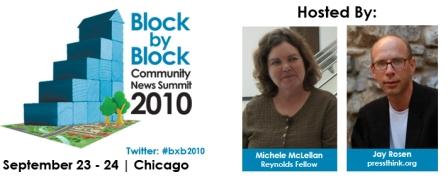
Saturday, September 25, 2010, 3:42 pm 3 Comments | Post a CommentThis Thursday and Friday I attended the Block By Block conference in Chicago, a meeting about local and niche online journalism.
The conference was organized by Michele McLellan (Twitter), a Reynolds Fellow, and Jay Rosen (Twitter), professor of journalism at NYU.
For various reasons (mostly personal and financial) I had to miss a number of interesting conferences this year, from Lindau Nobel meeting, through Open Summit in Berkeley, to Science Online London, but this meeting was worth the scramble and a tight-budget travel. Out of 120 participants, the only one I have met before in real life was Jay Rosen. But I knew a number of others from their online work - on Twitter, their blogs, their news-sites and in case of Scott Rosenberg (Twitter) also his excellent book which I keep recommending to everyone who is interested in blogs.
The first thing I did when I arrived was edit my name-tag. I crossed off “PLoS” and in its place wrote in big black letters ScienceInTheTriangle.com - the local, niche news-site we have been developing over the past three years or so. What we are doing with the site and our experiences with developing it were topics of interest for many of the people I met and talked to at the conference.
Read more…
Mythbusters in town - and why we love them
Saturday, September 25, 2010, 10:28 am 6 Comments | Post a CommentAs the readers of this blog already know, Adam Savage and Jamie Hyneman of the Mythbusters show came to Chapel Hill last week and did an event at the Dean Dome on UNC campus as the starting event of the NC Science Festival.
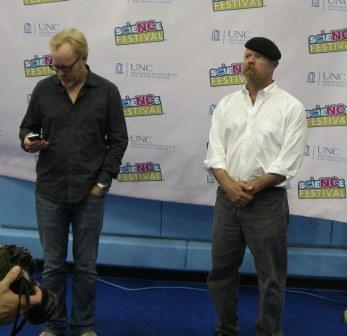
I am not going to recap what happened, as Tyler Dukes, Ross Maloney and Maria Gontaruk did it masterfully last week. I want to think a little bit more about Mythbusters and what their show means in the ecosystem of science media and communication.
I assume that many will agree that the goal of science communication is not just to highlight the latest scientific findings, but also to educate the population about science: what it is, how it works, and to what extent should scientists be trusted. In a democratic society in which science is trusted, the population drives their leaders to adopt reality-based policy solutions to problems. Which is a Good Thing, I hope you agree.
There is an idea out there that science needs rock stars. The name bandied about as an example is usually Carl Sagan who seems to be beloved and deified by people of certain age, geography and socio-economic status. Thus the question is often posed as “How do we get a new Carl Sagan?”.
But the media ecosystem is completely different today in comparison to the 1970s when Sagan and some others were on TV. Thus the question is erroneous to begin with. We have many, many science communicators who are much better than Sagan ever was. But in the new media ecosystem, they are relegated to the “pull media” instead of the “push media“. They are all over the places visited by people who are already interested in science, but are effectively barred from the media with broad reach and wide audience.
So, we need to rethink our question. It is not “who can be the next Carl Sagan?” but “what works in today’s media ecosystem?”. We can try to get scientists onto TV, an uphill battle against the media houses, but we can also see what existing and popular shows already do a good job at pursing our goals: how science works, and why empiricism wins the day.
And “what works in today’s media ecosystem”, like it or not, is Mythbusters.
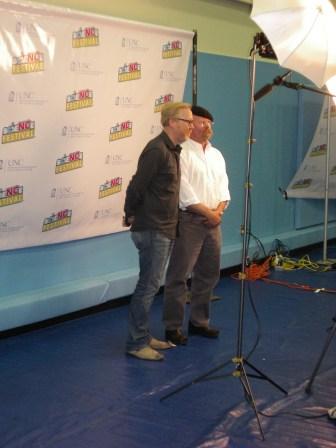 Sagan, Attenborough, Cousteau, Bellamy and others were scientists. Adam and Jamie are not - at least in the sense of not having formal education and degrees in science. Jamie grew up on a farm, and both of them went through a variety of jobs, mostly manual work, that required them to use ingenuity and come up with hands-on solutions to immediate problems in their work. Their life experience turned them into de facto scientists. If you agree that science is a refined and regimented common sense, Adam and Jamie have developed it to the maximum that an informal training can get one to. On one hand, they are a return to the era of Victorian gentlemen naturalists when doing science did not require a PhD in science - everyone could do it. On the other hand, they are the modern Citizen Scientists - where again, doing science does not require a PhD in science - everyone can do it.
One thing that Jamie and Adam stress is that their show is unlike any of the others we like to mention - they are not “demonstrations” or narrated visuals of the wonders of nature. They are experiments, answering real questions with real work. They start with a question and do not know what the final answer will be - and that is the key: their audiences are going with them for the ride knowing that this is not a high school science lab where answers are already known in advance. It is a journey that the audience takes together with Adam and Jamie.
Sure, the purists may object to some aspects of the methodology of their experiments - a sample size of one, for example - but Mythbusters is not a school program, it is a TV show, thus entertainment. Many of the tests they do are too big and expensive to be done more than once so a sample size of one is better than a sample size of zero (yes, I have seen wonderful N=1 papers in big journals, e.g., dissection of a whale tongue showing the counter-current arrangement of blood vessels published in Science - would you as a reviewer insist they kill a few more whales to up their sample sizes?).
There was a show, though, that was somewhat of a precursor to Mythbusters. It was Don’t Ask Me which ran on ITV (and most of Europe) back in the 1970s, at the same time when Sagan and others had their heyday.
I asked Jamie and Adam if they ever saw that show and they didn’t.
Of course, with so many decades in-between, there are some big difference between the shows, but as I mentioned, the show was just a precursor, a seed of an idea, that years later resulted in a full-blown realization of that idea in Mytbusters. For one, Don’t Ask Me was filmed inside the studio, with a very small budget. There was no way they could do things that require a lot of space and money, or that involved huge explosions. It was obviously and transparently ‘fake’ - there is no way an audience member could stand up with a question and immediately have it answered with all the tools and props ready to go in the studio within seconds - that was obviously staged.
Also, some of the questions asked by the audience members were already answered by science before - the scientists knew it, but the lay audience did not. This made answering the questions easier, as Magnus Pyke, Miriam Stoppard and David Bellamy could confidently do their experiments, knowing in advance what the result would be. Much of what occurs on Mythbusters are really novel situations - answering questions for the first time in history, with the answer far from certain.
What unites these two shows is audience participation - the questions come from the public, the show acknowledges the questions (and even names or shows the face of the person who asked it), and then tries to answer the questions by doing experiments, not by lecturing or explaining or hand-waving (though Magnus Pyke did literally wave his hands a lot). Knowing or not what the answer would be, the show hosts and the audience go for the ride together - designing and doing the experiment - the exalted common sense that looks awfully like scientific method.
What also unites these two shows is how this audience engagement translates itself into real-world engagement. Watching BBC Survival, or Cousteau, or Attenborough was a solitary event - you turn on the TV, watch it, enjoy it, learn something, and that is it. If it is Sagan late at night, you fall asleep halfway through. But if it is Don’t Ask Me, you discuss the show the next day at school or work. You debate the results of the experiments. This is exactly what happens today with Mythbusters - one thing that Jamie and Adam say they are the proudest of is that the morning after the show, kids ask their science teachers to discuss the show. Online world also discusses their show, especially if the results are difficult to interpret or bust some very dearly held myths.
Don’t Ask Me also busted myths. I remember vividly their very first episode - they answered the question “can newborns swim” by throwing babies into a pool. Aside from the fact that no IRB would allow such an experiment today, it is important to remember that back in 1970s this issue was resolved by science, but it was still a very contentious issue among the public. Miriam Stoppard knew very well that the babies she was throwing would actually swim, but half the audience did not believe it….until they saw it with their own eyes. That day, this myth was busted forever. And it made for great, exciting television!
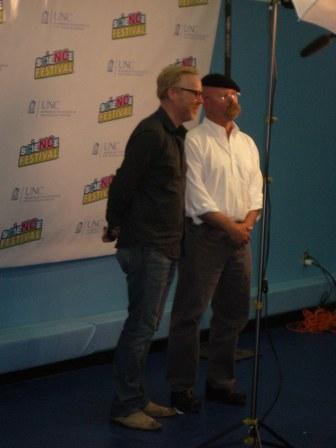 What Mythbusters are doing right is not so much that they are driving thousands of kids into dead-end scientific careers. What they are doing - and what is really worthwhile - is that they are helping millions of their viewers internalize empiricism as the way to think about the world. Questions are not answered by preaching or lecturing or reading or studying at the Google University (although all of those are useful for getting additional information after the show), but by testing the claims by doing experiments. They are helping millions enter the Enlightenment worldview and way of thinking.
Furthermore, by not being scientists themselves, by not looking like scientists, dressing like scientists, talking like scientists, or repeatedly stating that what they are doing is science, Jamie and Adam make science approachable to everyone. If they can do science, everyone can. Just like in Victorian England, and just like Citizen Scientists today. They are not pointy-headed, elitist denizens of the Ivory Tower, but people just like you and me, people who have been given the resources to do what most of us would be able to do as well with some thinking and work. They are our representatives, members of our own community, not someone talking down to us from a position of power. And in today’s climate in the USA, this is very important.
Finally, Mythbusters teach skepticism. Many of the myths they busted were strongly believed by millions…until they saw the show that obviously demonstrated that the myth is wrong. Sure, there are always a few die-hards who will contest everything to death, but most people accept what they see on Mythbusters and learn from it. And by watching the show regularly, they get into a skeptical habit that holds over in other realms of life as well - not trusting anyone (preachers, teachers, politicians, TV talking-heads, journalists, etc.) on their word, but demanding to see the data, the results of empirical work. Mythbusters are doing as much, or more, than Sagan and others did in the 1970s, to inculcate the public into a reality-based thinking. So what if sometimes they have N=1?
A Conversation with Dr. Robert Koger of Advanced Energy
Monday, September 20, 2010, 7:04 am 1 Comment | Post a Comment
Dr. Robert Koger
Dr. Robert Koger is president and executive director of Advanced Energy, a nonprofit organization established by the North Carolina Utilities Commission in 1980 to forestall electrical rate increases by promoting energy conservation and alternative and renewable sources of electricity. Advanced Energy provides services that focus on energy efficiency for commercial and industrial markets, electric motors and drives, plug-in transportation, and applied building science.
Advanced Energy also operates NC GreenPower, a program funded through consumers’ voluntary contributions, designed to increase the amount of renewable energy put on the electric grid in North Carolina and to mitigate greenhouse gas emissions.
This month, Dr. Koger assumes the chairmanship of Triangle Area Research Directors Council (TARDC), a group of science and technology leaders from local companies, nonprofits, and universities. The group meets over lunch monthly from September to May, to exchange ideas and information and to hear from guest speakers. TARDC’s first meeting under Dr. Koger’s leadership will be September 21, and the guest speaker will be Mr. Joe Freddoso, president and CEO of MCNC/NC STEM. Non-members of TARDC can attend the luncheons.
I recently asked Dr. Koger about the history of Advanced Energy and about his leadership of TARDC. Read more…
“Power Plants” on North Carolina’s Roadsides
Monday, September 13, 2010, 9:46 am 1 Comment | Post a CommentLike many farmers, Ted Sherrod double-crops, growing canola in the winter on the same land where he harvested sunflowers or safflower grown during the summer. But Sherrod’s “farms” are stretches of roadside or median across the state, and his crops are part of an innovative experiment designed to produce biodiesel for N.C. Department of Transportation vehicles.
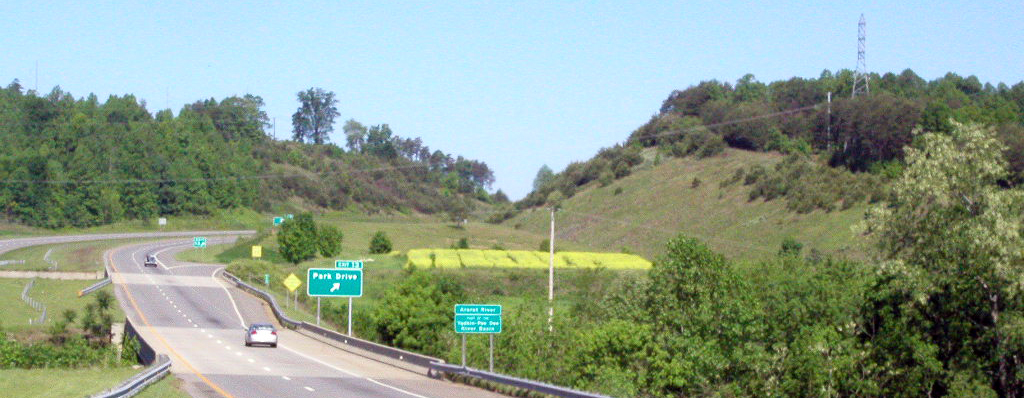
Biofuel crops on a roadside near Raleigh. Photo: NCDOT


