Archive for the ‘Environment’ Category

“Power Plants” on North Carolina’s Roadsides
Monday, September 13, 2010, 9:46 am 1 Comment | Post a CommentLike many farmers, Ted Sherrod double-crops, growing canola in the winter on the same land where he harvested sunflowers or safflower grown during the summer. But Sherrod’s “farms” are stretches of roadside or median across the state, and his crops are part of an innovative experiment designed to produce biodiesel for N.C. Department of Transportation vehicles.
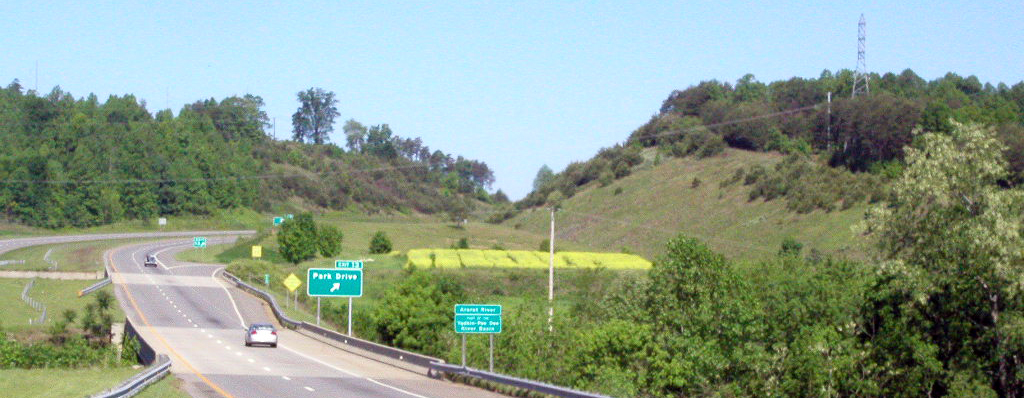
Biofuel crops on a roadside near Raleigh. Photo: NCDOT
Lyme disease, ecologists, and public health
Friday, June 25, 2010, 9:10 am 2 Comments | Post a CommentLast week I wrote about the impacts of swine operations on our water quality. It’s one example of how land use patterns can disrupt the environment and affect public health. That subject came up again this week during a conversation with Dr. Laura Jackson of the Environmental Protection Agency’s National Health and Environmental Effects Research Laboratory (NHEERL), a unit of the EPA’s Office of Research and Development that is housed in Research Triangle Park.

Dr. Laura Jackson of the EPA's National Health and Environmental Effects Research Laboratory (NHEERL), a unit of the EPA’s Office of Research and Development that is housed in Research Triangle Park.
Dr. Jackson and her colleagues in this RTP lab—more than 100 scientists—conduct research on ecosystem services, those benefits provided by the environment over and above the psychological benefits of being out in nature. These services can have tangible and measurable economic value.
For instance, in a normally functioning ecosystem, vegetation would take up nitrogen and phosphorus from animal waste and keep those nutrients from overburdening groundwater and streams. In last week’s example, when hogs were added to an ecosystem, they knocked it out of balance by depositing more nutrients than the vegetation could handle and by removing plants that could take up the nutrients and provide erosion control. The researchers at the Center for Environmental Farming Systems were developing countermeasures to keep the water clean near hog farming operations and restore ecosystem function. Read more…

Books: ‘Bonobo Handshake’ by Vanessa Woods
Sunday, June 6, 2010, 9:49 pm No Comments | Post a CommentTo get disclaimers out of the way, first, Vanessa Woods (on Twitter) is a friend. I first met her online, reading her blog Bonobo Handshake where she documented her day-to-day life and work with bonobos in the Congo. We met in person shortly after her arrival to North Carolina, at a blogger meetup in Durham, after which she came to three editions of ScienceOnline conference.
I interviewed Vanessa after the 2008 event and blogged (scroll down to the second half of the post) about her 2009 session ‘Blogging adventure: how to post from strange locations’. At the 2010 conference, she was one of the five storytellers at the ScienceOnline Monti on Thursday night (and did another stint at The Monti in Carrboro a couple of months later). I have since then also met her husband Brian Hare and we instantly hit it off marvelously.
I have read Vanessa’s previous book, ‘It’s every monkey for themselves‘, but never reviewed it on the blog because I felt uneasy - that book is so personal! But it is an excellent and wonderfully written page-turner of a book so I knew I was in for a treat when I got a review copy of her new book, Bonobo Handshake (amazon.com). I could not wait for it to officially come out so I could go to the first public reading (where I took the picture) at the Regulator in Durham on May 27th, on the day of publication.
Vanessa recently moved her blog to a new location on Psychology Today network and had a few interviews in local papers, more sure to come soon.
Vanessa will also soon read/sign the book at Quail Ridge Books on June 9th at 7:30pm, and at Chapel Hill Borders on June 12th at 2pm (also June 22 at Barnes & Noble on Maynard in Cary, June 30 at The Country Bookshop in Southern Pines, and Aug. 10 at Broad Street Café in Durham, in-between readings in other cities on the East and West coasts) and I hope you can make it to one of these events as they are fun, especially the way she tries to talk about a species renowned for its sexual behavior by using language that is appropriate for the kids in the audience 
The book weaves four parallel threads. The first is Vanessa’s own life. Bonobo Handshake starts where ‘Each monkey’ leaves off. And while the ‘Monkey’ covered the period of her life that was pretty distressing, this book begins as her life begins to normalize, describing how she met Brian, fell in love, and got married - a happy trajectory.
The second thread is the science - the experiments they did on behavior and cognition in bonobos and chimps, and how the results fit into the prior knowledge and literature on primate (including human) nature.
The third thread reports on the conservation status of great apes, especially bonobos, and all the social, cultural, financial and political factors that work for or against the efforts to prevent them from going extinct.
Seventeen Years of Discovery in Duke Forest
Tuesday, June 1, 2010, 1:22 pm 5 Comments | Post a Comment
Higher concentrations of carbon dioxide are pumped into four of the experimental rings. Photo: Will Owen
Late in 2010, an epic ecological experiment in the Triangle will begin drawing to a close when carbon dioxide stops pumping from four massive rings of towers in the Duke Forest. Since 1996, more than 250 scientists at Duke and dozens of other institutions have measured the response of this forest ecosystem to the elevated amounts of carbon dioxide expected in the Earth’s atmosphere in the future. They’ve measured tree and plant growth, photosynthesis, leaf size, soil composition, root growth, and water use in the plots bathed in elevated carbon dioxide and in three other “ambient” control plots.
The first, prototype ring was built in 1994; six more came in 1996 (three controls and three experiments). Each ring consists of 16 metal towers in a 30-meter diameter. Computer-controlled instruments in the experimental rings bathe the interior of the plot in carbon dioxide. It’s called Free-Air CO2 Enrichment, or FACE. As opposed to “chamber studies,” in which plants are studied in carefully controlled growth chambers or greenhouses, the rings are open to nature. That means that mammals and insects can circulate freely and that natural events like hurricanes, ice storms, and droughts affect the research site. Read more…
ScienceOnline2010 - interview with Emily Fisher
Wednesday, May 19, 2010, 11:34 am No Comments | Post a CommentContinuing with the tradition from last two years, I will occasionally post interviews with some of the participants of the ScienceOnline2010 conference that was held in the Research Triangle Park, NC back in January. See all the interviews in this series here. You can check out previous years’ interviews as well: 2008 and 2009.
Today, I asked Emily Fisher from Oceana to answer a few questions:
ScienceOnline2010 - interview with Amy Freitag
Tuesday, May 18, 2010, 2:38 pm No Comments | Post a CommentContinuing with the tradition from last two years, I will occasionally post interviews with some of the participants of the ScienceOnline2010 conference that was held in the Research Triangle Park, NC back in January. See all the interviews in this series here. You can check out previous years’ interviews as well: 2008 and 2009.
Today, I asked Amy Freitag from Southern Fried Science to answer a few questions:

NCSU engineering students unveil their EcoCAR
Saturday, May 1, 2010, 7:05 pm No Comments | Post a CommentN.C. State University engineering students participating in the national EcoCAR Challenge for the first time Saturday showed off their entry: A Saturn Vue that runs up to 65 miles on electricity.
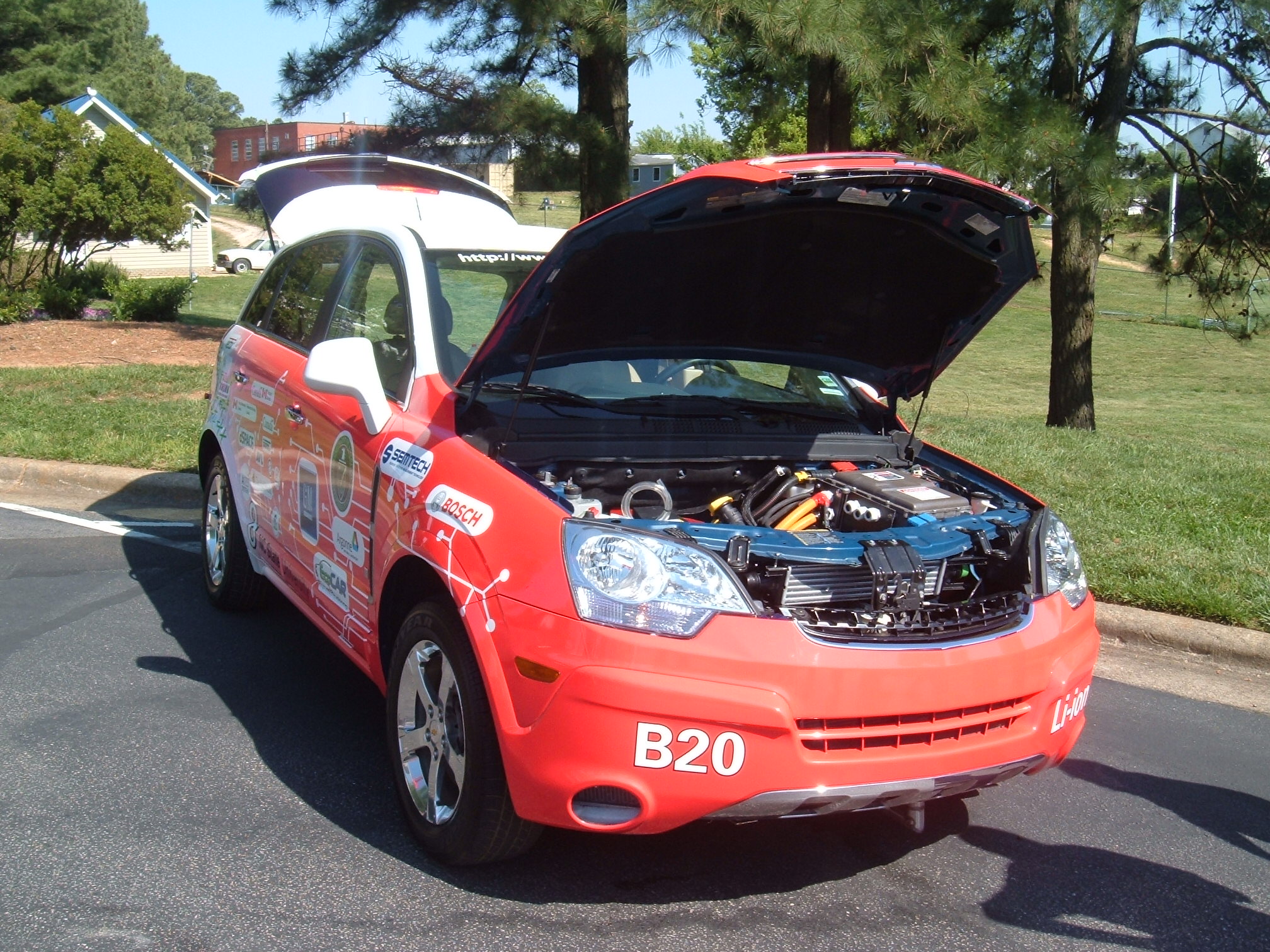
NCSU's EcoCAR
To reduce greenhouse gas emissions and fossil fuel consumption, the NCSU team installed a large lithium-ion battery pack behind the front seats of the crossover SUV. Up front is a diesel engine from an Opel Corsa, a European fuel-sipper, to power the wheels on longer-distance drives.
The NCSU team had less than six months to take the vehicle apart to where only a blue shell remained and rebuild it to specifications they had determined the previous school year.
On May 8, a carrier will pick up the car and take it to the General Motors Desert Proving Ground in Yuma, Ariz., where less than two weeks later it will be judged in more than a dozen technical events against entries of 15 other teams from Canadian and U.S. universities. Read more…
RTP researchers help track diseases linked to climate change
Tuesday, April 27, 2010, 8:53 pm No Comments | Post a CommentDuke University researchers suspect climate change is a reason why a deadly new version of a tropical fungus is spreading in the temperate climate of the Pacific Northwest.
Cryptococcus gattii
In Africa, South America, Southeast Asia and Australia, crytococcus gattii infects eucalyptus trees and bothers people with compromised immune systems, such as HIV/AIDS patients and organ transplant recipients, who inhale its spores. But the strain that was first documented on Vancouver Island, Canada, a decade ago and has now spread to Seattle and Portland causes chest pain, fever, shortness of breath and weight loss in otherwise healthy people and has killed at least six of them.
In February 2007, the first North Carolina case, an otherwise healthy man, was treated at Duke University Medical Center, the Duke researchers reported in PLoS One. In a paper they published a week ago in PLoS Pathogen, the researchers wrote that the cryptococcus gattii strain in the Pacific Northwest was new, much more virulent and favored mammals.
Wash Your Stinking Car and Don’t Feel Guilty
Thursday, April 8, 2010, 3:29 pm 1 Comment | Post a CommentI want you to take a minute to rethink your relationship to water. Because if you get your water from Falls Lake, then you can do the world a big favor by running right out and washing your car to get that green stuff off it. Or for that matter, taking a nice long shower to get that green stuff off you. Or even watering your lawn.
What? I am urging you to USE water?
I am doing just that. Not always – not even commonly. But today – right now. You’ll be helping Raleigh and the Army Corps of Engineers if you do.
I hear you scoffing, so I’ll explain.
Remember the drought? Yeah, that one, a couple years ago – Falls Lake was ten feet low, and we were letting our lawns dry out and our cars dust up and washing our babies’ butts in tubs with only an inch or so of water, letting things mellow if they were yellow and taking all kinds of other conservation measures. If you recall, fortunately it started raining again, though we sensibly left in place basic conservation measures.
But remember last November? As recently as November 9th, 2009, Falls Lake, the only source Raleigh (and the almost half a million people to whom who Raleigh Public Utilities delivers water) has for its drinking water, was more than four feet low, down from its managed 251.5 feet above sea level to 247.45 feet. And remember – that doesn’t mean the lake had gone from 251.5 feet deep to 247.45 feet. The Army Corps of Engineers, who manages the lake, measures not how deep it is but how high it is above sea level. The lake itself averages around twelve feet deep – which should tell you something about how much of it turns into dry land when it’s four feet low. You can check historical lake depth, by the way, here.
I bring all this up because it started raining again in November and didn’t stop for a while. At the moment I write this, the lake sits 8.64 inches high, at 252.22 feet above sea level (which you can instantly check here). That’s worth knowing for a couple reasons: for one, we’ve had about eight inches of rain since January 16, and the lake rose more than eight feet in that time. That is, you can see that at our current level of ground saturation, an inch of rain brings the lake up a foot. Given that the Corps works to keep it at 251.5, that means that the work the Corps is doing now is counterintuitive: It’s trying to drain our water source. At this very moment, they’re dumping water out at the rate of 580 cubic feet per second (at the moment you read this you can get the exact total here).
Let me translate for you: each cubic foot of water contains 7.48 gallons, so 580 cubic feet per second equals 4338.4 gallons per second. Which keeps the kayakers in the Neuse just below the dam happy, but above all dwarfs the 80 or 85 cubic feet per second the city of Raleigh drains to supply drinking water for its customers.
So, okay, this takes a bit of rethinking.
The point is you need to understand your lake. Falls Lake is Raleigh’s water source, sure – but it also provides flood storage to protect downstream communities (it can rise to 264.8 feet above sea level before it reaches the spillway – that will hold, by the way, almost twice the volume of the lake at its maintained level); it provides “water quality” storage – or water for constant releases to keep the Neuse River running at a healthy level. It also provides wildlife habitat and recreation opportunities. Five jobs the lake has – and the Corps keeps it at 251.5 feet because that’s where it’s designed to be. If Raleigh water customers get a little concerned about drought, the Corps doesn’t hold back extra water – that soaks habitat, wrecks beaches, and may parch the people downstream.
Which means that when the lake gets high, the Corps works like hell to get it down to 251.5 feet again, releasing, in recent weeks, anywhere from a hundred cubic feet per second or so to nearly 3000. Now the lake hasn’t had a drop of rain since March 29, and in that time, while you weren’t paying attention, the water level has risen and dropped a foot and a half.
I’m advocating paying attention: doing a little backyard and online science without wearing a lab coat. That is, yes – we need to conserve water, but much more important, we need to be aware of our water. Good-natured helpful people were probably conserving water back in early February, because we’ve all been trained to conserve. Except the thing is, the lake was almost nine feet high then (it peaked at almost 260 feet on February 10), the Corps was releasing water at as much as 4000 cubic feet per second), and though I was preaching a gospel of 20-minute showers for everyone, not too many people were listening.
This is a pretty small point, but it’s science and I think we should be doing it. I advocate, first, knowing where your water comes from — mine comes from the Upper Neuse River basin (interactive map; there’s also a list of other NC river basins, so wherever you live you can get this data for your own source of water. And if you happen to reach this piece from outside North Carolina, you can find your watershed here). Next, learn what the conflicts are: Who’s polluting? Who’s cleaning up? Who’s using and who’s complaining? The USGS and the EPA put this information online because they want you to have it. In Raleigh we have predictable fights – when it’s droughty, we want the lake release diminished, though the folks downstream in Goldsboro and Kinston don’t find that neighborly; when it’s hurricane season we want the lake low enough to absorb a Hurricane Fran if one comes by, whereas that’s when the folks downstream would prefer Raleigh to not even flush its toilets for a week (our treated wastewater reenters the Neuse downstream, of course).
Everybody’s talking about water right now: from NASA (http://launch.org/) to National Geographic, with its special issue about water, but water isn’t something that happens to people in sub-Saharan Africa or from satellites in space. Water falls on your yard, fills your reservoir, comes from your faucet, travels to the sea — here’s a video of a drop of water doing just that:
So anyhow, a small point: know your water. Know where it comes from. Check in on it to keep track: is this a time to conserve, or to use to my heart’s content? Today the lake is high, so go wild. It’s even supposed to rain soon, so Falls Lake will probably get higher again. And if science – organized observation of your surroundings, right? – does nothing more for you this week than get that green stuff off you and your car, that’s still a good week for science.
And by the way, wash your car on your lawn, not the driveway. Let that good stuff percolate into the ground, not run off into a creek.


