Archive for October, 2010

TEDxRaleigh highlights innovation in Triangle’s backyard
Friday, October 15, 2010, 5:11 pm 1 Comment | Post a Comment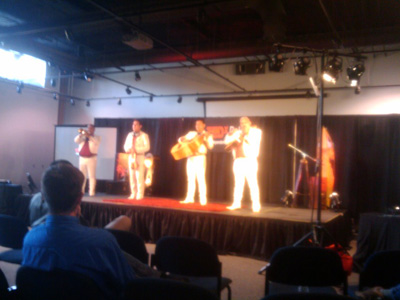
TEDxRaleigh featured a post-lunch surprise in the form of a mariachi band.
To hear the speakers at TEDxRaleigh tell it, there’s not much we as a species are incapable of accomplishing.
We can turn “big data” into “big answers.” We can use art to progress scientific understanding. We can harness depression to make ourselves better people.
Oh, and an unlimited supply of completely clean energy? We’ve got that covered too.
“It sounds too good to be true,” former NASA engineer Walter Drew told TEDxRaleigh attendees as he introduced his concept for harnessing geothermal power. “I’m going to show you how to do it.”
It was a common attitude among the 13 speakers who stepped up to the stage at Marbles Museum in downtown Raleigh Friday for the city’s first-ever independently organized TED event. The short presentations — all in the areas of technology, entertainment and design — mimicked the format of the annual TED conference, meant to promote “ideas worth spreading.”
But the ideas presented here didn’t have to travel very far.
Take David Hwang for instance. His Greensboro-based company, Managed Data Group, is out to solve a big problem when it comes to big data: We can’t possibly understand it. In fact, he pointed out any set of items larger than seven stops being a discrete number and starts being “many” to our brains. That can be a bit of a cognitive problem when computer scientists deal with hundreds or thousands of items in a database with hundreds of thousands of connections.
The fix, Hwang said, is to divide and conquer, partitioning the data into easily digestible pieces to solve problems not tractable with vertical scale alone.
He envisions an era of “big answers,” where timely, accessible data is pulled from multiple sources and consumed not just by humans, but by the devices we use on a regular basis. The result is a more integrated approach to understanding everything from shopping behavior to the world around us.
“Insights only big companies have now will be available to consumers,” Hwang said.
But data isn’t the only sense-making tool we have in our arsenal, according to science illustrator Liz Bradford, a graduate of N.C. State’s School of Design and College of Textiles.
“Art can be a tool to discover the world around us,” Bradford said.
Growing up, Bradford said she never lost the belief that science and art were connected. That’s one of the reasons her work, like drawings of aspecies of skink less than an inch long, are so painstakingly accurate. After all, if you’re trying to recreate the look of a lizard foot smaller than a grain of sand, it pays to do your research.
But there’s also plenty of room for artistic interpretation — or “educated guesses,” as she calls them — when it comes to illustrating the unknown. The common question she gets from children viewing her dinosaur work is how she knows what color to paint the skin. Aside from theorizing about what traits may have been beneficial to the beasts, she says she has no idea.
“I just make it up,” Bradford told a chuckling audience. “If you think of a skeleton of a peacock or a giraffe, you’d have no idea how colorful it is.”
Aside from evoking that childlike curiosity, Bradford said her work also has the practical purpose of helping people understand science.
“Every picture of a dinosaur you’ve ever seen has been created by an artist,” she pointed out.
Other ideas, from the pros of raising backyard chickens to partnering with the poor to change the world, have the potential to spread far and wide. But it’s nice to know they got their start right down the road.
Tyler Dukes is a freelance reporter and journalism adviser at N.C. State University. Follow him on Twitter as @mtdukes.
RTP Week Ahead, Oct. 18-23
Friday, October 15, 2010, 3:00 pm No Comments | Post a Comment
Monday, October 18
Marketing Mondays: Culture of Brands and Brands of Culture
4:00 – 5:30pm
RTP HQ, 12 Davis Drive, RTP, NC 27709
*Sponsored event. Paul Kalbfleisch, VP of Brand Creativity at Research In Motion (RIM), will discuss how culture influences brands as well as how brands influence culture. He will share his observations on how the BlackBerry(r) success story has been affected by this powerful duality. Paul has also graciously provided a NEW BlackBerry Torch as our October event door prize!
6:00 – 8:00pm
Hotel Indigo, 161 Tatum Drive, Durham, NC 27703
This CleanLinks event will feature a panel discussing Clean Lighting in North Carolina. The group will define and discuss why energy efficient lighting works from a financial, technological and political perspective and how this sector can continue to accelerate the North Carolina economy. Free (cash bar available).
Tuesday, October 19
Sigma Xi pizza lunch lecture: Images of Darwin and the Nature of Science
12:00pm- 1:30pm
Sigma Xi
Free! Speaker: NCSU evolutionary biology professor Will Kimler. Prof. Kimler researches the history of evolutionary ideas in natural history, ecology, genetics and behavior.
TGHC Gates Challenge Grants Collaboration
5:00 – 8:00pm
North Carolina Biotechnology Center, 15 TW Alexander Drive, RTP, NC
Join us for this two part inaugural event aimed to increase knowledge about funding opportunities and foster the development of local collaborative relationships.
Wednesday, October 20
Science Cafe Raleigh: March of the Fossil Penguins
6:00 – 8:00pm
Tir Na Nog, 218 South Blount Street, Raleigh
In this Science Cafe we will get to know some of the diverse cast of extinct penguins, including primitive species from the deep past, spear-billed penguins from Peru, and giants that would have towered over today’s Emperor Penguins.
Thursday, October 21
Epic Games, IBM and Spark Plug Games Discuss Marketing and Gaming
11:30am – 1:30pm
Brier Creek Country Club, 9400 Club Hill Dr Raleigh, NC 27617 US
The Triangle AMA presents a star-studded panel of gaming experts who will discuss how marketing and gaming are intertwined, what the future holds for gaming, and how the Triangle ranks in the top five of US gaming hubs and is now the #1 hub worldwide for gaming engines!
Friday, October 22
AgBiotech Industry Round Table
8:00am – 1:30pm
North Carolina Biotechnology Center
The goal of the AgBiotech Industry Round Table is to strengthen industry/university collaborations and to provide insight to university researchers and business representatives from agriculture/biotechnology companies on how to foster greater innovation and economic development impact. Speakers: Monsanto, Syngenta, BASF.
Saturday, October 23
BarCampRDU 2010
Red Hat’s Headquarters on NC State’s Centennial Campus
RSVP. Pre-party Friday night, downtown Raleigh.

——————————-
To view a complete calendar of RTP community events, please visit the Science in the Triangle calendar.

ScienceOnline2010 - interview with Anne Jefferson
Wednesday, October 13, 2010, 9:52 pm 1 Comment | Post a CommentContinuing with the tradition from last two years, I will occasionally post interviews with some of the participants of the ScienceOnline2010 conference that was held in the Research Triangle Park, NC back in January. See all the interviews in this series here. You can check out previous years’ interviews as well: 2008 and 2009.
Today, I asked Dr. Anne Jefferson to answer a few questions.
Welcome to Science In The Triangle. Would you, please, tell my readers a little bit more about yourself? Where are you coming from (both geographically and philosophically)? What is your (scientific) background?
I’m a hydrologist – meaning I study water – and an assistant professor at the University of North Carolina at Charlotte. My pursuit of groundwater and rivers has taken me all over the country from my childhood in Minnesota, east to Johns Hopkins University in Baltimore for my undergraduate degree, back to Minnesota for a MS, out west to Oregon State University for a PhD and post-doc, and now to the south. My interaction with on-line communication has similarly meandered; I learned HTML and created a website as a high school student but only came to science blogging a few years ago.
Tell us a little more about your career trajectory so far: interesting projects past and present?
Read more…

RTP area leverages its biotech strengths to become vaccine R&D hub
Friday, October 8, 2010, 3:56 pm 1 Comment | Post a CommentSixty years after Jonas Salk took aim at the polio virus, vaccines are no longer just used to prevent infections. They now treat chronic diseases - like Provenge, the first cancer vaccine to get regulatory approval. Vaccines now have boosters, called adjuvants, to make them more effective. And they target all age groups, not just children.
Vaccines are still administered by injection, but needles have shrunken to 1.5 millimeters in length.
The innovations played to North Carolina’s strengths in biotechnology. Particularly the Research Triangle area has benefited by capturing a larger and larger piece of the vaccine market, which generated about $22.1 billion in global sales last year and is expanding rapidly. Merck and Novartis built state-of-the-art vaccine manufacturing plants in the Triangle. Diosynth Biotechnology, a biotech manufacturer in Morrisville that operates as a Merck subsidiary, got the contract to make the active ingredient in Provenge. Duke University opened the first of 13 regional biocontainment labs the National Institutes of Health funded nationwide to support vaccine research. And researchers at universities and small companies were able to advance novel vaccine technology.
So far, so good.
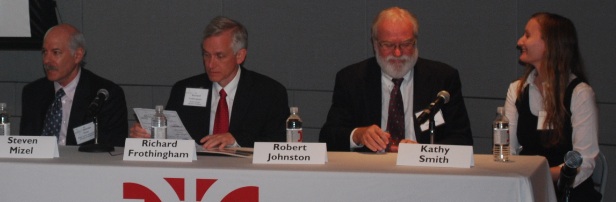
NCBIO's vaccine panel: from left, Steven Mizel of Wake Forest University, Dr. Richard Frothingham of Duke University, Robert Johnston of UNC-CH and Kathy Smith, cell and molecular analyst at Arbovax.
But the Triangle could do even better, according to vaccine researchers who spoke Wednesday at NCBIO’s annual meeting. Read more…
RTP Week Ahead, October 11-15
Friday, October 8, 2010, 12:53 pm No Comments | Post a Comment
Monday, October 11
2010 Biostatistics Seminar Series
12:00 – 1:50pm
Bondurant Hall, Room 2020, UNC-CH
Semester-long seminar series: Each session will be led by a different member of the NC TraCS Biostatistics Core or other Biostatistics faculty member. The next session is October 11, 2010 and will be led by Jianwen Cai: “Analysis of Recurrent Events”
Tuesday, October 12
BioNetwork Course: Good Laboratory Practices: FDA and EPA Regulations
6:00 – 10:00pm (Tues. 10/12 & Thurs. 10/14)
BioNetwork Capstone Center BTEC 120 850 Oval Drive, Centennial Campus Raleigh, NC 27695
Develop an understanding of the documentation guidelines required for the generation of acceptable EPA and FDA product registration safety studies. A Series of excercises, including labeling excersices, a protocol review, and adherence to SOPs, reinforce course concepts.(0.8 CEUs) $65.
Periodic Tables: The Science of Fine Dining
7:00 – 9:00pm
Broad Street Cafe, Durham
Join Matthew Novak, a graduate student in biomedical engineering at Duke University, as he recounts his time spent cooking with Chef Grant Achatz, one of the world’s leading practitioners of this new progressive cuisine at his Chicago restaurant, Alinea. He will lend insight into the new scientific methods being employed in the world of cuisine and may even have a few interactive and tasty demos for everyone to enjoy!
Wednesday, October 13
Validation Academy Courses: Steam Sterilization Validation for Autoclaves and SIP System
8:00am – 5:00pm (Wed. 10/13 – Thurs. 10/14)
BioNetwork Capstone Center, BTEC 124, 850 Oval Drive, Centennial Campus, Raleigh, NC 27695
Provides participants with an in-depth understanding of steam sterilization as well as the current methods of validation for sterile processes in the pharma/biotech manufacturing environment, including Autoclaves and Steam in Place (SIP) Systems, by providing a thorough understanding of sterilization, sterile equipment design, the regulatory requirements associated with sterilization and the methods used to test and validate sterile processes. (1.6 CEUs). $65.
Thursday, October 14
Deep Fried #TriangleTweetup at the NC State Fair
North Carolina State Fair
Event fee is $5 fee for the #DeepFried @TriangleTweetup includes fair gate admission + the Tweetup. Sponsored by SocialCarolina.org. RSVP.
Friday, October 15
Venture Hall Room, Marbles Kids’ Museum, Downtown Raleigh
TEDx is a program of local, self-organized events that bring people together to share a TED-like experience. Our event is called TEDxRaleigh, where x=independently organized TED event. At our TEDxRaleigh event, TEDTalks video and live speakers will combine to spark deep discussion and connection in a small group.
——————————-
To view a complete calendar of RTP community events, please visit the Science in the Triangle calendar.
Shoot-em-up gamers prove better decision makers
Thursday, October 7, 2010, 2:47 pm No Comments | Post a Comment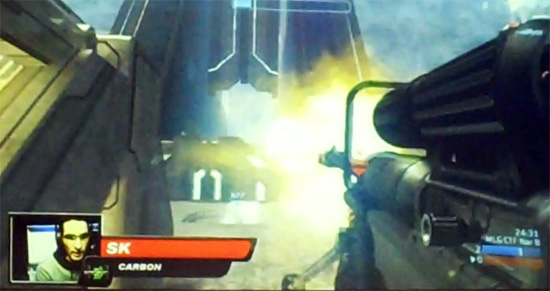
First-person shooters like Halo 3, featured at the Major League Gaming tournament in Raleigh Aug. 28, require quick reaction times from the world’s top players. | Image by Ross Maloney
With the release of the much-anticipated Halo: Reach on Sept. 14, I’ve spent much more free time than I’m willing to admit planted in front of my television locked in frenetic death matches with gamers around the world.
That hasn’t sat terribly well with my wife, who among other interests still enjoys occasionally hanging out with me for some reason.
But avid gamers with frustrated spouses, roommates and families take note: scientists have added another weapon to our arsenal of arguments that the benefits of action gaming go beyond geek cred.
The very same day Reach hit store shelves, the journal Current Biology published a report from the University of Rochester showing that gamers who spend their time playing shoot-em-ups are more effective decision makers.
Now that conclusion comes with a bit of a caveat, since “decision making” is a bit broad. What the scientists in the Department of Brain and Cognitive Sciences actually determined was that gamers are consistently better at “probabilistic inference” — essentially the act of evaluating the evidence before them and acting on it based on the chance it’s correct. What’s more, the scientists found that even non-gamers exhibited this improved probabilistic inference after they were trained to play video games for 50 hours.
To draw those conclusions, psychologists tested both gamers and non-gamers by asking them first to identify the collective direction of randomly moving dots on a screen. To prove the improvements were more than just visual, subjects took a second test asking them to determine which headphone emanated a sound masked with white noise.
The results were similar, even for those trained to play: the gamers made “more efficient use of the evidence.”
Interestingly enough, just being considered a “gamer” wasn’t enough to achieve that improvement. Non-gamers trained on EA’s Sims 2 scored similarly to non-gamers. It was the players who trained on Activision’s Call of Duty 2 or Epic’s Unreal Tournament 2004 who made the big gains.
And the researchers said they think they know why that’s the case.
“This type of learning may be a consequence of the nature of action video game training. Unlike standard learning paradigms, which have a highly specific solution, there is no such specific solution in action video games because situations are rarely, if ever, repeated.”
The Economist speculates that given the rise in popularity of action video games, society may see some collective benefits over time — better drivers for instance. That makes sense, since drivers are forced to quickly process their sensory experiences and react quickly based on that information.
Now if only science can prove being a gamer makes me a better husband, I’ll be all set.
Tyler Dukes is a freelance reporter and journalism adviser at N.C. State University. Follow him on Twitter as @mtdukes.
Two science events in the Triangle: Fossil Penguins and Images of Darwin
Thursday, October 7, 2010, 2:45 pm 1 Comment | Post a CommentScience Cafe Raleigh - March of the Fossil Penguins
“Wednesday, October 20, 2010
6:30-8:30 p.m. with discussion beginning at 7:00 followed by Q&A
Tir Na Nog, 218 South Blount Street, Raleigh, 833-7795
RSVP to kateyDOTahmannATncdenrDOTgov
Penguins are familiar faces at zoos and aquariums, but they evolved long before humans. These fascinating birds have been around for more than 60 million years, during which they survived dramatic changes in climate, wholesale re-arrangements of the continents, and the rise of new mammalian competitors. Thanks to their dense bones, penguins have left behind a rich fossil record that we can use to trace their geographical expansion and morphological evolution. In this Science Cafe we will get to know some of the diverse cast of extinct penguins, including primitive species from the deep past, spear-billed penguins from Peru, and giants that would have towered over today’s Emperor Penguins.
About our Speaker:
Dr. Daniel Ksepka (blog) is a paleontologist at North Carolina State University and a research associate at the North Carolina Museum of Natural Sciences. His research focuses on reconstructing the evolutionary tree of birds and understanding the transition from aerial flight to underwater wing-propelled diving in groups like penguins and the now extinct plotopterid birds. Ksepka has traveled to South America and New Zealand to collect and study fossil penguins. He is the author of numerous scientific papers on penguin evolution as well as the science blog “March of the Fossil Penguins.”"
For the coverage of Dr.Ksepka’s latest paper, see How the Penguin Got His Tuxedo and Inkayacu – Peru’s Giant Fossil Penguin and the Stories Its Feathers Tell, Giant extinct penguin skipped tuxedo for more colorful feathers, How the penguin got its tuxedo and A fossil penguin gets its colours.
Watch Dr. Ksepka discuss his research: March of the Fossilized Penguins
Sigma Xi pizza lunch lecture: Images of Darwin and the Nature of Science
From Sigma Xi:
“Join us at noon, Tuesday, Oct. 19 here at Sigma Xi to hear NC State University evolutionary biologist Will Kimler talk about “Images of Darwin and the Nature of Science.” Prof. Kimler researches the history of evolutionary ideas in natural history, ecology, genetics and behavior.
Thanks to a grant from the N.C. Biotechnology Center, American Scientist Pizza Lunch is free and open to science journalists and science communicators of all stripes. Feel free to forward this message to anyone who might want to attend. RSVPs are required (for the slice count) to cclabby@amsci.org
Directions to Sigma Xi, the Scientific Research Society in RTP, are here “
Astrobiology “is way beyond hunting for little green men.”
Wednesday, October 6, 2010, 7:47 pm 1 Comment | Post a CommentWhat is somebody who tracks the way life evolved on Earth doing at NASA?
Lynn Rothschild, a research scientist at NASA’s Ames Research Center, suggests that evolutionary biology, not just geology and astronomy, holds answers to questions that scientists have asked for thousands of years: Where do we come from? Are we alone in the universe? And where are we going?

Lynn Rothschild
During a seminar Wednesday at the National Evolutionary Synthesis Center in Durham, Rothschild argued that studying life on Earth under the most extreme conditions can provide clues where to search for life elsewhere in space - life that may be a lot more primitive than little green men who build radio transmitters capable of sending signals powerful enough to reach Earth.
Astrobiology, Rothschild said, “is way beyond hunting for little green men.”
Evolutionary biology is based on the fact that all life, from microbes to plants to humans, adapt when push comes to shove. Poor adaptors disappear, good adaptors multiply. About 150 years after Charles Darwin grasped the dynamics of natural selection, evolution is still not universally accepted. Uniformed police officers recently attended a Rothschild talk in Texas to make sure everybody in the audience behaved.
 Astrobiologists start with the building blocks of life in our solar system, which is part of the Milky Way, a relatively old galaxy at about 13 billion years of age.
Rothschild counts organic carbon, carbon that is part of a molecule, as a building block of life. It’s the fourth most common chemical element in the universe and various molecules containing carbon can be found in space, even molecules needed in the construction of genetic information.
She is not as sure that water and oxygen are essential building blocks of life.
Here’s why: life forms that have adapted to extreme conditions on Earth.
Single-cell microorganisms can be found near hot springs and in salt lakes. Flamingos and algae thrive in ammonia water. Some plants can survive in areas with just 1-inch of rainfall per year and high radiation from ultraviolet rays.
Based on what evolutionary biologists have learned from extremophiles, life forms that push the limits, Rothschild pinpoints the following places in the solar system where life might have been or might be possible:
- Venus could have been Earth’s twin, but a run-away greenhouse effect turned it into an 800-degree-Fahrenheit inferno.
- Mars could have been where life originated, even though no organic carbon has been fund.
- Jupiter moon Europa and Saturn moons Titan and Enceladus could support some type of life underneath the miles of ice that covers them.
More about NESCent planning to get into astrobiology here.
Blog about evolution, come to ScienceOnline2011!
Wednesday, October 6, 2010, 8:45 am 1 Comment | Post a CommentIf you are a blogger, and if you write a post with an evolutionary topic, you may be eligible to win one of the travel grants to come to ScienceOnline2011 from NESCent - National Evolutionary Synthesis Center:
“Win a travel award for best evolution-themed blog
Application deadline: December 1, 2010
Are you a blogger who is interested in evolution? The National Evolutionary Synthesis Center is offering two travel awards to attend ScienceOnline2011, a science communication conference to be held January 13-15, 2011, in North Carolina’s Research Triangle Park.
The awards offer the opportunity to travel to North Carolina to meet with several hundred researchers, writers, editors and educators to explore how online tools are changing the way science is done and communicated to the public. Each winner will receive $750 to cover travel and lodging expenses to attend the conference. For more information about ScienceOnline2011, visit http://scienceonline2011.com/.
To apply for an award, writers should submit a blog post that highlights current or emerging evolutionary research. In order to be valid, posts must deal with research appearing in the peer-reviewed literature within the last five years. Posts should be 500-1000 words, and must mention the NESCent contest. Two recipients will be chosen by a panel of judges from both NESCent and the science blogging community. Please send your name, contact information, the title and date of your blog post, and a URL to travel.award@nescent.org. Winners will be notified by December 15th, 2010.
For the results of last year’s contest, visit http://www-dev.nescent.org/news/TravelAward.php. For more information contact Craig McClain at cmcclain@nescent.org, or Robin Smith at rsmith@nescent.org.”
Mixing Carolina blue and Duke blue … and Wolfpack red
Tuesday, October 5, 2010, 9:57 pm 1 Comment | Post a CommentOff the athletic field, more Tarheels and Blue Devils may have difficulty picking Carolina blue from Duke blue.
The two athletic rivals, whose campuses are 15 miles apart, have added another opportunity for academic collaboration among their students.
Started Monday, the Kenan-Biddle Partnership offers about $5,000 per calendar year for projects in the arts, sciences and humanities that students at Duke University and the University of North Carolina at Chapel Hill propose to do together. Proposals that are made jointly by students from Duke and UNC have preference.
Another program to mix the two blues already exists. The Robertson Scholars Program, which has been around for a decade, is a merit-based scholarship that allows 18 students at Duke and UNC each to take classes at either institution.
But wait, the academic collaboration even extends into Wolfpack territory. Students at Duke’s Nicholas School of the Environment have figured out how to take classes at UNC-CH and N.C. State University. A free shuttle runs from Duke to UNC-CH every 30 minutes and students carpool to get to NCSU about 30 miles away.
With permission from the Nicholas School, here’s how signing up for class across the Research Triangle works: